What are the Key Facts About Northeast African Cheetahs? - Environment And Ecology | UPSC Learning
Topics
0 topics • 0 completed
🔍
No topics match your search
What are the Key Facts About Northeast African Cheetahs?
Medium⏱️ 6 min read
environment and ecology
📖 Introduction
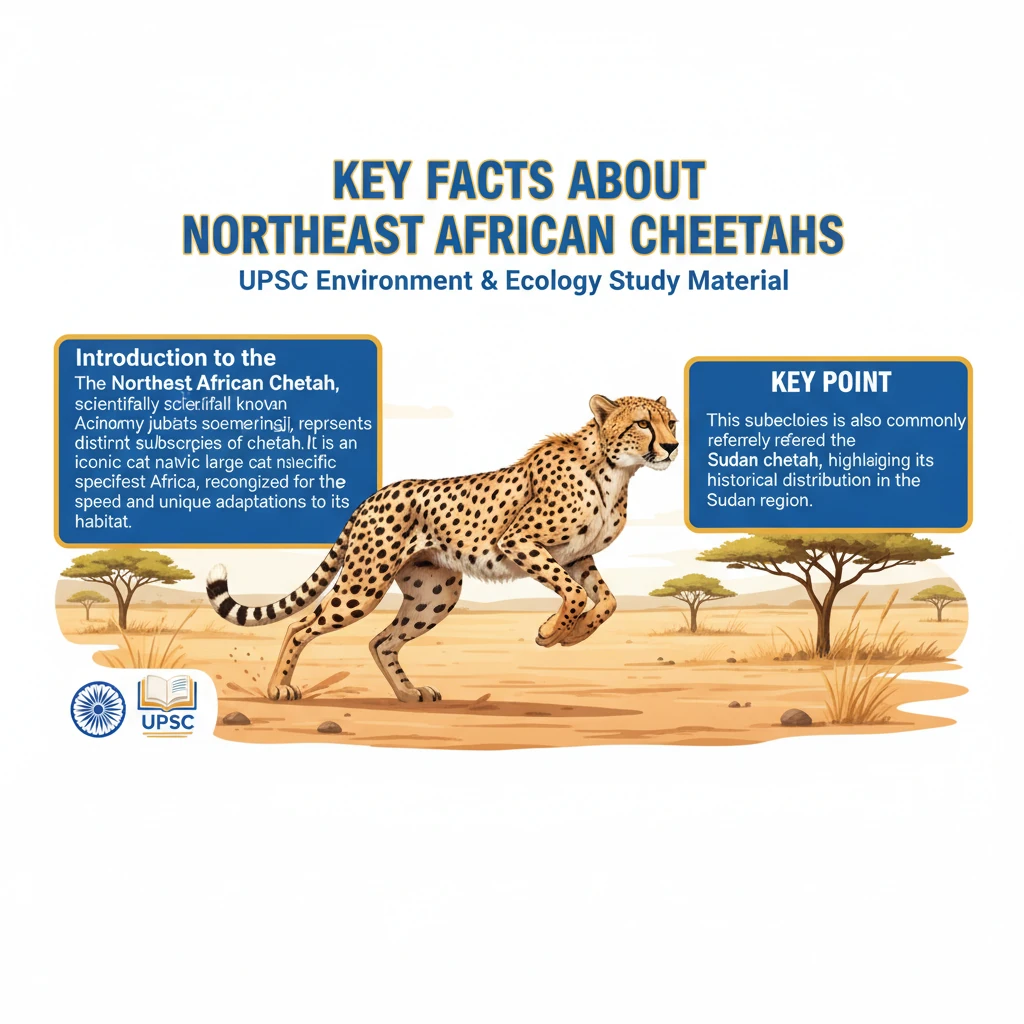
<h4>Introduction to the Northeast African Cheetah</h4><p>The <strong>Northeast African Cheetah</strong>, scientifically known as <strong>Acinonyx jubatus soemmeringii</strong>, represents a distinct subspecies of cheetah. It is an iconic large cat native to specific regions of Northeast Africa, recognized for its speed and unique adaptations to its habitat.</p><div class='key-point-box'><p>This subspecies is also commonly referred to as the <strong>Sudan cheetah</strong>, highlighting its historical and geographical association with the region.</p></div><h4>Scientific Description and Classification</h4><p>The <strong>Northeast African Cheetah</strong> was first scientifically described in <strong>1855</strong> by the Austrian zoologist <strong>Leopold Fitzinger</strong>. He initially classified it under the scientific name <strong>Cynailurus soemmeringii</strong>.</p><div class='info-box'><ul><li><strong>First Description:</strong> <strong>1855</strong> by <strong>Leopold Fitzinger</strong>.</li><li><strong>Original Scientific Name:</strong> <strong>Cynailurus soemmeringii</strong>.</li><li><strong>Basis of Description:</strong> A specimen obtained from <strong>Sudan's Bayuda Desert</strong>.</li><li><strong>Location:</strong> The specimen was brought to the <strong>Tiergarten Schönbrunn</strong> in <strong>Vienna</strong>.</li></ul></div><p>Genetic studies indicate that the <strong>Northeast African cheetah</strong> shares a closer genetic lineage with the <strong>Southern African cheetah</strong> populations. This distinguishes it from the <strong>Saharan cheetah</strong> populations, suggesting a specific evolutionary pathway.</p><h4>Geographical Distribution</h4><p>The primary distribution range of the <strong>Northeast African Cheetah</strong> encompasses several countries within <strong>Northeast Africa</strong>. These magnificent predators are found across various open landscapes.</p><div class='info-box'><p><strong>Key Distribution Areas:</strong></p><ul><li><strong>Northeast Africa</strong> (broader region)</li><li><strong>Ethiopia</strong></li><li><strong>South Sudan</strong></li></ul></div><h4>Preferred Habitat</h4><p>These cheetahs thrive in environments that offer ample space and abundant prey, essential for their hunting strategy. Their habitats are characterized by open terrain.</p><div class='info-box'><p><strong>Typical Habitats Include:</strong></p><ul><li>Wide <strong>open lands</strong></li><li>Extensive <strong>grasslands</strong></li><li><strong>Semi-arid areas</strong></li><li>Other <strong>open habitats</strong> rich in prey</li></ul></div><p>A significant portion of their population resides in the <strong>East Sudanian Savanna</strong>, which provides ideal conditions for their survival and hunting activities.</p><div class='exam-tip-box'><p><strong>UPSC Insight:</strong> Questions on species distribution, scientific names, and habitat preferences are common in the <strong>Environment & Ecology</strong> section. Understanding the specific characteristics of subspecies like the <strong>Northeast African Cheetah</strong> can be crucial for both <strong>Prelims</strong> (factual recall) and <strong>Mains</strong> (conservation essays).</p></div>
💡 Key Takeaways
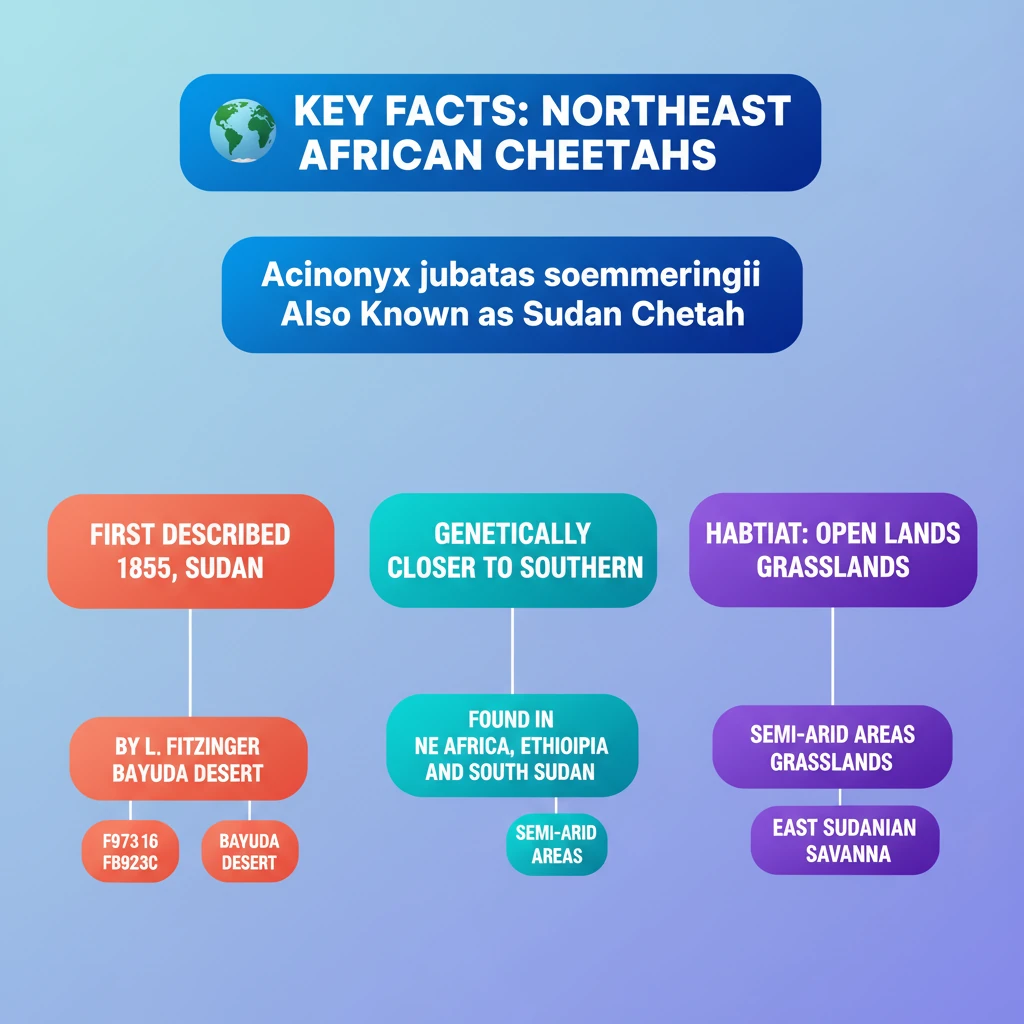
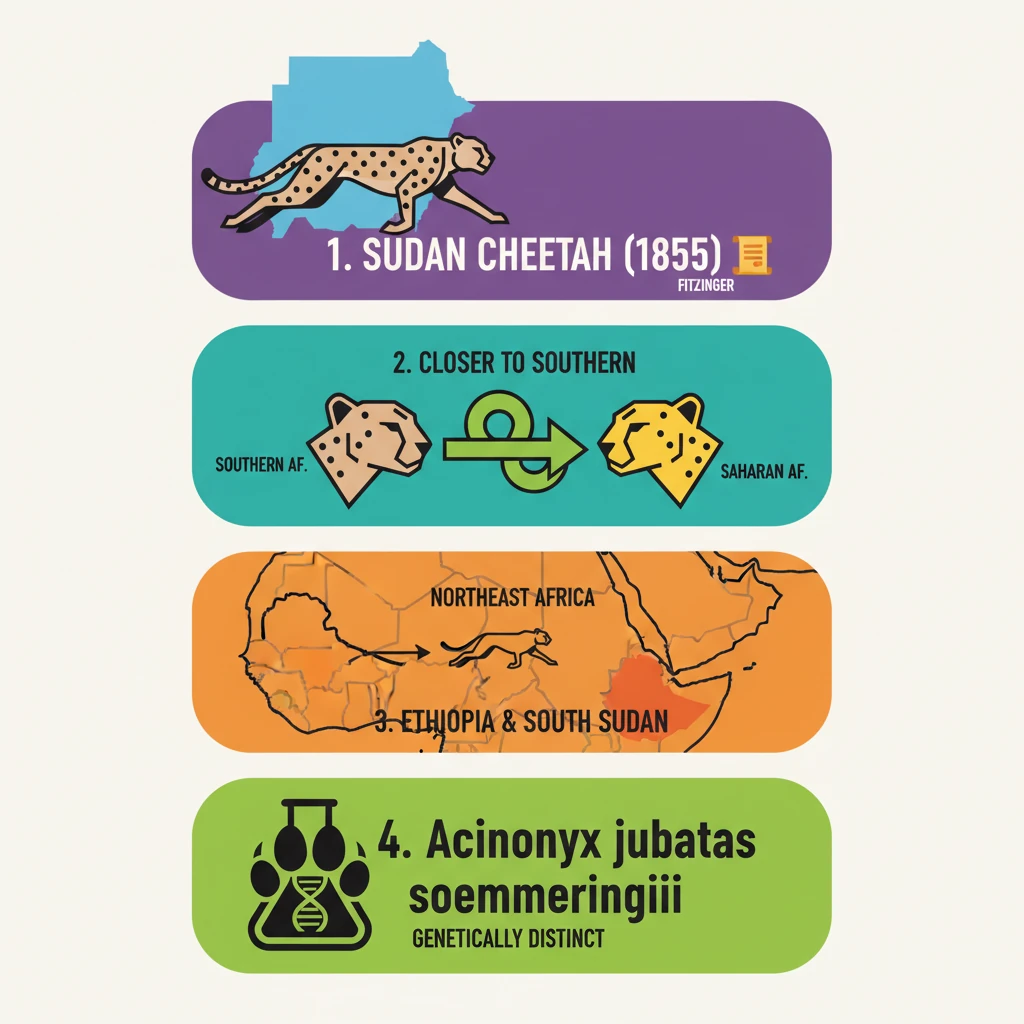
- •Northeast African Cheetah (Acinonyx jubatus soemmeringii) is also known as the Sudan cheetah.
- •First described by Leopold Fitzinger in 1855 from Sudan's Bayuda Desert.
- •Genetically closer to Southern African cheetahs than Saharan cheetahs.
- •Primarily found in Northeast Africa, Ethiopia, and South Sudan.
- •Inhabits open lands, grasslands, semi-arid areas, especially the East Sudanian Savanna.
🧠 Memory Techniques
98% Verified Content
📚 Reference Sources
•IUCN Red List (General Cheetah Species Information)
•Wikipedia (for scientific classification context)