What is Previous Evidence of Climate Change? - Environment And Ecology | UPSC Learning
Topics
0 topics • 0 completed
🔍
No topics match your search
What is Previous Evidence of Climate Change?
Medium⏱️ 6 min read
environment and ecology
📖 Introduction
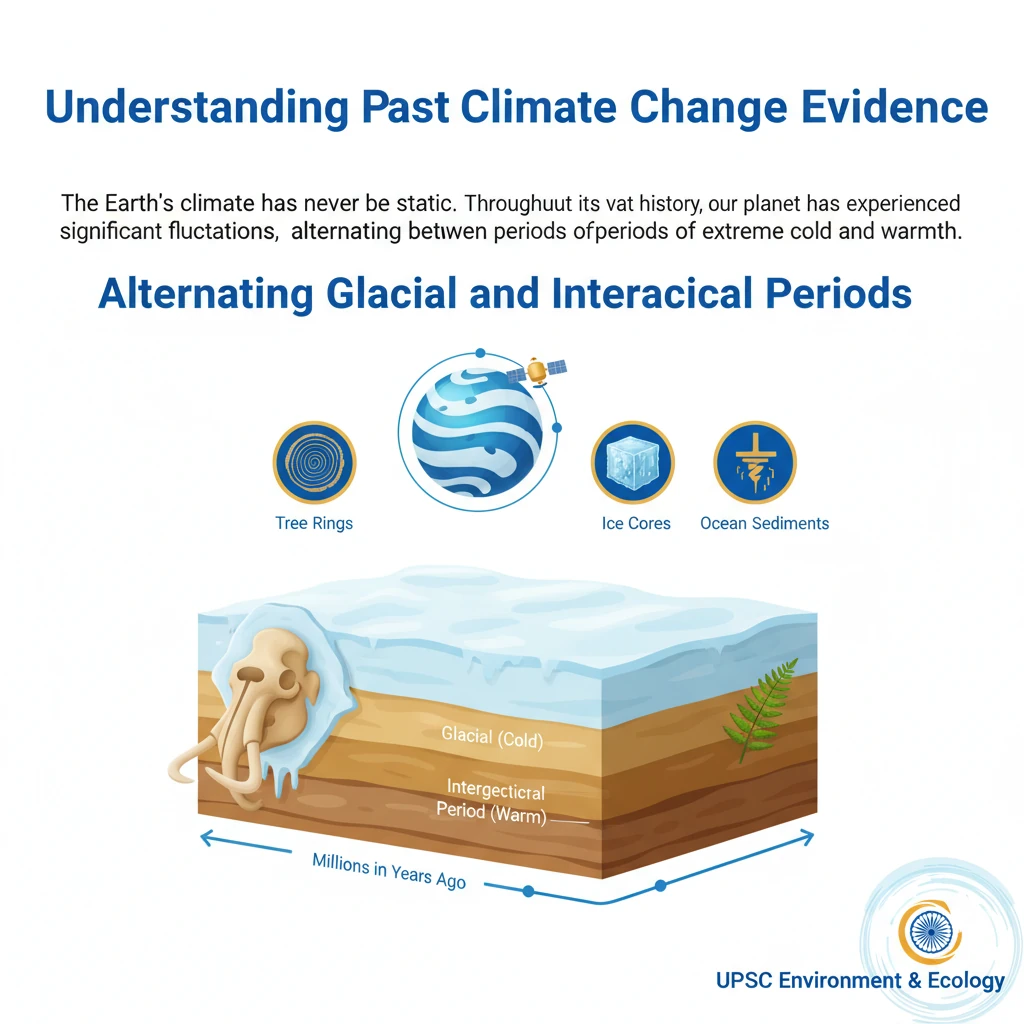
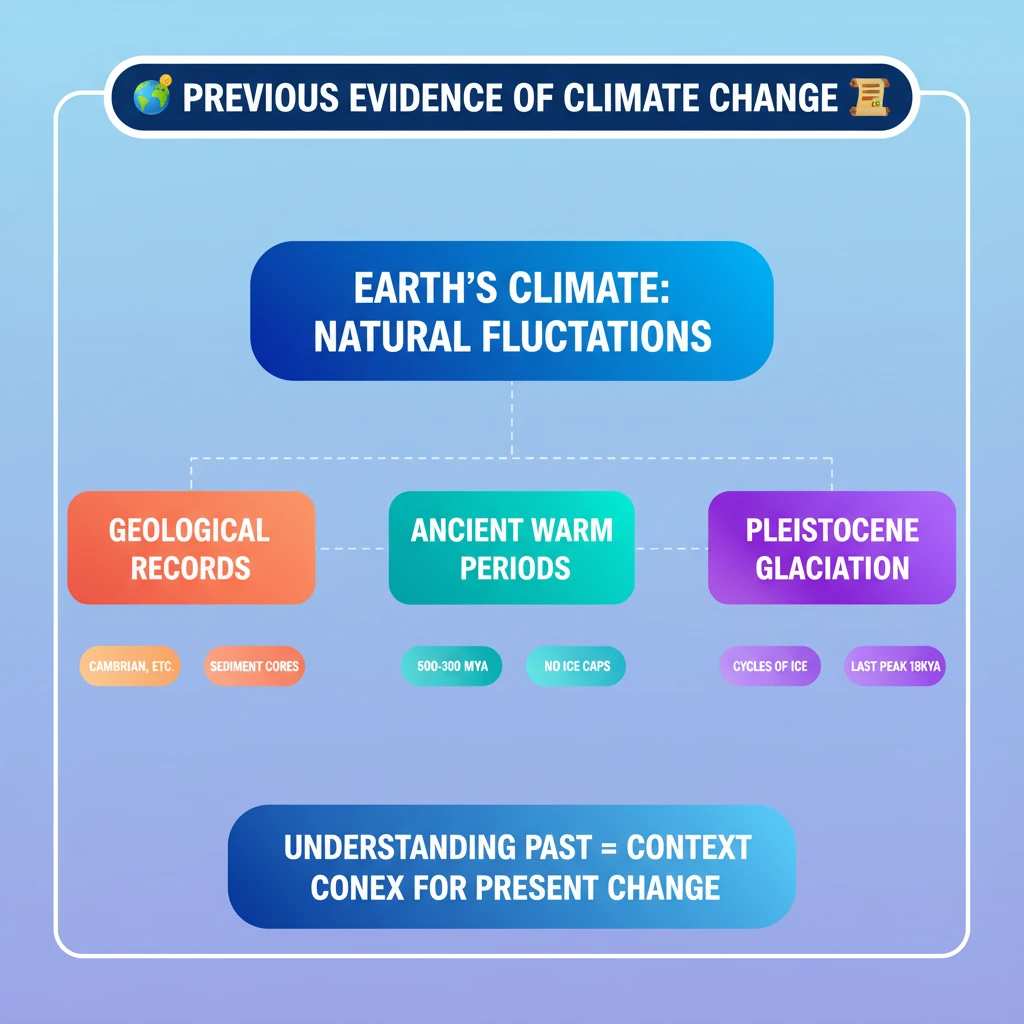
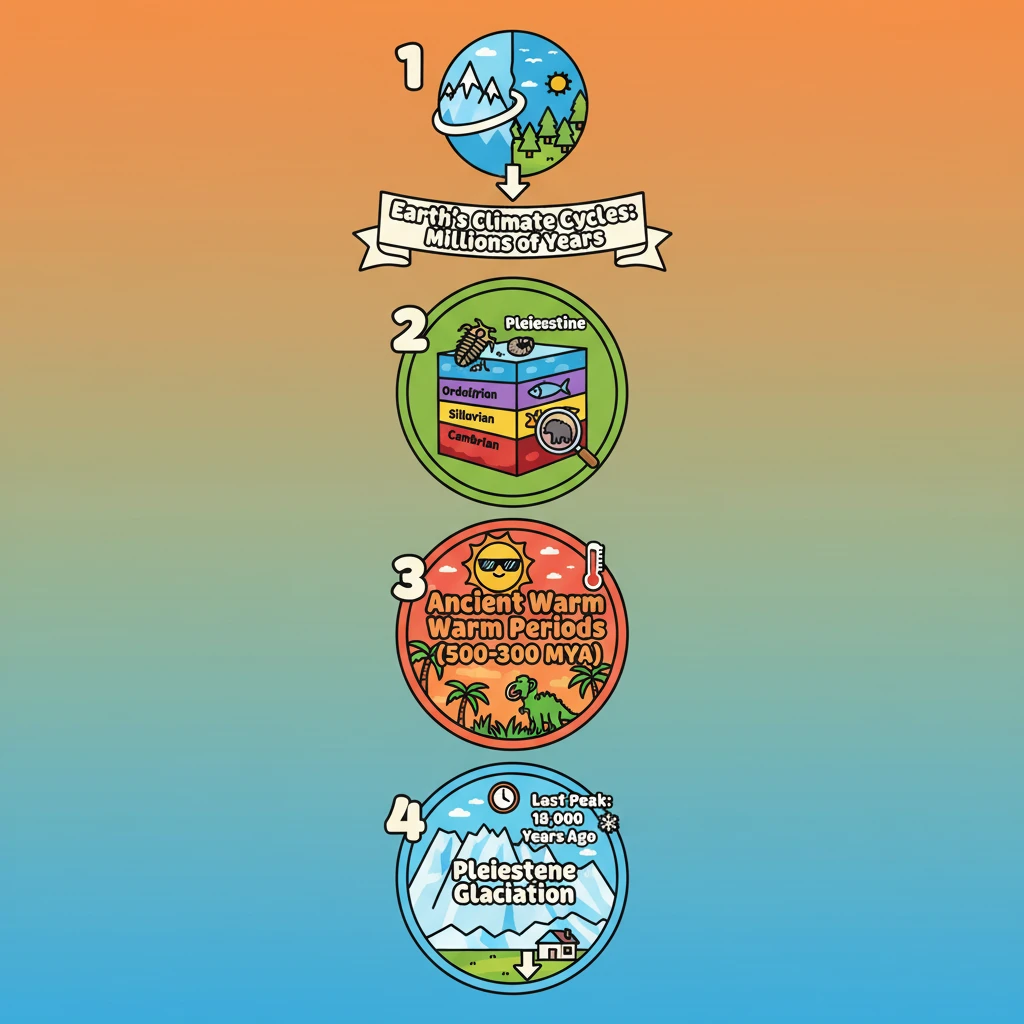
<h4>Understanding Past Climate Change Evidence</h4><p>The <strong>Earth's climate</strong> has never been static. Throughout its vast history, our planet has experienced significant fluctuations, alternating between periods of extreme cold and warmth.</p><p>These natural variations are well-documented in <strong>geological records</strong>. Studying these records provides crucial insights into the mechanisms and impacts of climate change over millions of years.</p><h4>Alternating Glacial and Inter-Glacial Phases</h4><p>One of the most prominent features of Earth's climate history is the occurrence of alternating <strong>glacial</strong> and <strong>warmer inter-glacial phases</strong>.</p><div class='info-box'><p>A <strong>glacial period</strong> is characterized by extensive ice sheets and glaciers covering large parts of the continents. An <strong>inter-glacial period</strong> is a warmer interval between two glacial periods, marked by the retreat of ice.</p></div><p>These cycles demonstrate the planet's inherent variability and its capacity for both cooling and warming trends over long timescales.</p><h4>Ancient Warm Periods</h4><p>In the distant geological past, Earth's climate was significantly warmer than it is today. This is evident during specific geological periods.</p><div class='info-box'><ul><li><strong>Cambrian Period</strong>: Approximately <strong>541 to 485 million years ago</strong>.</li><li><strong>Ordovician Period</strong>: Approximately <strong>485 to 443 million years ago</strong>.</li><li><strong>Silurian Period</strong>: Approximately <strong>443 to 419 million years ago</strong>.</li></ul></div><p>During these epochs, roughly <strong>500-300 million years ago</strong>, the planet experienced notably higher temperatures, supporting different forms of life and geological processes.</p><h4>The Pleistocene Epoch and Recent Glaciations</h4><p>More recently, during the <strong>Pleistocene epoch</strong>, the Earth underwent pronounced cycles of <strong>glaciation</strong> and <strong>interglacial periods</strong>.</p><div class='info-box'><p>The <strong>Pleistocene epoch</strong> spanned from about <strong>2.6 million to 11,700 years ago</strong>. It is often referred to as the "Ice Age" due to repeated glacial advances.</p></div><p>The <strong>last major glacial peak</strong> within the Pleistocene occurred approximately <strong>18,000 years ago</strong>. This period saw vast ice sheets covering much of North America, Europe, and Asia.</p><div class='exam-tip-box'><p>Understanding these past climate cycles is vital for <strong>UPSC Mains GS Paper 1 (Geography)</strong> and <strong>GS Paper 3 (Environment & Ecology)</strong>. It provides a natural baseline for evaluating current climate change.</p></div>
💡 Key Takeaways
- •Earth's climate has naturally fluctuated between glacial and inter-glacial periods for millions of years.
- •Geological records, including specific epochs like Cambrian, Ordovician, Silurian, and Pleistocene, provide evidence of these past changes.
- •Ancient periods (e.g., 500-300 million years ago) were notably warmer.
- •The Pleistocene epoch saw repeated cycles of glaciation, with the last major peak around 18,000 years ago.
- •Understanding past climate helps distinguish natural variability from current anthropogenic climate change.
🧠 Memory Techniques
98% Verified Content
📚 Reference Sources
•NCERT Geography Textbooks (Class XI & XII)
•IPCC Assessment Reports (General Concepts)
•NASA Earth Observatory (Paleoclimatology sections)