What are Big Cats? - Environment And Ecology | UPSC Learning
Topics
0 topics • 0 completed
🔍
No topics match your search
What are Big Cats?
Medium⏱️ 7 min read
environment and ecology
📖 Introduction
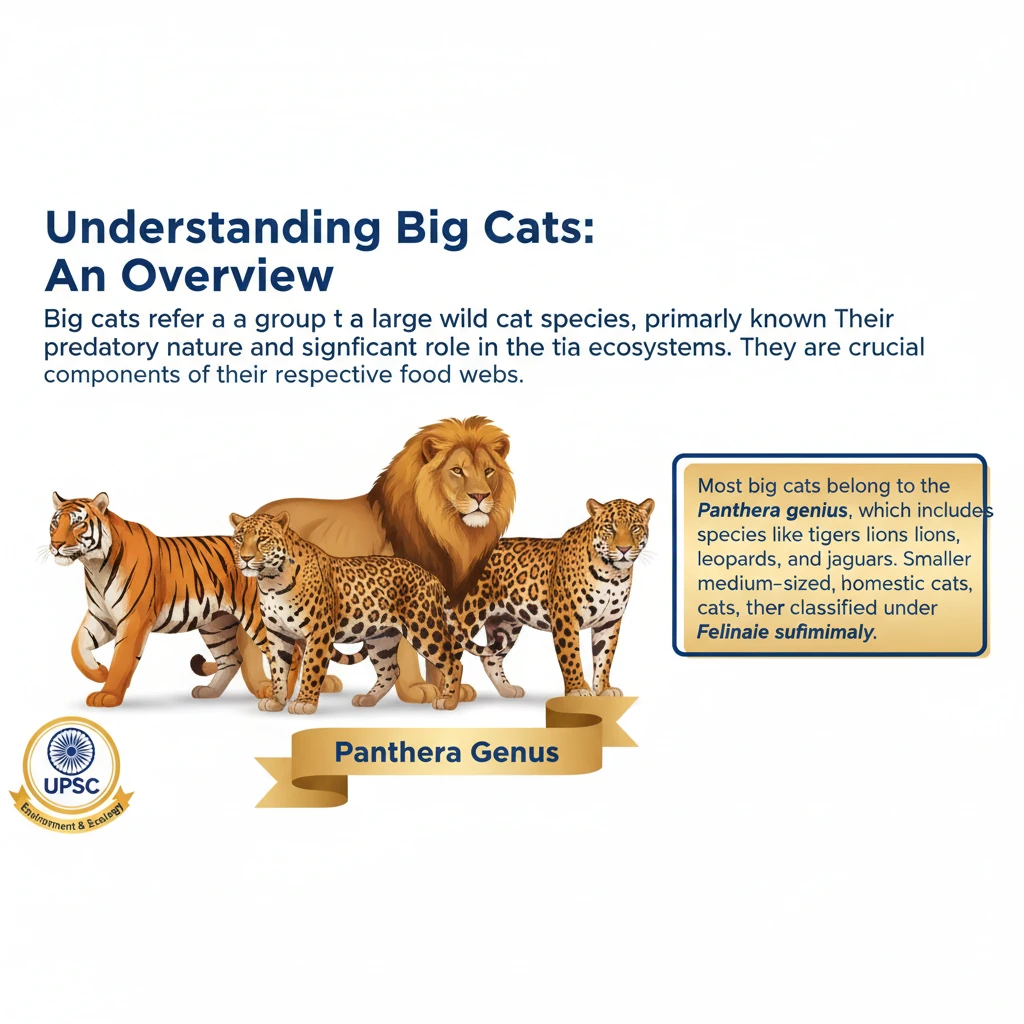
<h4>Understanding Big Cats: An Overview</h4><p><strong>Big cats</strong> refer to a group of large wild cat species, primarily known for their predatory nature and significant role in ecosystems. They are crucial components of their respective food webs.</p><div class='info-box'><p>Most big cats belong to the <strong>Panthera genus</strong>, which includes species like tigers, lions, leopards, and jaguars. Smaller and medium-sized cats, including domestic cats, are classified under the <strong>Felis genus</strong>.</p></div><div class='key-point-box'><p>Big cats are considered <strong>keystone species</strong>. Their presence is a critical indicator of the overall health and balance of an ecosystem, reflecting biodiversity and habitat integrity.</p></div><h4>Focus Species of Big Cat Conservation</h4><p>The global conservation initiative, the <strong>International Big Cat Alliance (IBCA)</strong>, focuses on the conservation of seven specific big cat species worldwide.</p><ul><li><strong>Tigers</strong> (Panthera tigris)</li><li><strong>Lions</strong> (Panthera leo)</li><li><strong>Leopards</strong> (Panthera pardus)</li><li><strong>Snow Leopards</strong> (Panthera uncia)</li><li><strong>Cheetahs</strong> (Acinonyx jubatus)</li><li><strong>Jaguars</strong> (Panthera onca)</li><li><strong>Pumas</strong> (Puma concolor), also known as cougars or mountain lions</li></ul><div class='info-box'><p>Out of these seven, <strong>five species are found in India</strong>: the <strong>tiger</strong>, <strong>lion</strong>, <strong>leopard</strong>, <strong>snow leopard</strong>, and <strong>cheetah</strong>. The <strong>puma</strong> and <strong>jaguar</strong> are not native to India.</p></div><h4>The International Big Cat Alliance (IBCA)</h4><p>The <strong>International Big Cat Alliance (IBCA)</strong> is a significant global initiative launched by India to conserve the world's big cat species. It represents a collaborative effort to protect these endangered animals.</p><div class='key-point-box'><p>Its primary objective is to advocate for policy initiatives that align <strong>biodiversity conservation efforts</strong> with local needs. This also contributes towards the attainment of <strong>United Nations-mandated Sustainable Development Goals (SDGs)</strong> within member countries.</p></div><h4>IBCA: Governance and Funding</h4><p>The IBCA's governance structure is robust, designed to ensure effective global coordination for big cat conservation and resource management.</p><ul><li>It comprises an <strong>Assembly of Members</strong>, a <strong>Standing Committee</strong>, and a <strong>Secretariat</strong>.</li><li>The Secretariat is based in <strong>India</strong>, highlighting India's leadership role in this global environmental endeavor.</li><li>The framework is modelled after the successful <strong>International Solar Alliance (ISA)</strong>, indicating a proven organizational blueprint.</li><li>A <strong>Director-General (DG)</strong> is appointed by the <strong>Ministry of Environment, Forest and Climate Change (MoEFCC)</strong>, Government of India.</li></ul><div class='info-box'><p>The Union Cabinet allocated a one-time budgetary support of <strong>Rs 150 crore</strong> for the IBCA. This funding is designated for a period of <strong>five years</strong>, from the financial year <strong>2023-24 to 2027-28</strong>.</p></div><p>Currently, <strong>four countries</strong> are members of the IBCA: <strong>India</strong>, <strong>Nicaragua</strong>, <strong>Eswatini</strong>, and <strong>Somalia</strong>. More countries are expected to join this crucial alliance.</p><h4>Unique Characteristics and Threats</h4><p>Big cats exhibit diverse behaviors and face various threats globally, necessitating targeted conservation strategies.</p><div class='key-point-box'><p><strong>Lions</strong> are unique among big cats as they are the only species that live in <strong>social groups</strong>, known as <strong>prides</strong>. They are also known for cooperative hunting. Most other big cats are solitary, except for mothers with cubs.</p></div><div class='info-box'><p>The <strong>Siberian tiger</strong> is recognized as the <strong>largest of all big cats</strong>. It is currently endangered due to significant threats such as <strong>trophy hunting</strong> and its extensive use in <strong>traditional Chinese medicine</strong>.</p></div><div class='exam-tip-box'><p>All big cat species are increasingly threatened by factors like <strong>poaching</strong>, <strong>illegal wildlife trade</strong>, and severe <strong>habitat loss</strong> and fragmentation. Understanding these interconnected threats is crucial for UPSC answers on environmental conservation and policy.</p></div>
💡 Key Takeaways
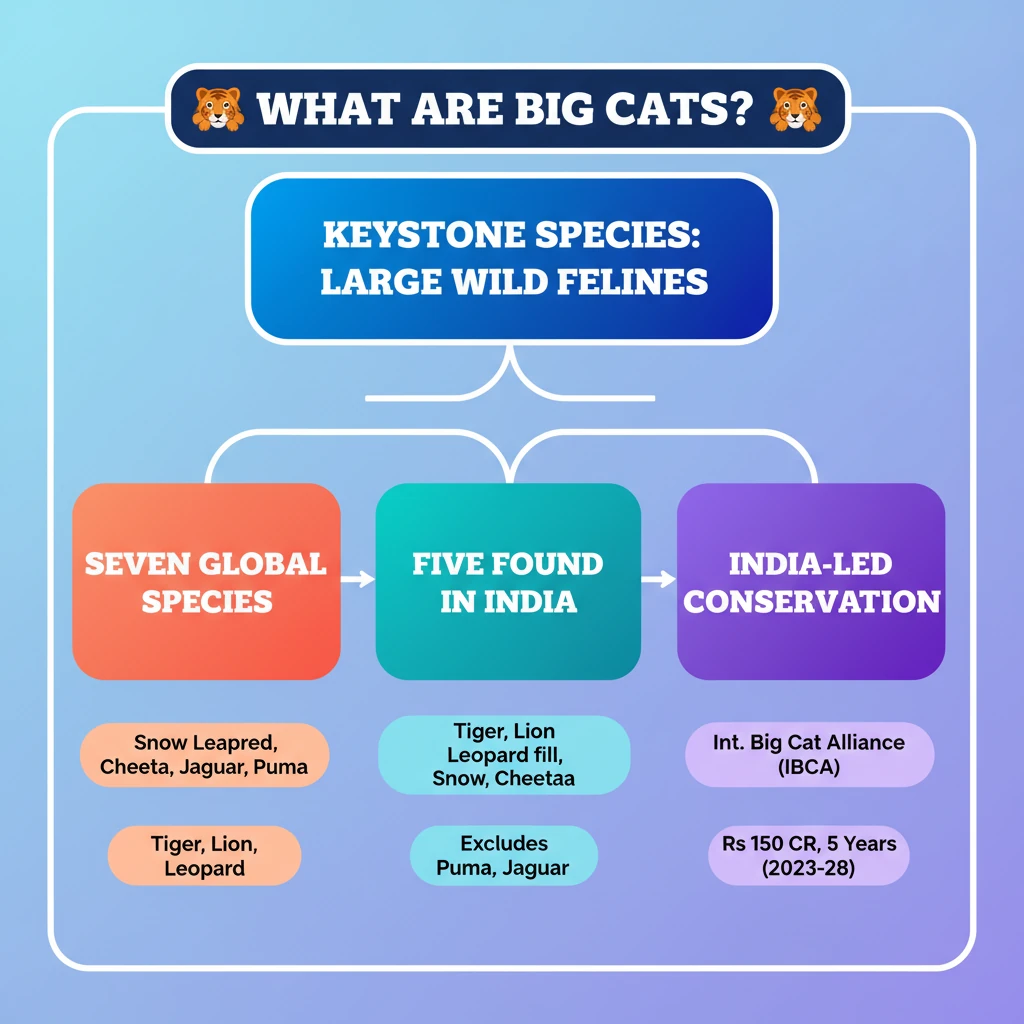
- •Big cats are large wild felines, mostly from the Panthera genus, serving as keystone species.
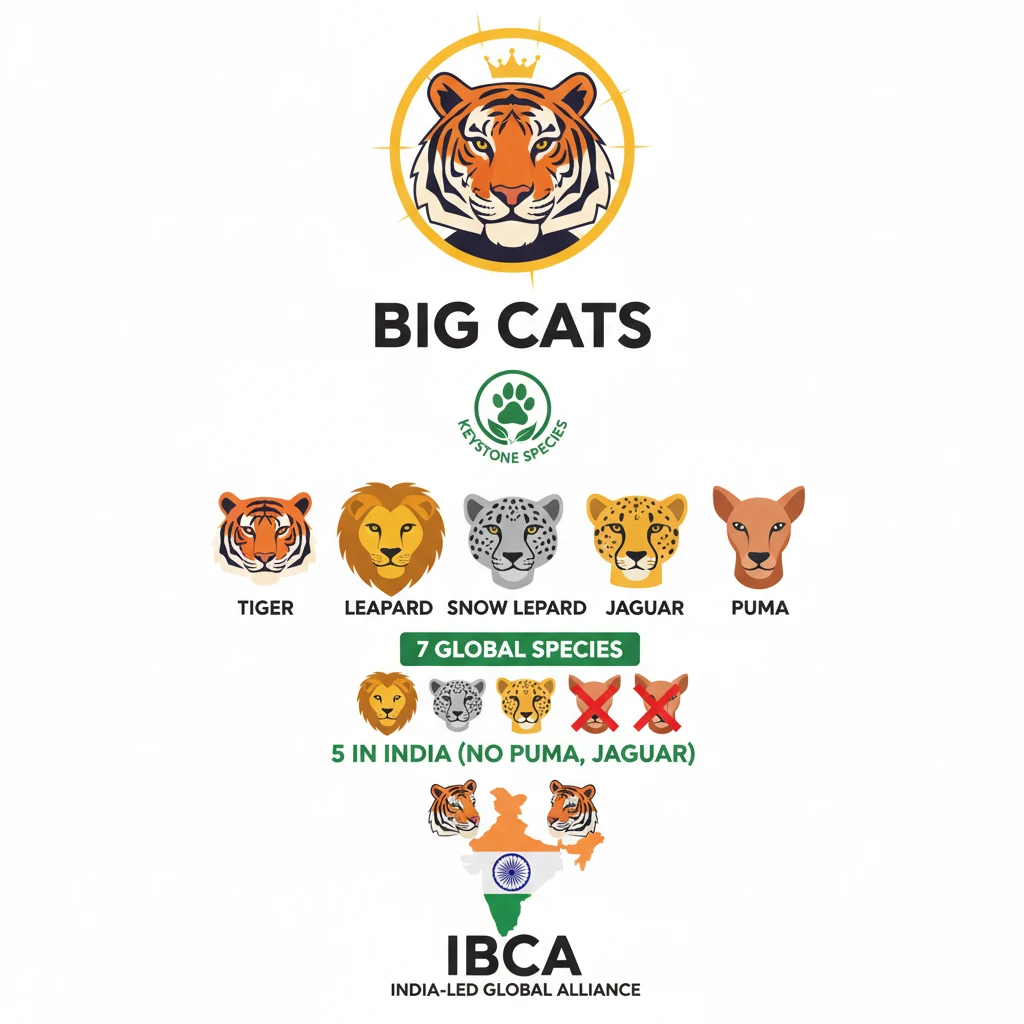
- •Seven key species are targeted for conservation: Tiger, Lion, Leopard, Snow Leopard, Cheetah, Jaguar, Puma.
- •Five of these seven big cat species are found in India (excluding Puma and Jaguar).
- •The International Big Cat Alliance (IBCA) is an India-led initiative for global big cat conservation.
- •IBCA, modeled after ISA, has a budget of Rs 150 crore for 5 years (2023-28) and aims to align conservation with SDGs.
- •Lions are the only social big cats; Siberian tiger is the largest and endangered.
- •Major threats include poaching, illegal trade, and habitat loss.
🧠 Memory Techniques
98% Verified Content
📚 Reference Sources
•Ministry of Environment, Forest and Climate Change (MoEFCC), Government of India - Press Releases on IBCA
•National Tiger Conservation Authority (NTCA) - Project Tiger reports
•IUCN Red List of Threatened Species
•United Nations Sustainable Development Goals official website