Brazilian Velvet Ant - Environment And Ecology | UPSC Learning
Topics
0 topics • 0 completed
🔍
No topics match your search
Brazilian Velvet Ant
Medium⏱️ 5 min read
environment and ecology
📖 Introduction
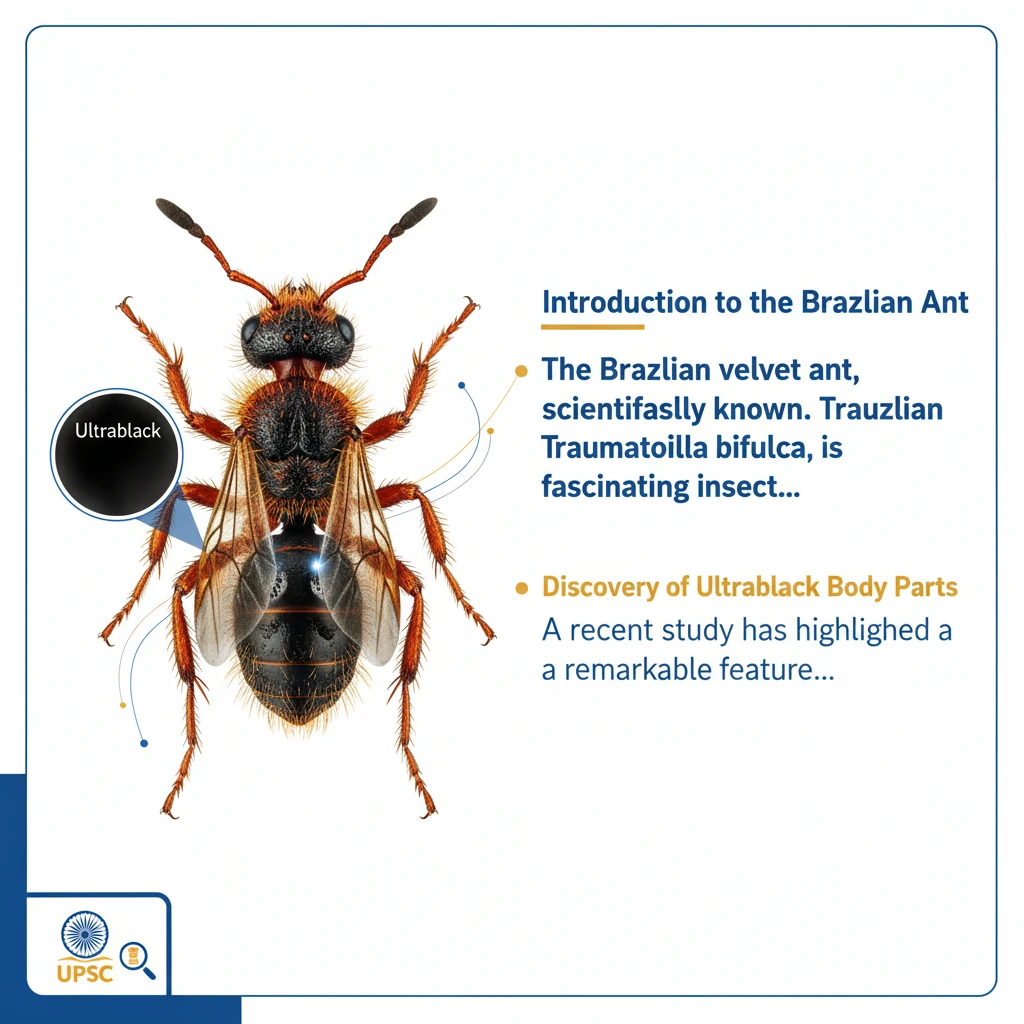
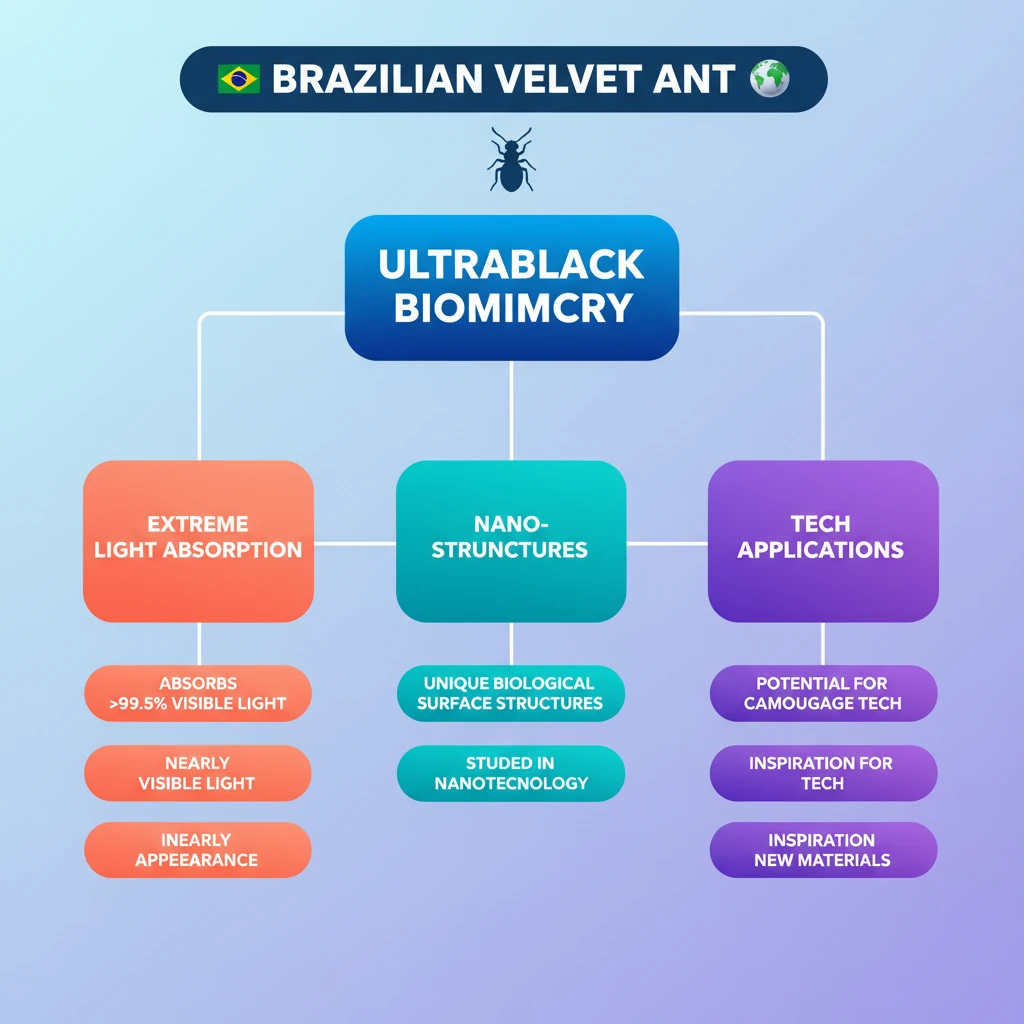
<h4>Introduction to the Brazilian Velvet Ant</h4><p>The <strong>Brazilian velvet ant</strong>, scientifically known as <strong>Traumatotilla bifulca</strong>, is a fascinating insect that has recently garnered scientific attention. It is a species of wingless wasp, often mistaken for an ant due to its appearance.</p><p>A recent study has highlighted a remarkable feature of this creature, revealing unique adaptations related to light absorption.</p><h4>Discovery of Ultrablack Body Parts</h4><p>A significant study published in the <strong>Beilstein Journal of Nanotechnology</strong> brought the <strong>Brazilian velvet ant</strong> into the limelight. The research focused on specific body parts of this insect.</p><div class='info-box'><p>The study revealed that certain body parts of the <strong>Brazilian velvet ant</strong> possess <strong>"ultrablack"</strong> properties. These parts are capable of absorbing <strong>over 99.5% of visible light</strong>.</p></div><p>This exceptional light absorption makes these parts appear almost entirely without reflection, rendering them nearly <strong>invisible</strong> to the naked eye under certain conditions.</p><h4>Biological Nanostructures and Technological Potential</h4><p>The secret behind the <strong>Brazilian velvet ant's</strong> ultrablackness lies in its <strong>unique biological nanostructures</strong>. These microscopic structures on the surface of its exoskeleton are precisely arranged to trap light.</p><div class='key-point-box'><p>The discovery of these natural <strong>nanostructures</strong> and their light-absorbing capabilities is not merely a biological curiosity. It holds significant <strong>potential applications in technology</strong>, particularly in fields like material science and optics.</p></div><div class='exam-tip-box'><p>For <strong>UPSC Prelims</strong>, remember the species name <strong>Traumatotilla bifulca</strong> and the journal <strong>Beilstein Journal of Nanotechnology</strong>. The concept of <strong>"ultrablack"</strong> and its percentage absorption (<strong>>99.5%</strong>) are also crucial. For <strong>Mains (GS-III)</strong>, focus on the implications for <strong>biomimicry</strong> and <strong>nanotechnology</strong>.</p></div>
💡 Key Takeaways
- •Brazilian velvet ant (Traumatotilla bifulca) has "ultrablack" body parts.
- •These parts absorb over 99.5% of visible light, making them nearly invisible.
- •The ultrablackness is due to unique biological nanostructures.
- •Discovery published in Beilstein Journal of Nanotechnology.
- •Holds significant potential for technological applications, especially in biomimicry.
- •Examples include advanced camouflage, optical instruments, and solar energy.
🧠 Memory Techniques
95% Verified Content
📚 Reference Sources
•Beilstein Journal of Nanotechnology (implied source of the study)
•General scientific literature on ultrablack materials and biomimicry