Coastal Regulation Zone (CRZ) - Environment And Ecology | UPSC Learning
Topics
0 topics • 0 completed
🔍
No topics match your search
Coastal Regulation Zone (CRZ)
Medium⏱️ 8 min read
environment and ecology
📖 Introduction
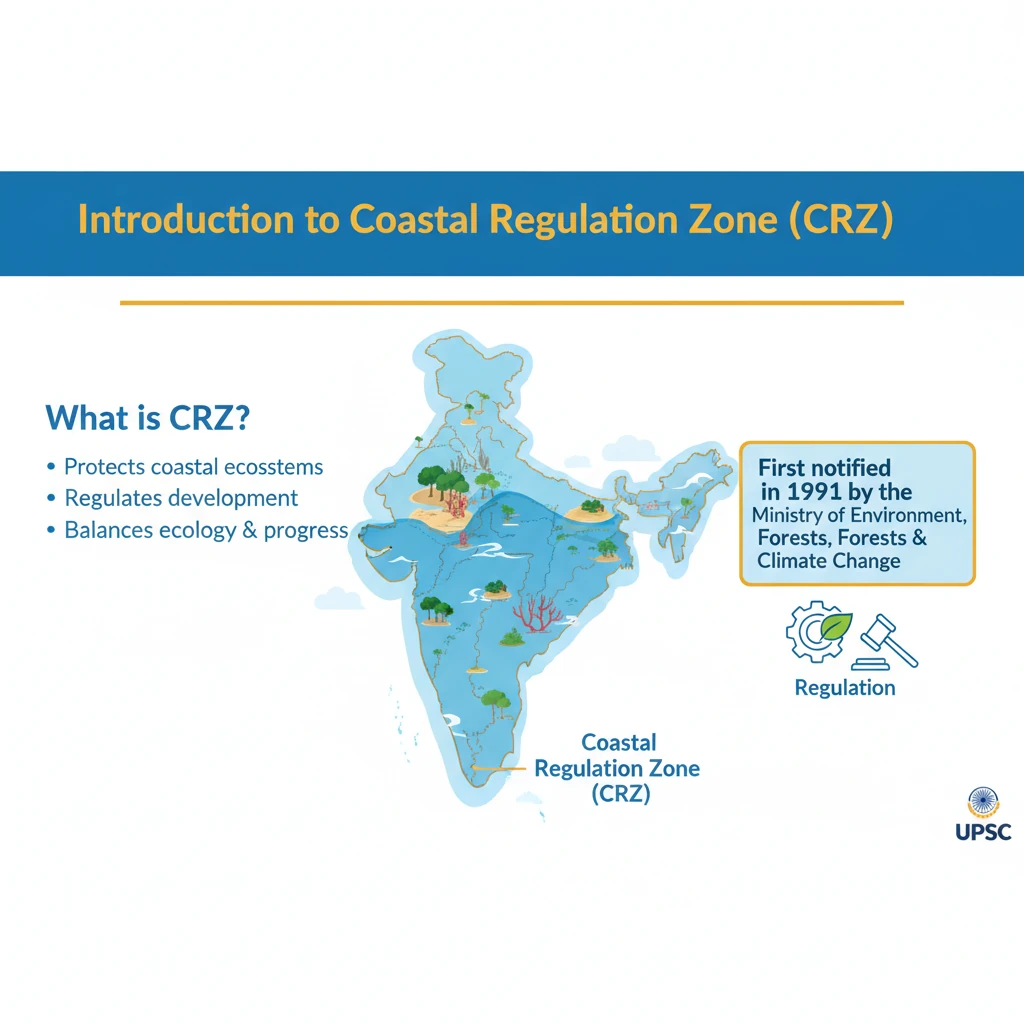
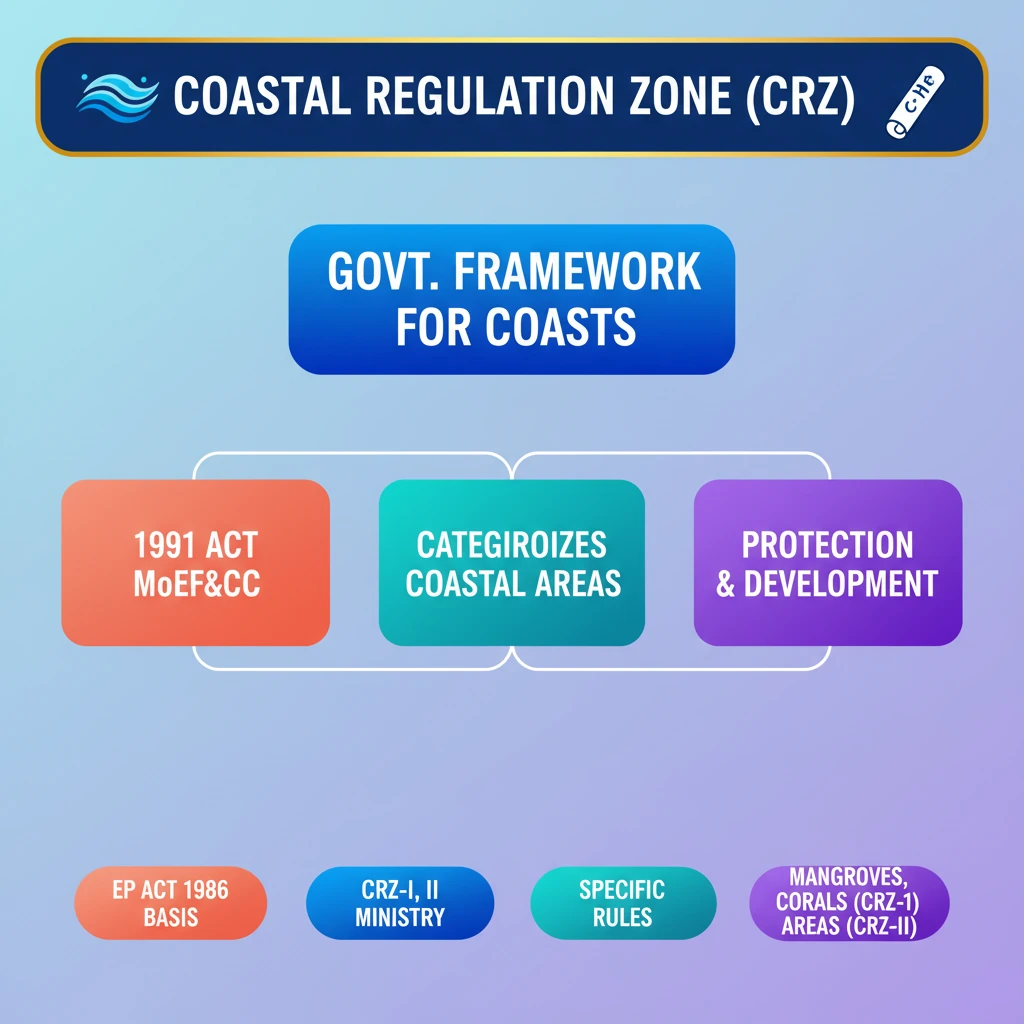
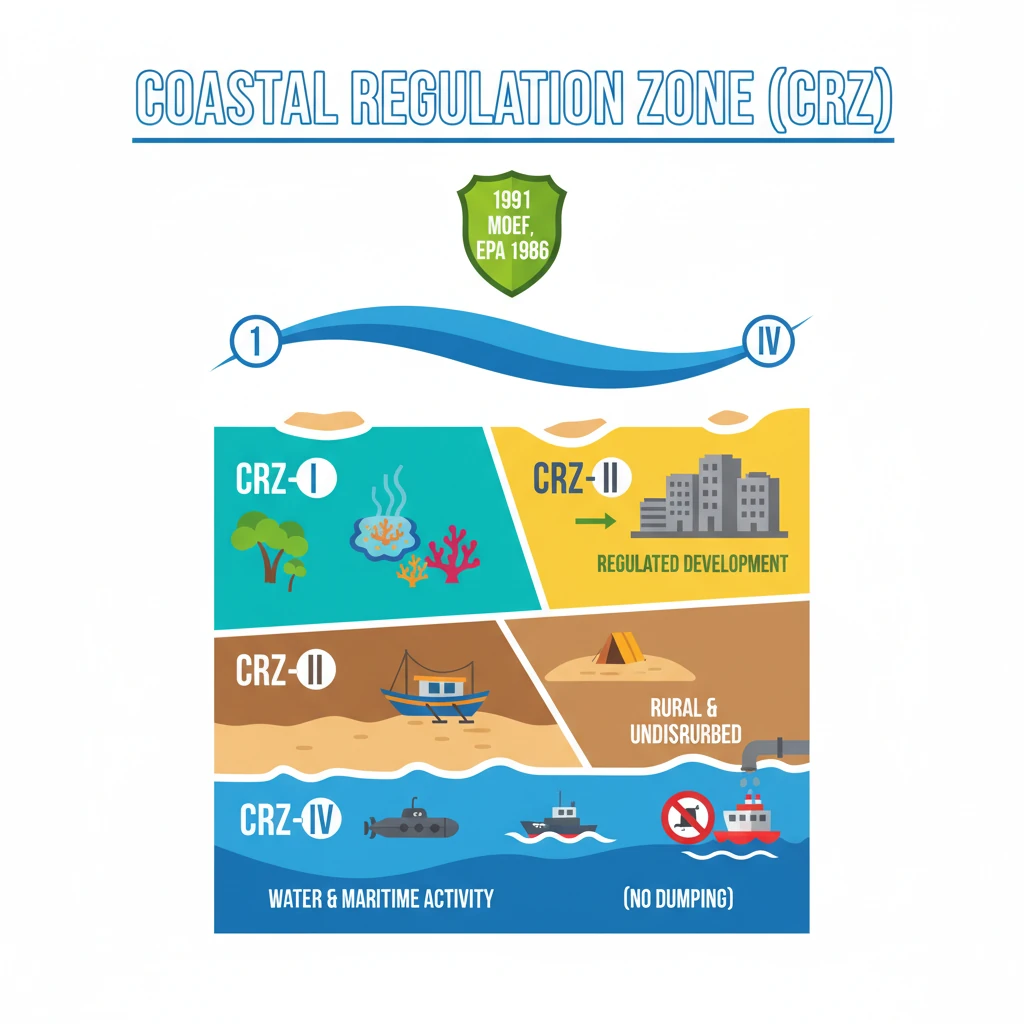
<h4>Introduction to Coastal Regulation Zone (CRZ)</h4><p>The <strong>Coastal Regulation Zone (CRZ)</strong> is a designated area near the coastline governed by specific rules. Its primary purpose is to <strong>protect the environment</strong> and promote <strong>sustainable development</strong> in these ecologically sensitive regions.</p><div class='key-point-box'><p>The <strong>CRZ Notification</strong> aims to regulate developmental activities along the Indian coastline to ensure ecological balance and prevent degradation of coastal ecosystems.</p></div><h4>Origin and Legal Basis of CRZ</h4><p>The <strong>CRZ</strong> was first officially notified in <strong>1991</strong> by the <strong>Ministry of Environment and Forests (MoEF)</strong>. This notification was issued under the provisions of the <strong>Environment Protection Act of 1986</strong>, providing it with a strong legal framework.</p><div class='info-box'><p><strong>Act:</strong> <strong>Environment Protection Act, 1986</strong></p><p><strong>Notifying Authority:</strong> <strong>Ministry of Environment and Forests (MoEF)</strong></p><p><strong>First Notification Year:</strong> <strong>1991</strong></p></div><h4>Defining the Coastal Regulation Zone Area</h4><p>The <strong>CRZ</strong> encompasses specific geographical stretches that are influenced by tidal action and proximity to the sea and associated water bodies. Understanding its boundaries is crucial for regulatory compliance.</p><ul><li><p>It includes the <strong>land area between the High Tide Line (HTL) and the Low Tide Line (LTL)</strong>, which is directly exposed to tidal fluctuations.</p></li><li><p>A <strong>100-metre stretch</strong> along the banks of various inland water bodies is also included. This applies to <strong>rivers, estuaries, backwaters, and creeks</strong> that are significantly affected by tides.</p></li><li><p>The <strong>river banks on either side of estuaries</strong>, where the sea's influence extends, are also part of the CRZ.</p></li></ul><h4>Categorization of CRZ</h4><p>To implement nuanced regulations based on ecological sensitivity and existing development, the <strong>CRZ</strong> is categorized into five distinct zones. Each zone has specific permissible and restricted activities.</p><div class='info-box'><p><strong>CRZ Categories:</strong></p><ul><li><strong>CRZ-I:</strong> Ecologically Sensitive Areas</li><li><strong>CRZ-II:</strong> Built-up Areas</li><li><strong>CRZ-III:</strong> Undisturbed Areas</li><li><strong>CRZ-IV:</strong> Aquatic Area</li><li><strong>CRZ-V:</strong> Specific to Goa (not detailed in source content, but implied by 'five zones')</li></ul></div><h4>CRZ-I: Ecologically Sensitive Areas</h4><p><strong>CRZ-I</strong> zones are designated as the most ecologically sensitive regions within the coastal stretch. These areas require the highest level of protection due to their invaluable biodiversity and ecological functions.</p><ul><li><p>Examples include <strong>mangroves</strong>, vital for coastal protection and biodiversity.</p></li><li><p><strong>Coral reefs</strong>, critical marine ecosystems, also fall under this category.</p></li><li><p>Other examples are <strong>biosphere reserves</strong> and other designated protected areas along the coast.</p></li></ul><h4>CRZ-II: Built-up Areas</h4><p><strong>CRZ-II</strong> includes areas that are already significantly developed. These are primarily <strong>villages and towns</strong> that have established infrastructure and human settlements.</p><p>Regulations in <strong>CRZ-II</strong> focus on managing further development to ensure it is sustainable and does not degrade the existing coastal environment.</p><h4>CRZ-III: Undisturbed Areas</h4><p><strong>CRZ-III</strong> covers coastal stretches that are relatively undisturbed and do not fit into either the ecologically sensitive <strong>CRZ-I</strong> or the built-up <strong>CRZ-II</strong> categories.</p><p>These are typically rural areas with limited development. The regulations here aim to conserve their natural state while allowing for traditional livelihoods.</p><h4>CRZ-IV: Aquatic Area</h4><p><strong>CRZ-IV</strong> specifically refers to the <strong>aquatic area</strong> within the coastal zone. This category extends from the <strong>Low Tide Line (LTL)</strong> outwards up to the <strong>territorial limits</strong> of the country.</p><p>Activities in this zone, such as fishing, dredging, and waste disposal, are strictly regulated to protect marine life and water quality.</p><div class='exam-tip-box'><p><strong>UPSC Insight:</strong> Understanding the specific permissible and prohibited activities within each <strong>CRZ category</strong> is crucial for both Prelims (factual recall) and Mains (policy analysis) questions. Pay attention to the rationale behind each classification.</p></div>
💡 Key Takeaways
- •CRZ was first notified in 1991 under the Environment Protection Act, 1986 by MoEF.
- •It regulates activities in coastal areas to protect environment and promote sustainable development.
- •CRZ includes land between HTL & LTL, and a 100m stretch along tidal rivers/estuaries.
- •Categorized into CRZ-I (ecologically sensitive), CRZ-II (built-up), CRZ-III (undisturbed), CRZ-IV (aquatic area).
- •Each CRZ category has specific permissible and prohibited activities to balance development and conservation.
🧠 Memory Techniques
95% Verified Content
📚 Reference Sources
•Ministry of Environment, Forest and Climate Change (MoEFCC) Notifications (general knowledge of CRZ evolution)