Teal Carbon Study at Keoladeo National Park - Environment And Ecology | UPSC Learning
Topics
0 topics • 0 completed
🔍
No topics match your search
Teal Carbon Study at Keoladeo National Park
Medium⏱️ 7 min read
environment and ecology
📖 Introduction
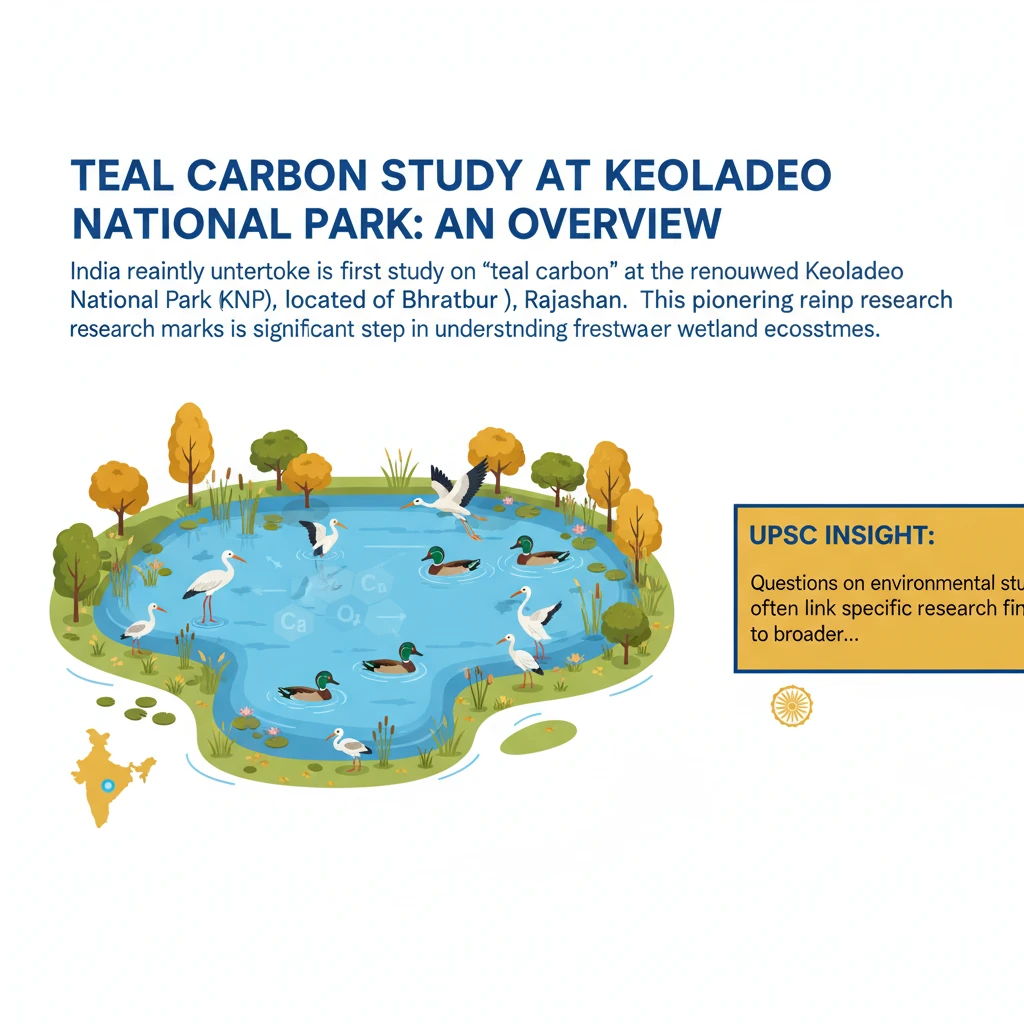
<h4>Teal Carbon Study at Keoladeo National Park: An Overview</h4><p>India recently undertook its <strong>first study on 'teal carbon'</strong> at the renowned <strong>Keoladeo National Park (KNP)</strong>, located in <strong>Bharatpur, Rajasthan</strong>. This pioneering research marks a significant step in understanding freshwater wetland ecosystems.</p><div class='exam-tip-box'><p><strong>UPSC Insight:</strong> Questions on environmental studies often link specific research findings to broader concepts like climate change mitigation and biodiversity. Understanding such pilot projects is crucial for <strong>GS Paper 3</strong>.</p></div><h4>Key Findings and Recommendations</h4><p>The study at <strong>Keoladeo National Park</strong> revealed concerning findings: elevated levels of <strong>methane emissions</strong>. Methane is a potent greenhouse gas, contributing significantly to global warming.</p><p>To counteract these elevated emissions, the research recommended the application of specialized <strong>biochar</strong>. This suggests a practical, nature-based solution to a pressing environmental challenge.</p><div class='info-box'><p><strong>Biochar:</strong> A <strong>carbon-rich material</strong> created through <strong>pyrolysis</strong> (heating biomass with little or no oxygen). It enhances <strong>soil fertility</strong>, improves <strong>water retention</strong>, and boosts <strong>carbon productivity</strong> in soil.</p></div><h4>Importance of Wetland Conservation</h4><p>The pilot project's findings underscore the critical role of <strong>wetland conservation</strong>. Wetlands are vital for addressing challenges related to <strong>climate adaptation</strong> and building <strong>resilience</strong> against environmental changes.</p><p>The study aimed to develop innovative <strong>nature-based solutions</strong> to effectively combat the impacts of <strong>climate change</strong>. Such solutions leverage natural processes to achieve environmental benefits.</p><h4>What is Teal Carbon?</h4><p><strong>Teal carbon</strong> specifically refers to the carbon stored within <strong>freshwater (non-tidal) wetlands</strong>. This includes carbon found in various forms within these ecosystems.</p><p>Its reservoirs encompass <strong>vegetation</strong>, <strong>microbial biomass</strong>, and both <strong>dissolved and particulate organic matter</strong>. These components collectively contribute to the carbon sequestration capacity of wetlands.</p><div class='key-point-box'><p><strong>Distinguishing Feature:</strong> Unlike <strong>black carbon</strong> and <strong>brown carbon</strong>, which are products of incomplete combustion and contribute to climate change, <strong>teal carbon</strong> is defined by its role in <strong>carbon sequestration</strong> within wetland ecosystems.</p></div><h4>Types of Carbon</h4><p>Carbon is categorized based on its ecological role and location. Understanding these distinctions is vital for comprehensive environmental analysis.</p><ul><li><strong>Teal Carbon:</strong> Stored in <strong>freshwater wetlands</strong> (vegetation, microbial biomass, organic matter).</li><li><strong>Black Carbon:</strong> <strong>Sooty material</strong> from burning fossil fuels, a major air pollutant.</li><li><strong>Brown Carbon:</strong> From <strong>incomplete combustion of organic materials</strong> (e.g., biomass), absorbs UV and visible light, contributing to warming.</li><li><strong>Blue Carbon:</strong> Carbon stored in <strong>coastal and marine ecosystems</strong> (oceans, mangroves, salt marshes, seagrasses).</li><li><strong>Green Carbon:</strong> Carbon sequestered by <strong>terrestrial plants</strong> through <strong>photosynthesis</strong>.</li><li><strong>Gray Carbon:</strong> Emitted from <strong>industrial processes</strong> and stored in <strong>fossil fuels</strong> (coal, oil, biogas).</li><li><strong>Red Carbon:</strong> Released by <strong>biological particles</strong> found on <strong>snow and ice</strong>.</li></ul><h4>Role of Teal Carbon in Climate Change Mitigation</h4><p><strong>Teal carbon ecosystems</strong> are pivotal in mitigating climate change. They perform several crucial ecological functions that benefit the environment.</p><p>These functions include <strong>sequestering carbon</strong>, raising <strong>groundwater levels</strong>, reducing <strong>urban heat islands</strong>, controlling <strong>greenhouse gases</strong>, and mitigating the severity of <strong>floods</strong>.</p><h4>Primary Reservoirs of Teal Carbon</h4><p>The main storage sites for <strong>teal carbon</strong> are specific types of freshwater wetlands. These ecosystems are globally significant carbon sinks.</p><p>Key reservoirs include <strong>peatlands</strong>, <strong>freshwater swamps</strong>, and <strong>natural freshwater marshes</strong>. These contribute substantially to the planet's overall carbon sequestration capacity.</p><div class='info-box'><p><strong>Global Storage:</strong> The estimated global storage of <strong>teal carbon</strong> across various ecosystems is approximately <strong>500.21 petagrams of carbon (PgC)</strong>. This highlights their immense environmental value.</p></div><h4>Threats to Teal Carbon Ecosystems</h4><p>Despite their critical role, <strong>teal carbon ecosystems</strong> face severe threats. Degradation of these wetlands compromises their ability to store carbon and maintain ecological balance.</p><p>Major threats include <strong>pollution</strong>, adverse <strong>land use changes</strong>, excessive <strong>water extraction</strong>, and various <strong>landscape modifications</strong>. Protecting these areas is essential for climate action.</p><h4>About Keoladeo National Park (KNP)</h4><p><strong>Keoladeo National Park</strong> is a globally recognized wetland and a vital <strong>bird sanctuary</strong>. It is situated in <strong>Bharatpur, Rajasthan</strong>, and is celebrated for its rich biodiversity.</p><p>The park holds the prestigious status of a <strong>UNESCO World Heritage Site</strong>, acknowledging its outstanding universal value. It is a key destination for migratory birds.</p><div class='info-box'><p><strong>Ramsar Recognition:</strong> <strong>Keoladeo National Park</strong>, along with <strong>Chilika Lake (Odisha)</strong>, was among the <strong>first Ramsar Sites of India</strong>, designated in <strong>1981</strong>. This signifies its international importance as a wetland.</p></div><p>Currently, <strong>Keoladeo National Park</strong> is listed in the <strong>Montreux Record</strong>, along with <strong>Loktak Lake (Manipur)</strong>. This indicates that it is a Ramsar site facing or likely to face severe ecological changes due to human interference.</p>
💡 Key Takeaways
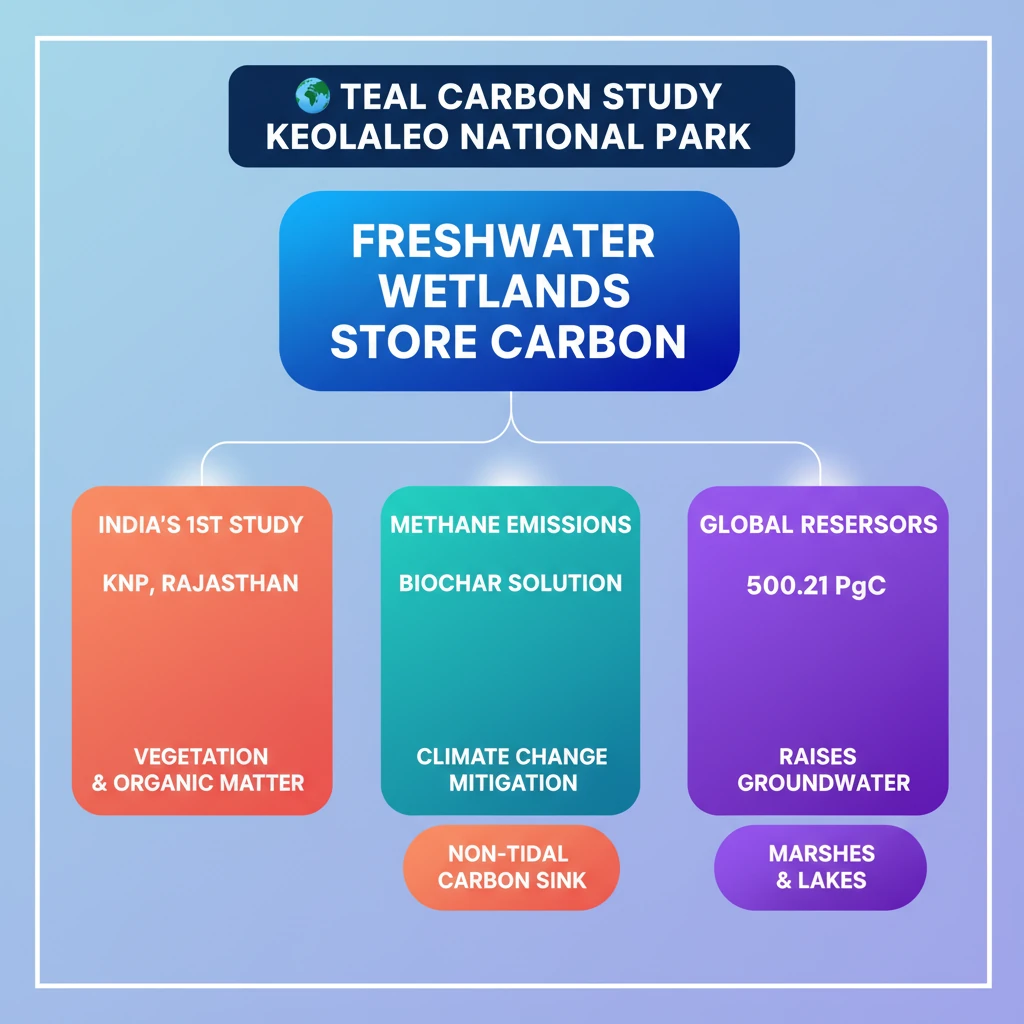
- •Teal carbon is carbon stored in freshwater wetlands (non-tidal), including vegetation and organic matter.
- •India's first teal carbon study was conducted at Keoladeo National Park (KNP), Rajasthan.
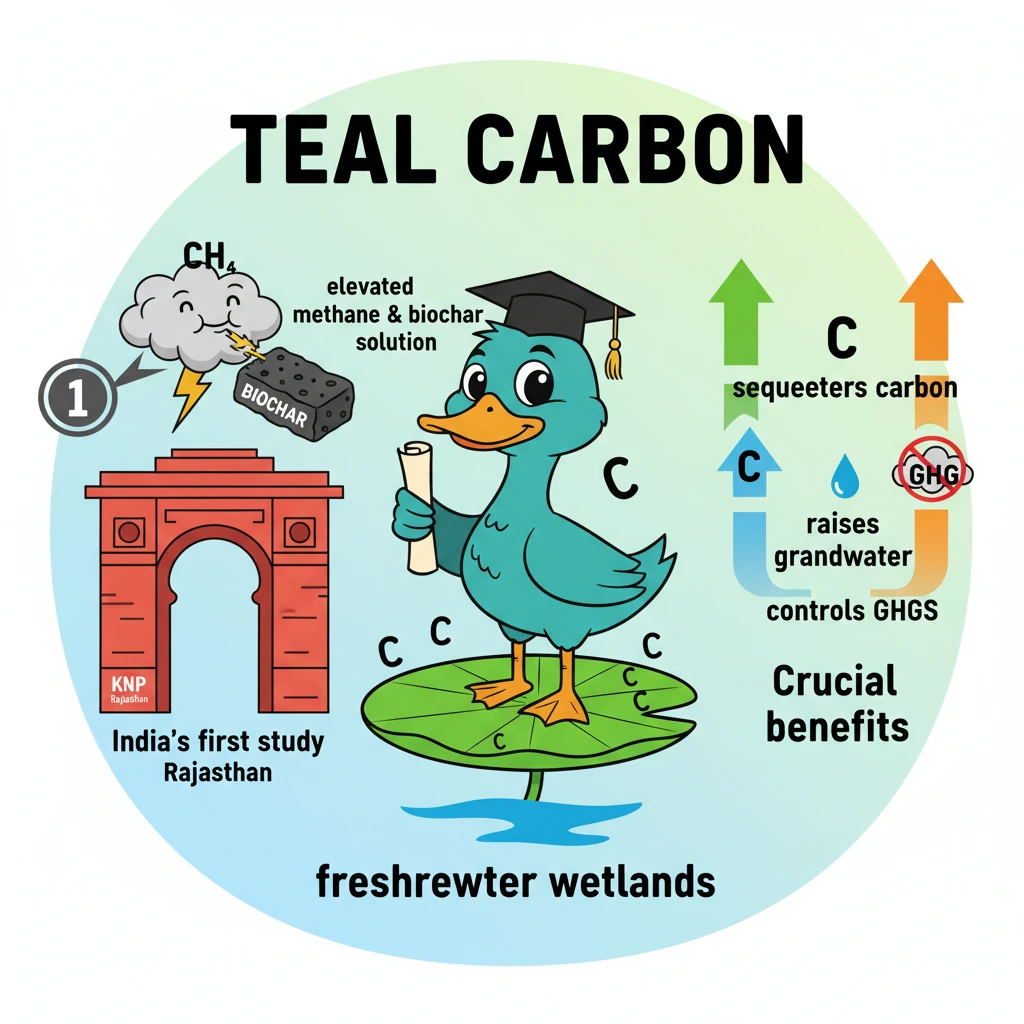
- •The KNP study found elevated methane emissions and recommended specialized biochar to reduce them.
- •Teal carbon ecosystems are crucial for climate change mitigation by sequestering carbon, raising groundwater, and controlling GHGs.
- •Primary reservoirs include peatlands, freshwater swamps, and marshes, storing an estimated 500.21 PgC globally.
- •KNP is a UNESCO World Heritage Site, one of India's first Ramsar Sites (1981), and is currently on the Montreux Record.
🧠 Memory Techniques
95% Verified Content
📚 Reference Sources
•Keoladeo National Park official information (general knowledge about KNP's status)
•Ramsar Convention Secretariat (information on Ramsar Sites and Montreux Record)