CGWB Report on Groundwater Contamination - Environment And Ecology | UPSC Learning
Topics
0 topics • 0 completed
🔍
No topics match your search
CGWB Report on Groundwater Contamination
Medium⏱️ 6 min read
environment and ecology
📖 Introduction
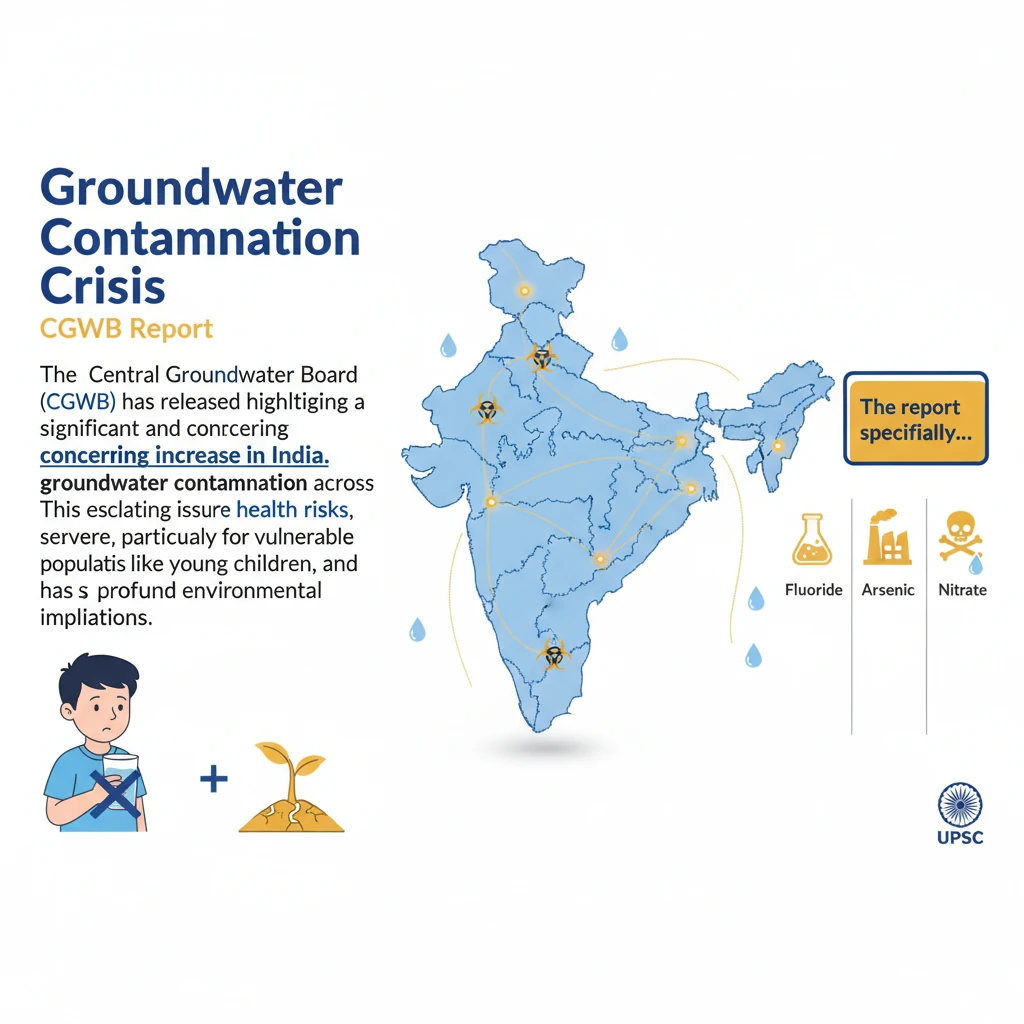
<h4>Introduction: Groundwater Contamination Crisis</h4><p>The <strong>Central Groundwater Board (CGWB)</strong> has released a report highlighting a significant and concerning increase in <strong>groundwater contamination</strong> across India. This escalating issue poses severe <strong>health risks</strong>, particularly for vulnerable populations like young children, and has profound <strong>environmental implications</strong>.</p><div class='key-point-box'><p>The report specifically identifies a troubling rise in districts reporting excessive levels of <strong>nitrate</strong>, a chemical contaminant, in their groundwater resources.</p></div><h4>Key Findings: Nitrate Contamination Escalation</h4><p>The <strong>CGWB report</strong> reveals a stark increase in <strong>nitrate contamination</strong>. As of <strong>2023</strong>, a total of <strong>440 districts</strong> across India reported groundwater with excessive nitrate levels. This marks a substantial rise from <strong>359 districts</strong> reported in <strong>2017</strong>.</p><p>A significant proportion of India's districts are now affected. Approximately <strong>56%</strong> of all districts in India have nitrate concentrations that exceed the prescribed safe limit of <strong>45 mg per litre</strong>.</p><div class='info-box'><p><strong>Safe Limit:</strong> The permissible limit for <strong>nitrate</strong> in drinking water, as per Indian standards, is <strong>45 mg per litre</strong>.</p></div><h4>Regional Hotspots for Nitrate Contamination</h4><p>Certain regions in India are disproportionately affected by high levels of <strong>nitrate contamination</strong>. The states reporting the highest percentages of nitrate contamination include <strong>Rajasthan (49%)</strong>, <strong>Karnataka (48%)</strong>, and <strong>Tamil Nadu (37%)</strong>.</p><p>Beyond these primary hotspots, other states are also experiencing notable and growing concerns regarding nitrate contamination. These include <strong>Maharashtra</strong>, <strong>Telangana</strong>, <strong>Andhra Pradesh</strong>, and <strong>Madhya Pradesh</strong>, with particular attention on central and southern India.</p><h4>Monsoon's Impact on Nitrate Levels</h4><p>The report indicates a clear correlation between the monsoon season and increased <strong>nitrate contamination</strong>. Levels of nitrate in groundwater tend to rise significantly after the monsoon period.</p><p>Specifically, <strong>32.66%</strong> of groundwater samples tested exceeded safe limits during the <strong>rainy season</strong>. This is notably higher compared to the <strong>30.77%</strong> of samples that exceeded safe limits in the <strong>pre-monsoon</strong> period.</p><h4>Other Significant Groundwater Contaminants</h4><p>While nitrate is a major concern, the <strong>CGWB report</strong> also highlights the persistence of other critical contaminants in India's groundwater.</p><ul><li><strong>Fluoride Contamination:</strong> This remains a significant problem, particularly in states such as <strong>Rajasthan</strong>, <strong>Haryana</strong>, <strong>Karnataka</strong>, <strong>Andhra Pradesh</strong>, and <strong>Telangana</strong>.</li><li><strong>Uranium Contamination:</strong> Levels of uranium exceeding safe limits have been detected in groundwater across several states. These include <strong>Rajasthan</strong>, <strong>Punjab</strong>, <strong>Haryana</strong>, <strong>Gujarat</strong>, <strong>Tamil Nadu</strong>, <strong>Andhra Pradesh</strong>, and <strong>Karnataka</strong>. This issue is particularly prevalent in <strong>over-exploited groundwater zones</strong>.</li></ul><h4>Groundwater Extraction Status</h4><p>The report also provides an overview of groundwater extraction rates across the country. Currently, approximately <strong>60.4%</strong> of the total groundwater resources are being extracted across India.</p><div class='info-box'><p><strong>Extraction Rate:</strong> The rate of groundwater extraction has remained relatively <strong>steady</strong> since <strong>2009</strong>, indicating consistent pressure on these vital resources.</p></div><div class='exam-tip-box'><p><strong>UPSC Insight:</strong> Understanding the regional distribution and types of contamination is crucial for questions on <strong>Environmental Geography</strong> (GS-I) and <strong>Environmental Pollution & Degradation</strong> (GS-III).</p></div>
💡 Key Takeaways
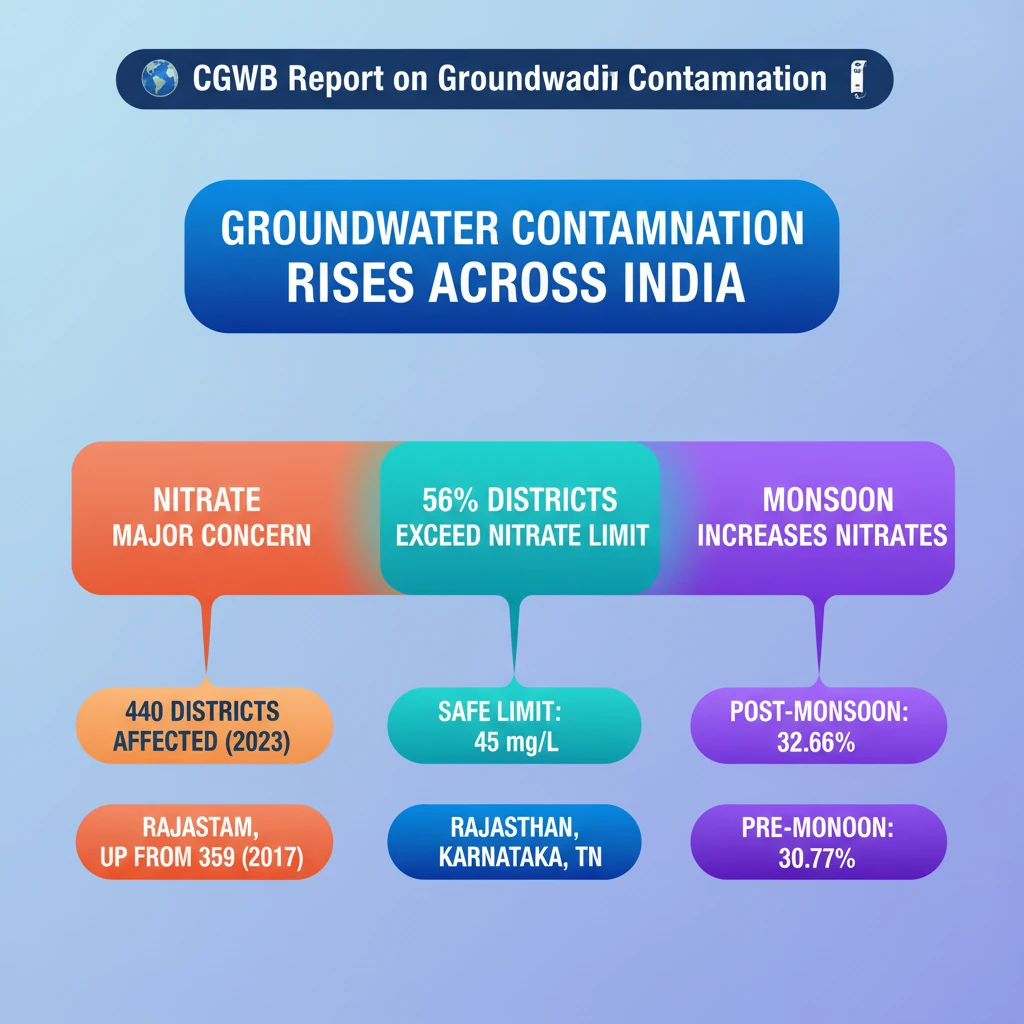
- •CGWB report reveals a significant rise in groundwater contamination across India.
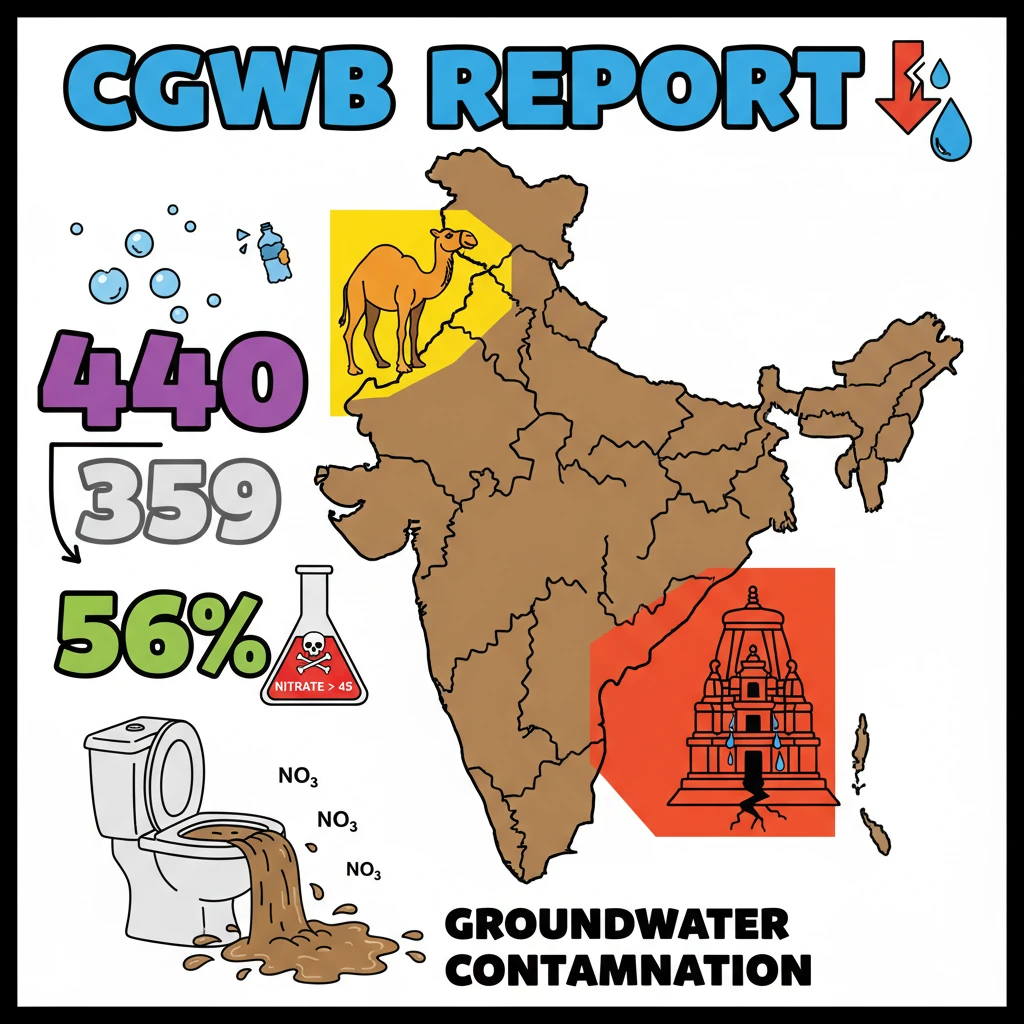
- •Nitrate contamination is a major concern, affecting 440 districts in 2023, up from 359 in 2017.
- •56% of India's districts exceed the safe nitrate limit of 45 mg/L.
- •Rajasthan, Karnataka, and Tamil Nadu are primary hotspots for nitrate contamination.
- •Monsoon season leads to an increase in nitrate levels (32.66% post-monsoon vs. 30.77% pre-monsoon).
- •Fluoride and Uranium are other persistent contaminants, particularly in over-exploited groundwater zones.
- •Groundwater extraction remains high at 60.4%, steady since 2009.
🧠 Memory Techniques
95% Verified Content
📚 Reference Sources
•Central Groundwater Board (CGWB) Report (implied from summary)