What Has the Recent Study Revealed? - Environment And Ecology | UPSC Learning
Topics
0 topics • 0 completed
🔍
No topics match your search
What Has the Recent Study Revealed?
Medium⏱️ 5 min read
environment and ecology
📖 Introduction
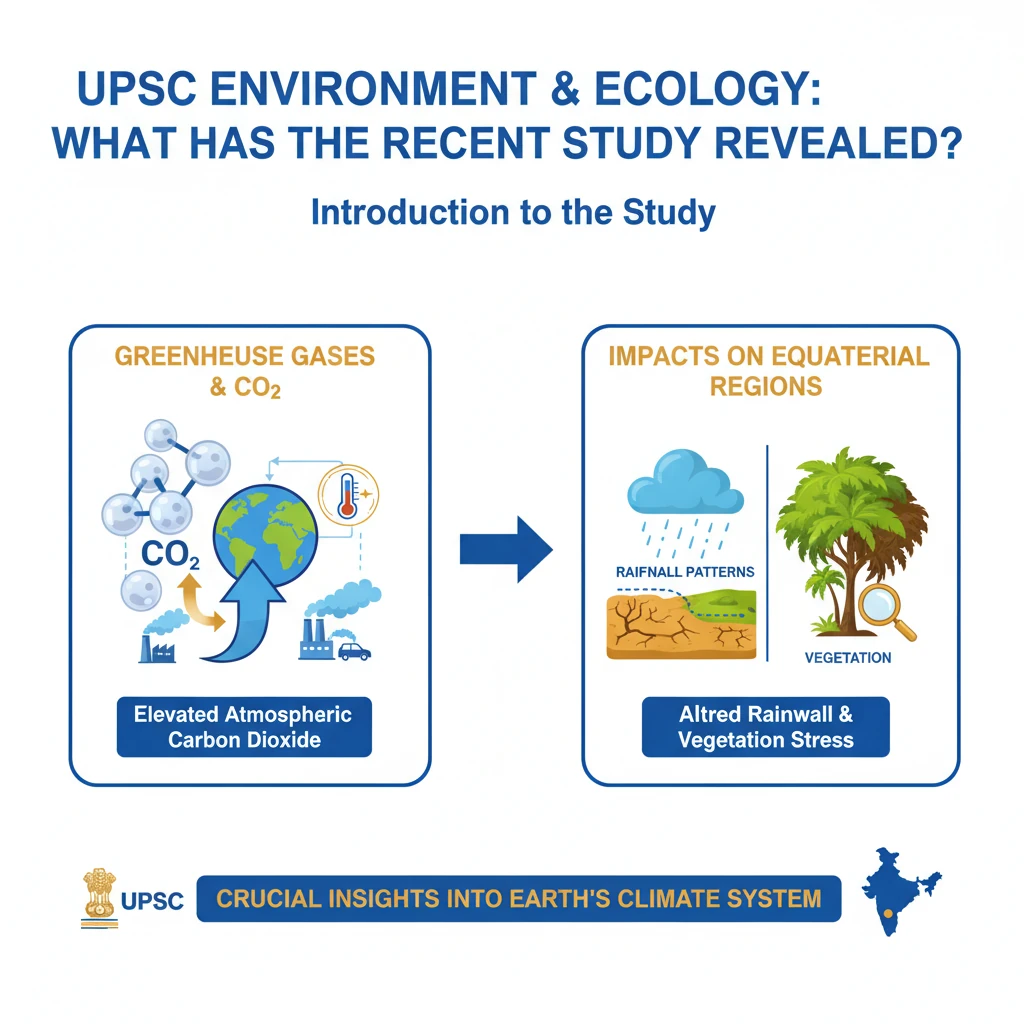
<h4>Introduction to the Study</h4><p>A recent study has shed light on the profound impacts of elevated <strong>greenhouse gases</strong>, particularly high levels of <strong>atmospheric carbon dioxide</strong>, on <strong>rainfall patterns</strong> and <strong>vegetation</strong> in <strong>equatorial regions</strong>.</p><p>This research offers crucial insights into how our planet's climate system responds to significant increases in atmospheric CO2, drawing parallels between past and potential future scenarios.</p><h4>Methodology and Data Sources</h4><p>The study meticulously utilized <strong>fossil pollen</strong> extracted from the <strong>Lignite Mine of Kutch</strong>, India. This paleobotanical data provides direct evidence of past vegetation types.</p><div class='info-box'><p>Additionally, <strong>carbon isotope data</strong> from the <strong>Eocene era</strong> was analyzed. The <strong>Eocene era</strong>, occurring approximately <strong>54 million years ago</strong>, was a geological period characterized by significant <strong>global warming</strong>.</p></div><p>A key aspect of the methodology involved using data from <strong>deep-time hyperthermal events</strong>. These are periods of extreme warmth in Earth's geological history.</p><div class='key-point-box'><p>Such events are considered valuable <strong>potential analogs</strong> for future <strong>climate predictions</strong>, offering a natural laboratory to understand Earth's response to present-day <strong>greenhouse gas emissions</strong>.</p></div><h4>Key Findings from the Eocene Era</h4><p>During the <strong>Eocene era</strong>, when atmospheric <strong>CO2 concentrations</strong> near the equator were exceptionally high, exceeding <strong>1000 parts per million by volume (ppmv)</strong>, a significant climatic shift occurred.</p><p>The study revealed a substantial <strong>decrease in rainfall</strong> across these <strong>equatorial regions</strong>. This reduction in precipitation had a direct and profound impact on the prevalent vegetation.</p><div class='info-box'><p>The decreased rainfall led to a notable <strong>increase in deciduous forests</strong>, replacing what would typically be more moisture-dependent vegetation types.</p></div><h4>Relevance to Present-Day Climate Change</h4><p>The findings of this study are highly relevant to our current understanding of <strong>climate change</strong>. It directly draws parallels between the climatic conditions of the <strong>Eocene era</strong> and potential future scenarios under increased <strong>greenhouse gas emissions</strong>.</p><div class='exam-tip-box'><p>Insights gained from this research are instrumental in formulating effective strategies for <strong>mitigating the impacts of climate change</strong>. Specifically, it can help protect vulnerable ecosystems such as <strong>rainforests</strong> and other <strong>sensitive ecosystems</strong> from adverse climatic shifts.</p></div>
💡 Key Takeaways
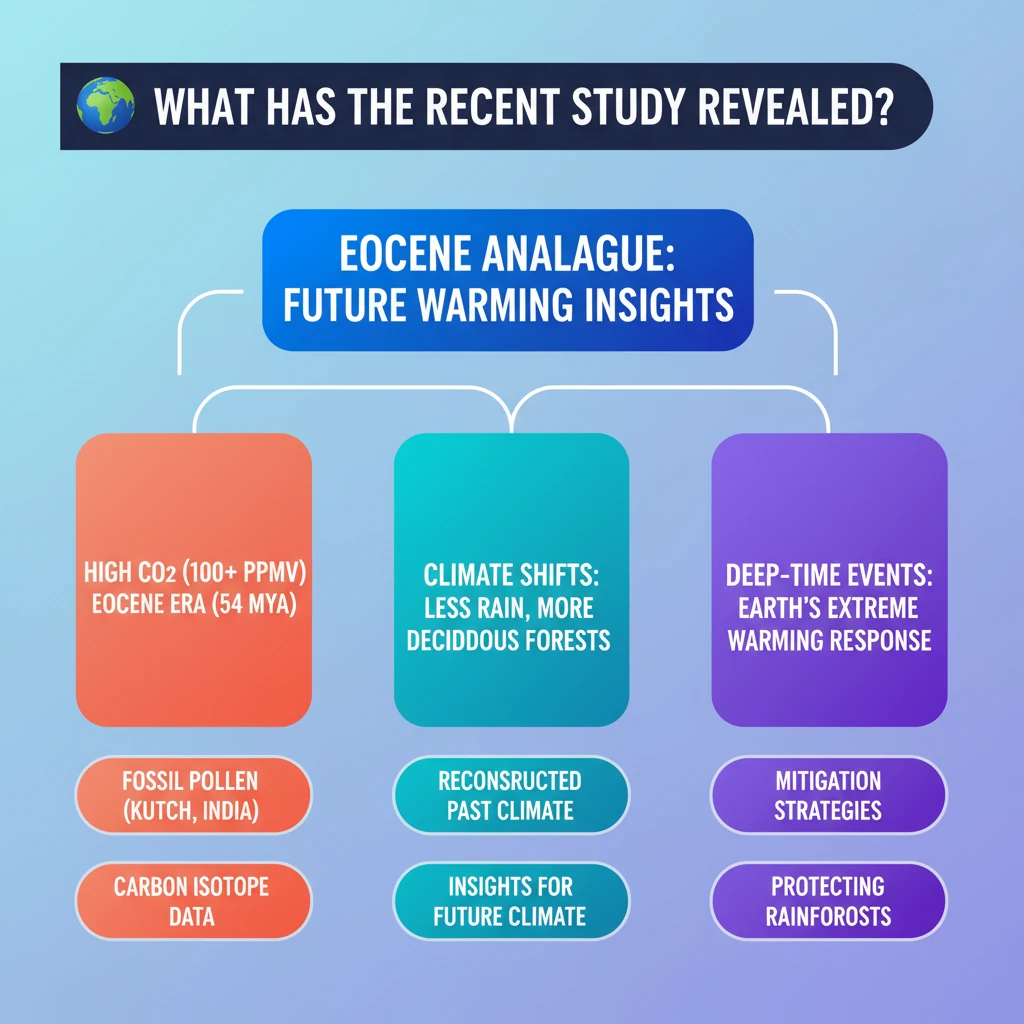
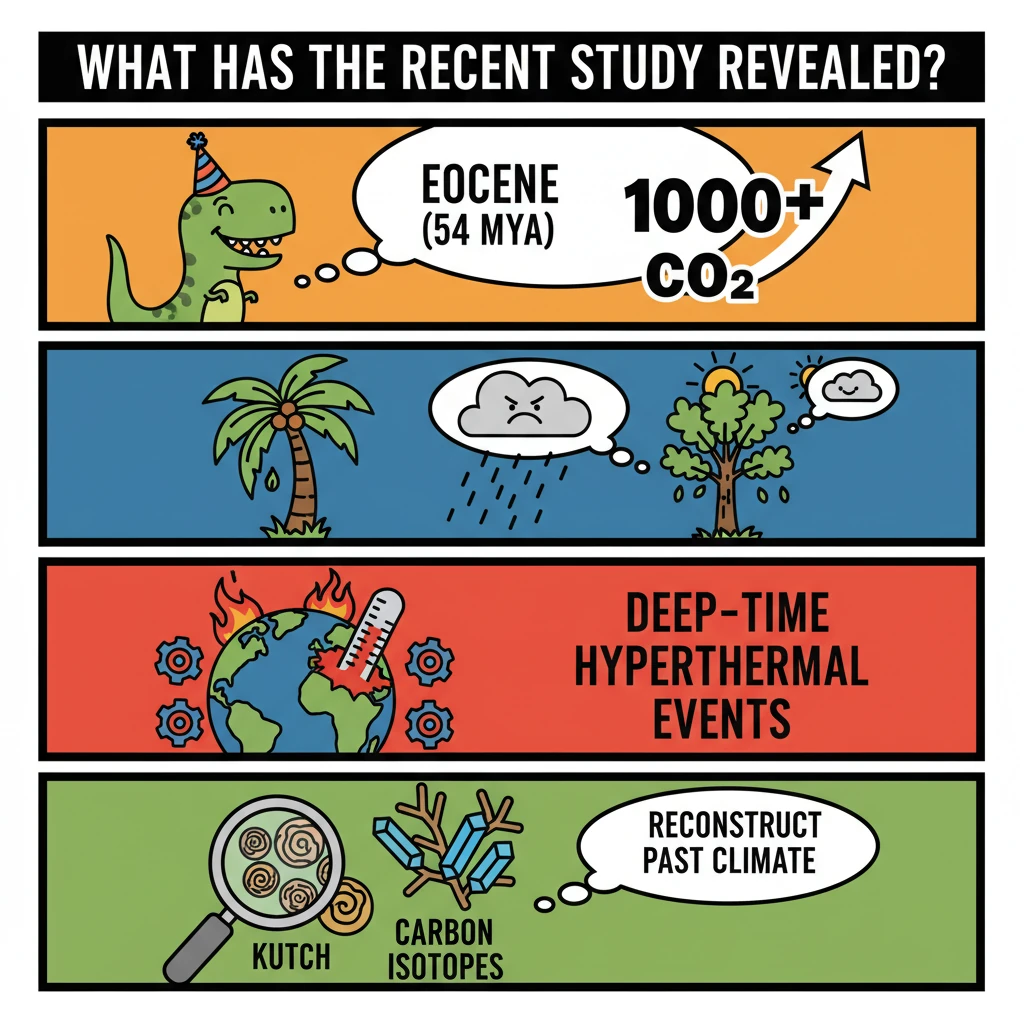
- •Eocene era (54 MYA) with >1000 ppmv CO2 serves as an analogue for future warming.
- •High CO2 in Eocene led to decreased equatorial rainfall and increased deciduous forests.
- •Deep-time hyperthermal events provide insights into Earth's response to extreme warming.
- •Study used fossil pollen from Kutch and carbon isotope data to reconstruct past climate.
- •Findings inform strategies for mitigating climate change impacts on rainforests and sensitive ecosystems.
🧠 Memory Techniques
95% Verified Content
📚 Reference Sources
•Scientific literature on Eocene Climate Optimum and hyperthermal events
•IPCC Assessment Reports (Working Group I: The Physical Science Basis - Paleoclimate chapter)