What are the Key Facts About Himalayan Magpies? - Environment And Ecology | UPSC Learning
Topics
0 topics • 0 completed
🔍
No topics match your search
What are the Key Facts About Himalayan Magpies?
Easy⏱️ 7 min read
environment and ecology
📖 Introduction
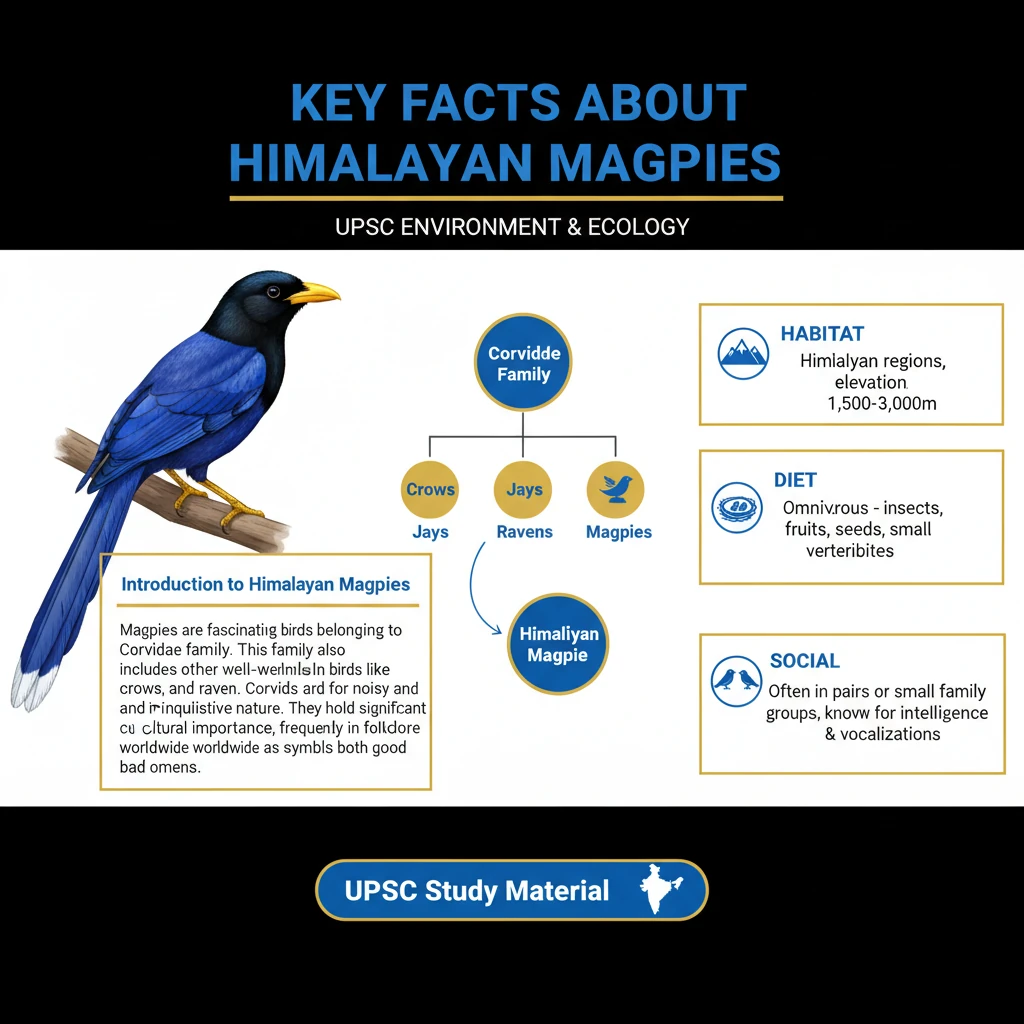
<h4>Introduction to Himalayan Magpies</h4><p><strong>Magpies</strong> are fascinating birds belonging to the <strong>Corvidae family</strong>. This family also includes other well-known birds like <strong>crows</strong>, <strong>jays</strong>, and <strong>ravens</strong>.</p><p><strong>Corvids</strong> are often recognized for their noisy and inquisitive nature. They hold significant cultural importance, frequently appearing in folklore worldwide as symbols of both good and bad omens.</p><p>Among the many striking species of magpies, some of the most noticeable are found in the majestic <strong>Himalayan region</strong>.</p><div class='info-box'><p><strong>IUCN Status:</strong> Himalayan magpies are currently classified as <strong>“Least Concern”</strong> on the <strong>IUCN Red List of Threatened Species</strong>, indicating a relatively stable population.</p></div><h4>Key Himalayan Magpie Species</h4><p>Across the vast stretch from <strong>Kashmir to Myanmar</strong>, several closely related <strong>blue magpie species</strong> are commonly sighted in the Himalayas.</p><div class='key-point-box'><p>There are distinct species inhabiting different altitudinal zones:</p><ul><li><strong>Gold-billed Magpie (Urocissa flavirostris):</strong> Also known as the <strong>yellow-billed blue magpie</strong>, this species thrives in high-altitude zones. It is typically found between <strong>2,000 and 3,000 meters above sea level</strong>.</li><li><strong>Red-billed Magpie (Urocissa erythroryncha):</strong> This species prefers slightly lower elevations compared to its gold-billed counterpart.</li><li><strong>Blue Magpie:</strong> Found at even lower altitudes, often in areas with larger <strong>human populations</strong>.</li></ul></div><h4>Habitat and Sighting Corridors</h4><p>The <strong>Himalayan ecosystem</strong> provides diverse habitats for these magpies. Specific regions offer excellent opportunities for birdwatching.</p><p>One of the prime locations for spotting both the <strong>yellow-billed</strong> and <strong>red-billed magpies</strong> is the <strong>trekking corridor in Western Sikkim</strong>.</p><div class='info-box'><p>This corridor extends from the town of <strong>Yuksom (1,780 meters)</strong> up to the <strong>Goche La pass (around 4,700 meters)</strong>, offering a range of altitudinal zones.</p></div><h4>Nesting Habits and Behavior</h4><p>The nesting and social behaviors of <strong>Himalayan magpies</strong> vary slightly among species.</p><p><strong>Yellow-billed blue magpies</strong> are known to construct their nests primarily in <strong>rhododendron trees</strong>. These nests are typically built hastily using <strong>twigs and grass</strong>.</p><p>In terms of appearance, the <strong>blue magpie</strong> and <strong>red-billed magpie</strong> share similarities, though they are generally a little smaller than the <strong>yellow-billed variety</strong>.</p><p>Magpies can be observed in various social configurations: as <strong>solitary birds</strong>, in <strong>pairs</strong>, or in noisy <strong>flocks of 8-10 individuals</strong>.</p><h4>Threats and Conservation Challenges</h4><p>Despite their "Least Concern" status, <strong>Himalayan magpies</strong> face emerging threats due to increasing anthropogenic pressures.</p><p>The rising level of <strong>human activity in forested areas</strong> is a significant concern. This activity raises questions about the magpies' ability to adapt to rapid <strong>habitat changes</strong>.</p><div class='exam-tip-box'><p>The popularity of <strong>rhododendron flowers</strong> as a tourist attraction, while economically beneficial, poses <strong>sustainability challenges</strong>. Local villagers may increasingly rely on <strong>forest resources</strong> to support the burgeoning tourism industry, impacting magpie habitats.</p></div>
💡 Key Takeaways
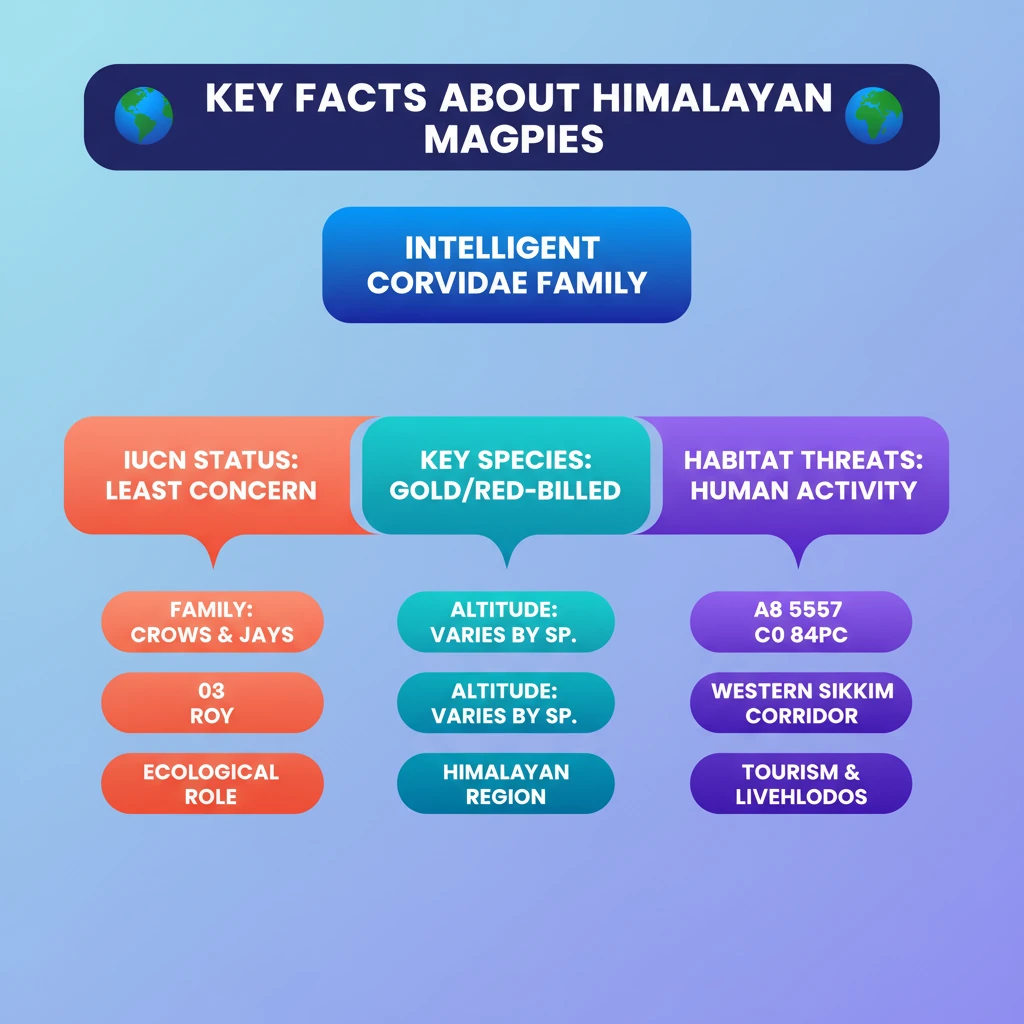
- •Himalayan Magpies belong to the intelligent Corvidae family, along with crows and jays.
- •They are classified as "Least Concern" on the IUCN Red List.
- •Key species include Gold-billed (yellow-billed) and Red-billed Magpies, found at different altitudes in the Himalayas.
- •Their habitats, like the Western Sikkim trekking corridor, face threats from increasing human activity and unsustainable tourism.
- •Conservation efforts must balance local livelihoods with habitat protection.
🧠 Memory Techniques

95% Verified Content