What are the Key Facts about Lithium? - Environment And Ecology | UPSC Learning
Topics
0 topics • 0 completed
🔍
No topics match your search
What are the Key Facts about Lithium?
Medium⏱️ 8 min read
environment and ecology
📖 Introduction
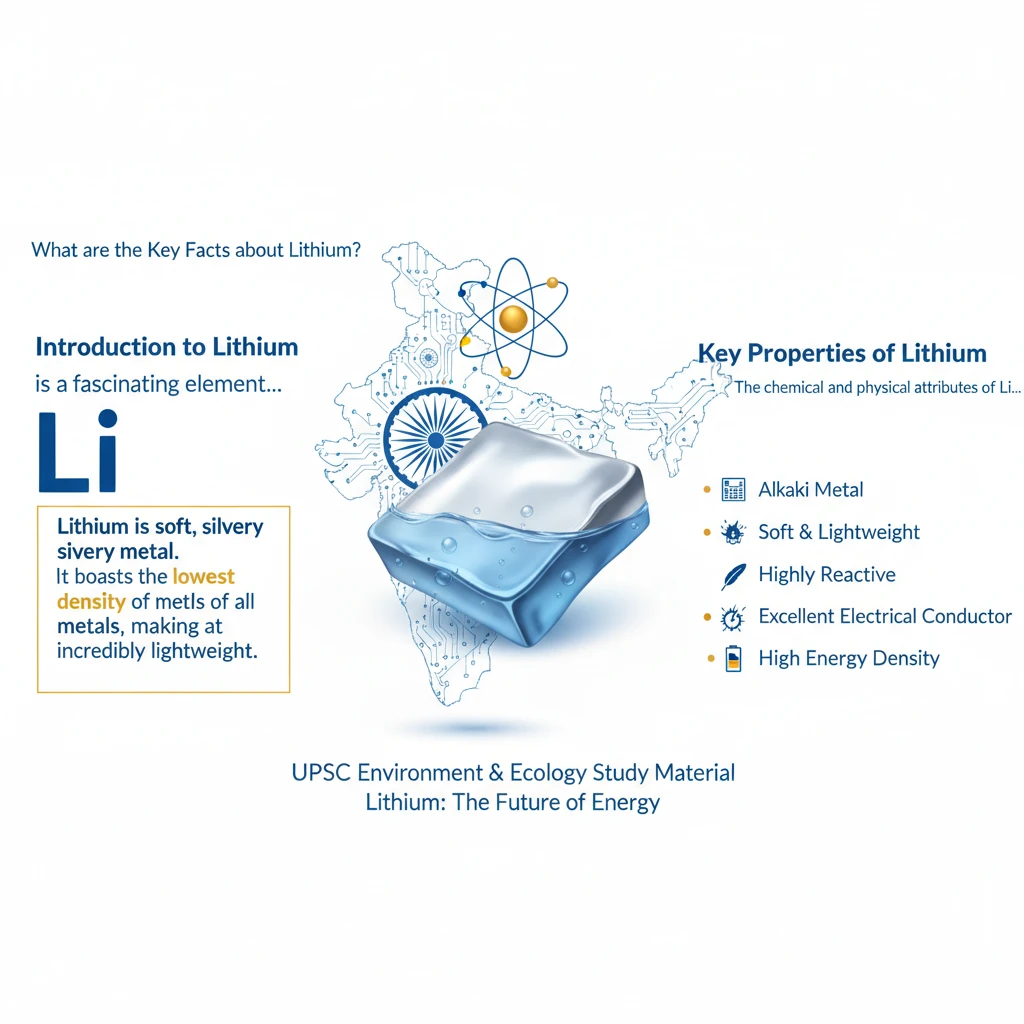
<h4>Introduction to Lithium</h4><p><strong>Lithium</strong> (Li) is a fascinating element known for its unique properties. It is classified as an alkali metal and holds a significant position in modern technology.</p><div class='info-box'><p><strong>Lithium</strong> is a <strong>soft, silvery metal</strong>. It boasts the <strong>lowest density</strong> of all metals, making it incredibly lightweight.</p></div><h4>Key Properties of Lithium</h4><p>The chemical and physical attributes of <strong>Lithium</strong> make it highly valuable across various industries. Its distinct characteristics contribute to its widespread applications.</p><ul><li><strong>High Reactivity:</strong> Lithium readily reacts with other elements, especially non-metals.</li><li><strong>Low Density:</strong> As the lightest metal, it is ideal for applications requiring minimal weight.</li><li><strong>Excellent Electrochemical Properties:</strong> These properties are crucial for its use in energy storage devices.</li></ul><h4>Important Ores of Lithium</h4><p><strong>Lithium</strong> is not found freely in nature due to its high reactivity. Instead, it is extracted from various mineral ores and brines.</p><div class='info-box'><p>Key mineral ores from which <strong>Lithium</strong> is commercially extracted include <strong>Petalite</strong>, <strong>Lepidolite</strong>, and <strong>Spodumene</strong>. These minerals are typically found in pegmatite deposits.</p></div><div class='key-point-box'><p>Due to its strategic importance and high value, <strong>Lithium</strong> is often referred to as <strong>“white gold”</strong>, especially in the context of the global energy transition.</p></div><h4>Diverse Applications of Lithium</h4><p>The versatility of <strong>Lithium</strong> extends to numerous critical applications, primarily driven by its unique electrochemical properties and lightweight nature.</p><h5>Batteries: The Primary Application</h5><p>The most significant use of <strong>Lithium</strong> is in the production of <strong>rechargeable batteries</strong>. These batteries power a vast array of portable electronic devices and electric vehicles.</p><ul><li><strong>Mobile Phones:</strong> Essential for powering smartphones and tablets.</li><li><strong>Laptops:</strong> Provides long-lasting energy for portable computing.</li><li><strong>Digital Cameras:</strong> Enables compact and efficient power sources.</li><li><strong>Electric Vehicles (EVs):</strong> Forms the core of high-capacity batteries driving the global shift towards sustainable transportation.</li></ul><p>Beyond rechargeable variants, <strong>Lithium</strong> is also used in certain <strong>non-rechargeable batteries</strong> for specialized purposes where reliability and longevity are paramount.</p><ul><li><strong>Heart Pacemakers:</strong> Critical for life-sustaining medical devices due to stable power output.</li><li><strong>Toys and Clocks:</strong> Provides compact and long-lasting power for small electronic items.</li></ul><h5>Alloys: Enhancing Material Properties</h5><p><strong>Lithium</strong> is alloyed with other metals to create materials with enhanced strength-to-weight ratios and other desirable properties.</p><div class='info-box'><p>A notable example is the <strong>magnesium-lithium alloy</strong>, which is specifically utilized for <strong>armour plating</strong>. This alloy offers superior protection while keeping the overall weight of the structure low, crucial for aerospace and defense applications.</p></div><div class='exam-tip-box'><p>Understanding <strong>Lithium's applications</strong> is vital for questions on <strong>critical minerals</strong>, <strong>energy security</strong>, and <strong>India's EV policy</strong> in <strong>GS Paper III</strong>. Focus on its role in the green economy.</p></div>
💡 Key Takeaways
- •Lithium is a soft, silvery metal with the lowest density and high reactivity.
- •Key ores include Petalite, Lepidolite, and Spodumene, often called 'white gold'.
- •Primarily used in rechargeable batteries for EVs, phones, and laptops.
- •Also used in non-rechargeable batteries for pacemakers and in lightweight alloys for armor plating.
- •A critical mineral vital for global energy transition, EVs, and renewable energy storage.
- •India's domestic Lithium discoveries are strategically important for self-reliance.
🧠 Memory Techniques

95% Verified Content
📚 Reference Sources
•Geological Survey of India (GSI) reports on Lithium discoveries
•International Energy Agency (IEA) reports on Critical Minerals
•General scientific literature on Lithium properties and applications