Tribal Ministry’s Directive on Forest Right Act, 2006 - Environment And Ecology | UPSC Learning
Topics
0 topics • 0 completed
🔍
No topics match your search
Tribal Ministry’s Directive on Forest Right Act, 2006
Medium⏱️ 7 min read
environment and ecology
📖 Introduction
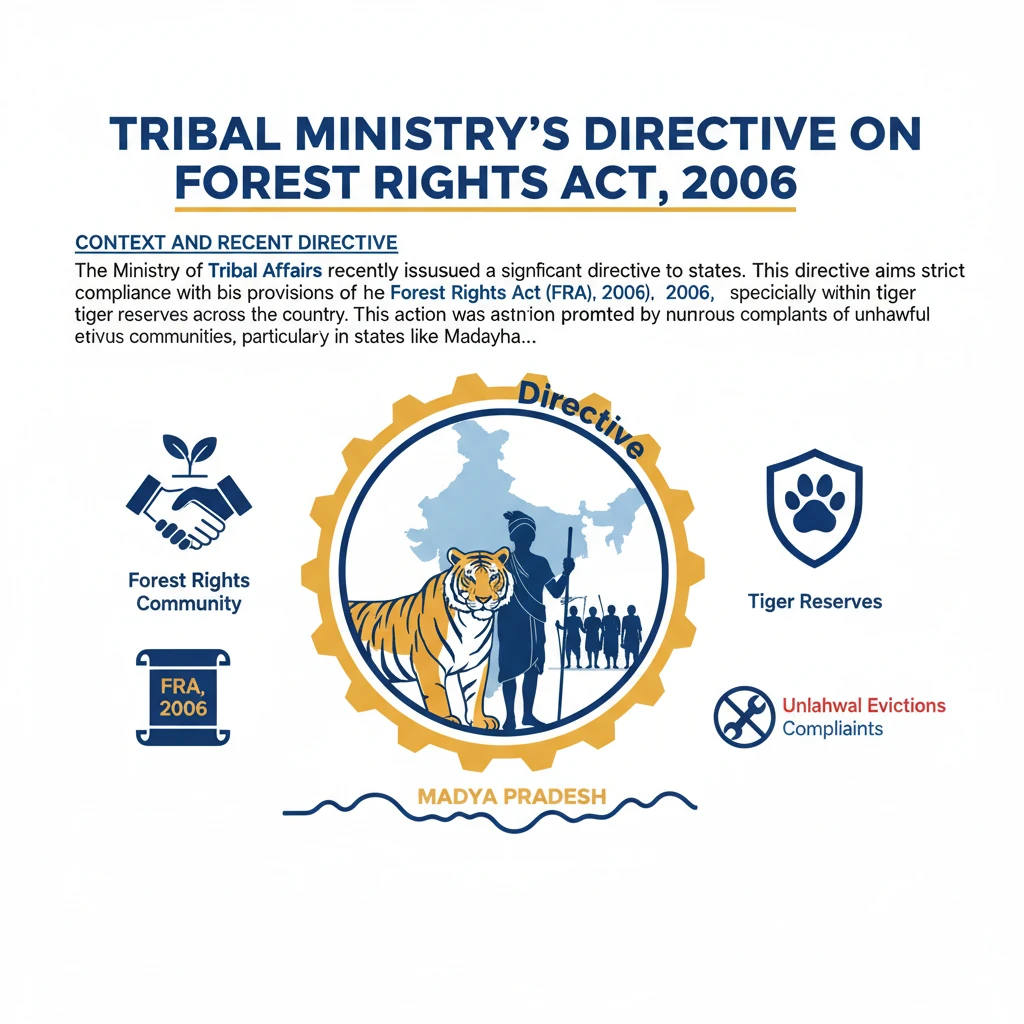
<h4>Context and Recent Directive</h4><p>The <strong>Ministry of Tribal Affairs</strong> recently issued a significant directive to states. This directive aims to ensure strict compliance with the provisions of the <strong>Forest Rights Act (FRA), 2006</strong>, specifically within <strong>tiger reserves</strong> across the country.</p><p>This action was prompted by numerous complaints of unlawful evictions. <strong>Forest-dwelling communities</strong>, particularly in states like <strong>Madhya Pradesh</strong>, <strong>Maharashtra</strong>, and <strong>West Bengal</strong>, reported being removed from their traditional habitats without due process.</p><h4>Key Highlights of the Tribal Ministry's Directive</h4><div class='key-point-box'><p>The Ministry emphasized that <strong>forest-dwelling communities cannot be evicted</strong> from forest areas. This is unless their rights under the <strong>FRA</strong> and the <strong>Wildlife Protection Act, 1972</strong>, are legally recognized and settled.</p></div><ul><li><strong>Consent for Relocation:</strong> <strong>Section 4(2) of the FRA</strong> mandates that free, informed consent of the respective <strong>Gram Sabhas</strong> must be obtained in writing before any relocation.</li><li><strong>Resettlement Rights:</strong> The law also explicitly provides for <strong>resettlement rights</strong> in the areas where the displaced communities are proposed to be settled.</li><li><strong>Reporting Requirement:</strong> States are required to submit detailed reports. These reports must include information on <strong>tribal villages in tiger reserves</strong> and the current status of their <strong>forest rights claims</strong>.</li><li><strong>NTCA Involvement:</strong> The <strong>National Tiger Conservation Authority (NTCA)</strong> has also requested timelines for relocating <strong>591 villages</strong> located within various tiger reserves. This highlights the ongoing debate between conservation needs and community rights.</li><li><strong>Grievance Redressal:</strong> States have been instructed to establish robust <strong>grievance redressal systems</strong>. These mechanisms are crucial for handling complaints related to evictions from forest areas effectively.</li></ul><h4>Understanding the Forest Rights Act (FRA), 2006</h4><div class='info-box'><p>The <strong>Forest Rights Act (FRA), 2006</strong>, officially known as <strong>The Scheduled Tribes and Other Traditional Forest Dwellers (Recognition of Forest Rights) Act</strong>, was enacted to address historical injustices.</p></div><p>Its primary objective is to recognize and vest <strong>forest rights and tenure</strong> to two main categories of communities. These are <strong>forest-dwelling Scheduled Tribes (STs)</strong> and <strong>Other Traditional Forest Dwellers (OTFDs)</strong>.</p><p>These communities have historically resided in forests for generations. However, they often lacked formal documentation of their rights, leading to vulnerability and displacement.</p>
💡 Key Takeaways
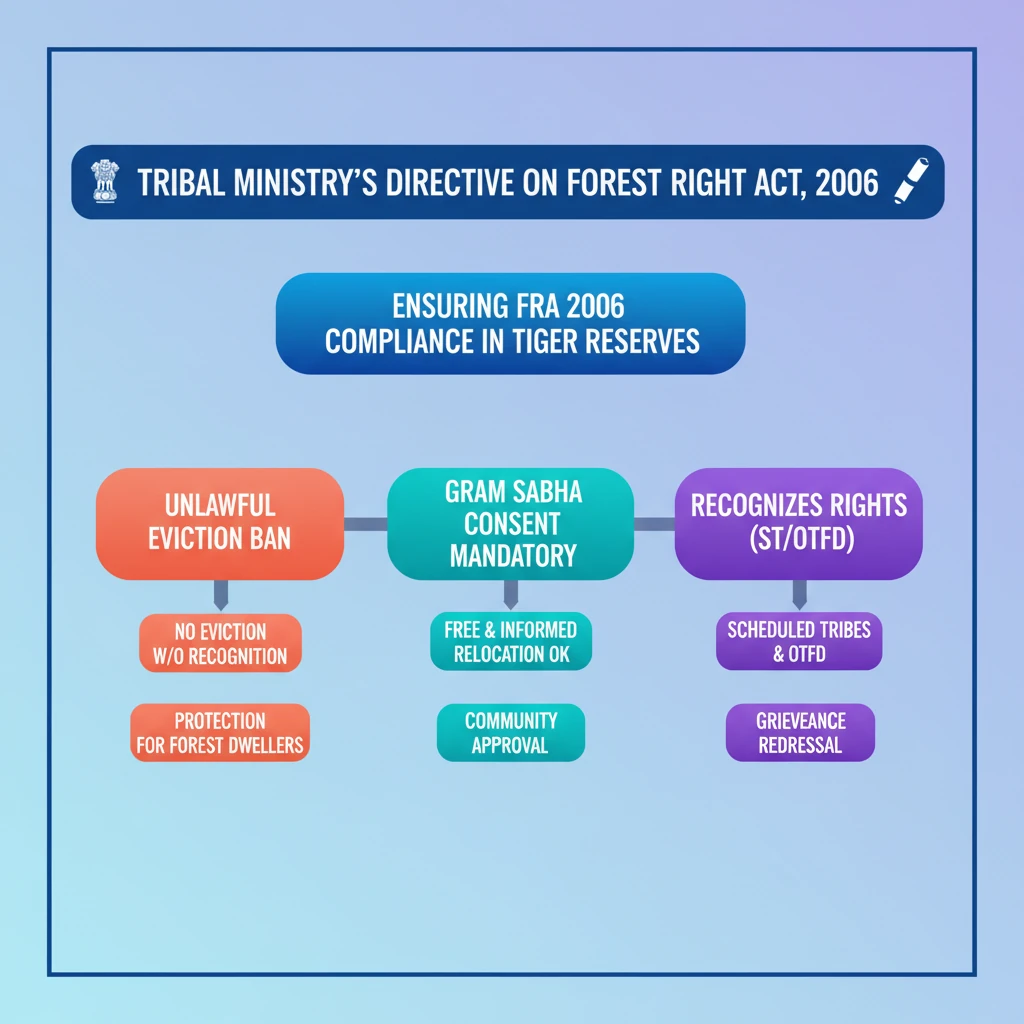
- •Ministry of Tribal Affairs directed states to ensure FRA 2006 compliance in tiger reserves.
- •Eviction of forest dwellers without FRA recognition is unlawful.
- •Free, informed consent of Gram Sabhas is mandatory for relocation.
- •FRA 2006 recognizes rights of Scheduled Tribes and Other Traditional Forest Dwellers.
- •States must establish grievance redressal mechanisms for eviction complaints.
🧠 Memory Techniques

95% Verified Content