FRA 2006: Aims, Provisions, and Rights (MFP, Community, Habitat) - Environment And Ecology | UPSC Learning
Topics
0 topics • 0 completed
🔍
No topics match your search
FRA 2006: Aims, Provisions, and Rights (MFP, Community, Habitat)
Medium⏱️ 7 min read
environment and ecology
📖 Introduction
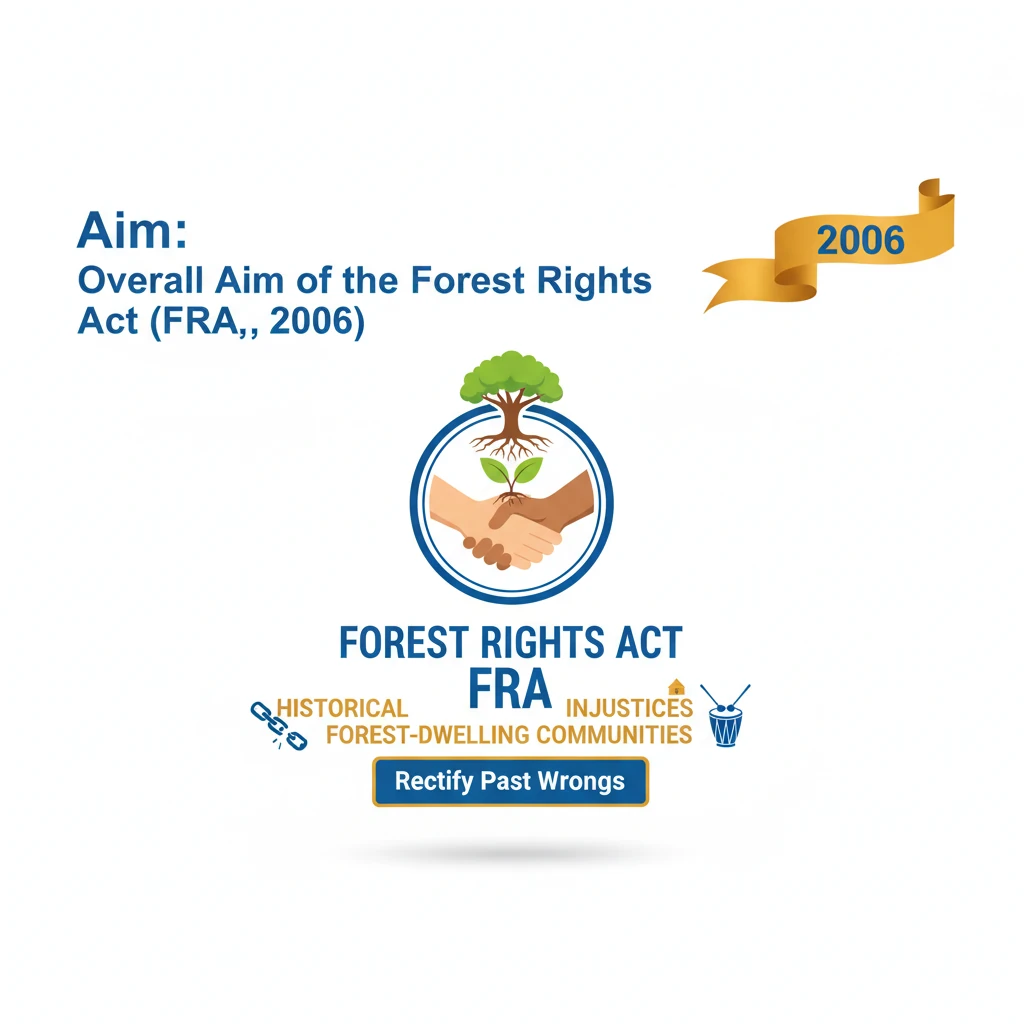
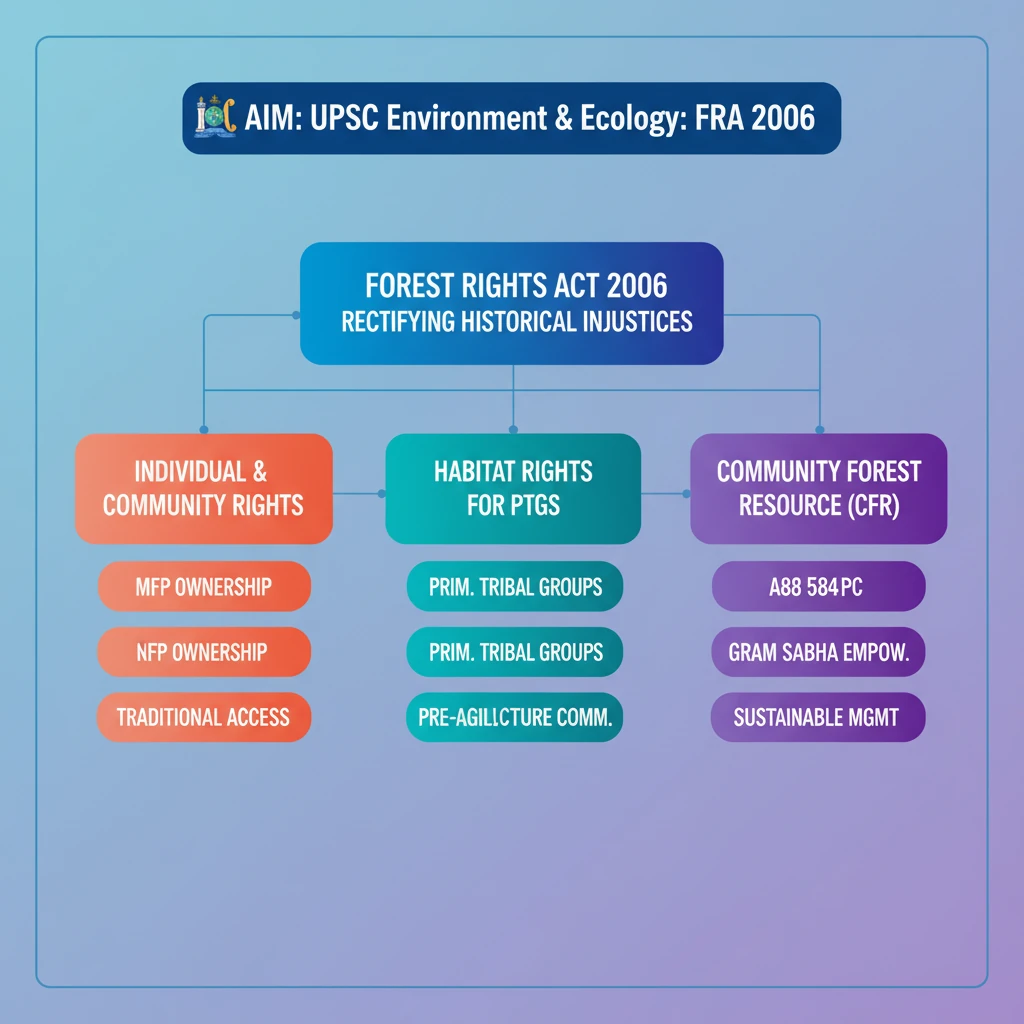
<h4>Overall Aim of the Forest Rights Act (FRA), 2006</h4><p>The <strong>Forest Rights Act (FRA)</strong> of <strong>2006</strong> primarily aims to rectify the <strong>historical injustices</strong> faced by <strong>forest-dwelling communities</strong>. These injustices arose from colonial and post-colonial forest management policies.</p><p>These past policies often disregarded the <strong>deep, symbiotic relationship</strong> that indigenous communities shared with their land and forest resources.</p><h4>Rectifying Historical Injustices</h4><p>The Act seeks to correct wrongs where traditional rights were overlooked or denied. This led to significant marginalization and displacement of forest dwellers.</p><div class='key-point-box'><p>The <strong>FRA</strong> recognizes and vests forest rights and occupation in <strong>Forest Dwelling Scheduled Tribes (FDSTs)</strong> and <strong>Other Traditional Forest Dwellers (OTFDs)</strong> who have been residing in such forests for generations.</p></div><h4>Empowerment and Sustainable Development</h4><p>A core objective is to <strong>empower these communities</strong>. It enables them to gain sustainable access to land and effectively utilize forest resources.</p><p>This empowerment is crucial for promoting <strong>biodiversity</strong> and maintaining <strong>ecological balance</strong>. It also provides essential protection against illegal evictions and displacement, securing their livelihoods.</p><h4>Key Provisions of the Act</h4><p>The <strong>FRA, 2006</strong>, outlines several critical provisions that grant various rights to eligible forest dwellers. These provisions ensure their land tenure, resource access, and traditional practices are legally recognized.</p><ul><li><strong>Ownership Rights</strong> over Minor Forest Produce (MFP).</li><li>Recognition of <strong>Community Rights</strong>, including traditional usage.</li><li>Protection of <strong>Habitat Rights</strong> for vulnerable groups.</li><li>Empowerment for <strong>Community Forest Resource (CFR)</strong> management.</li></ul><h4>Ownership Rights over Minor Forest Produce (MFP)</h4><p>The Act grants <strong>ownership rights</strong> over <strong>Minor Forest Produce (MFP)</strong> to forest-dwelling communities. This empowers them to collect, use, and dispose of these products.</p><div class='info-box'><p><strong>Minor Forest Produce (MFP)</strong> refers to all <strong>non-timber forest products</strong> of plant origin. This includes items such as <strong>bamboo, brushwood, stumps, canes, Tendu leaves, medicinal plants, lac, and honey</strong>.</p></div><h4>Community Rights and Traditional Usage</h4><p>The Act recognizes and secures various <strong>Community Rights</strong>. These include traditional usage rights that communities have exercised over generations within forest areas.</p><p>An important example of such a right is <strong>Nistar</strong>, which refers to traditional concessions or rights of local people to extract forest produce for their domestic use, often without payment.</p><h4>Habitat Rights for Vulnerable Communities</h4><p>The <strong>FRA</strong> specifically protects the <strong>Habitat Rights</strong> of <strong>Primitive Tribal Groups (PTGs)</strong> and <strong>pre-agricultural communities</strong>. This provision safeguards their traditional habitats and ensures their cultural and physical survival.</p><div class='exam-tip-box'><p>Understanding <strong>Habitat Rights</strong> is crucial for questions on tribal welfare and conservation. It highlights the Act's focus on the most vulnerable sections of forest dwellers, often linked to <strong>Particularly Vulnerable Tribal Groups (PVTGs)</strong>.</p></div><h4>Community Forest Resource (CFR) Rights</h4><p>The Act enables communities to protect, regenerate, conserve, and sustainably manage the <strong>forest resources</strong> they have traditionally conserved. This is done through the recognition of <strong>Community Forest Resource (CFR) rights</strong>.</p><p>These rights empower the <strong>Gram Sabha</strong> to manage their traditional forest lands, ensuring local governance and conservation.</p><h4>Diversion of Forest Land for Public Welfare</h4><p>While protecting community rights, the Act also facilitates the <strong>diversion of forest land</strong> for public welfare projects. These projects must be managed by the government.</p><p>Crucially, any such diversion is subject to the mandatory approval of the affected <strong>Gram Sabha</strong>, ensuring community consent in development decisions.</p>
💡 Key Takeaways
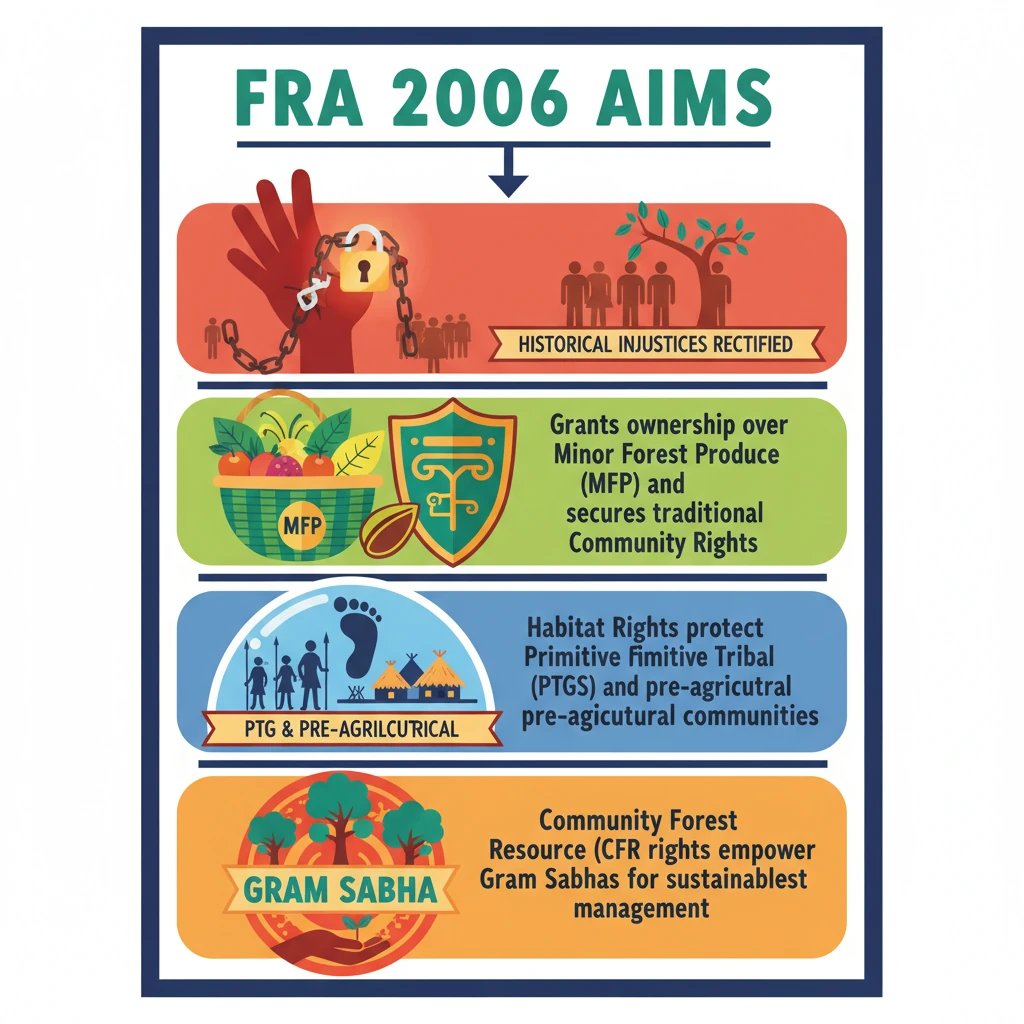
- •FRA 2006 aims to rectify historical injustices against forest-dwelling communities.
- •It grants ownership over Minor Forest Produce (MFP) and secures traditional Community Rights.
- •Habitat Rights protect Primitive Tribal Groups (PTGs) and pre-agricultural communities.
- •Community Forest Resource (CFR) rights empower Gram Sabhas for sustainable forest management.
- •Gram Sabha approval is mandatory for forest land diversion for public projects.
- •The Act promotes community-led conservation and decentralized governance.
🧠 Memory Techniques
98% Verified Content
📚 Reference Sources
•The Scheduled Tribes and Other Traditional Forest Dwellers (Recognition of Forest Rights) Act, 2006
•Ministry of Tribal Affairs, Government of India reports and guidelines on FRA implementation