Biofilms: Formation, Significance, and Role in Infections - Environment And Ecology | UPSC Learning
Topics
0 topics • 0 completed
🔍
No topics match your search
Biofilms: Formation, Significance, and Role in Infections
Medium⏱️ 8 min read
environment and ecology
📖 Introduction
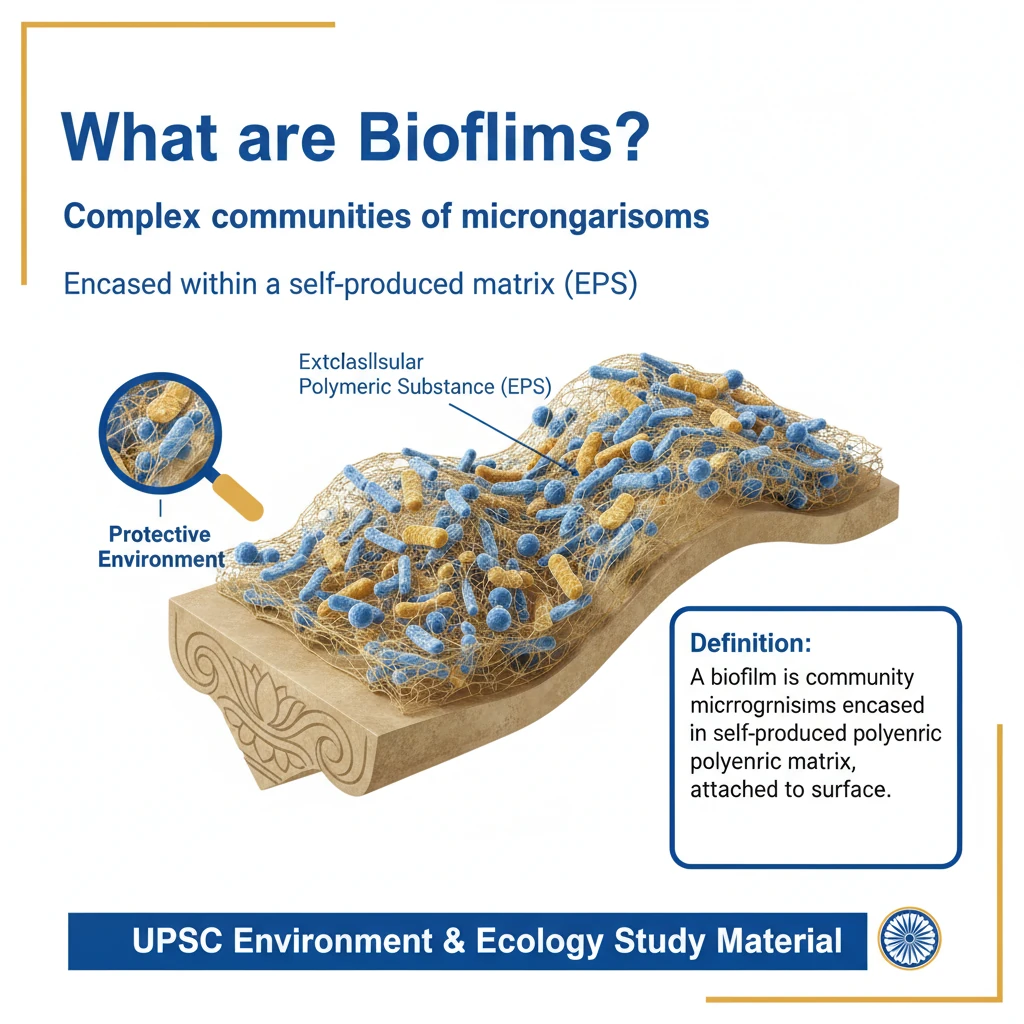
<h4>What are Biofilms?</h4><p><strong>Biofilms</strong> are complex communities of microorganisms, primarily bacteria, that adhere to surfaces. They are encased within a self-produced matrix, often referred to as the <strong>Extracellular Polymeric Substance (EPS)</strong>.</p><p>This unique structure provides a protective environment for the bacterial cells within, allowing them to thrive in various conditions.</p><div class='info-box'><p><strong>Definition:</strong> A <strong>biofilm</strong> is a structured consortium of microbial cells encased in a self-produced polymeric matrix and adherent to a surface.</p></div><h4>Structure of Biofilms</h4><p>The architecture of a biofilm is highly organized, comprising bacterial cells and the <strong>EPS matrix</strong>. The EPS is a complex mixture of polysaccharides, proteins, lipids, and nucleic acids.</p><p>This matrix acts as a scaffold, holding the cells together and mediating their attachment to surfaces. It also facilitates communication among the bacterial cells.</p><div class='key-point-box'><p><strong>Key Components:</strong></p><ul><li><strong>Microbial Cells:</strong> Predominantly bacteria, but can include fungi, algae, and protozoa.</li><li><strong>Extracellular Polymeric Substance (EPS):</strong> The self-produced matrix providing structural integrity and protection.</li></ul></div><h4>Formation Process</h4><p>Biofilm formation is a multi-step process, beginning with the initial attachment of planktonic (free-floating) cells to a surface. This is followed by irreversible attachment and the production of EPS.</p><p>The cells then proliferate and differentiate within the matrix, leading to the maturation of the biofilm. Finally, some cells may disperse from the biofilm to colonize new surfaces.</p><h4>Protective Mechanisms of Biofilms</h4><p>One of the most critical aspects of biofilms is their ability to shield bacteria from external threats. The EPS matrix acts as a physical barrier, preventing harmful substances from reaching the cells.</p><p>This protection makes biofilm-dwelling bacteria significantly more resistant to antibiotics and host immune responses compared to their planktonic counterparts.</p><div class='exam-tip-box'><p><strong>UPSC Insight:</strong> Understanding the protective mechanisms of <strong>biofilms</strong> is crucial for topics related to <strong>antibiotic resistance</strong> and <strong>public health challenges</strong> in microbiology and environmental science. Questions may focus on their role in persistent infections.</p></div><h4>Involvement in Bacterial Infections</h4><p>Biofilms are implicated in nearly all chronic and recurrent bacterial infections in humans. Their resistance to treatment makes these infections particularly difficult to eradicate.</p><p>Examples include infections on medical implants, chronic wound infections, and dental plaque, which is a common biofilm.</p>
💡 Key Takeaways
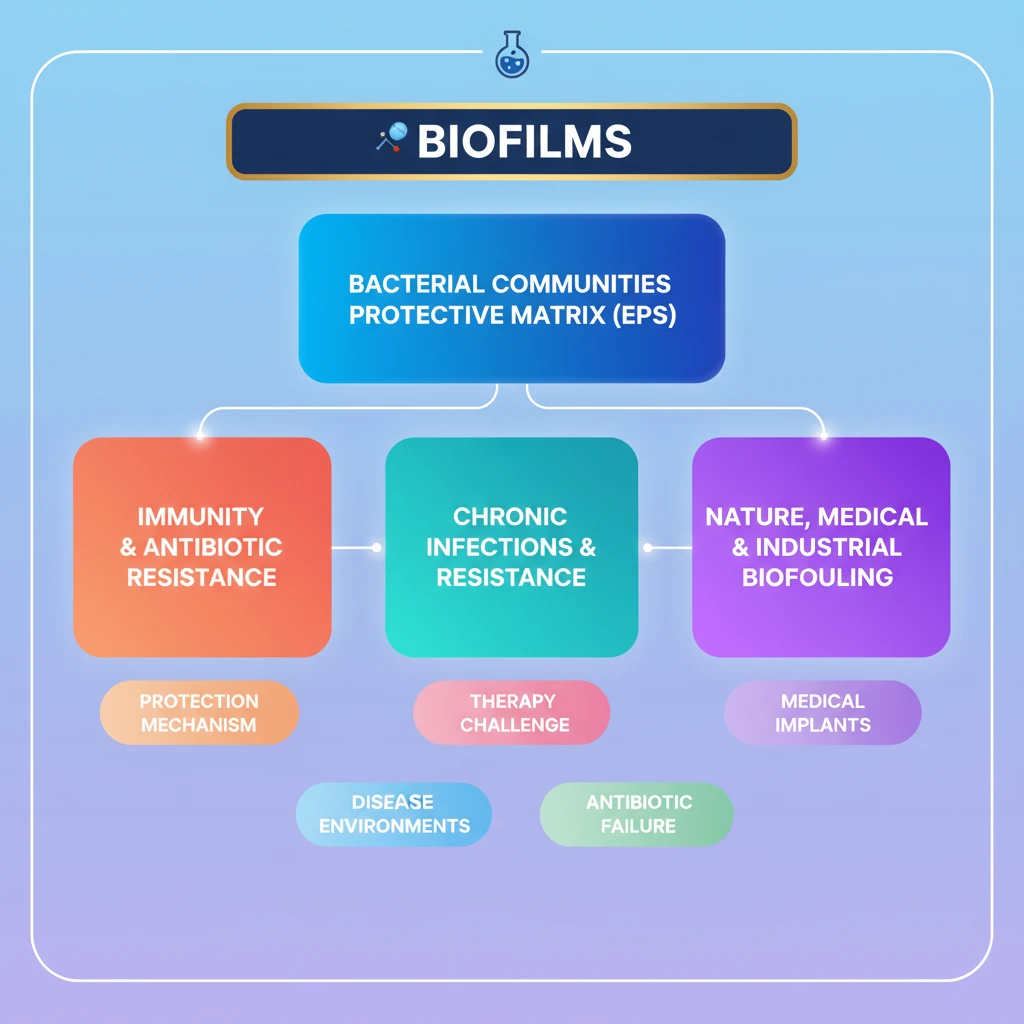
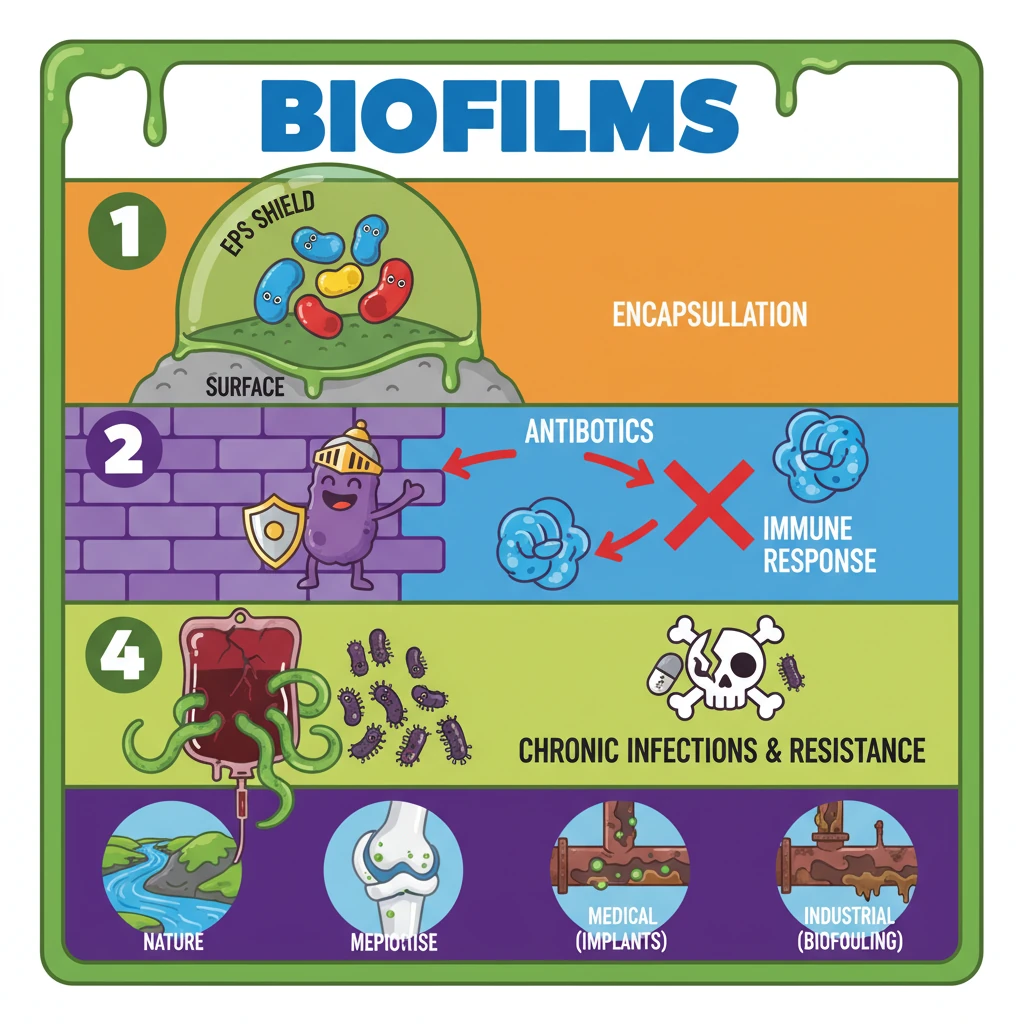
- •Biofilms are bacterial communities encased in a self-produced protective matrix (EPS) on surfaces.
- •They offer significant protection to bacteria from immune responses and antibiotics.
- •Biofilms are a major cause of chronic bacterial infections and contribute to antibiotic resistance.
- •They are prevalent in nature, medical settings (implants), and industrial systems (biofouling).
- •Understanding biofilms is crucial for public health, environmental management, and industrial sustainability.
🧠 Memory Techniques
98% Verified Content
📚 Reference Sources
•Costerton, J. W., Stewart, P. S., & Greenberg, E. P. (1999). Bacterial biofilms: a common cause of persistent infections. Science, 284(5418), 1318-1322.
•Donlan, R. M. (2001). Biofilm formation: a clinical perspective. Clinical Infectious Diseases, 33(8), 1387-1392.
•Flemming, H. C., & Wingender, J. (2010). The biofilm matrix. Nature Reviews Microbiology, 8(9), 623-633.