OECMs vs. PAs: Key Differences for Environment & Ecology - Environment And Ecology | UPSC Learning
Topics
0 topics • 0 completed
🔍
No topics match your search
OECMs vs. PAs: Key Differences for Environment & Ecology
Medium⏱️ 8 min read
environment and ecology
📖 Introduction
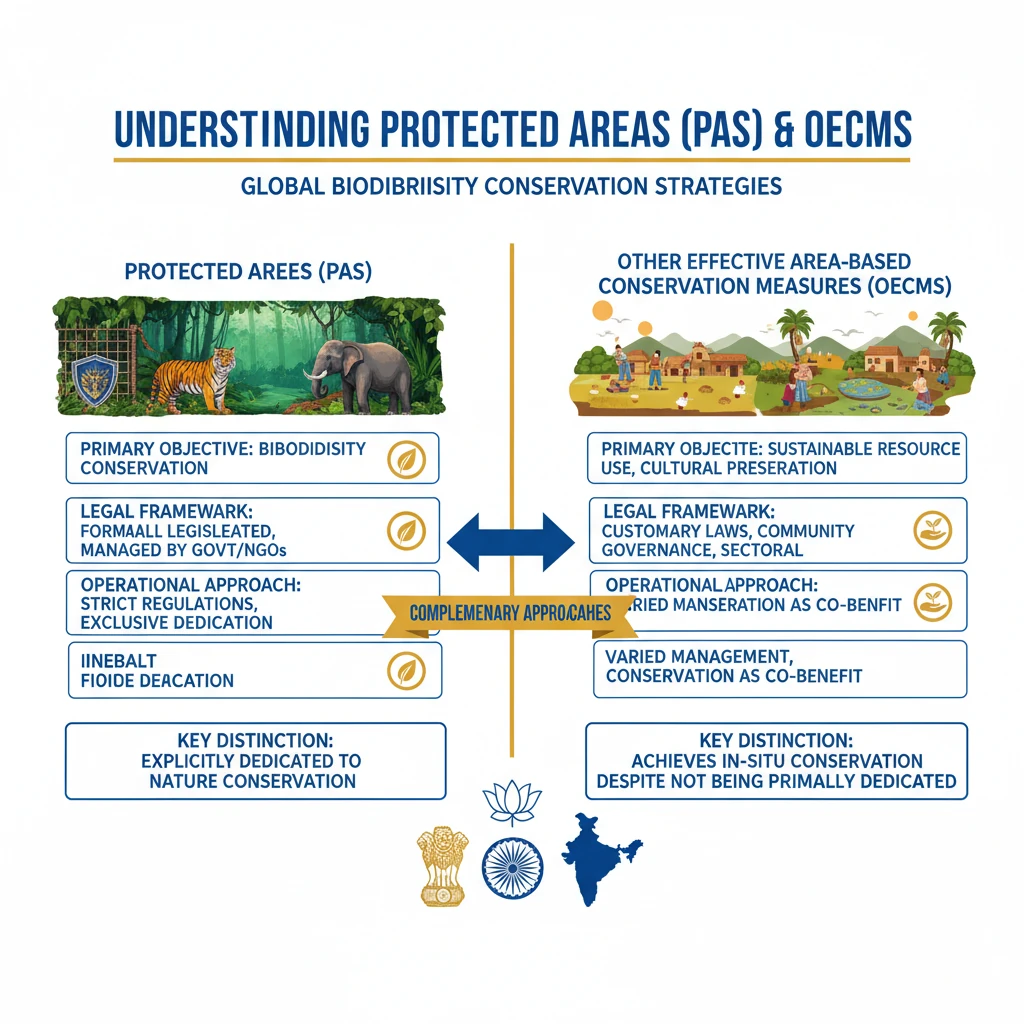
<h4>Understanding Protected Areas (PAs) and OECMs</h4><p>The distinction between <strong>Protected Areas (PAs)</strong> and <strong>Other Effective Area-based Conservation Measures (OECMs)</strong> is crucial for understanding global biodiversity conservation strategies. While both aim to safeguard nature, their primary objectives, legal frameworks, and operational approaches differ significantly.</p><div class='key-point-box'><p><strong>Key Distinction:</strong> PAs are explicitly dedicated to conservation, whereas OECMs achieve conservation outcomes as a secondary or incidental result of other management practices.</p></div><h4>Core Differences: A Comparative Overview</h4><p>The table below outlines the fundamental differences between <strong>Protected Areas</strong> and <strong>Other Effective Area-based Conservation Measures</strong> across various aspects:</p><table class='info-table'><tr><th>Aspect</th><th>Protected Areas (PAs)</th><th>Other Effective Area-based Conservation Measures (OECMs)</th></tr><tr><td><strong>Definition</strong></td><td>Area dedicated to <strong>long-term conservation</strong> of nature, with biodiversity protection as a primary goal.</td><td>Site conserving biodiversity, but not necessarily as the <strong>primary goal</strong>. Conservation is often a co-benefit.</td></tr><tr><td><strong>Primary Objective</strong></td><td>Focus on <strong>biodiversity</strong>, <strong>ecosystem services</strong>, and <strong>cultural values</strong>. Conservation is the explicit and main purpose.</td><td>Biodiversity conservation is a <strong>secondary</strong> or <strong>incidental outcome</strong> of other management activities.</td></tr><tr><td><strong>Legal Recognition</strong></td><td>Formally recognized and <strong>legally protected</strong> under national or international frameworks.</td><td>Voluntary, may <strong>lack formal protection</strong> under specific conservation laws. Recognition often comes from other sectors or communities.</td></tr><tr><td><strong>Role in Conservation Networks</strong></td><td>Form the <strong>core</strong> of conservation networks, vital for long-term, direct protection of ecosystems.</td><td><strong>Complements PAs</strong>, enhancing ecological representation and connectivity across broader landscapes.</td></tr><tr><td><strong>Conservation Outcome</strong></td><td>Characterized by <strong>strict regulations</strong> specifically for biodiversity protection and management.</td><td>May support biodiversity, but their management is <strong>not solely focused on conservation</strong>; it's a positive externality.</td></tr><tr><td><strong>Complementary Role</strong></td><td>Central to achieving global conservation targets, such as the <strong>30% by 2030</strong> goal (often referred to as 30x30).</td><td>Enhances <strong>ecological representation</strong> and <strong>connectivity</strong>, contributing significantly to overall conservation efforts beyond traditional PAs.</td></tr></table><h4>Protected Areas Explained</h4><p><strong>Protected Areas</strong> are geographically defined spaces that are recognized, dedicated, and managed through legal or other effective means. Their explicit purpose is to achieve the <strong>long-term conservation of nature</strong> with associated ecosystem services and cultural values.</p><p>These areas often involve <strong>strict regulations</strong> to prevent human activities that could harm biodiversity. Examples include <strong>National Parks</strong>, <strong>Wildlife Sanctuaries</strong>, and <strong>Biosphere Reserves</strong>.</p><h4>Other Effective Area-based Conservation Measures (OECMs) Explained</h4><p><strong>OECMs</strong> are geographically defined areas, other than Protected Areas, which are governed and managed in ways that achieve positive and sustained <strong>long-term outcomes for the in-situ conservation of biodiversity</strong>. This conservation outcome occurs irrespective of their primary objectives.</p><p>The conservation of biodiversity in OECMs is often a co-benefit of activities like sustainable resource management, traditional land use, or military training areas. They represent a broader approach to conservation beyond strictly designated PAs.</p><div class='exam-tip-box'><p><strong>UPSC Insight:</strong> Understanding the nuanced differences between PAs and OECMs is crucial for questions on <strong>biodiversity conservation strategies</strong>, <strong>global targets (e.g., 30x30)</strong>, and <strong>inclusive conservation models</strong>. Focus on the <strong>'primary objective'</strong> and <strong>'legal recognition'</strong> aspects as key differentiators.</p></div>
💡 Key Takeaways
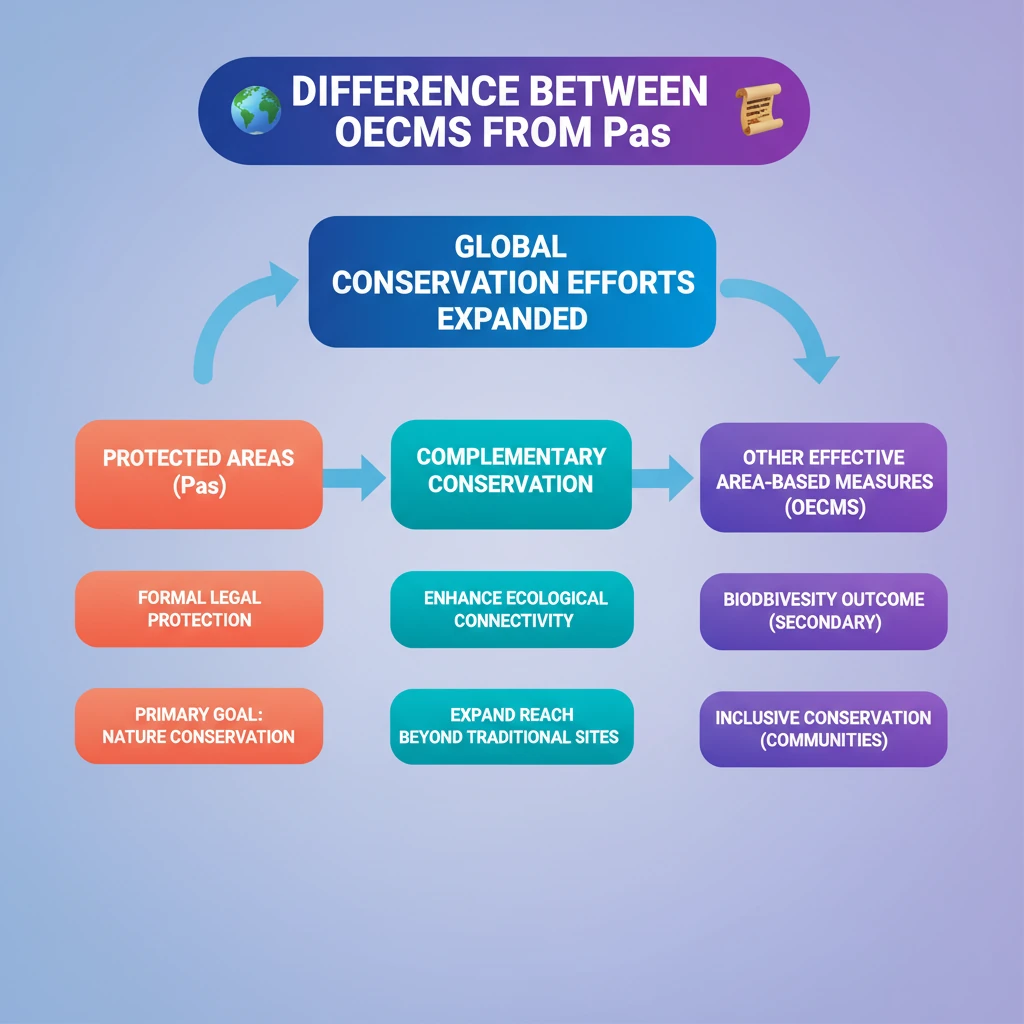
- •Protected Areas (PAs) are explicitly dedicated to long-term nature conservation with formal legal protection.
- •Other Effective Area-based Conservation Measures (OECMs) achieve biodiversity conservation as a secondary outcome of other management practices, often lacking formal conservation-specific legal recognition.
- •PAs form the core of conservation networks, while OECMs complement them by enhancing ecological connectivity and representation.
- •OECMs are crucial for achieving global targets like the 30x30 target, expanding the reach of conservation beyond traditional PAs.
- •The recognition of OECMs promotes inclusive conservation, acknowledging diverse stakeholders including local communities and indigenous peoples.
🧠 Memory Techniques

98% Verified Content
📚 Reference Sources
•IUCN Guidelines for OECMs
•Convention on Biological Diversity (CBD) documents (COP 14 and COP 15)
•Ministry of Environment, Forest and Climate Change (MoEFCC), Government of India reports