What are Some Key Facts About Ratanpani Tiger Reserve? - Environment And Ecology | UPSC Learning
Topics
0 topics • 0 completed
🔍
No topics match your search
What are Some Key Facts About Ratanpani Tiger Reserve?
Medium⏱️ 8 min read
environment and ecology
📖 Introduction
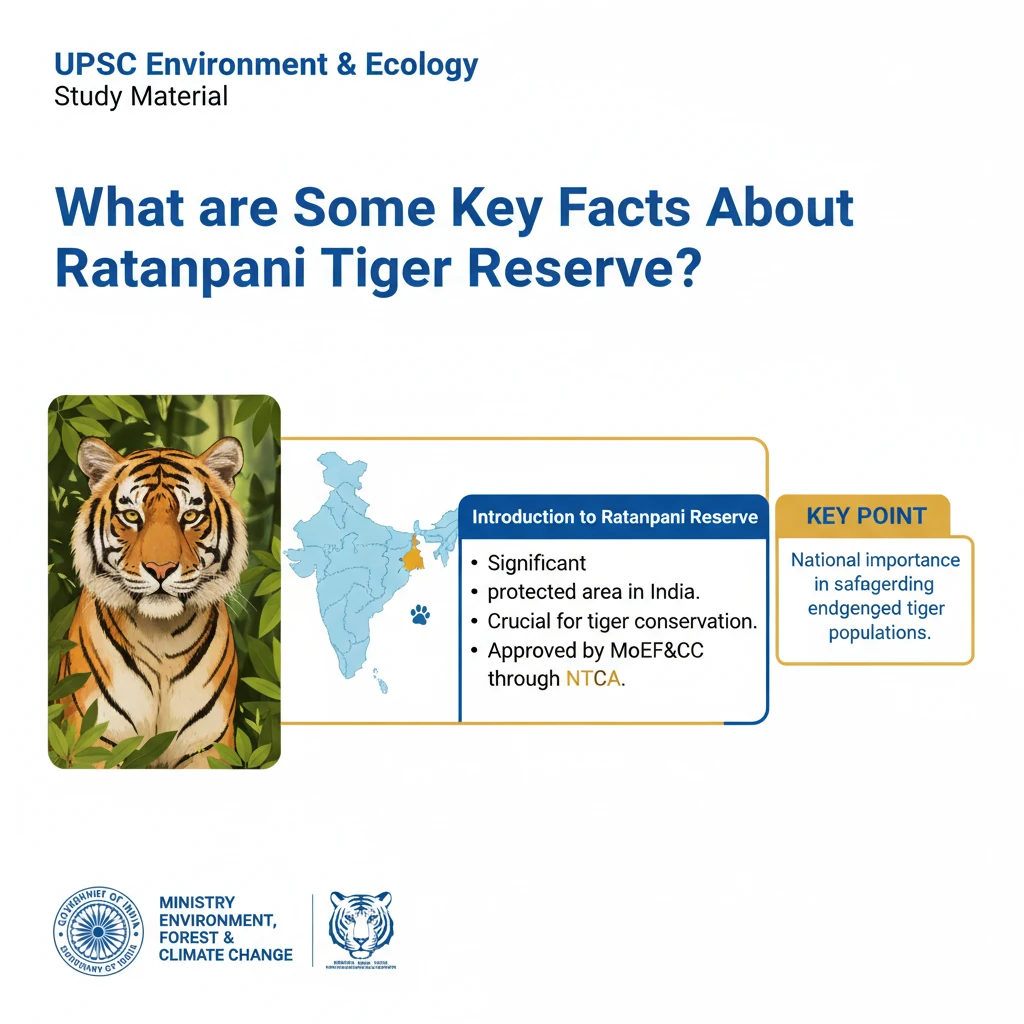
<h4>Introduction to Ratanpani Tiger Reserve</h4><p>The <strong>Ratanpani Tiger Reserve</strong> is a significant protected area in India, crucial for tiger conservation. Its establishment was officially approved by the <strong>Ministry of Environment, Forest, and Climate Change (MoEF&CC)</strong> through the <strong>National Tiger Conservation Authority (NTCA)</strong>.</p><div class='key-point-box'><p>This approval underscores its national importance in safeguarding the endangered tiger population and its habitat.</p></div><h4>Geographical Location and Significance</h4><p>The reserve is strategically located near the historic <strong>Vindhya hills</strong>, a prominent mountain range in central India. Its geographical position contributes to its rich biodiversity and ecological importance.</p><p>Notably, the sanctuary within the reserve encompasses the renowned <strong>Bhimbetka Rock Shelters</strong>, a designated <strong>UNESCO World Heritage Site</strong>. This integration highlights the reserve's dual significance for both natural and cultural heritage.</p><h4>Area and Zoning</h4><p>The <strong>Ratanpani Tiger Reserve</strong> spans a substantial total area of <strong>1,271.4 square kilometers</strong>. This vast expanse is meticulously divided into distinct zones to ensure effective conservation and management.</p><div class='info-box'><p>The reserve comprises a <strong>core area</strong> of <strong>763.8 square kilometers</strong>, dedicated to strict conservation, and a <strong>buffer area</strong> of <strong>507.6 square kilometers</strong>, which allows for some regulated human activity and serves as a protective zone.</p></div><h4>Flora: Dominant Vegetation</h4><p>The vegetation within <strong>Ratanpani Tiger Reserve</strong> is characterized by a mix of <strong>dry and moist deciduous forests</strong>. This diverse forest type supports a wide array of plant species.</p><ul><li><strong>Teak (<em>Tectona grandis</em>)</strong> is the most dominant tree species, covering approximately <strong>55%</strong> of the total area.</li><li>The presence of extensive <strong>bamboo</strong> patches further enriches the forest ecosystem.</li><li><strong>Evergreen Saja forests</strong> also contribute to the reserve's green cover, enhancing its scenic beauty and ecological value, which in turn boosts its appeal for tourism.</li></ul><h4>Fauna: Rich Biodiversity</h4><p>The reserve is a vibrant hub of wildlife, boasting a remarkable diversity of animal species. It provides a critical habitat for numerous mammals, reptiles, fish, and amphibians.</p><div class='info-box'><ul><li>Home to more than <strong>35 species of mammals</strong>.</li><li>Supports <strong>33 species of reptiles</strong>.</li><li>Contains <strong>14 species of fishes</strong>.</li><li>Houses <strong>10 species of amphibians</strong>.</li><li>Crucially, the reserve is home to over <strong>40 Tigers</strong>, making it a vital area for tiger population growth and conservation efforts.</li></ul></div><div class='exam-tip-box'><p><strong>UPSC Insight:</strong> Questions on Tiger Reserves often focus on their <strong>location, unique features (like UNESCO sites), dominant flora/fauna, and conservation significance</strong>. Remember the core and buffer area concept, and the role of bodies like <strong>NTCA</strong> and <strong>MoEF&CC</strong>.</p></div>
💡 Key Takeaways
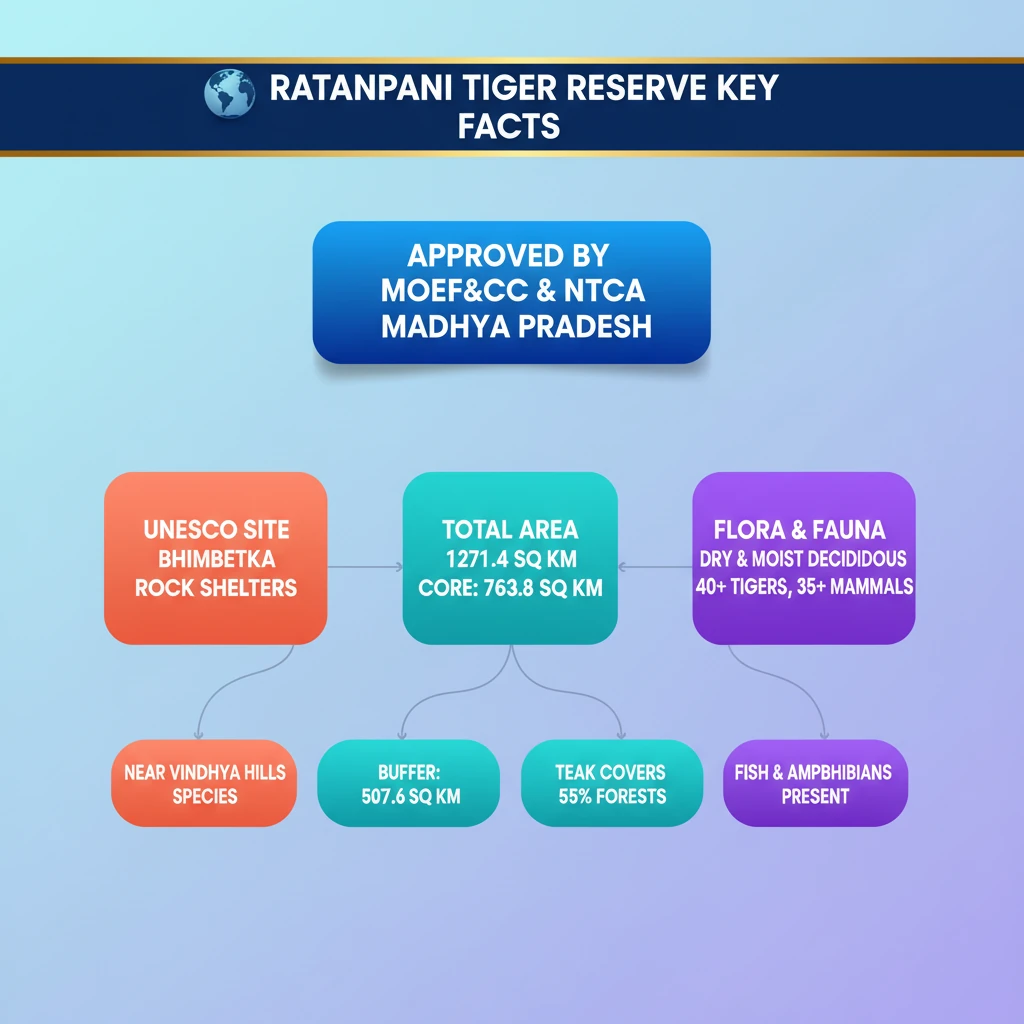
- •Ratanpani Tiger Reserve, approved by MoEF&CC and NTCA, is in Madhya Pradesh near the Vindhya hills.
- •It encompasses the Bhimbetka Rock Shelters, a UNESCO World Heritage Site.
- •Total area is 1,271.4 sq km, with a 763.8 sq km core and 507.6 sq km buffer.
- •Flora is dominated by dry and moist deciduous forests, with teak covering 55% of the area.
- •Rich fauna includes over 40 tigers, 35+ mammal species, 33 reptile species, and various fish and amphibians.
🧠 Memory Techniques

98% Verified Content
📚 Reference Sources
•Ministry of Environment, Forest and Climate Change (MoEF&CC) official reports
•National Tiger Conservation Authority (NTCA) website
•UNESCO World Heritage Centre: Bhimbetka Rock Shelters information