Saltwater Crocodiles: Habitat, Diet, & Conservation Status - Environment And Ecology | UPSC Learning
Topics
0 topics • 0 completed
🔍
No topics match your search
Saltwater Crocodiles: Habitat, Diet, & Conservation Status
Medium⏱️ 8 min read
environment and ecology
📖 Introduction
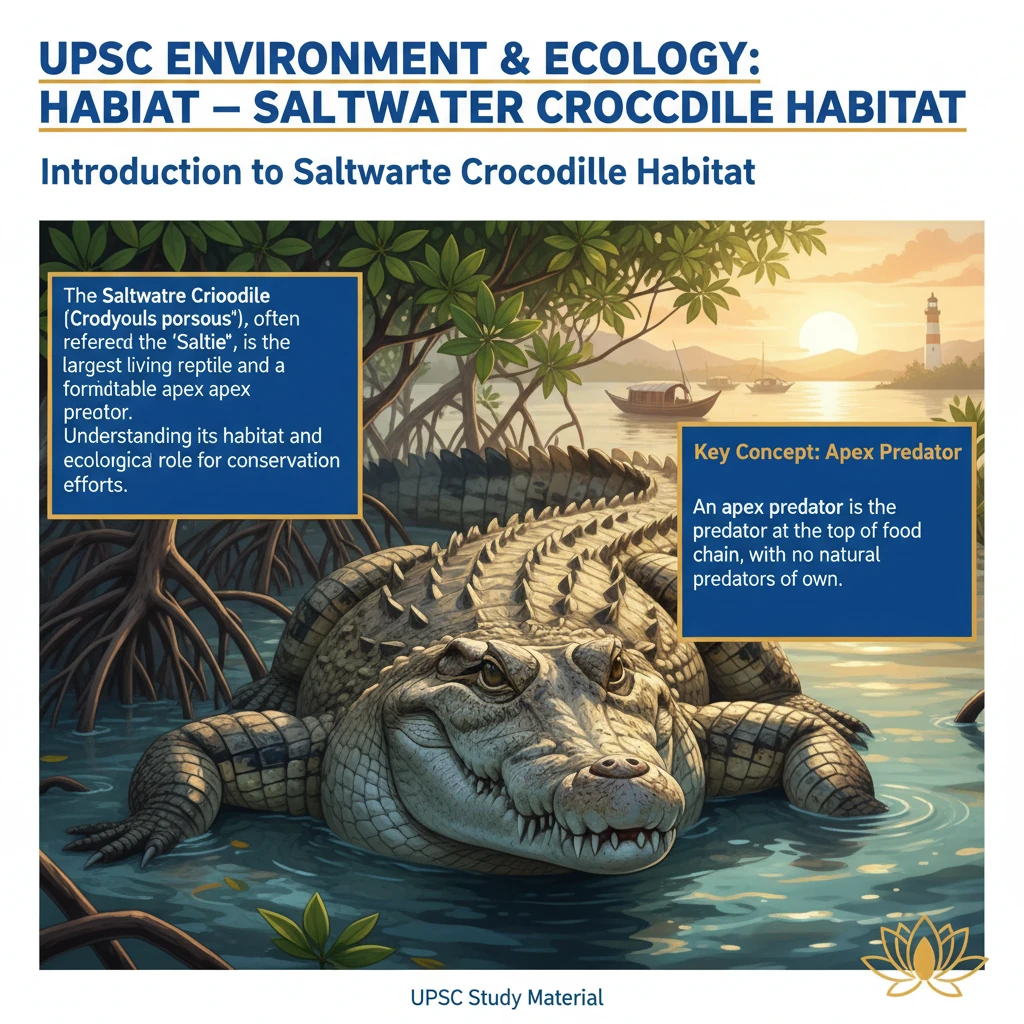
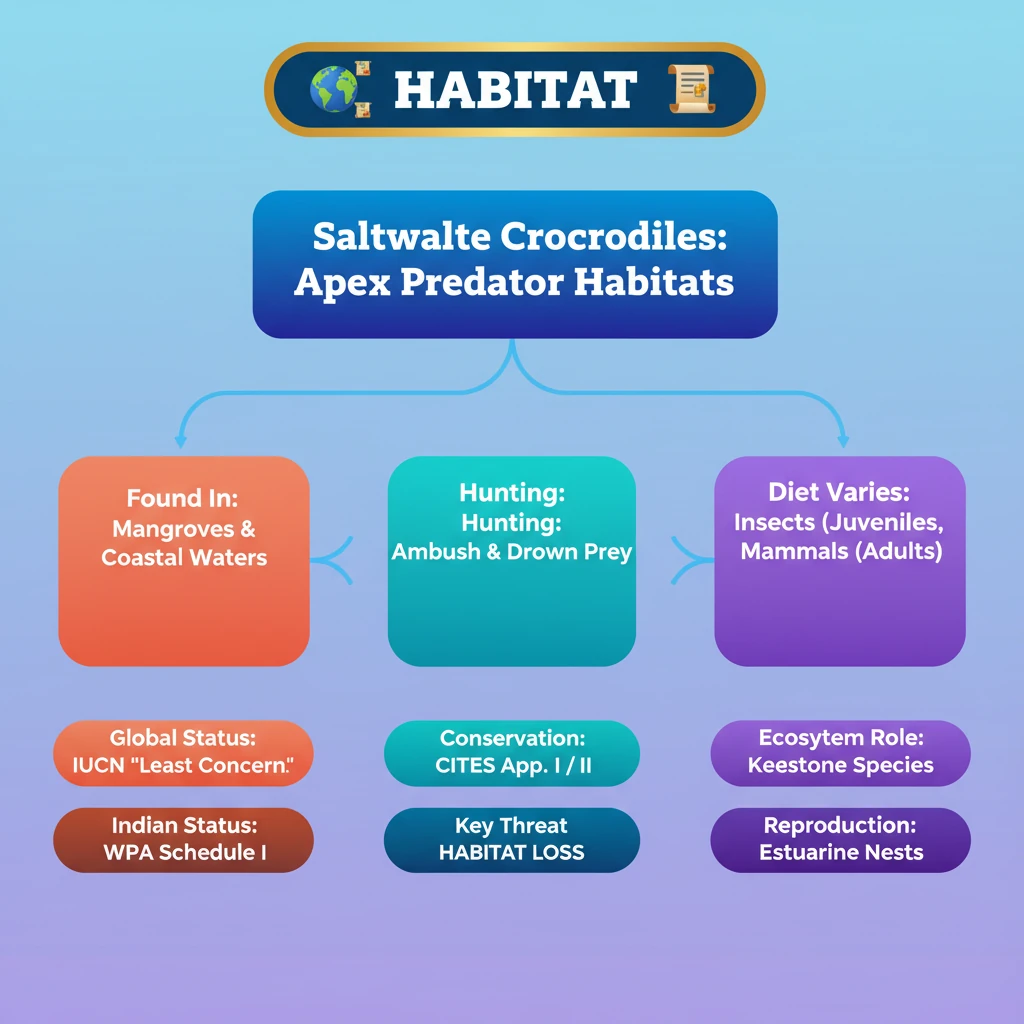
<h4>Introduction to Saltwater Crocodile Habitat</h4><p>The <strong>Saltwater Crocodile</strong> (<em>Crocodylus porosus</em>), often referred to as the "Saltie," is the largest living reptile and a formidable apex predator. Understanding its habitat and ecological role is crucial for conservation efforts.</p><div class="key-point-box"><p><strong>Key Concept: Apex Predator</strong><br>An <strong>apex predator</strong> is a predator at the top of a food chain, with no natural predators of its own. Saltwater crocodiles play a vital role in maintaining ecosystem balance.</p></div><h4>Primary Habitat Zones</h4><p>Saltwater crocodiles are highly adaptable and thrive in diverse aquatic environments. Their preferred habitats are typically found in tropical and subtropical regions.</p><div class="info-box"><p><strong>Specific Habitats:</strong></p><ul><li><strong>Mangrove Forests:</strong> These unique coastal ecosystems provide ideal shelter, breeding grounds, and abundant prey.</li><li><strong>Coastal Habitats:</strong> Estuaries, deltas, lagoons, and tidal rivers are also crucial for their survival.</li><li><strong>Freshwater Systems:</strong> While primarily marine, they can venture far upstream into rivers and freshwater swamps.</li></ul></div><h4>Diet and Prey Diversity</h4><p>The diet of the <strong>Saltwater Crocodile</strong> varies significantly with age and size, reflecting its opportunistic predatory nature.</p><div class="info-box"><p><strong>Prey Spectrum:</strong></p><ul><li><strong>Juveniles:</strong> Primarily feed on smaller organisms such as <strong>insects</strong>, <strong>amphibians</strong>, small <strong>reptiles</strong>, <strong>crustaceans</strong>, and small <strong>fish</strong>.</li><li><strong>Adults:</strong> Possess a much broader diet, including <strong>crabs</strong>, <strong>turtles</strong>, <strong>snakes</strong>, various <strong>birds</strong>, and large mammals like <strong>buffalo</strong>, <strong>wild boar</strong>, and <strong>monkeys</strong>.</li></ul></div><h4>Hunting Strategy and Techniques</h4><p>The <strong>Saltwater Crocodile</strong> employs a highly effective ambush hunting strategy, relying on stealth and powerful attacks.</p><ol><li>They typically <strong>hide in the water</strong>, submerging most of their body and exposing only their <strong>eyes and nose</strong> for observation.</li><li>Upon identifying suitable prey, they execute a sudden, explosive <strong>lunge</strong> from the water.</li><li>Prey is often killed with a single, powerful <strong>snap of the jaws</strong>, delivering immense crushing force.</li><li>The crocodile then <strong> drags the prey underwater</strong>, making it easier to consume and preventing escape.</li></ol><h4>Conservation Status and Protection</h4><p>The conservation status of the <strong>Saltwater Crocodile</strong> is assessed by various international and national bodies, reflecting its importance and past threats.</p><div class="info-box"><p><strong>Conservation Designations:</strong></p><ul><li><strong>IUCN Red List:</strong> Classified as <strong>Least Concern</strong>. This indicates a relatively healthy global population, though regional threats persist.</li><li><strong>Wildlife Protection Act (WPA), 1972 (India):</strong> Listed under <strong>Schedule I</strong>. This grants it the highest level of legal protection in India, prohibiting hunting and trade.</li><li><strong>CITES (Convention on International Trade in Endangered Species of Wild Fauna and Flora):</strong> Listed in <strong>Appendix I or II</strong> depending on the population. Appendix I prohibits commercial international trade, while Appendix II allows regulated trade.</li></ul></div><div class="exam-tip-box"><p><strong>UPSC Insight:</strong> Always note the specific schedules/appendices for critically important species. Questions often test knowledge of these classifications and their implications for conservation policy.</p></div>
💡 Key Takeaways
- •Saltwater crocodiles are apex predators found in mangrove and coastal habitats.
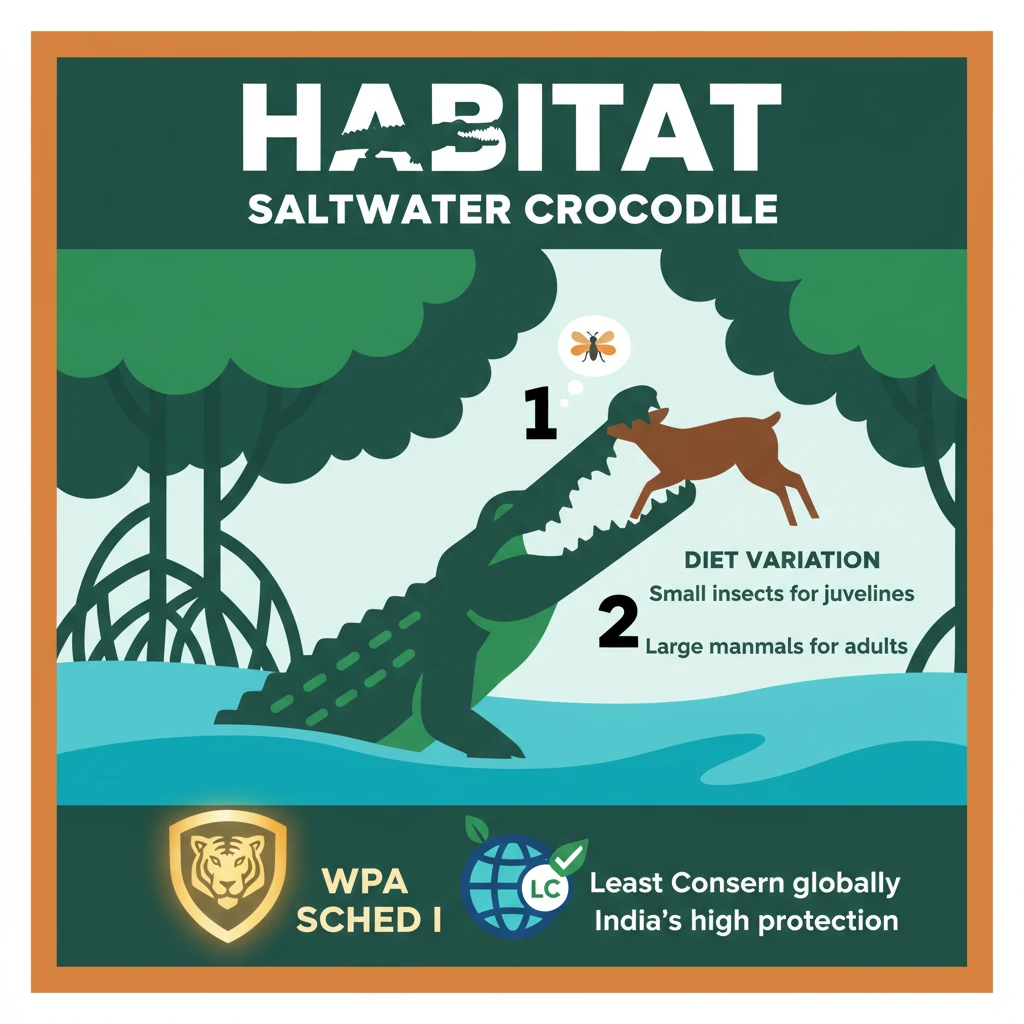
- •Their diet varies significantly from small insects for juveniles to large mammals for adults.
- •They employ an ambush hunting strategy, often dragging prey underwater.
- •Globally, they are IUCN 'Least Concern,' but in India, they are WPA Schedule I, indicating high protection.
- •CITES lists them in Appendix I or II, regulating international trade.
🧠 Memory Techniques
95% Verified Content
📚 Reference Sources
•IUCN Red List of Threatened Species (Crocodylus porosus entry)
•Wildlife Protection Act, 1972 (India)
•Convention on International Trade in Endangered Species of Wild Fauna and Flora (CITES appendices)
•General ecological principles for predator-prey dynamics and habitat definitions