Mass Nesting of Olive Ridley Turtles - Environment And Ecology | UPSC Learning
Topics
0 topics • 0 completed
🔍
No topics match your search
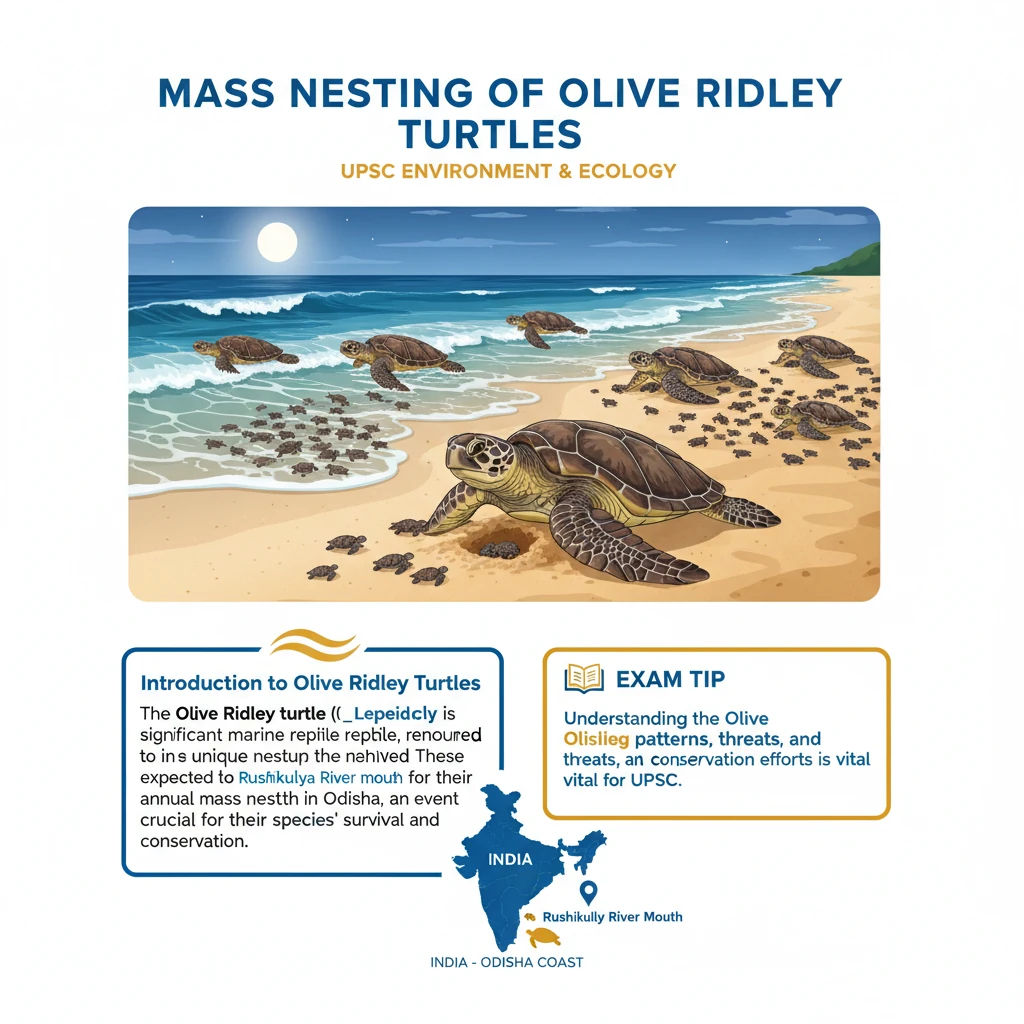
Mass Nesting of Olive Ridley Turtles
Medium⏱️ 8 min read
environment and ecology
📖 Introduction
<h4>Introduction to Olive Ridley Turtles</h4><p>The <strong>Olive Ridley turtle</strong> (<strong><em>Lepidochelys olivacea</em></strong>) is a globally significant marine reptile, renowned for its unique mass nesting behavior. These turtles are expected to return to the <strong>Rushikulya River mouth</strong> in <strong>Odisha</strong> for their annual mass nesting, an event crucial for their species' survival and conservation.</p><div class='exam-tip-box'><p>Understanding the <strong>Olive Ridley turtle's lifecycle</strong> and <strong>conservation status</strong> is vital for <strong>UPSC Prelims</strong> (<strong>Environment & Ecology</strong>) and <strong>Mains GS-III</strong> (<strong>Biodiversity & Conservation</strong>).</p></div><h4>Scientific Classification and Appearance</h4><p>The <strong>Olive Ridley turtle</strong> belongs to the class <strong>Reptilia</strong> and the family <strong>Cheloniidae</strong>. Its scientific name is <strong><em>Lepidochelys olivacea</em></strong>.</p><div class='info-box'><p><strong>Scientific Classification:</strong></p><ul><li><strong>Scientific Name:</strong> <strong><em>Lepidochelys olivacea</em></strong></li><li><strong>Class:</strong> <strong>Reptilia</strong></li><li><strong>Family:</strong> <strong>Cheloniidae</strong></li></ul></div><p>These turtles are characterized by their distinctive appearance. They typically have an <strong>olive or grayish-green coloration</strong> and a <strong>heart-shaped carapace</strong> (top shell). They closely resemble <strong>Kemp's ridleys</strong> (primarily found in the <strong>Gulf of Mexico</strong>) and are the <strong>smallest sea turtles</strong> globally, though their size and shape can vary by region, with the largest specimens found in <strong>West Africa</strong>.</p><h4>Habitat and Distribution</h4><p><strong>Olive Ridley turtles</strong> are widely distributed across the <strong>tropical regions</strong> of the <strong>Pacific</strong>, <strong>Indian</strong>, and <strong>Atlantic Oceans</strong>. They inhabit both <strong>pelagic</strong> (open ocean) and <strong>coastal waters</strong>, demonstrating adaptability to different marine environments.</p><div class='info-box'><p><strong>Major Nesting Sites in India:</strong></p><ul><li><strong>Rushikulya River mouth</strong>, <strong>Odisha</strong></li><li><strong>Gahirmatha Marine Sanctuary</strong>, <strong>Odisha</strong></li><li><strong>Devi River mouth</strong>, <strong>Odisha</strong></li><li><strong>Andaman Islands</strong></li></ul></div><p><strong>Gahirmatha Marine Sanctuary</strong> holds particular importance as it is recognized as the <strong>largest known mass nesting rookery</strong> for <strong>Olive Ridley sea turtles</strong> in the world.</p><h4>Reproduction: The Arribada Phenomenon</h4><p>The <strong>Olive Ridley turtles</strong> are most famous for their unique mass nesting behavior, known as <strong>arribada</strong> (a Spanish term meaning “arrival”). During an arribada, thousands of female turtles emerge simultaneously to nest on specific beaches.</p><div class='key-point-box'><p><strong>Arribada:</strong> This term describes the synchronized mass nesting event where thousands of female <strong>Olive Ridley turtles</strong> gather and lay eggs together on a single stretch of beach. This behavior is rare among sea turtle species.</p></div><p>Their migratory journey is extensive; from <strong>September</strong>, they travel approximately <strong>9,000 km</strong> from the <strong>Pacific</strong> to the <strong>Indian seas</strong>. After mating, the males typically retreat, while the females prepare for nesting, which occurs between <strong>December</strong> and <strong>March</strong>.</p><p>A female <strong>Olive Ridley</strong> can nest <strong>1-3 times per season</strong>, laying around <strong>100 eggs per clutch</strong>. A fascinating aspect of their reproduction is that the <strong>sex of the hatchlings</strong> is determined by the <strong>nest temperature</strong>, a phenomenon known as <strong>Temperature-Dependent Sex Determination (TSD)</strong>.</p><h4>Diet and Behavior</h4><p>Like all sea turtle species, except the herbivorous <strong>Green Turtle</strong>, the <strong>Olive Ridley</strong> is primarily a <strong>carnivore</strong>. Their diet consists of a variety of marine organisms, ensuring their role in the marine food web.</p><div class='info-box'><p><strong>Diet of Olive Ridley Turtles:</strong></p><ul><li><strong>Jellyfish</strong></li><li><strong>Snails</strong></li><li><strong>Crabs</strong></li><li><strong>Prawns</strong></li><li><strong>Algae</strong></li><li><strong>Small fish</strong></li></ul></div><p>They undertake significant <strong>long-distance migrations</strong> between their feeding grounds and nesting sites, highlighting the need for protection across vast marine territories.</p><h4>Conservation Status</h4><p>The <strong>Olive Ridley turtle</strong> is afforded high levels of protection both nationally and internationally due to its vulnerable status.</p><div class='info-box'><p><strong>Protection Status:</strong></p><ul><li><strong>Wildlife Protection Act, 1972:</strong> <strong>Schedule I</strong> (Highest protection)</li><li><strong>IUCN Red List:</strong> <strong>Vulnerable</strong></li><li><strong>CITES (Convention on International Trade in Endangered Species of Wild Fauna and Flora):</strong> <strong>Appendix I</strong> (Prohibits international commercial trade)</li></ul></div><div class='exam-tip-box'><p>Memorizing the <strong>conservation status</strong> (<strong>WPA, IUCN, CITES</strong>) for key species like the <strong>Olive Ridley</strong> is crucial for <strong>UPSC Prelims</strong>, as direct questions on these classifications are common.</p></div>
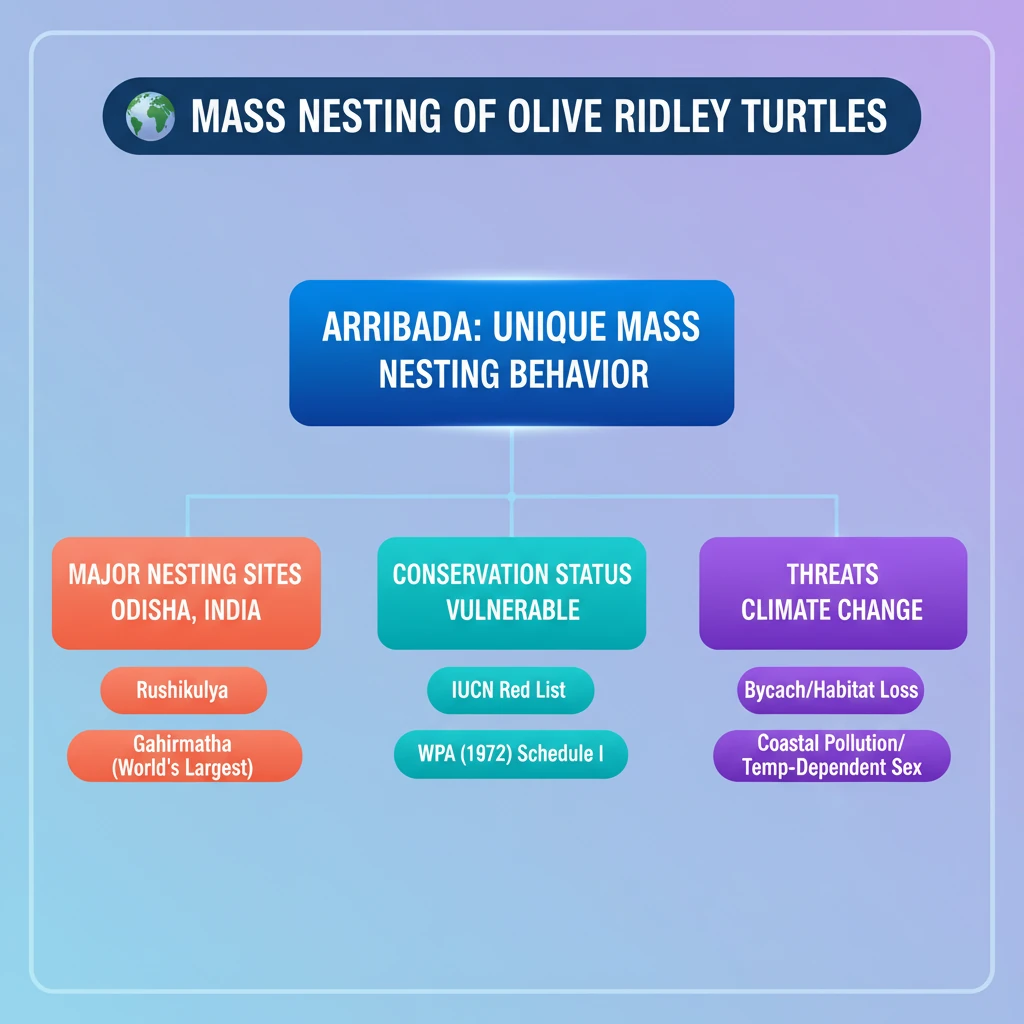
💡 Key Takeaways
- •<strong>Olive Ridley turtles</strong> are known for <strong>arribada</strong>, a unique mass nesting behavior.
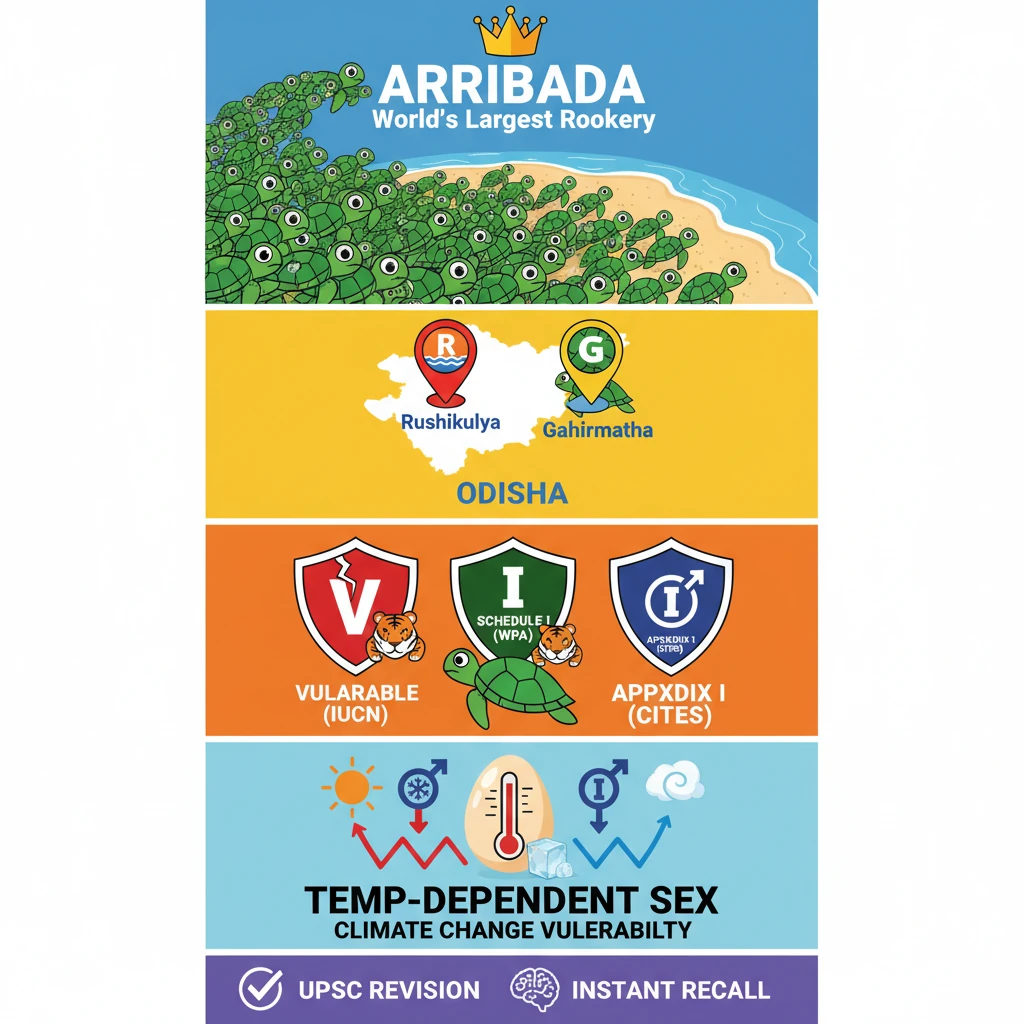
- •Major Indian nesting sites include <strong>Rushikulya</strong> and <strong>Gahirmatha</strong> (world's largest rookery) in <strong>Odisha</strong>.
- •They are classified as <strong>Vulnerable</strong> (IUCN), <strong>Schedule I</strong> (WPA, 1972), and <strong>Appendix I</strong> (CITES).
- •<strong>Sex determination</strong> in hatchlings is <strong>temperature-dependent</strong>, making them vulnerable to climate change.
- •Key threats include <strong>bycatch</strong>, <strong>habitat loss</strong>, and <strong>coastal pollution</strong>.
🧠 Memory Techniques
98% Verified Content
📚 Reference Sources
•Wildlife Protection Act, 1972 (Schedule I)
•IUCN Red List of Threatened Species (Vulnerable)
•CITES (Appendix I)
•General knowledge on Olive Ridley turtles and marine conservation