What are the Government Initiatives and Policies on Biofuels? - Environment And Ecology | UPSC Learning
Topics
0 topics • 0 completed
🔍
No topics match your search
What are the Government Initiatives and Policies on Biofuels?
Medium⏱️ 8 min read
environment and ecology
📖 Introduction
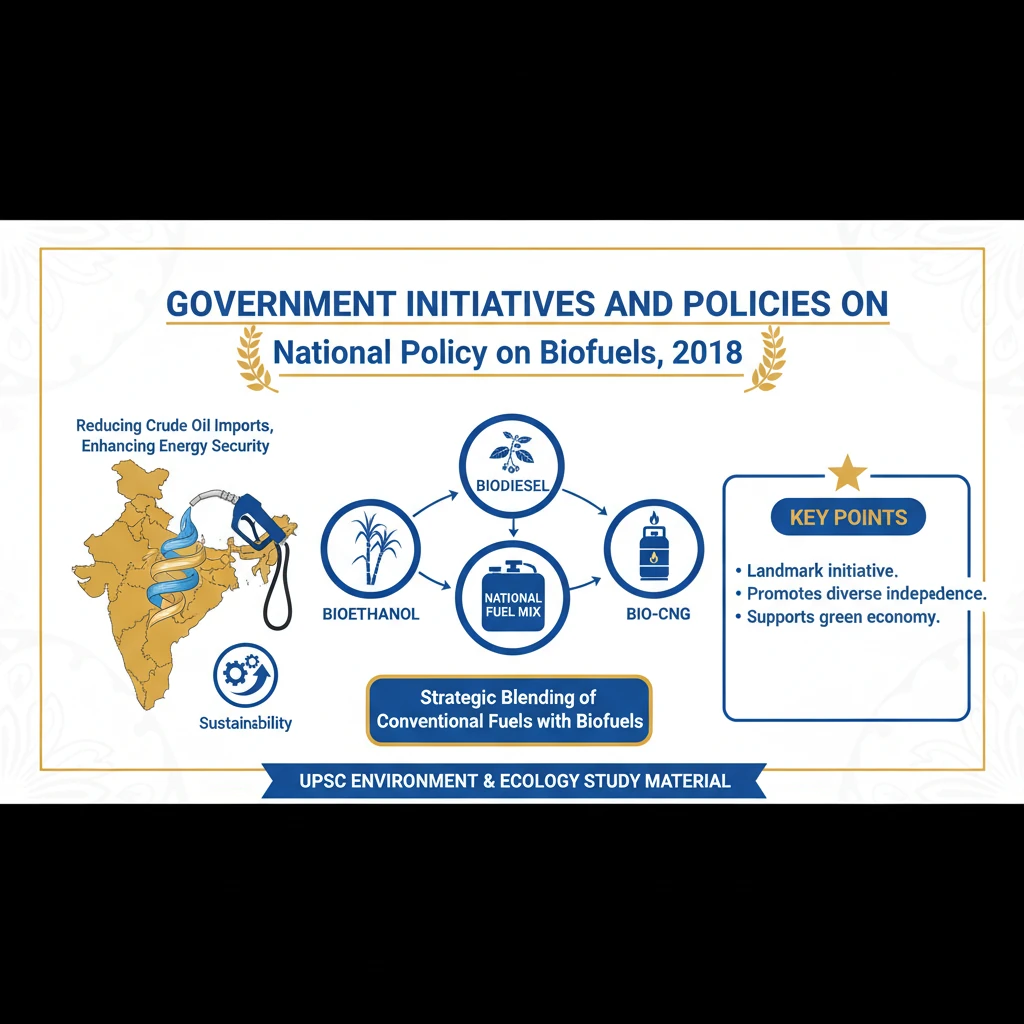
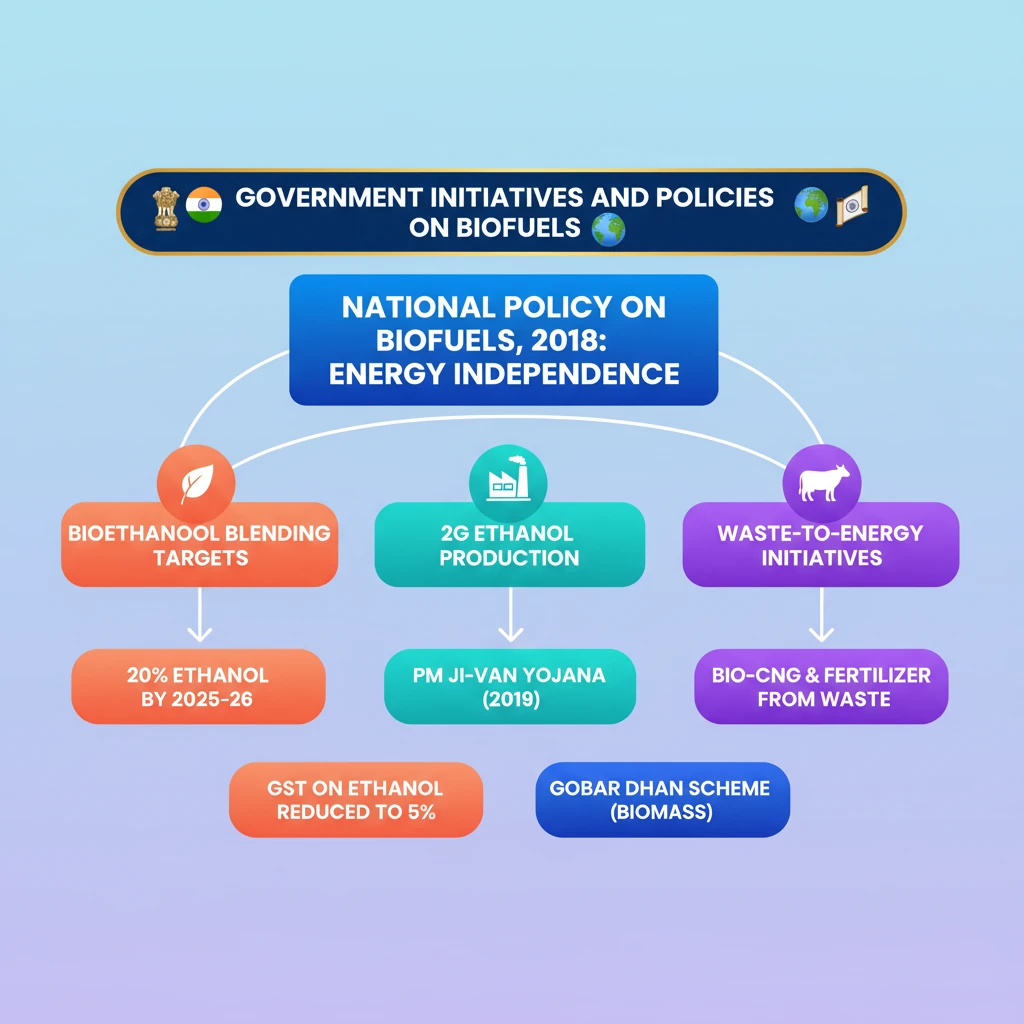
<h4>National Policy on Biofuel, 2018</h4><p>The <strong>National Policy on Biofuel, 2018</strong>, is a landmark initiative aimed at reducing India's reliance on crude oil imports. It strategically promotes the blending of conventional fuels with various biofuels.</p><p>This policy focuses on integrating <strong>bioethanol</strong>, <strong>biodiesel</strong>, and <strong>bio-CNG</strong> into the national fuel mix, thereby enhancing energy security and sustainability.</p><div class='key-point-box'><p><strong>Key Elements of the Policy:</strong></p><ul><li>Promotion of the <strong>Ethanol Blending Programme (EBP)</strong>.</li><li>Support for the production of <strong>second-generation ethanol</strong> from agricultural and forest residues.</li><li>Boosting local production of fuel additives under the <strong>“Make in India”</strong> initiative.</li><li>Emphasis on <strong>Research and Development (R&D)</strong> in feedstock for biofuels.</li></ul></div><div class='exam-tip-box'><p><strong>Important Amendment:</strong> In <strong>May 2022</strong>, the policy was amended to advance the <strong>20% ethanol blending target</strong> from <strong>2030</strong> to <strong>2025-26</strong>, highlighting the government's accelerated commitment.</p></div><h4>Reduced GST on Ethanol</h4><p>To further incentivize the use of ethanol for blending, the government significantly reduced the <strong>Goods and Services Tax (GST)</strong> rate on ethanol. This reduction applies specifically to ethanol used under the <strong>Ethanol Blended Petrol (EBP) Programme</strong>.</p><div class='info-box'><p>The <strong>GST rate</strong> on ethanol for blending was lowered from <strong>18% to 5%</strong>, making ethanol blending more economically viable for producers and distributors.</p></div><h4>Pradhan Mantri JI-VAN Yojana, 2019</h4><p>The <strong>Pradhan Mantri JI-VAN Yojana, 2019</strong> (JAI-VIGYAN, JAI-ANUSANDHAN) is a crucial scheme designed to bolster the production of <strong>Second Generation (2G) ethanol</strong>. It provides financial support for setting up commercial projects.</p><p>This scheme targets ethanol production from diverse <strong>cellulosic and lignocellulosic sources</strong>, including those derived from petrochemical routes.</p><div class='info-box'><p><strong>What is Lignocellulosic Biomass?</strong></p><p><strong>Lignocellulosic biomass</strong> refers to plant biomass composed primarily of <strong>cellulose</strong>, <strong>hemicellulose</strong>, and <strong>lignin</strong>. Examples include <strong>cereal straw</strong>, <strong>bagasse</strong>, <strong>forest residues</strong>, and purpose-grown energy crops like <strong>vegetative grasses</strong>.</p></div><div class='exam-tip-box'><p><strong>Scheme Extension:</strong> The government has approved an extension of the scheme's implementation timeline. It will now run until <strong>2028-29</strong>, indicating sustained focus on 2G ethanol production.</p></div><h4>GOBAR (Galvanizing Organic Bio-Agro Resources) DHAN Scheme, 2018</h4><p>The <strong>GOBAR DHAN Scheme, 2018</strong>, is an innovative initiative focused on sustainable waste management and resource generation in rural areas. It aims to convert organic waste into valuable resources.</p><p>The scheme primarily targets the management and conversion of <strong>cattle dung</strong> and other <strong>solid waste</strong> from farms into useful products such as <strong>compost</strong>, <strong>biogas</strong>, and <strong>bio-CNG</strong>.</p><div class='key-point-box'><p><strong>Dual Objectives:</strong> The <strong>GOBAR DHAN Scheme</strong> contributes to keeping villages clean by managing waste effectively and simultaneously enhances the income of rural households through value-added products.</p></div>
💡 Key Takeaways
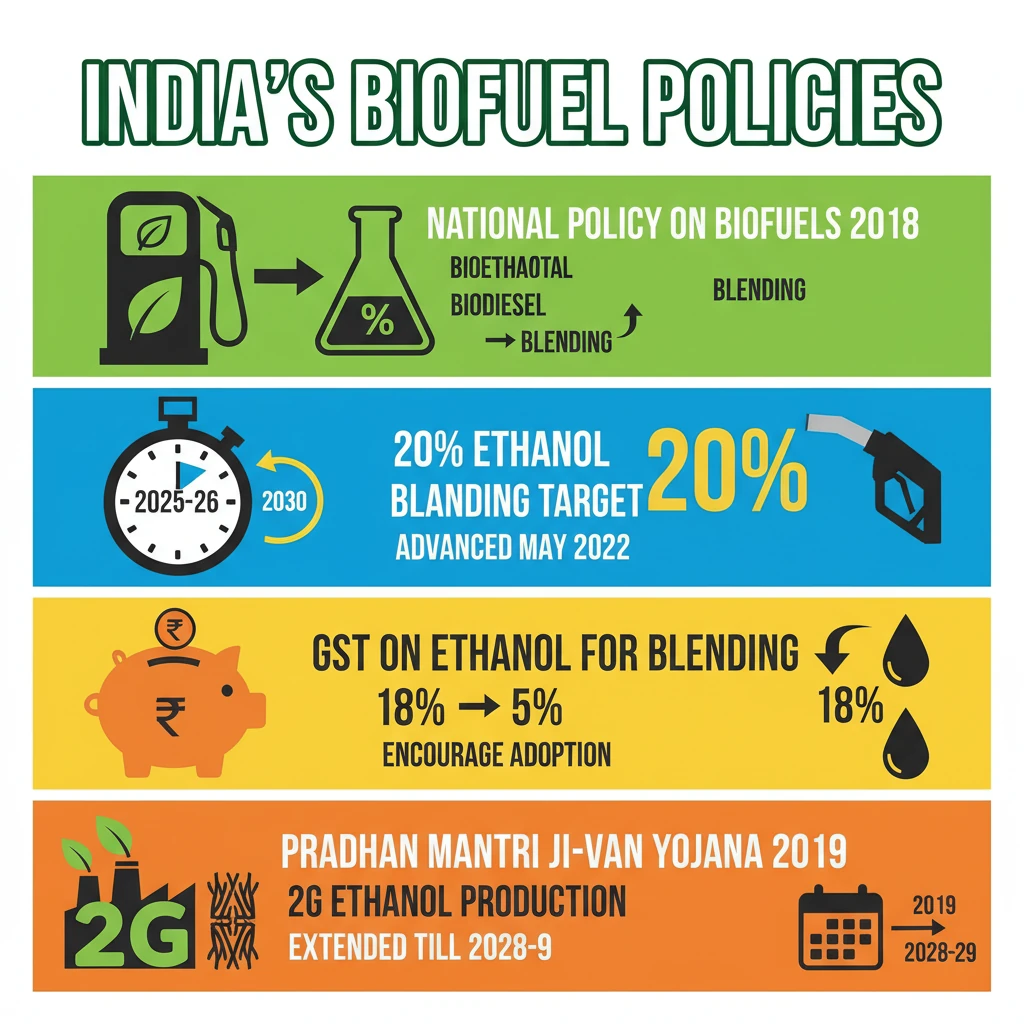
- •National Policy on Biofuel, 2018 aims to reduce import dependence via bioethanol, biodiesel, and bio-CNG blending.
- •The 20% ethanol blending target was advanced from 2030 to 2025-26 in May 2022.
- •GST on ethanol for blending was reduced from 18% to 5% to encourage adoption.
- •Pradhan Mantri JI-VAN Yojana, 2019 supports 2G ethanol production from lignocellulosic biomass, extended till 2028-29.
- •GOBAR DHAN Scheme, 2018 converts cattle dung and farm waste into compost, biogas, and bio-CNG, boosting rural income and cleanliness.
🧠 Memory Techniques
98% Verified Content