What Are Oysters? - Environment And Ecology | UPSC Learning
Topics
0 topics • 0 completed
🔍
No topics match your search
What Are Oysters?
Medium⏱️ 7 min read
environment and ecology
📖 Introduction
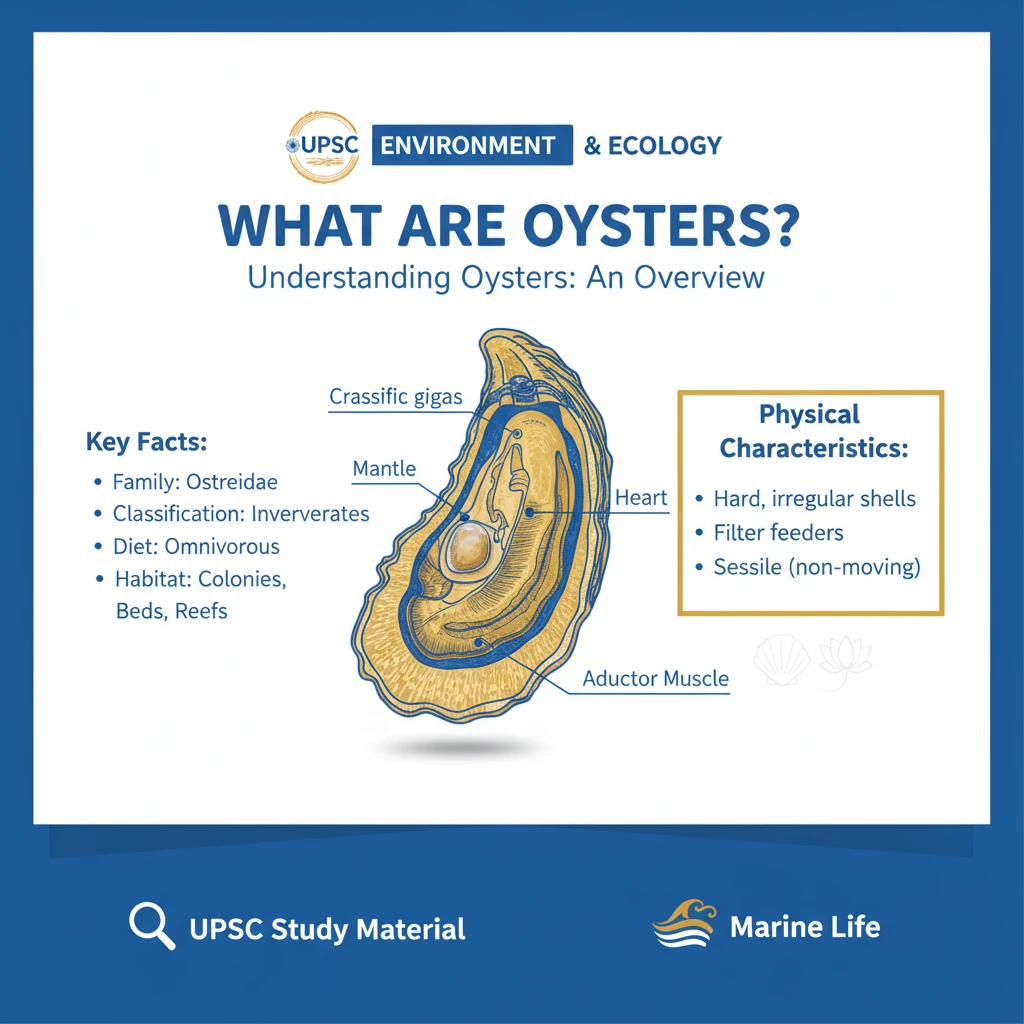
<h4>Understanding Oysters: An Overview</h4><p><strong>Oysters</strong> belong to the biological family <strong>Ostreidae</strong>. They are classified as <strong>invertebrates</strong>, meaning they lack a backbone.</p><p>These fascinating marine creatures are <strong>omnivorous</strong>. They typically live in large aggregations, which are referred to as <strong>colonies</strong>, <strong>beds</strong>, or <strong>reefs</strong>.</p><div class='info-box'><p><strong>Physical Characteristics:</strong></p><ul><li><strong>Shells:</strong> Rough, rock-hard, and usually <strong>oval or pear-shaped</strong>.</li><li><strong>Classification:</strong> Invertebrates, family Ostreidae.</li><li><strong>Diet:</strong> Omnivorous.</li></ul></div><h4>Habitat and Pearl Production</h4><p><strong>Oysters</strong> thrive in <strong>shallow ocean waters</strong> across the globe. They form their characteristic <strong>colonies</strong>, <strong>beds</strong>, or <strong>reefs</strong> in these coastal environments.</p><p>While some edible oysters can occasionally produce <strong>pearls</strong>, it is important to note they are distinct from <strong>pearl oysters</strong>. Pearl oysters belong to a different bivalve family specifically cultivated for pearl production.</p><h4>Ecological Significance: Keystone Species</h4><p>Oysters are widely recognized as a <strong>keystone species</strong> within their ecosystems. This designation highlights their disproportionately large impact relative to their abundance.</p><div class='key-point-box'><p><strong>What is a Keystone Species?</strong></p><p>A <strong>keystone species</strong> is an organism that has a unique and crucial role in the way an ecosystem functions. Without keystone species, the ecosystem would be dramatically different or cease to exist. Examples include <strong>tigers</strong> and <strong>sea otters</strong>.</p></div><p><strong>Oyster beds</strong> and <strong>reefs</strong> provide vital <strong>habitat</strong> and <strong>protection</strong>. They support a diverse array of marine organisms, including <strong>sea anemones</strong>, <strong>barnacles</strong>, and <strong>mussels</strong>.</p><h4>Water Filtration: Nature's Purifiers</h4><p>One of the most significant ecological roles of oysters is their ability to <strong>filter water</strong>. A single oyster is remarkably efficient, capable of filtering over <strong>two gallons of water per hour</strong>.</p><p>This translates to an impressive capacity of up to <strong>50 gallons per day</strong> per oyster. Their filtration process removes various pollutants from the water.</p><div class='info-box'><p><strong>Pollutants Removed by Oysters:</strong></p><ul><li><strong>Nitrates</strong></li><li><strong>Ammonia</strong></li><li><strong>Phosphates</strong></li><li><strong>Bacteria</strong></li><li><strong>Organic matter</strong></li></ul></div><p>By removing these substances, oysters significantly contribute to improving overall <strong>water quality</strong> and <strong>clarity</strong> in their habitats.</p><h4>Diet, Behavior, and Reproduction</h4><p><strong>Oysters</strong> are <strong>filter feeders</strong>. They obtain their nutrition by drawing water over their <strong>gills</strong>, which capture <strong>algae</strong> and other microscopic food particles.</p><p>A unique aspect of oyster biology is their reproductive behavior. All oysters begin their life cycle as <strong>males</strong>. However, they typically undergo a permanent gender change to become <strong>females</strong> after approximately one year.</p><p>Furthermore, oysters exhibit the fascinating ability to change their <strong>gender multiple times</strong> throughout their lifespan, adapting to environmental conditions and reproductive needs.</p><h4>Oysters as a Food Source</h4><p>For thousands of years, oysters have been a valuable food source for humans. They are consumed both <strong>raw</strong> and <strong>cooked</strong>, prized for their distinctive flavor and nutritional content.</p><div class='info-box'><p><strong>Nutritional Value of Oysters:</strong></p><ul><li>High in <strong>calcium</strong></li><li>Rich in <strong>iron</strong></li><li>Excellent source of <strong>protein</strong></li></ul></div><div class='exam-tip-box'><p><strong>UPSC Insight:</strong> Understanding the ecological roles of species like oysters (e.g., <strong>keystone species</strong>, <strong>bio-filters</strong>) is crucial for topics related to <strong>biodiversity conservation</strong>, <strong>marine ecosystems</strong>, and <strong>environmental pollution</strong> in <strong>GS Paper III</strong>.</p></div>
💡 Key Takeaways
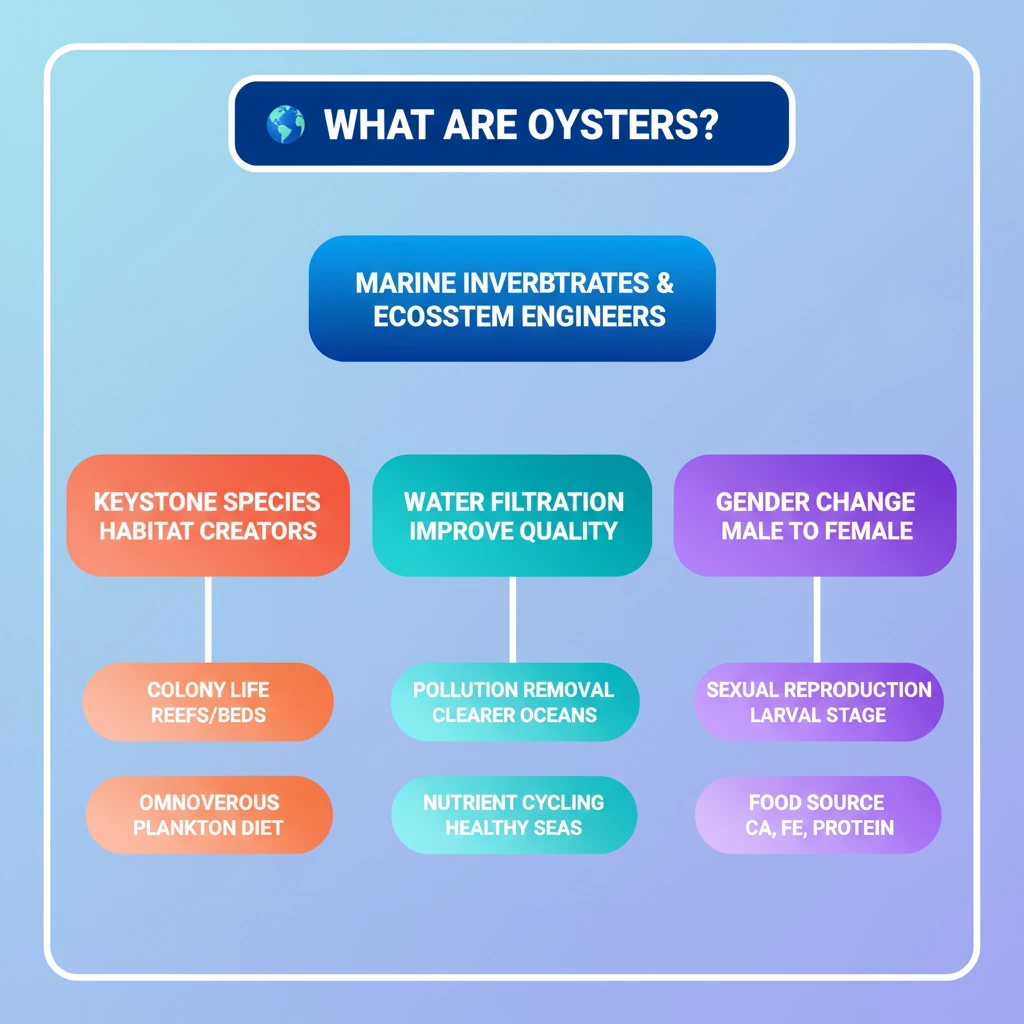
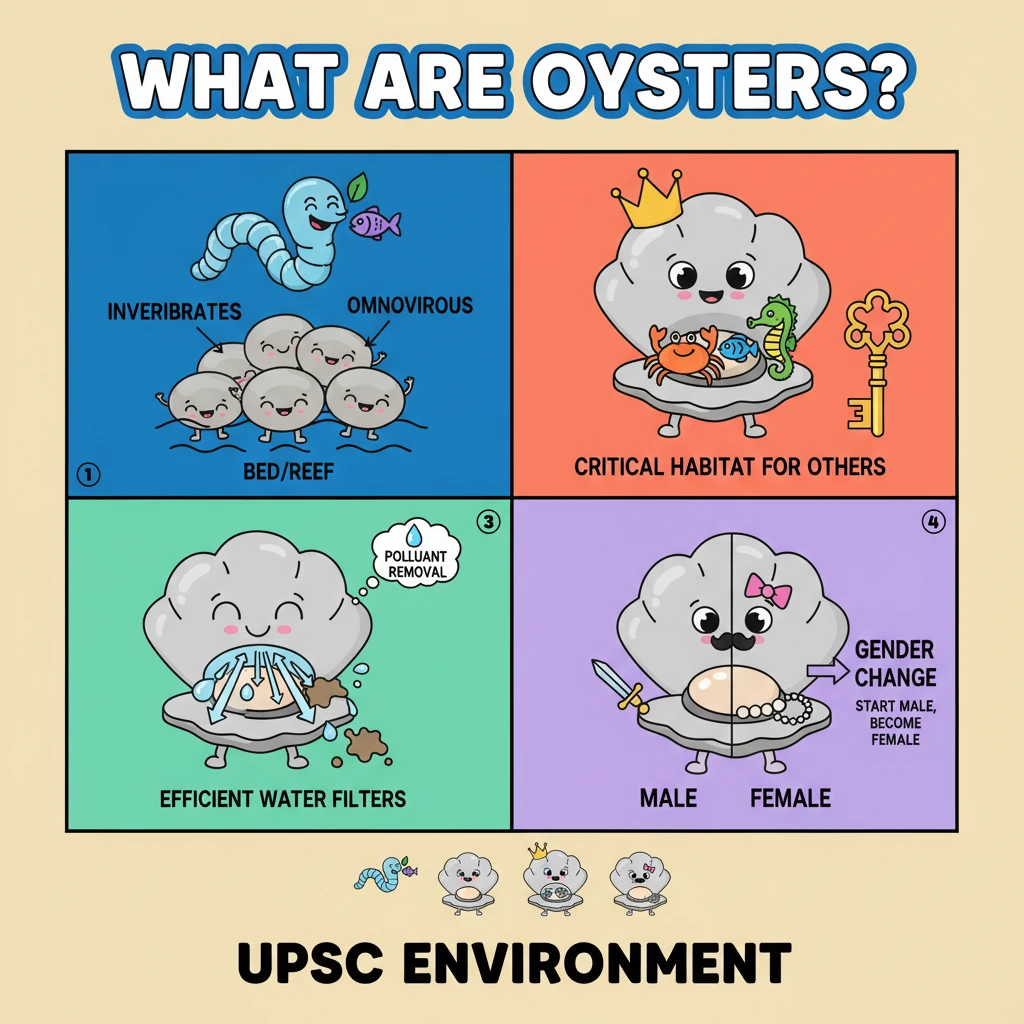
- •Oysters are invertebrates, omnivorous, and live in colonies (beds/reefs) in shallow ocean waters.
- •They are a keystone species, providing critical habitat for other marine organisms.
- •Oysters are highly efficient water filters, removing pollutants and improving water quality.
- •They exhibit gender change, starting as male and often becoming female.
- •Oysters are a nutritious food source, rich in calcium, iron, and protein.
- •Conservation and restoration of oyster reefs are crucial for marine health and coastal protection.
🧠 Memory Techniques
95% Verified Content
📚 Reference Sources
•NOAA (National Oceanic and Atmospheric Administration)
•Scientific journals on marine biology and ecology