What is Global Atmosphere Watch? - Environment And Ecology | UPSC Learning
Topics
0 topics • 0 completed
🔍
No topics match your search
What is Global Atmosphere Watch?
Medium⏱️ 6 min read
environment and ecology
📖 Introduction
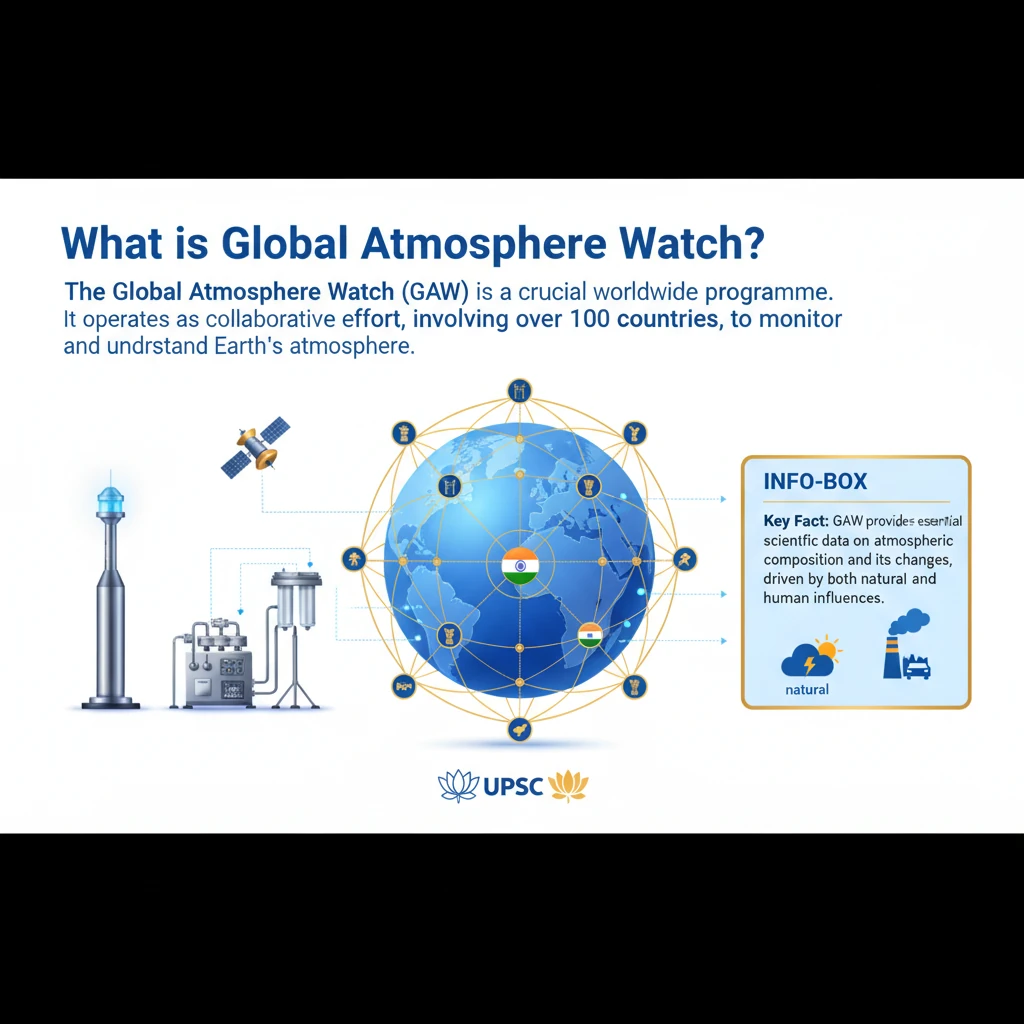
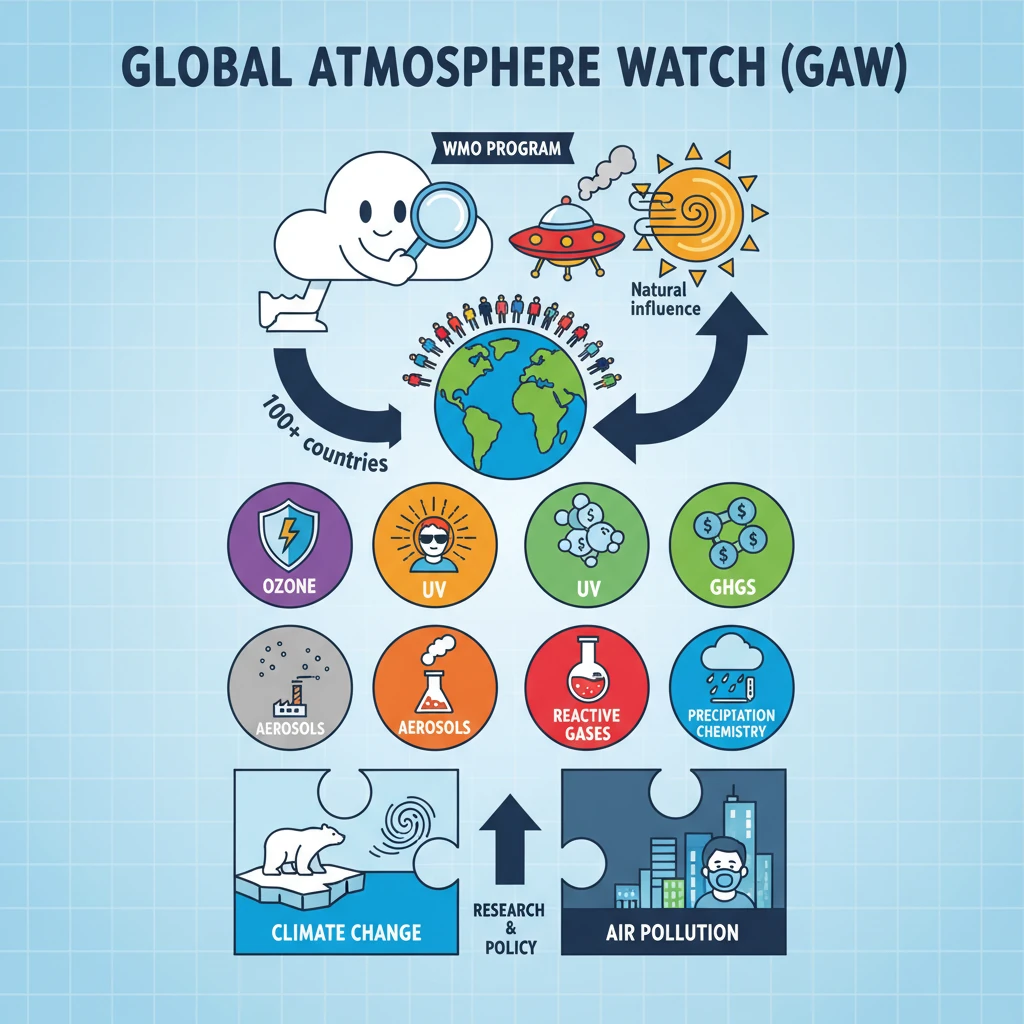
<h4>What is Global Atmosphere Watch (GAW)?</h4><p>The <strong>Global Atmosphere Watch (GAW)</strong> is a crucial worldwide programme. It operates as a collaborative effort, involving over <strong>100 countries</strong>, to monitor and understand the Earth's atmosphere.</p><div class='info-box'><p><strong>Key Fact:</strong> GAW provides essential scientific data on <strong>atmospheric composition</strong> and its changes, driven by both <strong>natural</strong> and <strong>human influences</strong>.</p></div><h4>Purpose of GAW</h4><p>The primary goal of GAW is to deepen our understanding of the complex interactions occurring between the <strong>atmosphere</strong>, <strong>oceans</strong>, and <strong>biosphere</strong>. This holistic approach is vital for environmental research.</p><p>Furthermore, GAW actively supports the collection of high-quality data. This data is indispensable for informing critical research into <strong>air pollution</strong> and <strong>climate change</strong>, aiding global efforts to address these challenges.</p><h4>Core Monitoring Targets</h4><p>The GAW programme focuses its monitoring efforts on six key atmospheric variables. These targets are selected for their significant impact on climate and air quality.</p><ul><li><strong>Ozone:</strong> Monitoring both stratospheric and tropospheric ozone levels.</li><li><strong>UV Radiation:</strong> Tracking ultraviolet radiation reaching the Earth's surface.</li><li><strong>Greenhouse Gases (GHGs):</strong> Measuring concentrations of major GHGs like CO2, CH4, N2O.</li><li><strong>Aerosols:</strong> Studying atmospheric particulate matter and its properties.</li><li><strong>Selected Reactive Gases:</strong> Monitoring gases involved in atmospheric chemical reactions.</li><li><strong>Precipitation Chemistry:</strong> Analyzing the chemical composition of rain and snow.</li></ul><div class='key-point-box'><p><strong>Important Concept:</strong> These six variables are critical indicators for assessing global atmospheric health and predicting future environmental changes.</p></div><h4>Governance and Oversight</h4><p>Leadership and coordination within the GAW programme are provided by various <strong>GAW expert groups</strong>. These groups comprise leading scientists and specialists in atmospheric science.</p><p>The GAW expert groups are ultimately overseen by the <strong>World Meteorological Organization (WMO) Research Board</strong>. Further guidance comes from its specialized <strong>Environmental Pollution and Atmospheric Chemistry Scientific Steering Committee (EPAC SSC)</strong>.</p><div class='exam-tip-box'><p><strong>UPSC Insight:</strong> Understanding the governance structure (WMO, Research Board, EPAC SSC) helps in linking GAW to broader international organizations and their roles in environmental governance (GS-II & GS-III).</p></div><h4>Key Publications</h4><p>GAW contributes significantly to scientific dissemination through several regular publications. These reports provide crucial data and analysis to the global community.</p><ul><li><strong>State of the Global Climate:</strong> A comprehensive annual report on climate indicators.</li><li><strong>Greenhouse Gas Bulletin:</strong> Provides updates on the concentrations of major greenhouse gases.</li><li><strong>GAW Reports:</strong> Technical reports detailing specific findings and methodologies.</li><li><strong>Ozone Bulletins:</strong> Regular updates on the state of the ozone layer.</li></ul>
💡 Key Takeaways
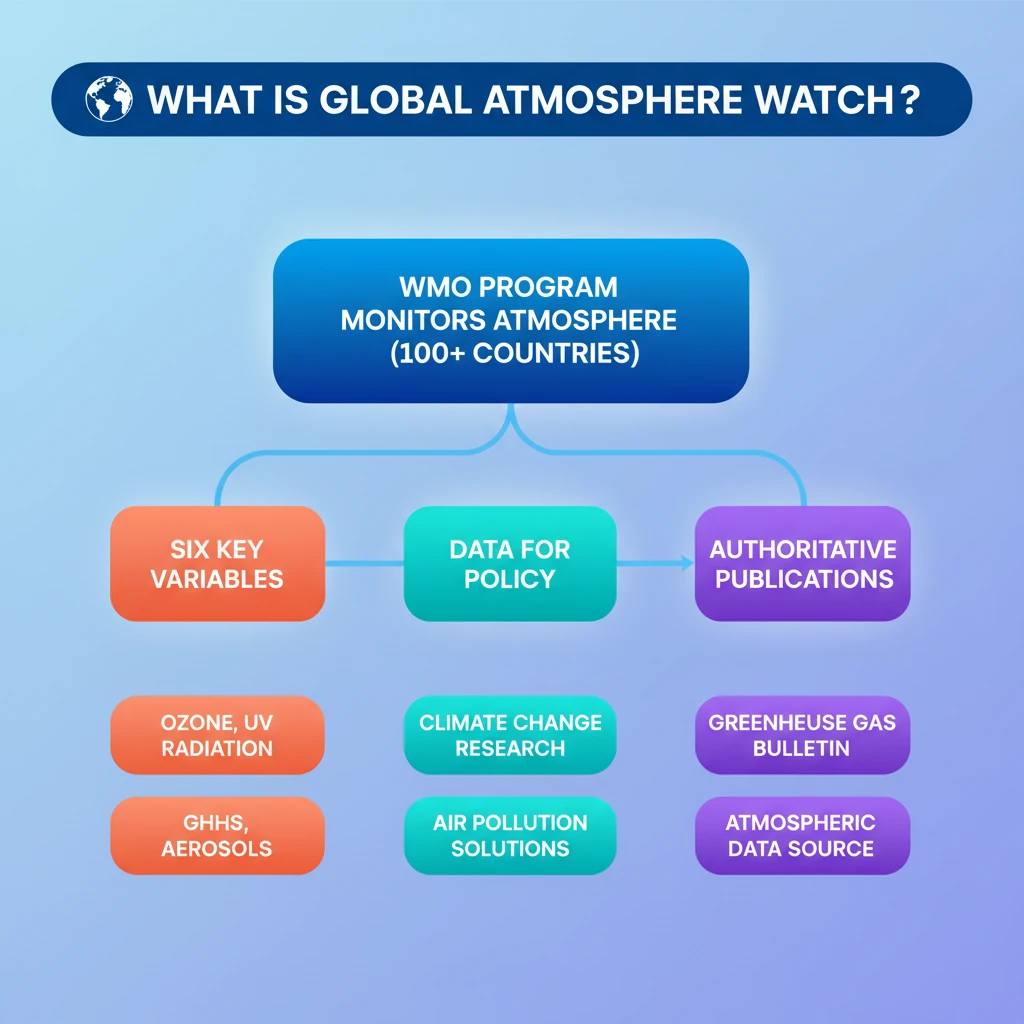
- •Global Atmosphere Watch (GAW) is a WMO program involving 100+ countries.
- •Its purpose is to monitor atmospheric composition changes due to natural and human influences.
- •GAW monitors six key variables: ozone, UV radiation, GHGs, aerosols, reactive gases, and precipitation chemistry.
- •It provides critical data for climate change and air pollution research and policy-making.
- •GAW publications like the Greenhouse Gas Bulletin are authoritative sources of atmospheric data.
🧠 Memory Techniques
98% Verified Content
📚 Reference Sources
•World Meteorological Organization (WMO) Official Website - Global Atmosphere Watch (GAW) Programme