What are the Key Facts About Pelagic Birds? - Environment And Ecology | UPSC Learning
Topics
0 topics • 0 completed
🔍
No topics match your search
What are the Key Facts About Pelagic Birds?
Easy⏱️ 6 min read
environment and ecology
📖 Introduction
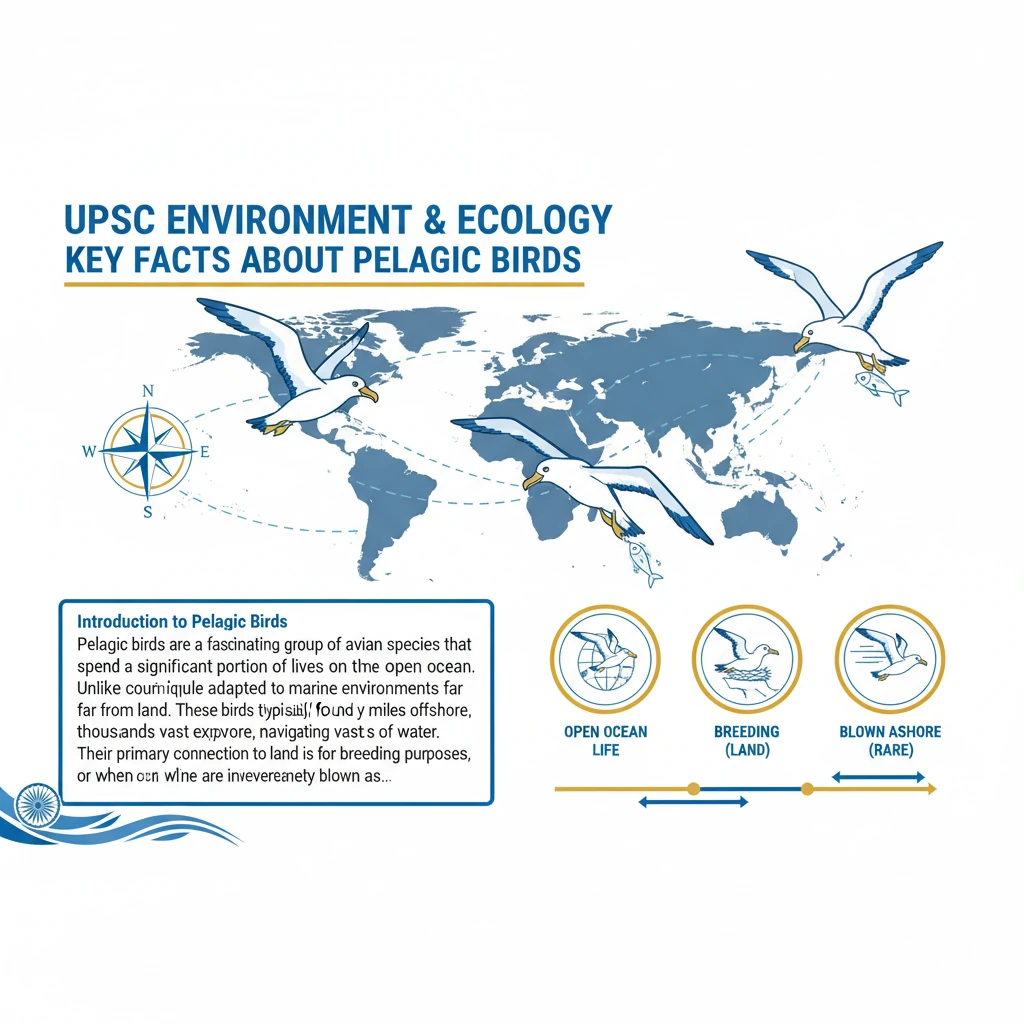
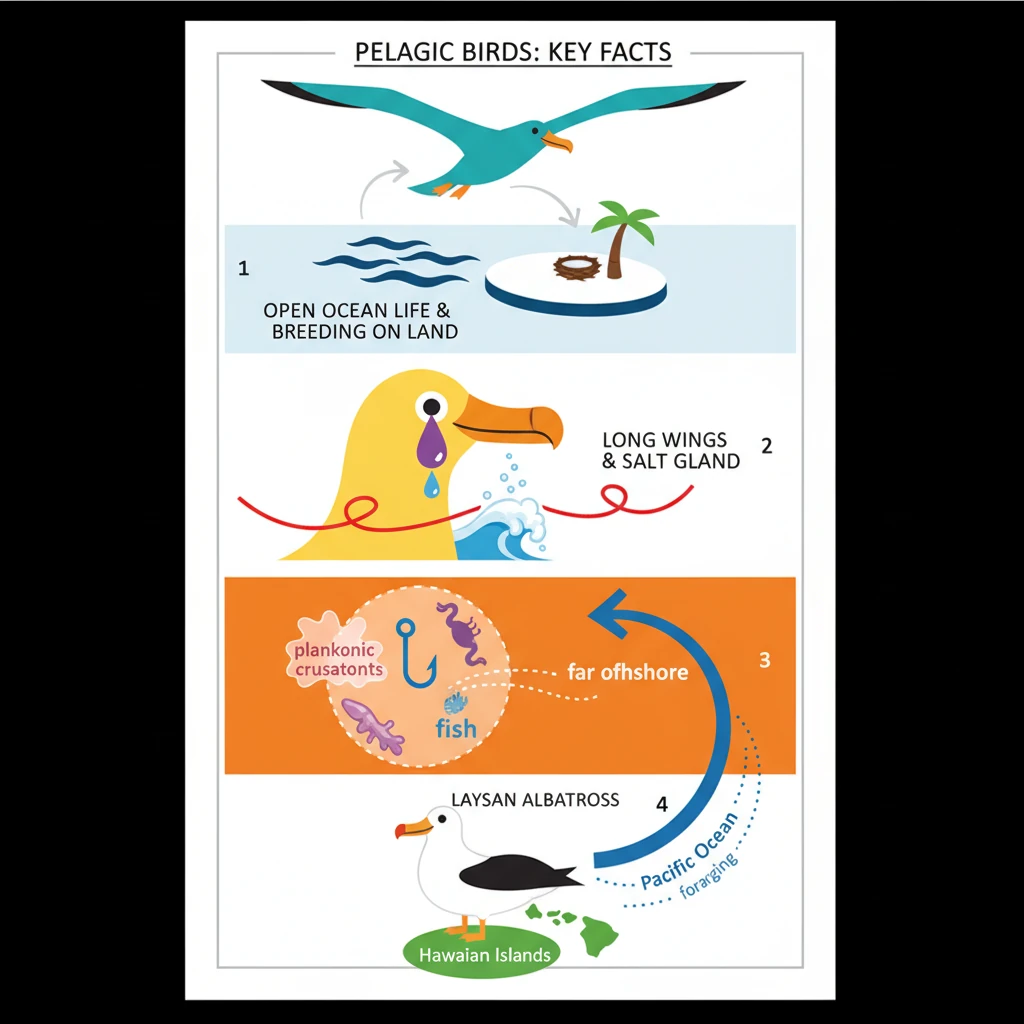
<h4>Introduction to Pelagic Birds</h4><p><strong>Pelagic birds</strong> are a fascinating group of avian species that spend a significant portion of their lives on the <strong>open ocean</strong>. Unlike coastal birds, they are uniquely adapted to marine environments far from land.</p><p>These birds are typically found thousands of miles offshore, navigating vast expanses of water. Their primary connection to land is for <strong>breeding purposes</strong>, or when they are inadvertently blown ashore during severe weather conditions like high winds and storms.</p><div class='info-box'><p><strong>Definition:</strong> <strong>Pelagic birds</strong> are marine birds that inhabit the open sea, often far from coastlines, and return to land primarily for reproduction.</p></div><h4>Key Characteristics of Pelagic Birds</h4><p>While varying greatly in size and appearance, all <strong>pelagic birds</strong> share core adaptations for their oceanic lifestyle. They are exceptional swimmers and divers, perfectly suited for foraging in the open water.</p><div class='key-point-box'><p><strong>Remarkable Flight Adaptations:</strong> These birds possess <strong>long, slender wings</strong>, which are crucial for extended, energy-efficient flights. Some species can remain airborne for days or even weeks without needing to rest, demonstrating incredible endurance.</p></div><p>A unique physiological feature of many <strong>pelagic birds</strong> is the presence of a specialized <strong>salt gland</strong>. This gland is vital for extracting excess salt from the seawater they ingest, preventing its accumulation to toxic levels within their bodies.</p><h4>Diet and Foraging Habits</h4><p>Their diet primarily consists of marine organisms found in the open ocean. They actively hunt for food far from coastal areas, utilizing their diving and swimming abilities.</p><ul><li><strong>Planktonic crustaceans:</strong> These include small organisms related to <strong>shrimp</strong> and <strong>crabs</strong>, forming a significant part of their diet.</li><li><strong>Squid:</strong> Many species are adept at catching various types of <strong>squid</strong> in the open water.</li><li><strong>Fish:</strong> They also prey on different species of <strong>fish</strong>, often diving to considerable depths to secure their meals.</li></ul><div class='exam-tip-box'><p><strong>UPSC Insight:</strong> Understanding the adaptations of <strong>pelagic birds</strong> (e.g., salt glands, wing structure) can be relevant for questions on <strong>biodiversity</strong>, <strong>ecological adaptations</strong>, and <strong>environmental physiology</strong> in <strong>GS Paper III (Environment & Ecology)</strong>.</p></div>
💡 Key Takeaways
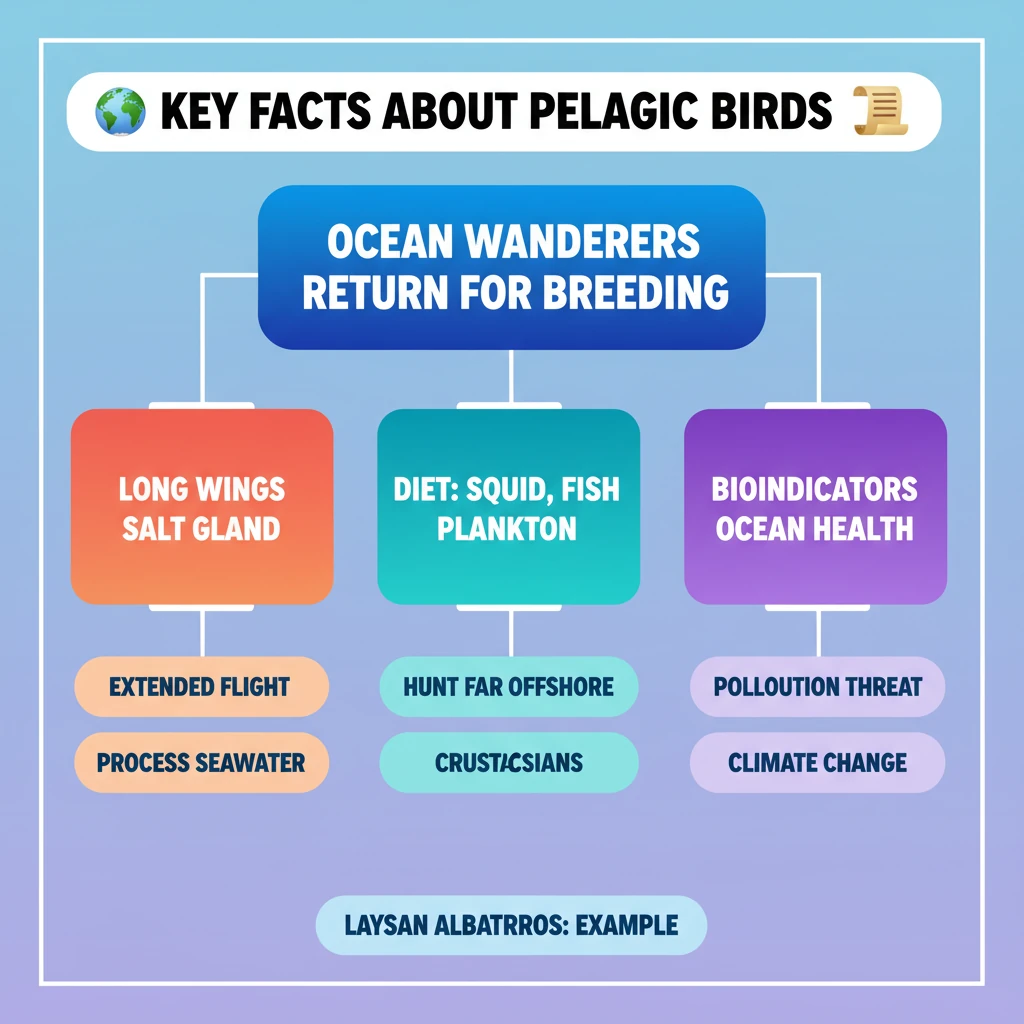
- •Pelagic birds spend most of their lives on the open ocean, returning to land mainly for breeding.
- •They possess long, slender wings for extended flight and a unique salt gland to process seawater.
- •Their diet includes planktonic crustaceans, squid, and fish, hunted far offshore.
- •The Laysan Albatross is a prime example, breeding on Hawaiian Islands and foraging across the Pacific.
- •Pelagic birds are crucial bioindicators of ocean health, facing threats from pollution and climate change.
🧠 Memory Techniques
95% Verified Content
📚 Reference Sources
•General Ornithology Texts (e.g., Cornell Lab of Ornithology)
•Marine Biology Resources (e.g., NOAA, IUCN Red List for specific species)