Dicliptra Polymorpha - Environment And Ecology | UPSC Learning
Topics
0 topics • 0 completed
🔍
No topics match your search
Dicliptra Polymorpha
Medium⏱️ 8 min read
environment and ecology
📖 Introduction
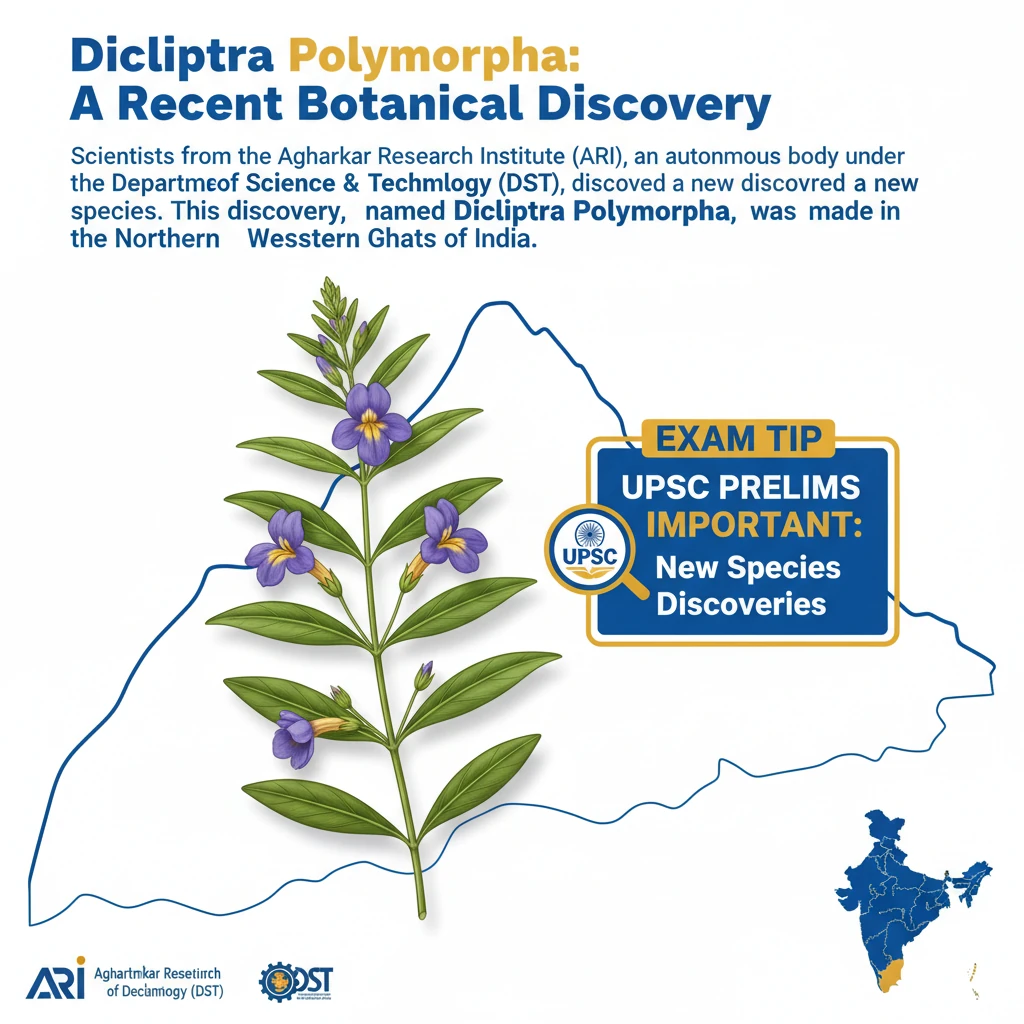
<h4>Dicliptra Polymorpha: A Recent Botanical Discovery</h4><p>Scientists from the <strong>Agharkar Research Institute (ARI)</strong>, an autonomous body under the <strong>Department of Science & Technology (DST)</strong>, recently discovered a new plant species. This discovery, named <strong>Dicliptra Polymorpha</strong>, was made in the <strong>Northern Western Ghats of India</strong>.</p><div class='exam-tip-box'><p>New species discoveries are important for <strong>UPSC Prelims</strong>, often appearing as direct questions. Understanding the associated geographical location and unique traits is crucial.</p></div><h4>Key Characteristics of Dicliptra Polymorpha</h4><p>The newly identified <strong>Dicliptra Polymorpha</strong> exhibits several distinctive traits, allowing it to thrive in challenging environments. These adaptations highlight its resilience within its natural habitat.</p><ul><li><strong>Fire Resilience</strong>: This species can successfully survive both prolonged <strong>summer droughts</strong> and frequent <strong>grassland fires</strong>, demonstrating remarkable hardiness.</li><li><strong>Dual Blooming Pattern</strong>: It displays an unusual flowering cycle, blooming twice a year. The first phase occurs <strong>post-monsoon (November–April)</strong>, and a second phase emerges in <strong>May–June</strong>, specifically after fires.</li><li><strong>Morphological Distinction</strong>: Its <strong>inflorescence flower structures</strong> are unique among Indian species of Dicliptra. Interestingly, these structures bear similarities to those found in certain <strong>African species</strong>.</li></ul><div class='info-box'><p><strong>Adaptations to Harsh Conditions</strong>: <strong>Dicliptra Polymorpha</strong> thrives on open grassland slopes. It develops <strong>woody rootstocks</strong> that produce dwarf flowering shoots during its second, post-fire blooming phase, aiding its survival.</p></div><h4>Threats to Dicliptra Polymorpha</h4><p>Despite its resilience, <strong>Dicliptra Polymorpha</strong> faces significant threats, primarily from anthropogenic activities and environmental pressures within its habitat.</p><ul><li><strong>Human-Induced Fires</strong>: While fires can trigger a second blooming, uncontrolled or excessive fires can severely degrade the species' habitat and impact its long-term survival.</li><li><strong>Habitat Overuse</strong>: Practices such as <strong>overgrazing</strong> by livestock and extensive <strong>land-use changes</strong> pose a considerable threat. These activities directly impact the delicate balance of grassland biodiversity where the species resides.</li></ul><h4>The Western Ghats: A Global Biodiversity Hotspot</h4><p>The <strong>Western Ghats</strong>, also known as the <strong>Sahyadri Hills</strong>, are renowned globally for their exceptionally rich and unique assemblage of <strong>flora and fauna</strong>. This mountain range is a critical ecological zone in India.</p><div class='info-box'><p><strong>Geographical Nomenclature</strong>: The range is called <strong>Sahyadri</strong> in northern Maharashtra, <strong>Nilgiri Hills</strong> in Karnataka and Tamil Nadu, and <strong>Anaimalai Hills</strong> and <strong>Cardamom Hills</strong> in Kerala.</p></div><p>Recognized as a <strong>UNESCO World Heritage Site</strong>, the Western Ghats are a cornerstone of India's natural heritage. They are one of <strong>India’s four recognized biodiversity hotspots</strong>, harboring numerous endemic and yet-to-be-discovered species.</p><p>This region is home to <strong>two biosphere reserves</strong>, <strong>13 National Parks</strong>, numerous <strong>wildlife sanctuaries</strong>, and many <strong>Reserve Forests</strong>. It encompasses diverse ecosystems, from the evergreen forests of <strong>Nagarahole</strong> to the deciduous forests of <strong>Bandipur National Park</strong>.</p><h4>Central Zoo Authority (CZA): A Statutory Body for Conservation</h4><p>The <strong>Central Zoo Authority (CZA)</strong> plays a pivotal role in strengthening national efforts for biodiversity conservation. It is a <strong>statutory body</strong> operating under the <strong>Ministry of Environment, Forest and Climate Change</strong>.</p><div class='info-box'><p><strong>Establishment & Structure</strong>: The <strong>CZA</strong> was established in <strong>1992</strong> under the provisions of the <strong>Wildlife (Protection) Act, 1972</strong>. It is chaired by the <strong>Environment Minister</strong> and comprises <strong>10 members</strong> and a <strong>member-secretary</strong>.</p></div><p>The primary objective of the <strong>CZA</strong> is to complement and reinforce national initiatives aimed at the conservation of India's rich biodiversity, particularly through the regulation and oversight of zoos.</p><h4>Conservation Efforts in the Western Ghats</h4><p>Given its immense ecological value, the <strong>Western Ghats</strong> have been the focus of various conservation initiatives. One notable effort was the formation of the <strong>Gadgil Committee</strong>.</p><div class='key-point-box'><p>The <strong>Gadgil Committee (2011)</strong>, also known as the <strong>Western Ghats Ecology Expert Panel (WGEEP)</strong>, was established to assess the ecological status of the Western Ghats and recommend measures for its protection and sustainable management.</p></div>
💡 Key Takeaways
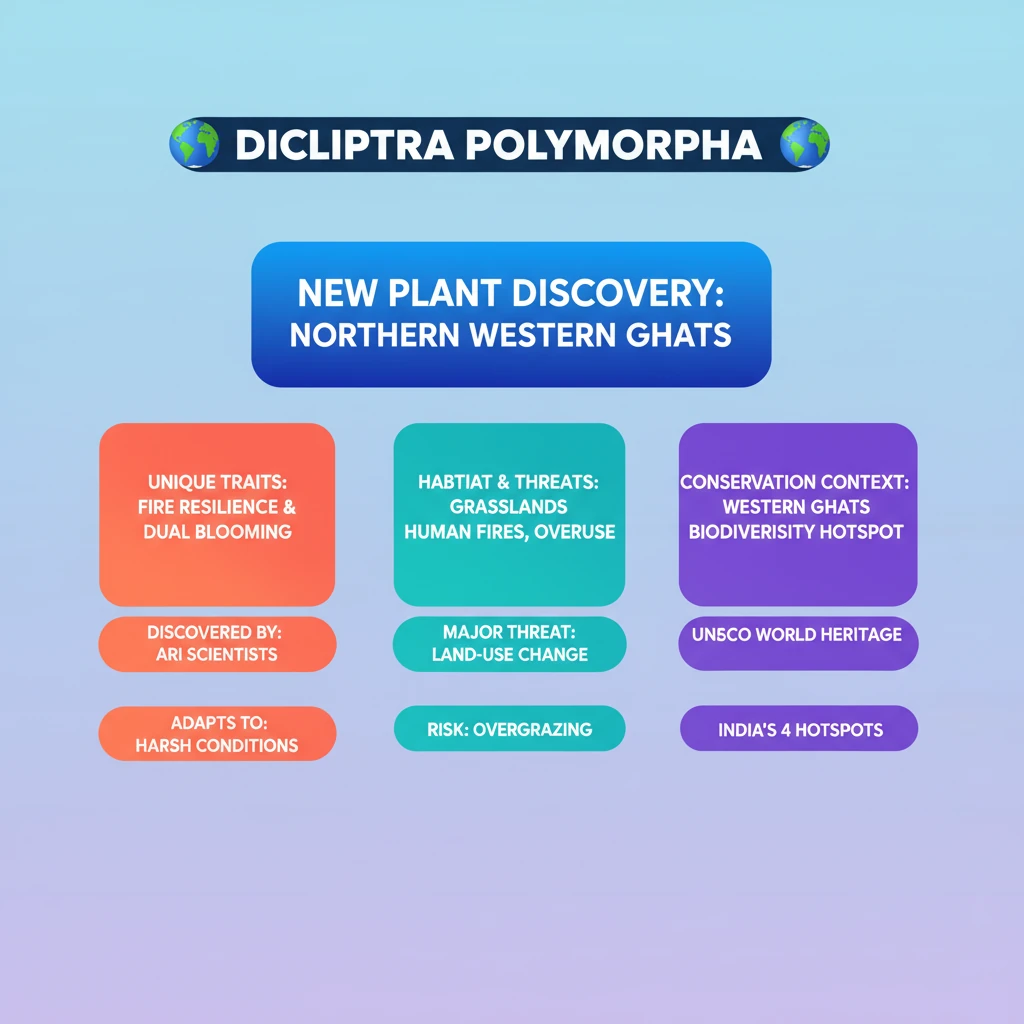
- •<strong>Dicliptra Polymorpha</strong> is a new plant species discovered in the <strong>Northern Western Ghats</strong> by <strong>ARI</strong> scientists.
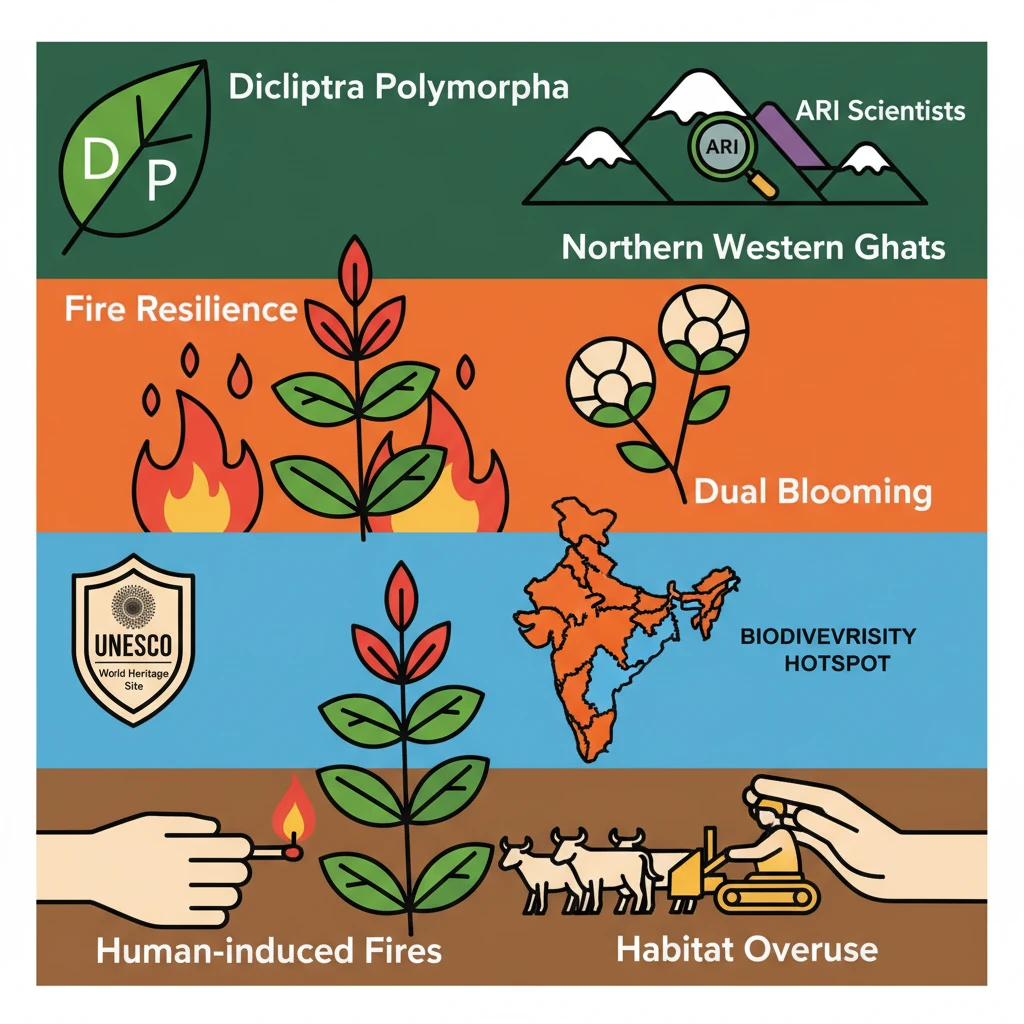
- •It exhibits unique traits like <strong>fire resilience</strong> and a <strong>dual blooming pattern</strong>, adapting to harsh grassland conditions.
- •Major threats include <strong>human-induced fires</strong> and <strong>habitat overuse</strong> (overgrazing, land-use changes).
- •The <strong>Western Ghats</strong> is a <strong>UNESCO World Heritage Site</strong> and one of India's four <strong>biodiversity hotspots</strong>, rich in endemic flora and fauna.
- •The <strong>Central Zoo Authority (CZA)</strong>, established in <strong>1992</strong> under the <strong>Wildlife (Protection) Act, 1972</strong>, is a statutory body for biodiversity conservation.
- •The <strong>Gadgil Committee (2011)</strong> focused on the ecological protection of the <strong>Western Ghats</strong>.
🧠 Memory Techniques
95% Verified Content