What is the Great Indian Bustard? - Environment And Ecology | UPSC Learning
Topics
0 topics • 0 completed
🔍
No topics match your search
What is the Great Indian Bustard?
Medium⏱️ 8 min read
environment and ecology
📖 Introduction
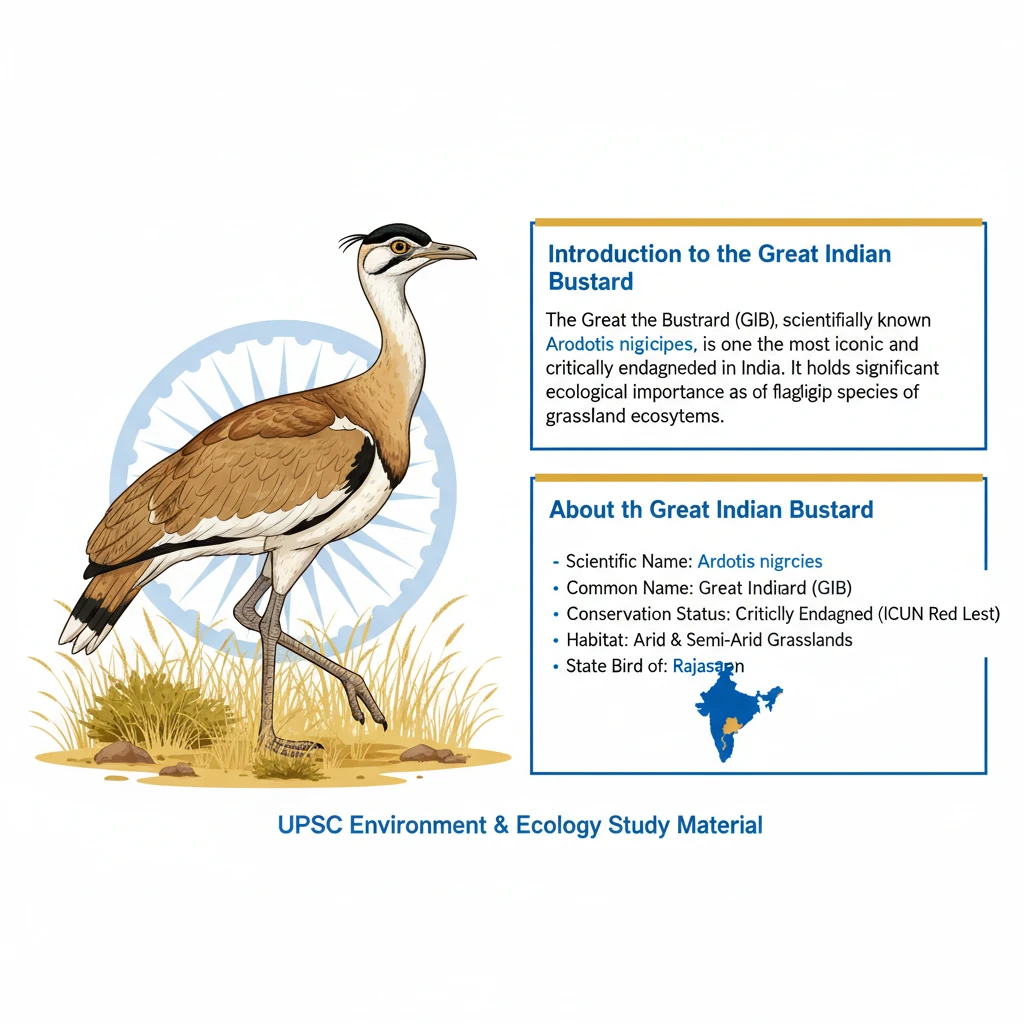
<h4>Introduction to the Great Indian Bustard</h4><p>The <strong>Great Indian Bustard</strong> (GIB), scientifically known as <strong>Ardeotis nigriceps</strong>, is one of the most iconic and critically endangered bird species in India. It holds significant ecological importance as a flagship species of grassland ecosystems.</p><h4>About the Great Indian Bustard</h4><div class='info-box'><ul><li><strong>Scientific Name:</strong> <strong>Ardeotis nigriceps</strong></li><li><strong>Common Name:</strong> <strong>Great Indian Bustard</strong> (GIB)</li><li><strong>State Bird:</strong> Officially recognized as the <strong>State Bird of Rajasthan</strong>.</li></ul></div><p>The <strong>Great Indian Bustard</strong> is a large, terrestrial bird known for its majestic appearance. Its presence is a vital indicator of the health and biodiversity of its grassland habitat.</p><h4>Flagship Species and Grassland Ecology</h4><div class='key-point-box'><p>The <strong>Great Indian Bustard</strong> is considered a <strong>flagship grassland species</strong>. This means its conservation efforts indirectly protect many other species sharing the same habitat, representing the overall health of the <strong>grassland ecology</strong>.</p></div><p>Protecting the GIB ensures the preservation of vast grassland ecosystems, which are crucial for numerous other flora and fauna. These habitats are often overlooked but are biodiversity hotspots.</p><h4>Habitat and Distribution</h4><p>Historically, the <strong>Great Indian Bustard</strong> had a much wider distribution across the Indian subcontinent. However, its population is now severely fragmented and confined to a few specific regions.</p><div class='info-box'><p><strong>Primary Habitats:</strong></p><ul><li>Mostly confined to <strong>Rajasthan</strong> and <strong>Gujarat</strong>.</li><li>Small, isolated populations also exist in <strong>Maharashtra</strong>, <strong>Karnataka</strong>, and <strong>Andhra Pradesh</strong>.</li></ul></div><p>These remaining habitats are critical for the survival of the species and require urgent, targeted conservation interventions.</p><h4>Conservation Status: Critically Endangered</h4><p>The <strong>Great Indian Bustard</strong> is classified as <strong>Critically Endangered</strong> by the <strong>IUCN Red List</strong>, making it one of India’s most threatened bird species. This status reflects an extremely high risk of extinction in the wild.</p><div class='exam-tip-box'><p>For <strong>UPSC Prelims</strong>, remember the <strong>IUCN status</strong> (Critically Endangered) and its recognition as the <strong>State Bird of Rajasthan</strong>. These are common factual questions.</p></div><h4>Major Threats and Vulnerabilities</h4><p>The GIB faces a multitude of threats, primarily anthropogenic in nature, which have led to its drastic population decline. These threats are complex and interconnected.</p><ul><li><strong>Collision/Electrocution with Power Transmission Lines:</strong> High-tension power lines pose a significant and often fatal risk, especially in their flight paths.</li><li><strong>Hunting:</strong> Although illegal in India, hunting remains a threat, particularly in border areas and neighboring countries like <strong>Pakistan</strong>.</li><li><strong>Habitat Loss and Alteration:</strong> Widespread agricultural expansion, industrialization, and infrastructure development convert crucial grassland habitats into other land uses.</li><li><strong>Habitat Degradation:</strong> Overgrazing, invasive species, and improper land management further degrade the quality of remaining habitats.</li></ul><h4>Reproductive Biology and Slow Population Growth</h4><p>The GIB's inherent biological characteristics also contribute to its vulnerability and slow recovery rates. They are a species with a low reproductive output.</p><div class='info-box'><ul><li><strong>Slow Reproduction:</strong> GIBs are a <strong>slow-reproducing species</strong>.</li><li><strong>Egg Laying:</strong> They lay only a few eggs per breeding cycle.</li><li><strong>Parental Care:</strong> Chicks require almost a <strong>year-long parental care</strong>, making them vulnerable for an extended period.</li><li><strong>Maturity:</strong> Individuals achieve sexual maturity relatively late, around <strong>3-4 years</strong> of age.</li></ul></div><p>This combination of low egg production, extended parental care, and delayed maturity means that population recovery is inherently slow, making every individual loss critical.</p>
💡 Key Takeaways
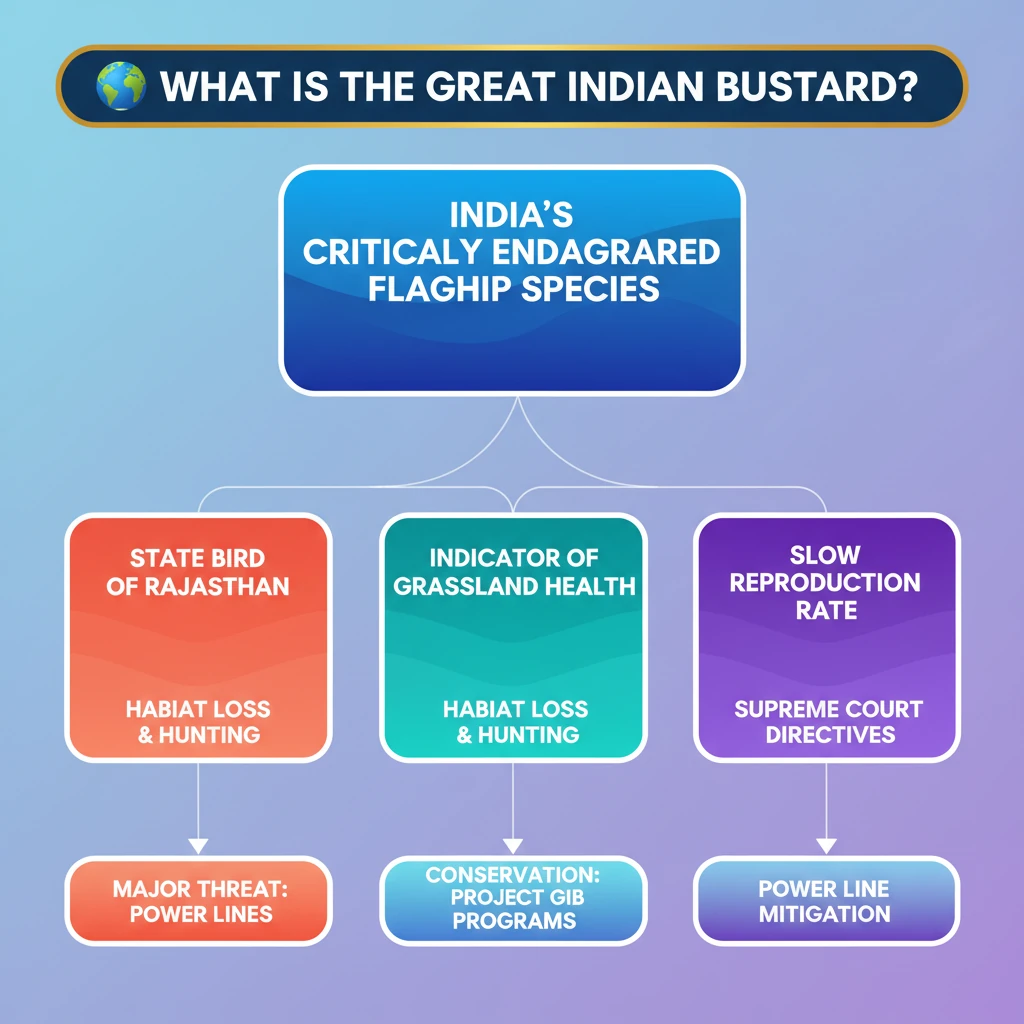
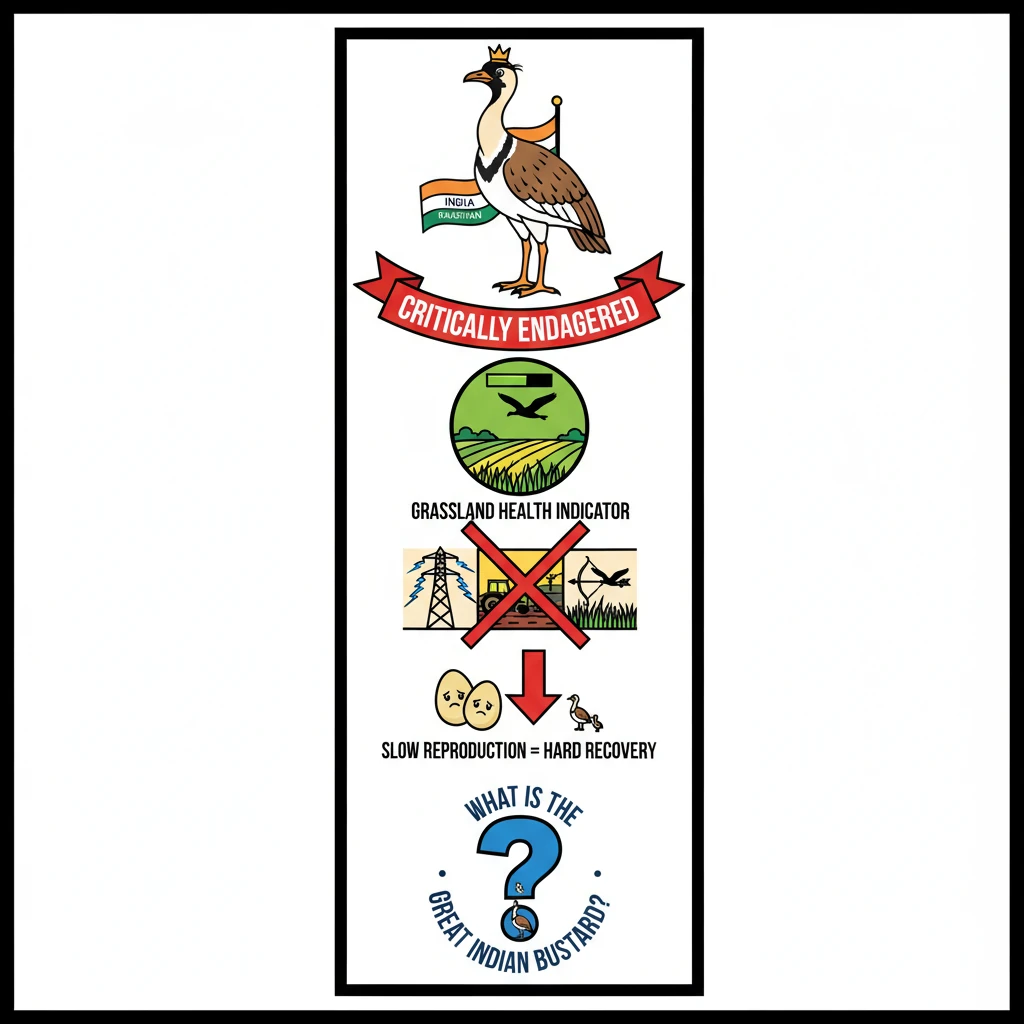
- •The Great Indian Bustard (GIB) is India's critically endangered state bird of Rajasthan.
- •It serves as a flagship species for grassland ecosystems, indicating their health.
- •Major threats include power line collisions, habitat loss from agriculture, and hunting.
- •GIBs are slow-reproducing, making population recovery extremely challenging.
- •Conservation efforts include Project GIB, breeding programs, and Supreme Court directives for power line mitigation.
🧠 Memory Techniques
95% Verified Content
📚 Reference Sources
•IUCN Red List of Threatened Species
•Ministry of Environment, Forest and Climate Change (MoEFCC) official documents
•Supreme Court of India judgments related to GIB conservation
•Wildlife Institute of India (WII) reports on GIB