Crocodile Conservation Project: Objectives, Implementation & Sanctuaries - Environment And Ecology | UPSC Learning
Topics
0 topics • 0 completed
🔍
No topics match your search
Crocodile Conservation Project: Objectives, Implementation & Sanctuaries
Medium⏱️ 6 min read
environment and ecology
📖 Introduction
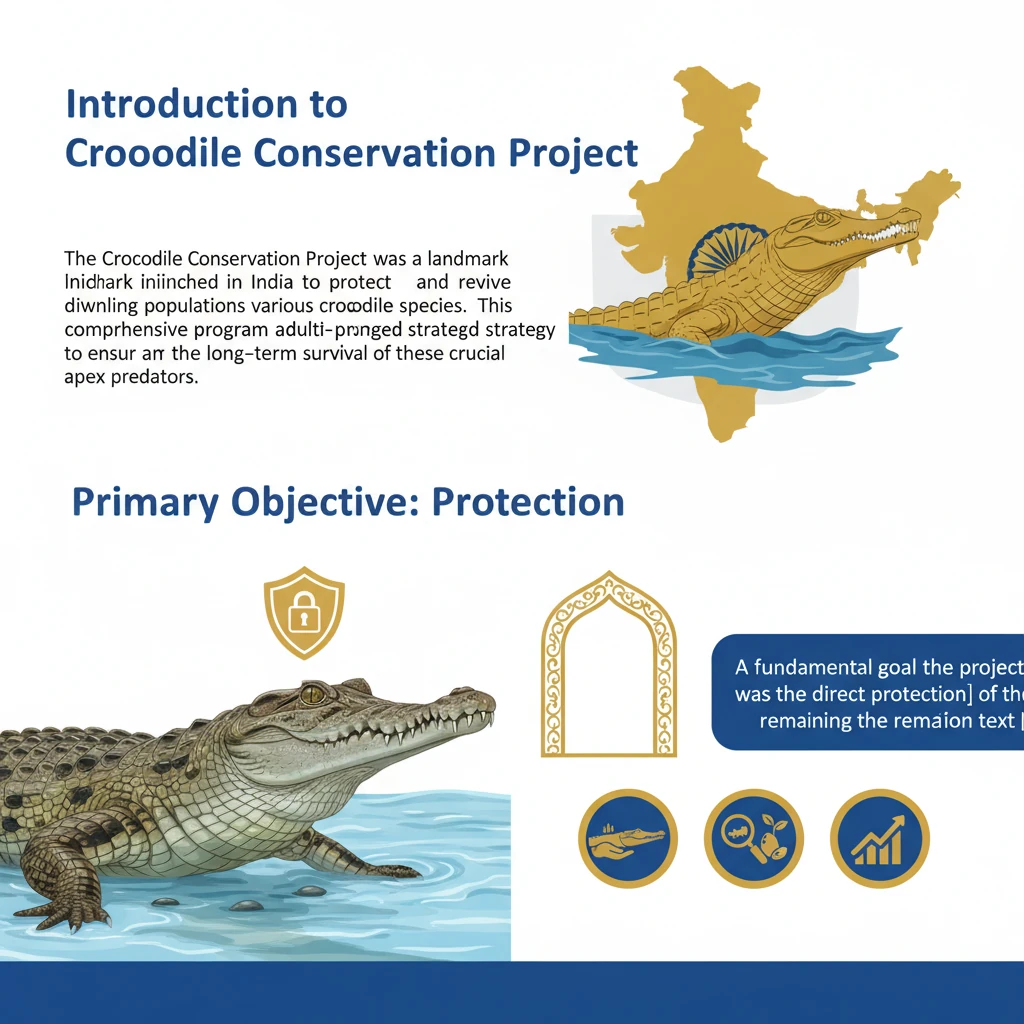
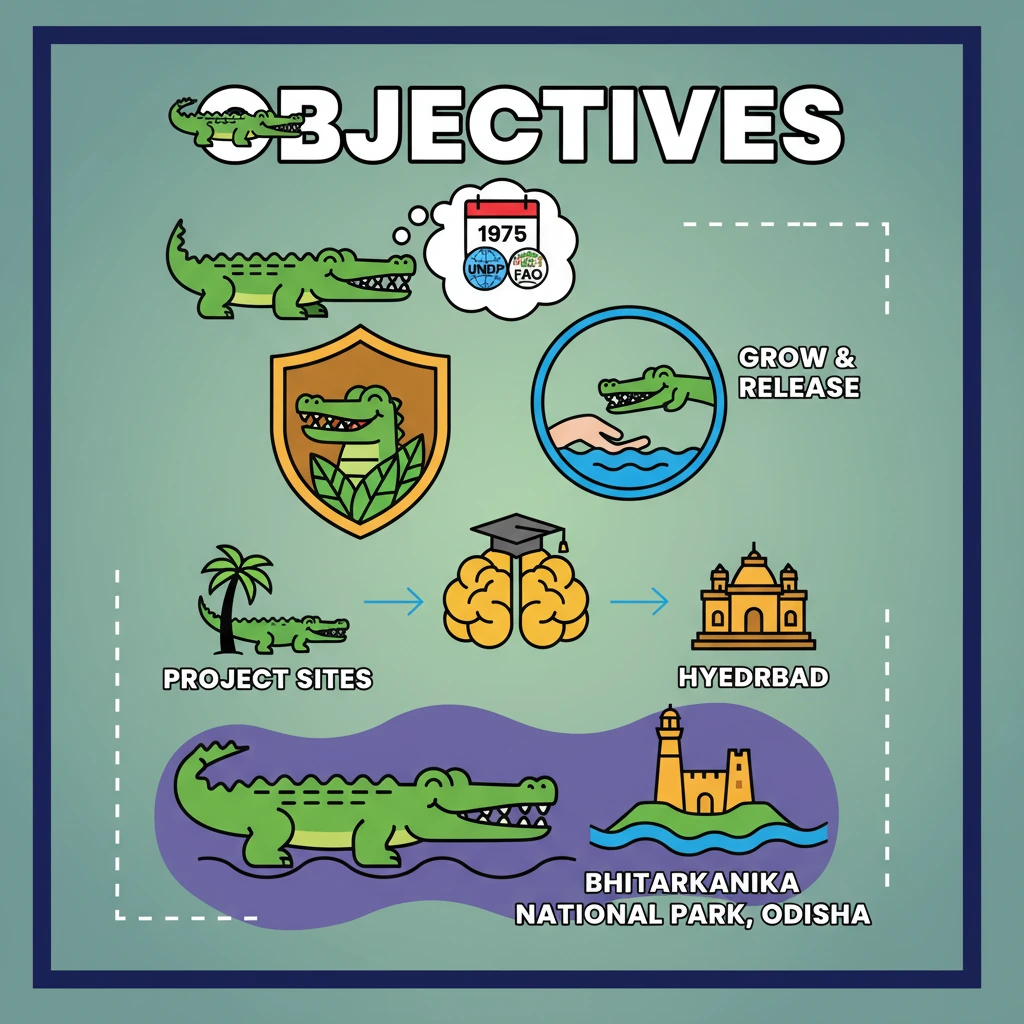
<h4>Introduction to Crocodile Conservation Project</h4><p>The <strong>Crocodile Conservation Project</strong> was a landmark initiative launched in India to protect and revive the dwindling populations of various crocodile species. This comprehensive program adopted a multi-pronged strategy to ensure the long-term survival of these crucial apex predators.</p><h4>Primary Objective: Protection</h4><p>A fundamental goal of the project was the direct <strong>protection</strong> of the remaining <strong>crocodile populations</strong>. This involved safeguarding them in their <strong>natural habitats</strong>, primarily through the establishment and effective management of dedicated sanctuaries.</p><div class='info-box'><p><strong>Habitat Protection:</strong> Establishing and managing <strong>sanctuaries</strong> and <strong>protected areas</strong> is critical for providing safe breeding grounds and foraging areas, free from human interference and poaching.</p></div><h4>Secondary Objective: Population Rebuilding ('Grow and Release')</h4><p>A core strategy for population recovery was the '<strong>grow and release</strong>' or '<strong>rear and release</strong>' approach. This involved a systematic process designed to significantly increase the survival rates of young crocodiles.</p><div class='key-point-box'><p><strong>'Grow and Release' Process:</strong><ul><li><strong>Egg Collection:</strong> Gathering crocodile eggs from natural nests.</li><li><strong>Incubation:</strong> Controlled incubation of eggs in protected environments.</li><li><strong>Rearing:</strong> Raising hatchlings in captivity until they reach a suitable size, reducing vulnerability to predators.</li><li><strong>Release:</strong> Releasing the sub-adult crocodiles into designated natural habitats.</li><li><strong>Monitoring:</strong> Post-release tracking and observation to assess survival and adaptation.</li></ul></p></div><h4>Capacity Building: Personnel Training</h4><p>To ensure the project's success, a strong emphasis was placed on developing skilled human resources. This involved intensive <strong>training for personnel</strong> involved in crocodile conservation activities.</p><div class='info-box'><p><strong>Training Locations:</strong> Training was provided at various <strong>project sites</strong> across the country, as well as at the specialized <strong>Central Crocodile Breeding and Management Institute</strong> located in <strong>Hyderabad</strong>.</p></div><h4>International Collaboration and Implementation</h4><p>The initiation and successful implementation of the <strong>Crocodile Conservation Project</strong> benefited significantly from international support. This collaboration underscored the global importance of wildlife conservation efforts.</p><div class='info-box'><p><strong>International Assistance:</strong> The project was launched with crucial assistance from the <strong>United Nations Development Programme (UNDP)</strong> and the <strong>Food and Agriculture Organization (FAO)</strong>.</p></div><h4>Key Crocodile Conservation Sanctuaries in India</h4><p>Several protected areas became vital centers for crocodile conservation, each specializing in different species. These sanctuaries played a pivotal role in the project's achievements.</p><ul><li><strong>Bhitarkanika National Park (Odisha):</strong> Renowned for its successful conservation of <strong>saltwater crocodiles</strong>.</li><li><strong>National Chambal Sanctuary (Madhya Pradesh, Rajasthan, Uttar Pradesh):</strong> A critical habitat for the endangered <strong>gharials</strong>, spanning three Indian states.</li></ul><h4>Project Achievements and Recent Developments</h4><p>The long-term commitment to the <strong>Crocodile Conservation Project</strong> has yielded significant positive outcomes, particularly for certain species.</p><div class='highlight-box'><p><strong>Major Achievement:</strong> Since its launch in <strong>1975</strong>, the project has led to a steady and substantial rise in the population of <strong>saltwater crocodiles</strong> in India, marking a notable conservation success story.</p></div><p>However, successful conservation also brings new challenges and management decisions. A recent development highlights this evolution in strategy.</p><div class='exam-tip-box'><p><strong>Important Update (2024):</strong> The intensive <strong>crocodile breeding program</strong> within <strong>Bhitarkanika National Park</strong> was officially stopped in <strong>2024</strong>. This decision was made due to the achievement of <strong>population saturation</strong> for saltwater crocodiles within the park. Despite this, <strong>egg collection</strong> continues annually, with eggs being bred for <strong>tourism purposes</strong> rather than for release into the wild.</p></div>
💡 Key Takeaways
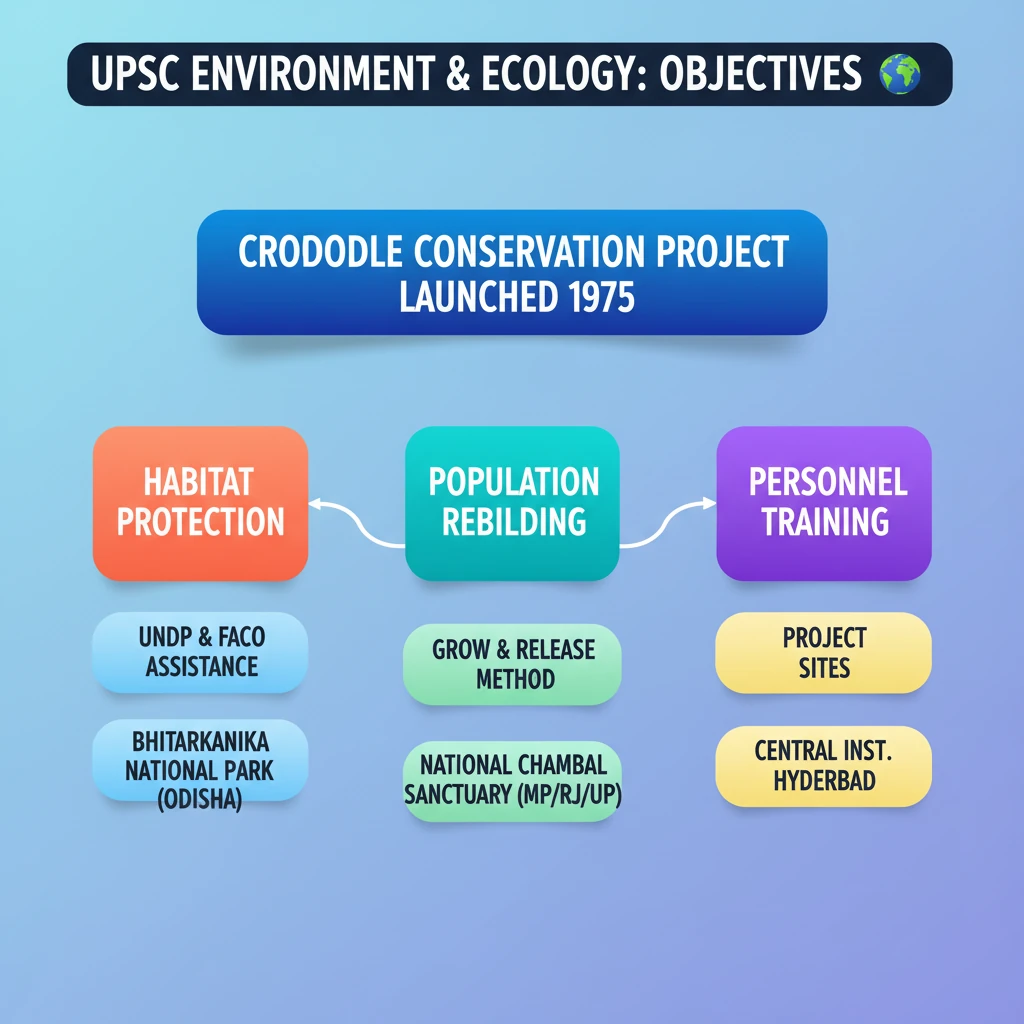
- •Crocodile Conservation Project launched in 1975 with UNDP and FAO assistance.
- •Key objectives: Protection of natural habitats and rebuilding populations via 'grow and release' method.
- •Personnel training conducted at project sites and Central Crocodile Breeding Institute, Hyderabad.
- •Bhitarkanika National Park (Odisha) is crucial for saltwater crocodiles.
- •National Chambal Sanctuary (MP, Rajasthan, UP) is vital for gharials.
- •Saltwater crocodile population has significantly risen since 1975.
- •Bhitarkanika's breeding program stopped in 2024 due to population saturation; eggs now bred for tourism.
🧠 Memory Techniques
95% Verified Content
📚 Reference Sources
•Ministry of Environment, Forest and Climate Change (MoEFCC) reports on wildlife conservation
•IUCN Red List for crocodile species status
•National Park and Wildlife Sanctuary official websites (Bhitarkanika, Chambal)