18th India State of Forest Report 2023 - Environment And Ecology | UPSC Learning
Topics
0 topics • 0 completed
🔍
No topics match your search
18th India State of Forest Report 2023
Medium⏱️ 7 min read
environment and ecology
📖 Introduction
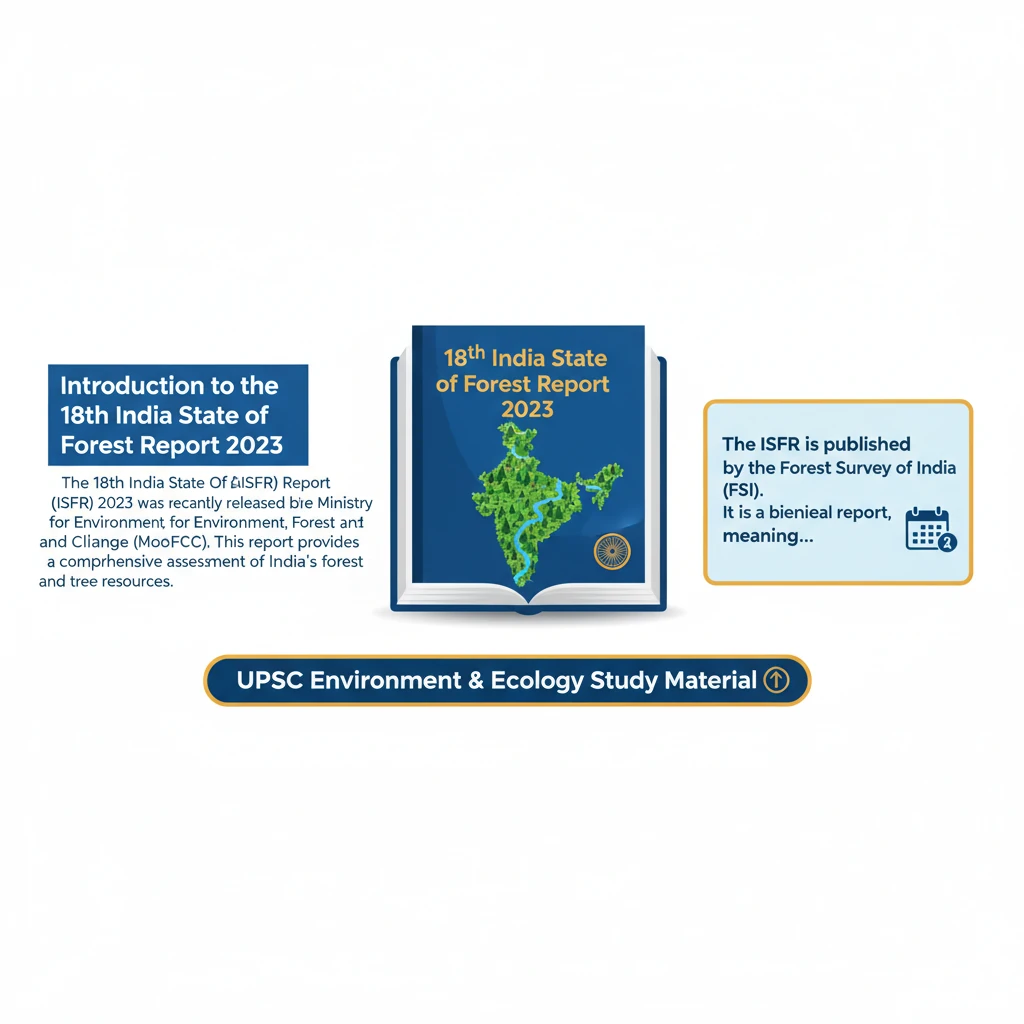
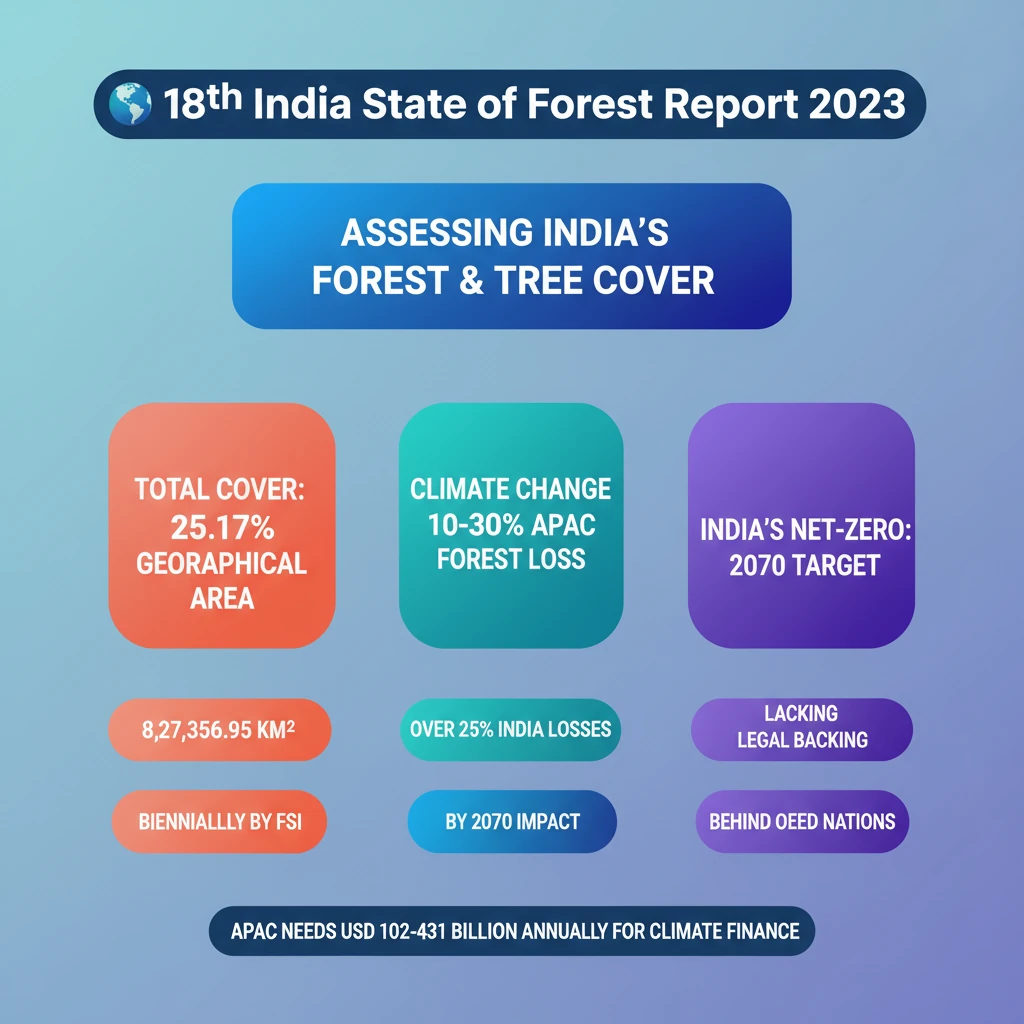
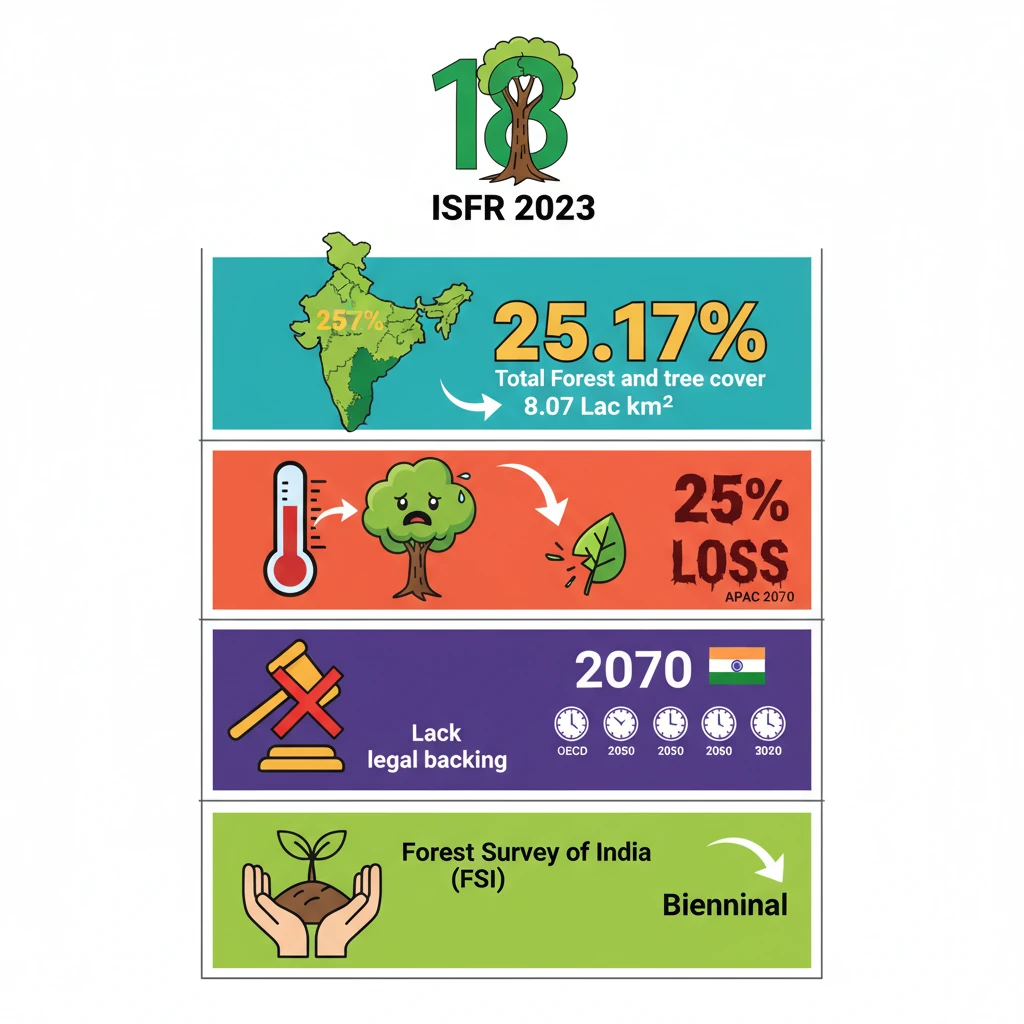
<h4>Introduction to the 18th India State of Forest Report 2023</h4><p>The <strong>18th India State of Forest Report (ISFR) 2023</strong> was recently released by the <strong>Ministry for Environment, Forest and Climate Change (MoEFCC)</strong>. This report provides a comprehensive assessment of India's forest and tree resources.</p><div class='info-box'><p>The <strong>ISFR</strong> is published by the <strong>Forest Survey of India (FSI)</strong>. It is a <strong>biennial</strong> report, meaning it is released every two years, a practice that began in <strong>1987</strong>.</p></div><h4>Key Findings: Forest and Tree Cover</h4><p>The report highlights the current status of <strong>forest and tree cover</strong> across the country. This data is crucial for understanding India's progress in achieving its environmental goals.</p><div class='key-point-box'><p>The <strong>total forest and tree cover</strong> of India stands at <strong>8,27,356.95 km²</strong>. This constitutes <strong>25.17%</strong> of the country's total <strong>geographical area (GA)</strong>.</p></div><p>The report further breaks down this total into distinct categories:</p><table class='info-table'><tr><th>Class</th><th>Area (km²)</th><th>Percentage of GA</th></tr><tr><td><strong>Forest Cover</strong></td><td><strong>7,15,342.61 km²</strong></td><td><strong>21.76%</strong></td></tr><tr><td><strong>Tree Cover</strong></td><td><strong>1,12,014.34 km²</strong></td><td><strong>3.41%</strong></td></tr><tr><td><strong>Total Forest and Tree Cover</strong></td><td><strong>8,27,356.95 km²</strong></td><td><strong>25.17%</strong></td></tr></table><h4>Environmental Impact Projections</h4><p>The <strong>ISFR 2023</strong> also delves into the potential environmental impacts, particularly concerning <strong>forest productivity</strong> under changing climatic conditions. These projections are vital for long-term planning.</p><div class='info-box'><p><strong>Climate change</strong> is projected to significantly reduce <strong>forest output</strong> in the <strong>Asia-Pacific (APAC)</strong> region. Estimates suggest a <strong>10–30% reduction</strong> by <strong>2070</strong>.</p></div><p>Specific regions within <strong>APAC</strong> are expected to face varying degrees of impact:</p><ul><li><strong>India</strong>, <strong>Vietnam</strong>, and <strong>Southeast Asia</strong> could experience losses exceeding <strong>25%</strong>.</li><li>In contrast, <strong>China</strong> and <strong>Central Asia</strong> might see modest increases, typically under <strong>5%</strong>.</li></ul><h4>Required Actions: Addressing Climate Change</h4><p>The report emphasizes several critical actions needed to mitigate climate change and its impacts on forests. These actions involve policy, finance, and technological shifts.</p><h5>Net-Zero Commitments and Targets</h5><p>Achieving <strong>net-zero emissions</strong> is a global imperative. The report assesses the commitments made by Asian economies in this regard.</p><div class='key-point-box'><p>Out of <strong>44 Asian economies</strong>, <strong>36</strong> have announced <strong>net-zero targets</strong>. However, only <strong>four</strong> of these commitments currently possess <strong>legal backing</strong>.</p></div><p>Comparison with developed nations reveals a lag:</p><ul><li><strong>India's net-zero target</strong> is set for <strong>2070</strong>.</li><li><strong>China's target</strong> is for <strong>2060</strong>.</li><li>Most <strong>OECD nations</strong> aim for <strong>2050</strong>, indicating a more ambitious timeline.</li></ul><h5>Climate Finance Needs</h5><p>Adequate financial resources are indispensable for effective climate action. The report quantifies the substantial funding gap in the region.</p><div class='info-box'><p>The <strong>APAC region</strong> requires an estimated <strong>USD 102–431 billion annually</strong> for climate action. This significantly exceeds the <strong>USD 50 billion</strong> recorded in <strong>2021-22</strong>.</p></div><p>To bridge this gap, crucial reforms are needed:</p><ul><li>Greater mobilization of <strong>private investment</strong>.</li><li>Implementation of robust <strong>regulatory reforms</strong> to facilitate climate-friendly investments.</li></ul><h5>Renewable Energy and Carbon Markets</h5><p>The report identifies key strategies for cost-effective climate mitigation. Scaling up clean energy and utilizing market mechanisms are central to these strategies.</p><div class='exam-tip-box'><p>For <strong>UPSC Mains (GS-III Environment)</strong>, understanding the interplay between <strong>renewable energy expansion</strong> and <strong>carbon markets</strong> is crucial. These are practical tools for achieving climate goals efficiently.</p></div><p>The <strong>ISFR 2023</strong> underscores the necessity for:</p><ul><li>Rapidly <strong>scaling up renewable energy</strong> infrastructure and adoption.</li><li>Effectively <strong>leveraging carbon markets</strong> to drive cost-effective climate action and incentivize emission reductions.</li></ul>
💡 Key Takeaways
- •The 18th ISFR 2023, released biennially by FSI, assesses India's forest and tree cover.
- •Total forest and tree cover is 8,27,356.95 km², representing 25.17% of India's geographical area.
- •Climate change could reduce APAC forest output by 10-30% by 2070, with India facing over 25% losses.
- •Most Asian net-zero targets lack legal backing; India's target is 2070, behind OECD nations.
- •APAC needs USD 102-431 billion annually for climate finance, requiring private investment and regulatory reforms.
- •Scaling up renewable energy and leveraging carbon markets are critical for cost-effective climate action.
🧠 Memory Techniques
95% Verified Content
📚 Reference Sources
•Ministry for Environment, Forest and Climate Change (MoEFCC)
•Forest Survey of India (FSI) official reports (implied by source content)