What is Carbon Dioxide Removal (CDR)? - Environment And Ecology | UPSC Learning
Topics
0 topics • 0 completed
🔍
No topics match your search
What is Carbon Dioxide Removal (CDR)?
Medium⏱️ 10 min read
environment and ecology
📖 Introduction
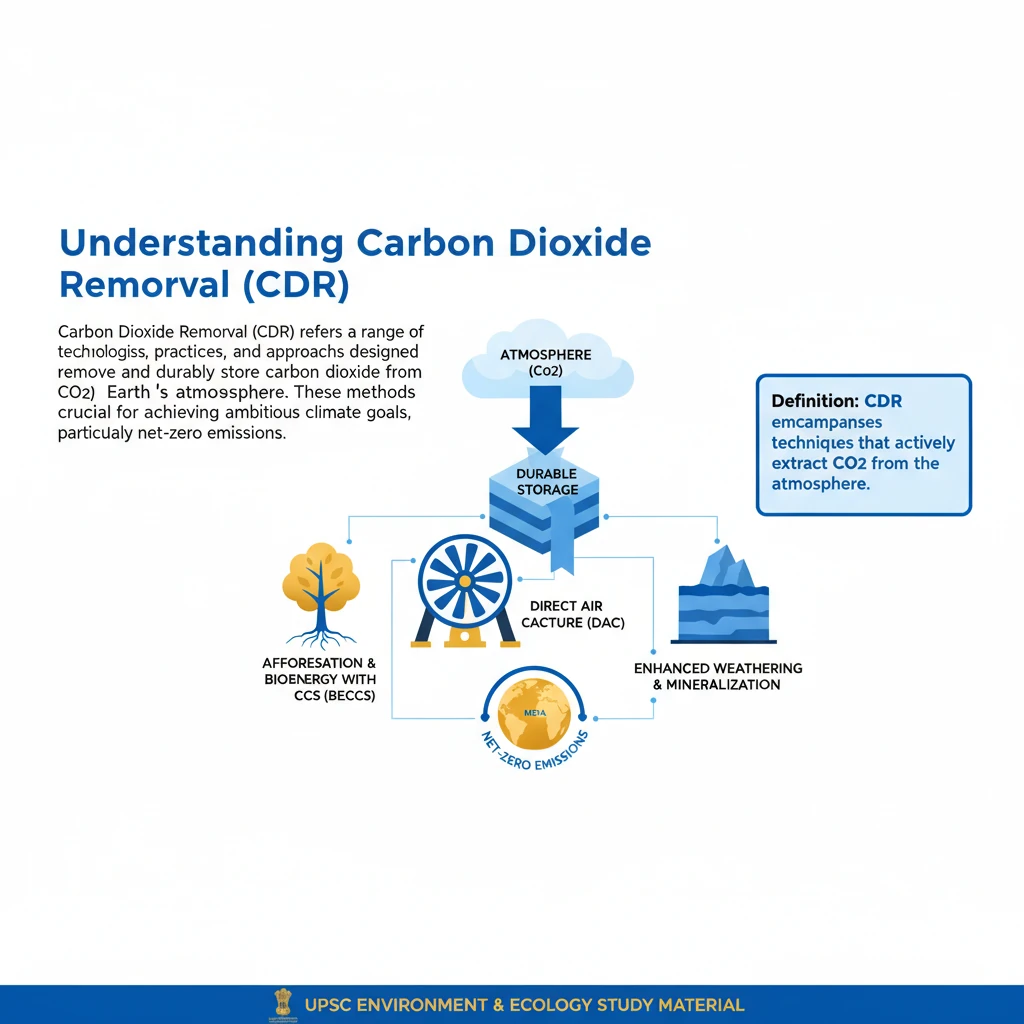
<h4>Understanding Carbon Dioxide Removal (CDR)</h4><p><strong>Carbon Dioxide Removal (CDR)</strong> refers to a range of technologies, practices, and approaches designed to remove and durably store <strong>carbon dioxide (CO2)</strong> from the Earth's atmosphere. These methods are crucial for achieving ambitious climate goals, particularly <strong>net-zero emissions</strong>.</p><div class='info-box'><p><strong>Definition:</strong> <strong>CDR</strong> encompasses techniques that actively extract existing <strong>CO2</strong> from the atmosphere and lock it away for extended periods, complementing efforts to reduce new emissions.</p></div><h4>Land-Based Carbon Dioxide Removal Methods</h4><p>Land-based <strong>CDR</strong> strategies leverage natural processes and engineered solutions on terrestrial ecosystems to capture and store <strong>CO2</strong>. These methods often involve vegetation, soil, and geological formations.</p><table class='info-table'><thead><tr><th><strong>CDR Method</strong></th><th><strong>Implementation Options</strong></th><th><strong>Storage Timescale</strong></th><th><strong>Financial Cost ($/tonne CO2)</strong></th><th><strong>Trade-offs & Risks</strong></th></tr></thead><tbody><tr><td><strong>Afforestation, Reforestation, and Avoided Deforestation</strong></td><td>Agriculture & tree planting; silviculture; timber in construction; bio-based products</td><td>Decades to centuries (in vegetation, buildings, soils)</td><td>Afforestation/reforestation: ~$50-$100</td><td>Deforestation/reforestation can increase or decrease agricultural yields; large-scale changes can impact water cycles on regional scales; fertilizer use and introduced species can impact biodiversity.</td></tr><tr><td><strong>Soil Carbon Sequestration</strong></td><td>Agricultural practices; pasture management</td><td>Decades to centuries (in soils)</td><td>Agroforestry and soil carbon sequestration: ~$10-$100</td><td>Potential impacts to agricultural crop yields; competition for biomass could lead to negative impacts from growing energy crops for bioenergy and food.</td></tr><tr><td><strong>Biochar</strong></td><td>Cropping and forestry residues; industrial organic waste; purpose-grown biomass crops</td><td>Decades to centuries (in soils and sediments)</td><td>~$10-$45</td><td>Could lead to growing competition for land and food; increased eutrophication; increased acidification.</td></tr><tr><td><strong>Bioenergy with Carbon Capture and Storage (BECCS)</strong></td><td>Purpose-grown biomass crops with industrial carbon capture</td><td>100+ years (in geological formations)</td><td>~$50-$500</td><td>High energy requirement; potential for increased water use and energy use; SACC processes require energy generation.</td></tr><tr><td><strong>Direct Air Carbon Capture (DACC)</strong></td><td>Industrial capture plants</td><td>100+ years (in geological formations)</td><td>~$100-$500</td><td>Some products are used for food production, so could compete with food production; could lead to growing competition for land and food; increased eutrophication; increased acidification.</td></tr><tr><td><strong>Enhanced Rock Weathering</strong></td><td>Agricultural land application of silicate rock</td><td>Decades to centuries (weathered rock, sediments)</td><td>~$50-$200</td><td>Potential for increased GHG emissions from mining, transport, and deployment.</td></tr><tr><td><strong>Wetland and Waterbed Revegetation</strong></td><td>Rewetting; revegetation of coastal and freshwater wetlands</td><td>Decades to centuries (in soils, sediments)</td><td>Not enough data</td><td>Potential for significant <strong>CH4</strong> release; waste nutrients are likely to release carbon back to the atmosphere.</td></tr></tbody></table><div class='key-point-box'><p><strong>Key Point:</strong> Land-based methods vary widely in cost, storage duration, and associated environmental trade-offs. Careful planning is essential to maximize benefits and mitigate risks.</p></div><h4>Ocean-Based Carbon Dioxide Removal Methods</h4><p>Ocean-based <strong>CDR</strong> approaches utilize the vast capacity of marine environments to absorb and store <strong>CO2</strong>. These methods often involve altering ocean chemistry or enhancing biological processes.</p><table class='info-table'><thead><tr><th><strong>CDR Method</strong></th><th><strong>Implementation Options</strong></th><th><strong>Storage Timescale</strong></th><th><strong>Financial Cost ($/tonne CO2)</strong></th><th><strong>Trade-offs & Risks</strong></th></tr></thead><tbody><tr><td><strong>Blue Carbon Management</strong></td><td>Rewetting; coastal revegetation (mangroves, salt marshes, seagrass)</td><td>Decades to centuries (in sediments, dedicated)</td><td>Not enough data</td><td>Potential for significant <strong>CH4</strong> release; waste nutrients are likely to release carbon back to the atmosphere.</td></tr><tr><td><strong>Ocean Alkalinity Enhancement</strong></td><td>Adding alkaline materials such as carbonate or silicate rock to the ocean</td><td>10,000+ years (in ocean, sediments)</td><td>$40-$500</td><td>Potential for increased <strong>GHG</strong> emissions from mining, transport, and deployment; may negatively impact marine ecosystems and alter the albedo.</td></tr><tr><td><strong>Iron Fertilisation</strong></td><td>Ocean fertilization; nitrogen and phosphorus fertilization; enhanced upwelling</td><td>Centuries to millennia (in ocean, sediments)</td><td>$50-$500</td><td>Ocean acidification and eutrophication; altered supply of ocean macronutrients; potential impacts on marine food webs and biodiversity.</td></tr></tbody></table><div class='key-point-box'><p><strong>Key Point:</strong> Ocean-based <strong>CDR</strong> methods offer potentially longer storage timescales but carry significant uncertainties regarding ecological impacts and operational feasibility.</p></div><div class='exam-tip-box'><p><strong>UPSC Insight:</strong> Understanding the diverse methods, their pros and cons, and their scalability is critical for questions on climate change mitigation strategies in <strong>GS-III Environment</strong>. Be prepared to discuss both technological and nature-based solutions.</p></div>
💡 Key Takeaways
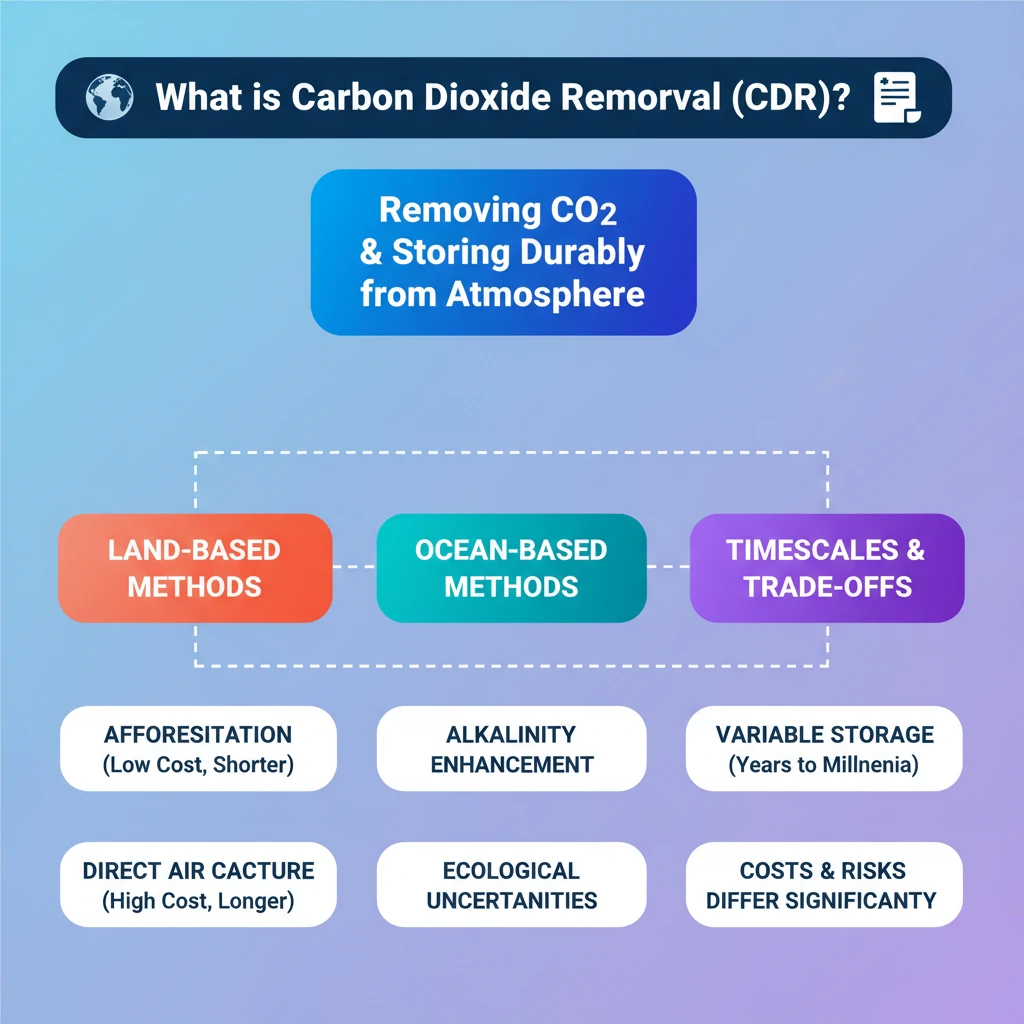
- •Carbon Dioxide Removal (CDR) involves removing CO2 from the atmosphere and storing it durably.
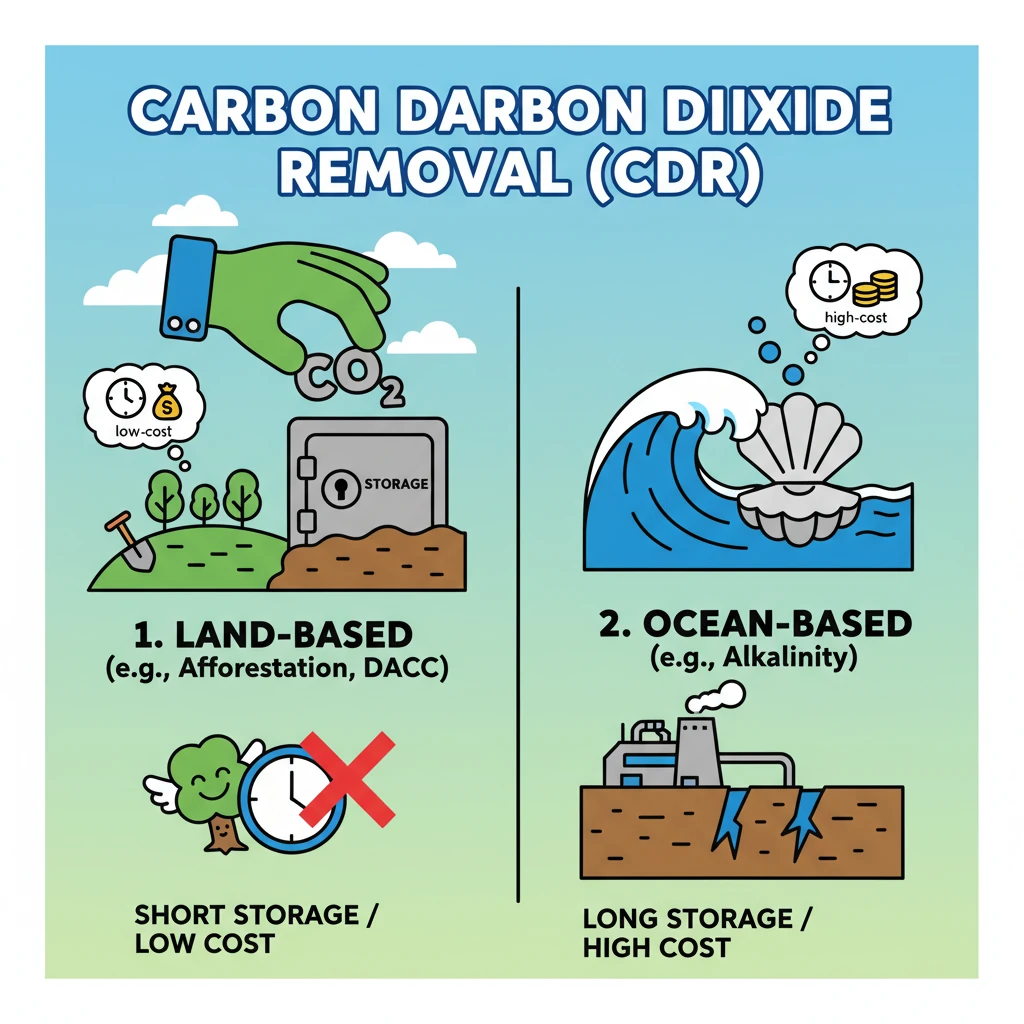
- •CDR methods are categorized as land-based (e.g., afforestation, DACC) or ocean-based (e.g., ocean alkalinity enhancement).
- •Each method has varying storage timescales, financial costs, and associated trade-offs/risks.
- •Land-based methods like afforestation are relatively low-cost but have shorter storage, while DACC is high-cost but offers long-term geological storage.
- •Ocean-based methods offer very long storage but come with significant ecological uncertainties.
- •CDR is crucial for achieving net-zero emissions and bridging the gap in climate targets, complementing emissions reduction.
- •Responsible deployment requires careful consideration of energy, land, water use, and potential environmental impacts.
🧠 Memory Techniques
95% Verified Content
📚 Reference Sources
•Intergovernmental Panel on Climate Change (IPCC) Reports (general knowledge)
•Various academic and policy reports on climate change mitigation and CDR technologies