Increase in Forest and Tree Cover - Environment And Ecology | UPSC Learning
Topics
0 topics • 0 completed
🔍
No topics match your search
Increase in Forest and Tree Cover
Medium⏱️ 8 min read
environment and ecology
📖 Introduction
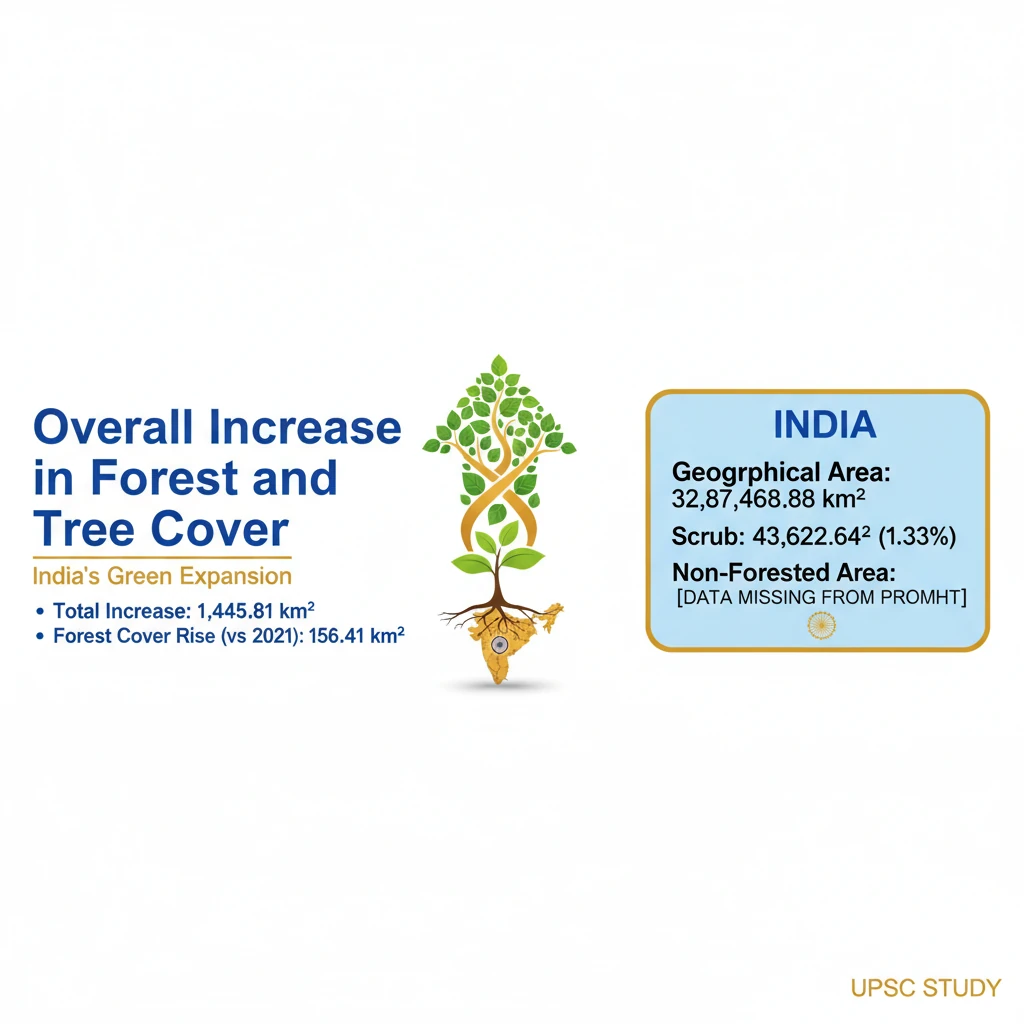
<h4>Overall Increase in Forest and Tree Cover</h4><p>India has shown a positive trend in its <strong>forest and tree cover</strong>. The total increase is <strong>1,445.81 km²</strong>, with a specific rise of <strong>156.41 km²</strong> in forest cover compared to <strong>2021</strong>.</p><div class="info-box"><p>The <strong>geographical area</strong> of India is <strong>32,87,468.88 km²</strong>. <strong>Scrub</strong> constitutes <strong>43,622.64 km² (1.33%)</strong>, while <strong>Non-Forest</strong> land is <strong>24,16,489.29 km² (73.50%)</strong>.</p></div><h4>States with Maximum Increase in Forest and Tree Cover</h4><p>Several states have contributed significantly to the overall increase in <strong>forest and tree cover</strong>. <strong>Chhattisgarh</strong> led with an increase of <strong>684 sq km</strong>.</p><p>It was closely followed by <strong>Uttar Pradesh</strong> and <strong>Odisha</strong>, both recording an increase of <strong>559 sq km</strong>. <strong>Rajasthan</strong> also showed a notable rise of <strong>394 sq km</strong>.</p><h4>States with Maximum Increase in Forest Cover (Specifically)</h4><p>When considering only <strong>forest cover</strong>, <strong>Mizoram</strong> registered the highest increase of <strong>242 sq km</strong>. <strong>Gujarat</strong> followed with an increase of <strong>180 sq km</strong>.</p><p><strong>Odisha</strong> also contributed significantly with a rise of <strong>152 sq km</strong> in its forest cover.</p><h4>States with Largest Decrease in Forest Cover</h4><p>Despite the overall increase, some states experienced a decrease in their forest cover. <strong>Madhya Pradesh</strong> saw the largest reduction of <strong>612.41 km²</strong>.</p><p>Other states with significant decreases included <strong>Karnataka (439.36 km²)</strong>, <strong>Ladakh (159.26 km²)</strong>, and <strong>Telangana (125.32 km²)</strong>.</p><h4>Top States by Forest Area</h4><p>In terms of the absolute geographical area covered by forests, certain states stand out. <strong>Madhya Pradesh</strong> holds the largest forest cover with <strong>77,073 sq km</strong>.</p><p>It is followed by <strong>Arunachal Pradesh (65,882 sq km)</strong> and <strong>Chhattisgarh (55,812 sq km)</strong>.</p><h4>Top States by Percentage of Forest Cover</h4><p>When considering the percentage of forest cover relative to the total geographical area, the picture changes. <strong>Lakshadweep</strong> has the highest percentage at <strong>91.33%</strong>.</p><p><strong>Mizoram (85.34%)</strong> and <strong>Andaman & Nicobar Island (81.62%)</strong> also have very high percentages.</p><div class="key-point-box"><p><strong>19 states/UTs</strong> have more than <strong>33%</strong> of their geographical area under forest cover, a crucial ecological benchmark.</p></div><p>Eight of these states/UTs—<strong>Mizoram, Lakshadweep, A & N Island, Arunachal Pradesh, Nagaland, Meghalaya, Tripura, and Manipur</strong>—boast forest cover above <strong>75%</strong>.</p><h4>Forest Carbon Stock</h4><p>Forests play a vital role as <strong>carbon sinks</strong>, absorbing atmospheric carbon dioxide. India's forest carbon stock is estimated at <strong>7,285.5 million tonnes</strong>, showing an increase of <strong>81.5 million tonnes</strong> since <strong>2021</strong>.</p><div class="info-box"><p>The country's total carbon stock has reached <strong>30.42 billion tonnes of CO₂ equivalent</strong>. This exceeds the <strong>2005 base year</strong> by <strong>2.29 billion tonnes</strong>, bringing India closer to its <strong>2030 target</strong> of <strong>2.5–3.0 billion tonnes</strong>.</p></div><p>Top contributors to carbon stock include <strong>Arunachal Pradesh (1,021 Mt)</strong>, <strong>Madhya Pradesh (926 Mt)</strong>, <strong>Chhattisgarh (505 Mt)</strong>, and <strong>Maharashtra (465 Mt)</strong>.</p><h4>Regional Performance</h4><p>Specific ecological regions demonstrate unique forest cover characteristics. The <strong>Western Ghats Eco-Sensitive Areas (WGESA)</strong> span <strong>60,285.61 km²</strong>, with <strong>73% (44,043.99 km²)</strong> under forest cover.</p><p>The <strong>Northeastern region</strong> has a total forest and tree cover of <strong>1,74,394.70 km²</strong>, which accounts for <strong>67%</strong> of its geographical area.</p><h4>Mangrove Cover</h4><p><strong>Mangroves</strong> are crucial coastal ecosystems. India's mangrove cover is <strong>4,991.68 km²</strong>, representing <strong>0.15%</strong> of the total geographical area.</p><p>There was a net decrease of <strong>7.43 km²</strong> in mangrove cover since <strong>2021</strong>. <strong>Gujarat</strong> saw a decrease of <strong>36.39 km²</strong>.</p><p>However, <strong>Andhra Pradesh</strong> and <strong>Maharashtra</strong> experienced increases of <strong>13.01 km²</strong> and <strong>12.39 km²</strong> respectively.</p><h4>Forest Fire Incidents</h4><p>Forest fires pose a significant threat to forest ecosystems. In the <strong>2023-24 season</strong>, the states with the most fire incidents were <strong>Uttarakhand, Odisha, and Chhattisgarh</strong>.</p><div class="exam-tip-box"><p>Understanding the trends in forest fires is crucial for disaster management and environmental policy questions in <strong>UPSC Mains GS-III</strong>.</p></div>
💡 Key Takeaways
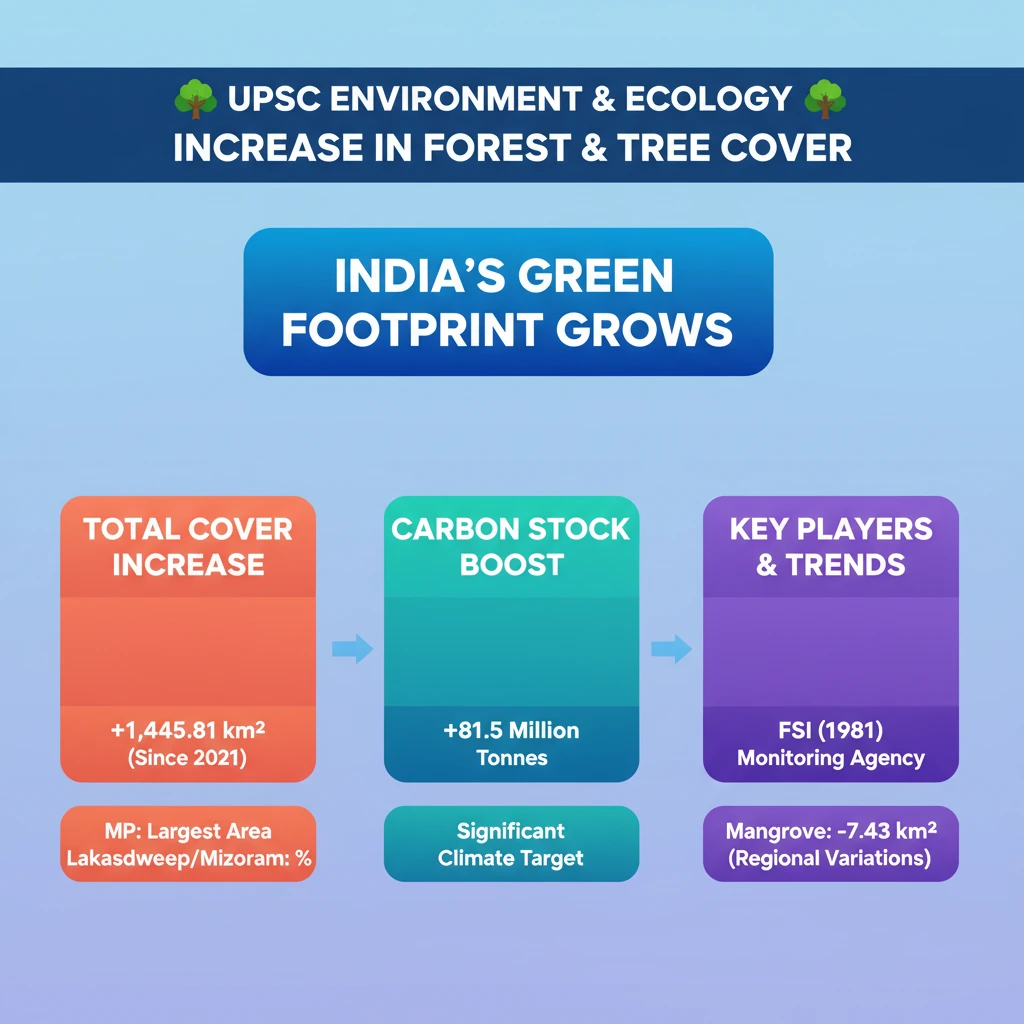
- •India's forest and tree cover increased by 1,445.81 km² since 2021, showing a positive trend.
- •Madhya Pradesh has the largest forest area, while Lakshadweep and Mizoram lead in percentage of forest cover.
- •India's forest carbon stock increased by 81.5 million tonnes, contributing significantly to climate targets.
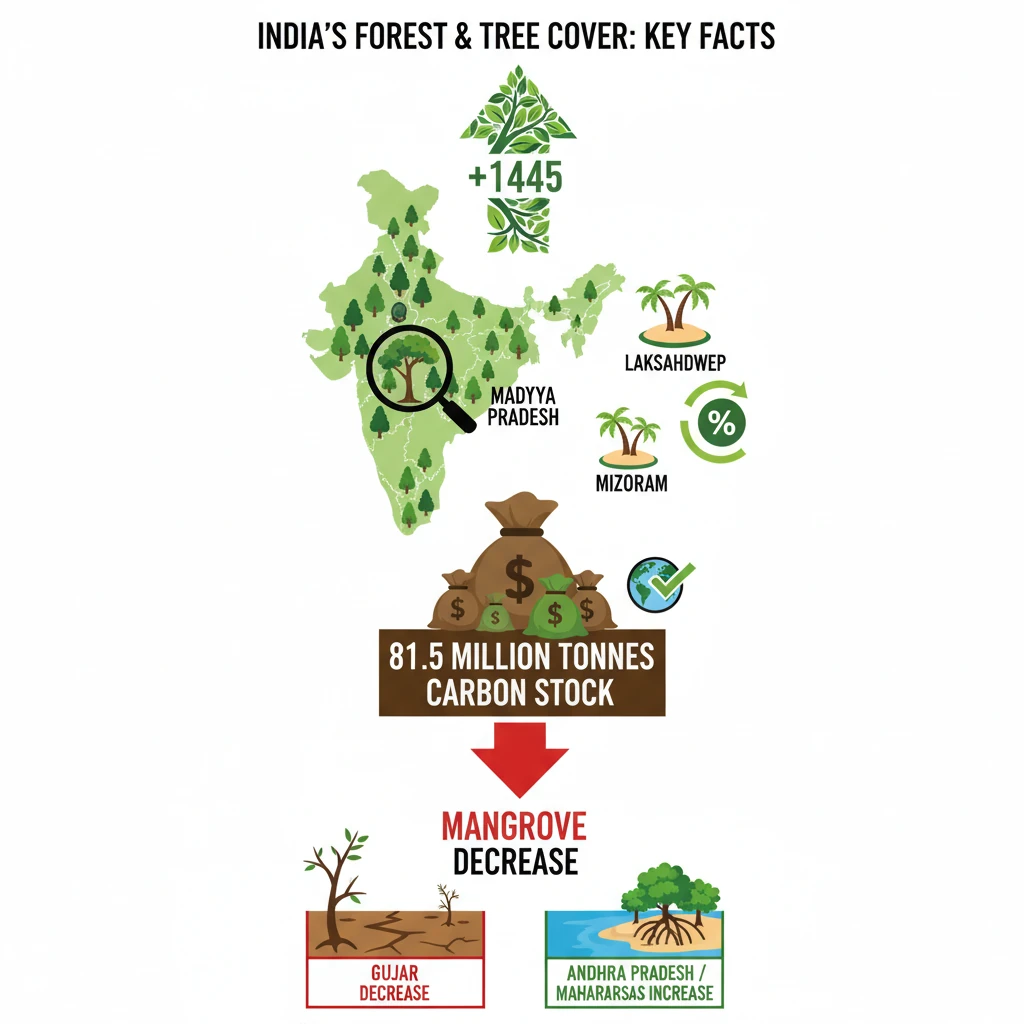
- •Mangrove cover experienced a net decrease of 7.43 km², with regional variations (e.g., Gujarat's decrease vs. Andhra Pradesh/Maharashtra's increase).
- •The Forest Survey of India (FSI), established in 1981, is the key national agency for monitoring forest resources.
- •India's efforts in forest expansion align with international commitments like the Paris Agreement and Bonn Challenge, bolstering its global standing.
🧠 Memory Techniques
95% Verified Content