What are Key Facts about the Panama Canal? - Environment And Ecology | UPSC Learning
Topics
0 topics • 0 completed
🔍
No topics match your search
What are Key Facts about the Panama Canal?
Medium⏱️ 7 min read
environment and ecology
📖 Introduction
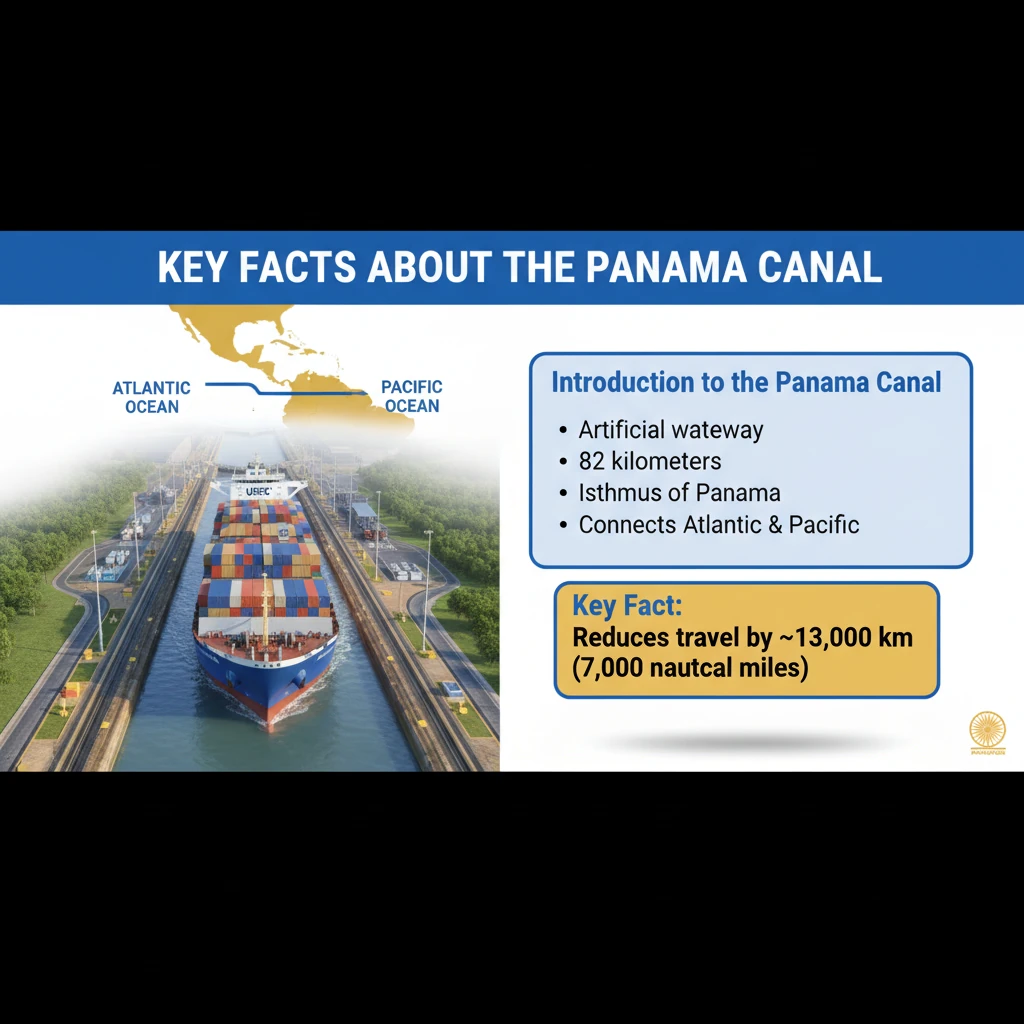
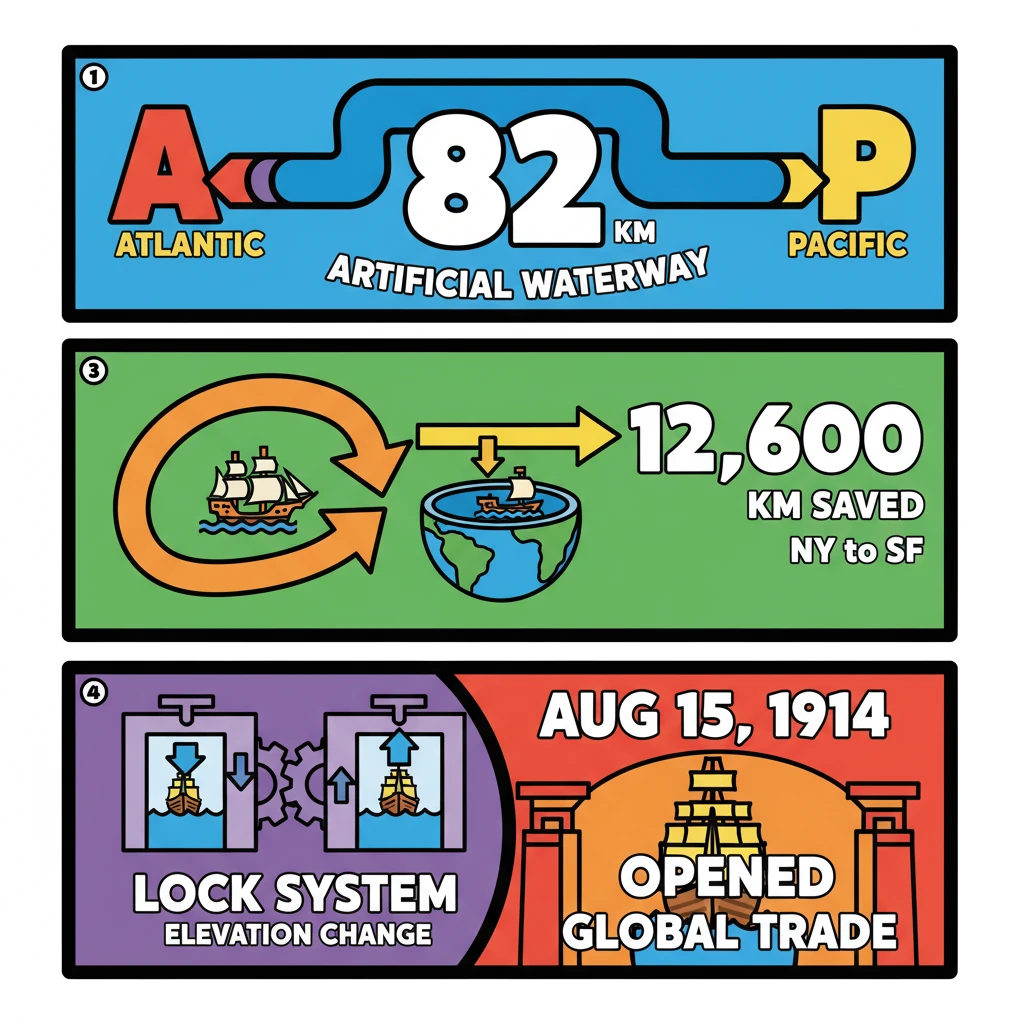
<h4>Introduction to the Panama Canal</h4><p>The <strong>Panama Canal</strong> is an <strong>artificial waterway</strong>, stretching approximately <strong>82 kilometers</strong> across the <strong>Isthmus of Panama</strong>. It serves as a vital link, connecting the <strong>Atlantic Ocean</strong> with the <strong>Pacific Ocean</strong>.</p><div class='info-box'><p><strong>Key Fact:</strong> This engineering marvel significantly reduces travel distances for maritime trade, saving approximately <strong>12,600 km</strong> on a journey between <strong>New York</strong> and <strong>San Francisco</strong>.</p></div><h4>Geographical Significance</h4><p>Cutting across the narrow <strong>Isthmus of Panama</strong>, the canal acts as a crucial <strong>conduit for maritime trade</strong>. Its strategic location eliminates the need for ships to navigate the lengthy and often hazardous route around <strong>South America</strong>.</p><h4>Historical Milestone</h4><p>A pivotal moment in global shipping history occurred on <strong>August 15, 1914</strong>, when the <strong>first ship</strong> successfully traversed the <strong>Panama Canal</strong>. This marked the official opening and operationalization of the waterway.</p><h4>Understanding the Canal's Functioning</h4><p>The <strong>Panama Canal</strong> operates as a highly sophisticated and engineered system. Its primary mechanism involves a series of <strong>locks and elevators</strong> designed to facilitate the passage of ships between the two oceans.</p><div class='key-point-box'><p>The need for this intricate system arises because the <strong>Atlantic Ocean</strong> and <strong>Pacific Ocean</strong> do not lie at the same <strong>elevation</strong>, with the <strong>Pacific Ocean</strong> being slightly higher than the <strong>Atlantic</strong>.</p></div><h4>The Lock System Explained</h4><p>For a ship entering the canal from the <strong>Atlantic side</strong>, it must gain elevation to reach the level of the <strong>Pacific Ocean</strong>. Conversely, ships traveling from the <strong>Pacific</strong> must lose elevation.</p><p>This critical adjustment is achieved through the ingenious <strong>lock system</strong>, which effectively lifts and drops vessels to the required sea level at either end of the canal.</p><h4>Mechanism of Locks: Water Elevators</h4><p>Each <strong>lock chamber</strong> functions as a "water elevator." To lift a ship, the lock is <strong>flooded</strong> with water, raising the vessel's elevation. To lower a ship, water is <strong>drained</strong> from the lock, decreasing its elevation.</p><div class='info-box'><p>The entire system of the <strong>Panama Canal</strong> comprises a total of <strong>12 locks</strong>. These locks are efficiently serviced and supplied with water through a network of <strong>artificial lakes and channels</strong>.</p></div>
💡 Key Takeaways
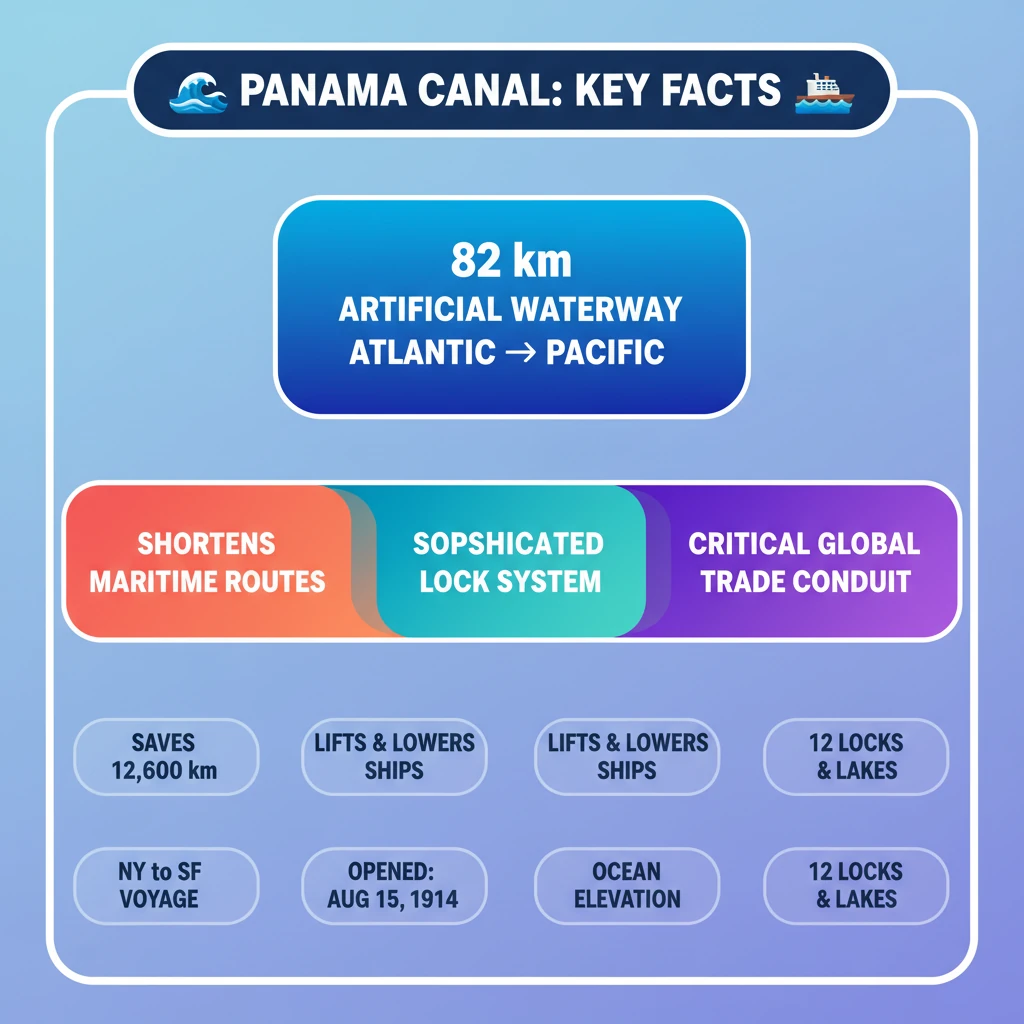
- •The Panama Canal is an 82 km artificial waterway connecting the Atlantic and Pacific Oceans.
- •It significantly shortens maritime routes, saving 12,600 km between New York and San Francisco.
- •The canal uses a sophisticated lock system to lift and lower ships due to differing ocean elevations.
- •Opened on August 15, 1914, it remains a critical conduit for global maritime trade.
- •The system comprises 12 locks, fed by artificial lakes and channels.
🧠 Memory Techniques
95% Verified Content