OECMs for Achieving KMGbF 2022 Targets - Environment And Ecology | UPSC Learning
Topics
0 topics • 0 completed
🔍
No topics match your search

OECMs for Achieving KMGbF 2022 Targets
Medium⏱️ 7 min read
environment and ecology
📖 Introduction
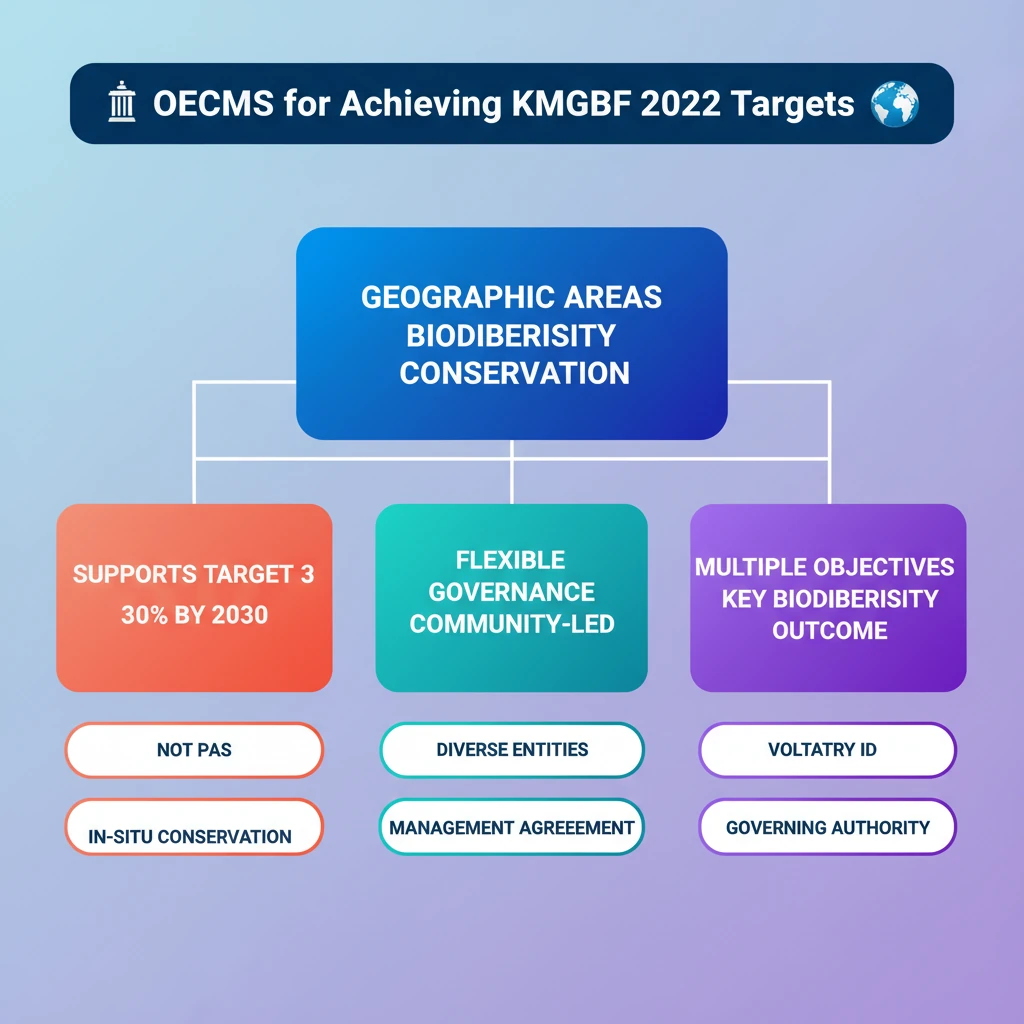
<h4>Introduction to OECMs and the Recent Report</h4><p>A significant report titled <strong>“Guidance on other effective area-based conservation measures (OECMs)”</strong> has been jointly released by the <strong>International Union for Conservation of Nature (IUCN)</strong>, its <strong>World Commission on Protected Areas (WCPA)</strong>, and the <strong>World Wide Fund for Nature (WWF)</strong>. This publication aims to provide comprehensive guidelines and case studies on OECMs.</p><p>The guidelines specifically focus on the conservation of <strong>land, water, and marine areas</strong>. Their primary objective is to facilitate the achievement of <strong>Target 3</strong> of the <strong>Kunming-Montreal Global Biodiversity Framework (KMGBF) 2022</strong>, which mandates conserving <strong>30%</strong> of these areas by the year <strong>2030</strong>.</p><h4>What are Other Effective Area-Based Conservation Measures (OECMs)?</h4><div class='info-box'><p><strong>Definition:</strong> An <strong>OECM</strong> is officially defined as a <strong>geographically defined area</strong> that is <strong>not a protected area (PA)</strong>. However, it is governed and managed in a way that achieves <strong>positive, sustained long-term outcomes</strong> for the <strong>in situ conservation of biodiversity</strong>.</p></div><p>These designated areas play a crucial role in conserving various <strong>ecosystem functions and services</strong>. This includes safeguarding areas with significant <strong>cultural, spiritual, socio-economic, or other local values</strong>, alongside their biodiversity importance.</p><p>Examples of areas that could qualify as OECMs include certain types of <strong>agricultural lands</strong> managed sustainably, or <strong>forests designated for timber production</strong> where biodiversity conservation is also a key management objective.</p><h4>Key Characteristics and Criteria for Identifying OECMs</h4><div class='key-point-box'><p>Identifying a site as an OECM requires adherence to several key characteristics and criteria:</p></div><ul><li><strong>Not a Protected Area:</strong> The fundamental characteristic is that OECMs are <strong>not formally designated protected areas (PAs)</strong>. Despite this, they make a significant contribution to overall <strong>biodiversity conservation efforts</strong>.</li><li><strong>Governance Flexibility:</strong> OECMs demonstrate significant flexibility in their governance structures. They can be effectively managed by diverse entities, including <strong>governments, private groups, indigenous peoples, or local communities</strong>.</li><li><strong>Multiple Objectives:</strong> While biodiversity conservation is a core outcome, OECMs may often be established with other primary objectives. These could include goals like <strong>water resource management</strong>, sustainable <strong>agriculture</strong>, or cultural preservation, with biodiversity conservation serving as a vital secondary benefit.</li><li><strong>Sustained Conservation:</strong> For an area to be recognized as an OECM, it must guarantee <strong>long-term in-situ biodiversity conservation</strong>. This requires robust and effective <strong>governance and management practices</strong> that ensure sustained positive outcomes.</li><li><strong>Voluntary Designation:</strong> The process of identifying and designating a site as an OECM is entirely <strong>voluntary</strong>. It necessitates the explicit agreement and commitment of the governing authority or entity responsible for the area.</li></ul><h4>OECMs in India</h4><p>The concept of <strong>OECMs in India</strong> is gaining recognition. While the source material did not provide specific examples, India possesses a rich tapestry of traditionally managed landscapes, sacred groves, and community-conserved areas that hold significant potential to be identified and formally recognized as OECMs, contributing to the nation's biodiversity targets.</p><div class='exam-tip-box'><p><strong>UPSC Insight:</strong> Understanding OECMs is crucial for questions on <strong>biodiversity conservation strategies</strong> (GS3) and <strong>international environmental agreements</strong> (GS2/3). Be prepared to differentiate OECMs from PAs and discuss their role in achieving global targets like <strong>KMGBF 30x30</strong>.</p></div>
💡 Key Takeaways
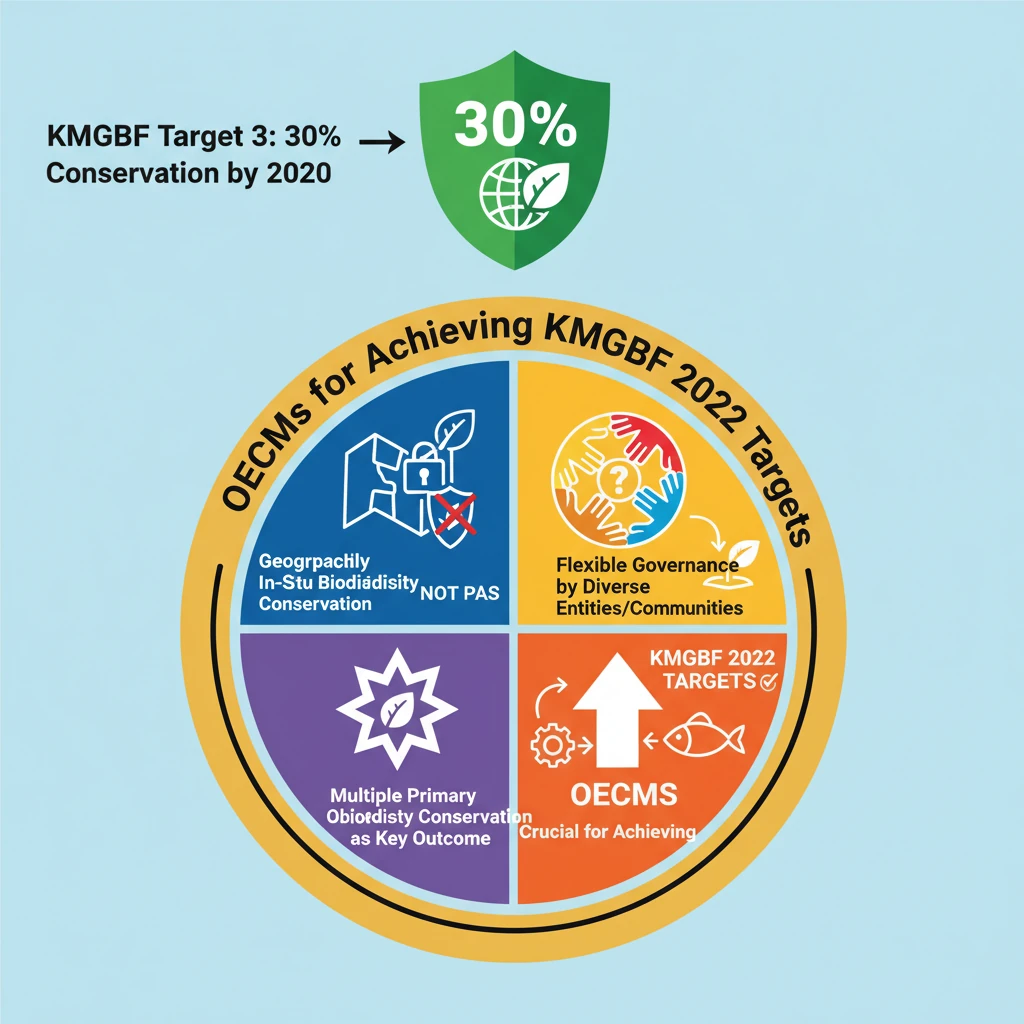
- •OECMs are geographically defined areas, not PAs, but achieve sustained in-situ biodiversity conservation.
- •They are crucial for achieving KMGBF Target 3 (30% conservation by 2030).
- •OECMs exhibit flexible governance, managed by diverse entities including communities.
- •They can have multiple primary objectives, with biodiversity conservation as a key outcome.
- •Identification and designation of OECMs are voluntary, requiring governing authority agreement.
🧠 Memory Techniques
95% Verified Content
📚 Reference Sources
•IUCN World Commission on Protected Areas (WCPA) publications on OECMs
•World Wide Fund for Nature (WWF) reports on conservation
•Convention on Biological Diversity (CBD) documents, particularly on the Kunming-Montreal Global Biodiversity Framework