What is Rat-hole Mining? - Environment And Ecology | UPSC Learning
Topics
0 topics • 0 completed
🔍
No topics match your search
What is Rat-hole Mining?
Medium⏱️ 7 min read
environment and ecology
📖 Introduction
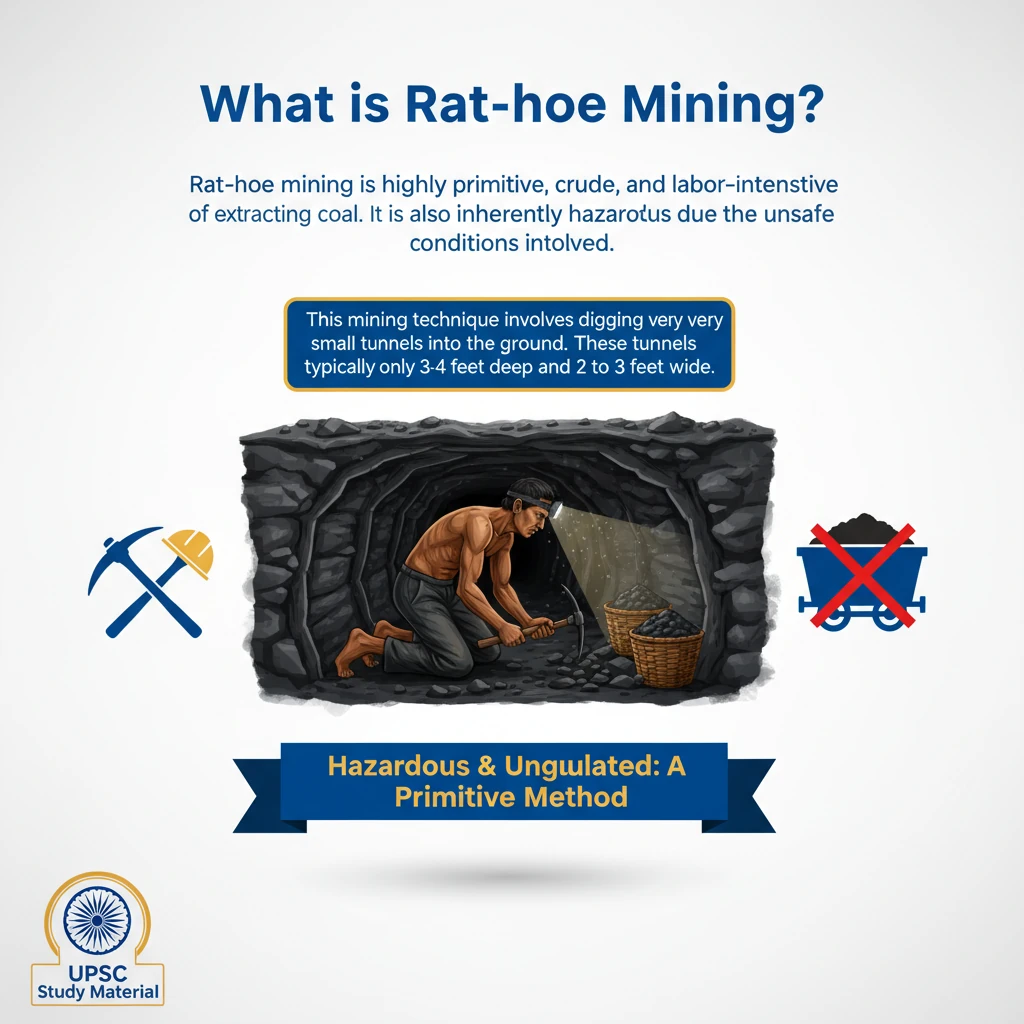
<h4>What is Rat-hole Mining?</h4><p><strong>Rat-hole mining</strong> is a highly <strong>primitive</strong>, <strong>crude</strong>, and <strong>labor-intensive</strong> method of extracting coal. It is also inherently <strong>hazardous</strong> due to the unsafe conditions involved.</p><div class='info-box'><p>This mining technique involves digging very <strong>small tunnels</strong> into the ground. These tunnels are typically only <strong>3-4 feet deep</strong> and <strong>2 to 3 feet wide</strong>, making them extremely confined spaces.</p><p>Workers, often including <strong>children</strong>, must enter these narrow shafts to manually extract coal. This practice is predominantly found in <strong>northeastern India</strong>, particularly in states like <strong>Meghalaya</strong> and <strong>Assam</strong>.</p></div><h4>Methods of Extraction</h4><p>Two primary methods are employed in rat-hole mining, each adapted to the local geological conditions.</p><ul><li><strong>Side-Cutting Procedure:</strong> This method involves digging <strong>narrow tunnels</strong> directly into <strong>hill slopes</strong>. It is used to access thin coal seams, which are typically less than <strong>2 meters in height</strong>, characteristic of the region's hilly terrain.</li><li><strong>Box-Cutting:</strong> In this procedure, miners first create a <strong>rectangular opening</strong> on the surface. Following this, a <strong>vertical pit</strong> is dug downwards. From the bottom of this pit, <strong>horizontal tunnels</strong>, resembling actual rat holes, are then excavated to extract coal.</li></ul><h4>Reasons for Rat-Hole Mining</h4><p>Several socio-economic factors contribute to the persistence of this dangerous mining practice.</p><div class='key-point-box'><p><strong>Poverty:</strong> A significant driver is the profound <strong>poverty</strong> faced by local tribal communities. With limited alternative livelihood options, rat-hole mining becomes a desperate means of <strong>survival</strong>.</p><p>The immediate financial gain from selling the extracted coal, despite the severe risks, provides a crucial income for those struggling economically.</p></div><p><strong>Lack of Ownership Issues:</strong> Ambiguities surrounding <strong>land titles</strong> and a general absence of proper <strong>regulation</strong> create a fertile ground for illegal mining. These operations exploit gaps in governance, allowing them to persist without proper accountability or oversight.</p><p><strong>Coal Demand:</strong> The continuous and robust demand for coal, both through legal and illegal channels, sustains the practice. A network of <strong>middlemen</strong> and <strong>illegal traders</strong> further perpetuates this cycle by creating a ready market for unlawfully mined coal.</p><div class='exam-tip-box'><p><strong>UPSC Insight:</strong> Understanding the socio-economic drivers behind illegal activities like <strong>rat-hole mining</strong> is crucial for Mains answers, particularly in <strong>GS-I (Society)</strong> and <strong>GS-III (Economy/Environment)</strong>. Focus on the interplay of poverty, governance, and demand.</p></div>
💡 Key Takeaways
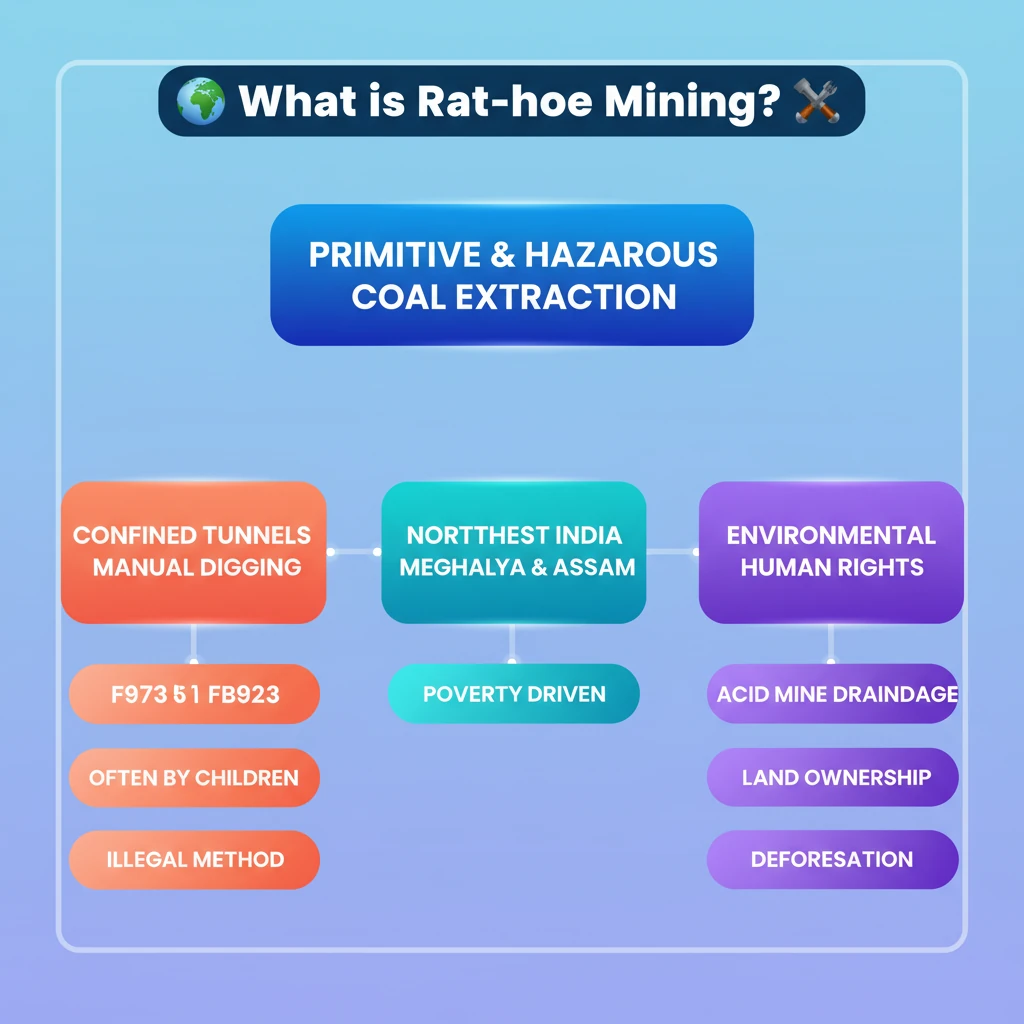
- •Rat-hole mining is a primitive, hazardous, and illegal coal extraction method.
- •It involves digging small, confined tunnels, often by children.
- •Prevalent in northeastern India, especially Meghalaya and Assam.
- •Driven by poverty, lack of clear land ownership, and persistent coal demand.
- •Causes severe environmental damage (acid mine drainage, deforestation) and human rights abuses.
- •Banned by the National Green Tribunal (NGT) in 2014, but continues clandestinely.
🧠 Memory Techniques
95% Verified Content
📚 Reference Sources
•Reports by National Green Tribunal (NGT) on mining bans
•News articles and investigative reports on rat-hole mining incidents in Meghalaya and Assam
•Government reports on illegal mining and environmental impact assessments