What is the Namami Gange Programme? - Environment And Ecology | UPSC Learning
Topics
0 topics • 0 completed
🔍
No topics match your search
What is the Namami Gange Programme?
Medium⏱️ 8 min read
environment and ecology
📖 Introduction
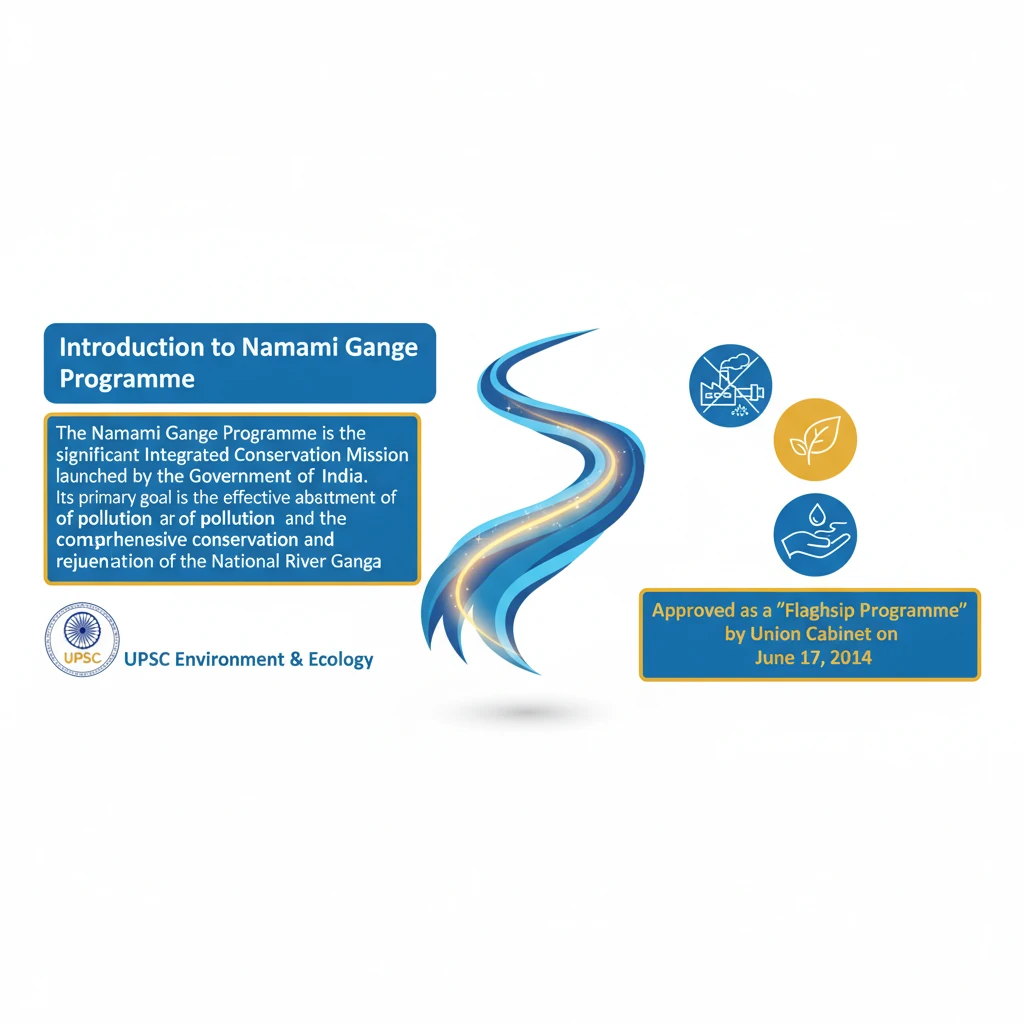
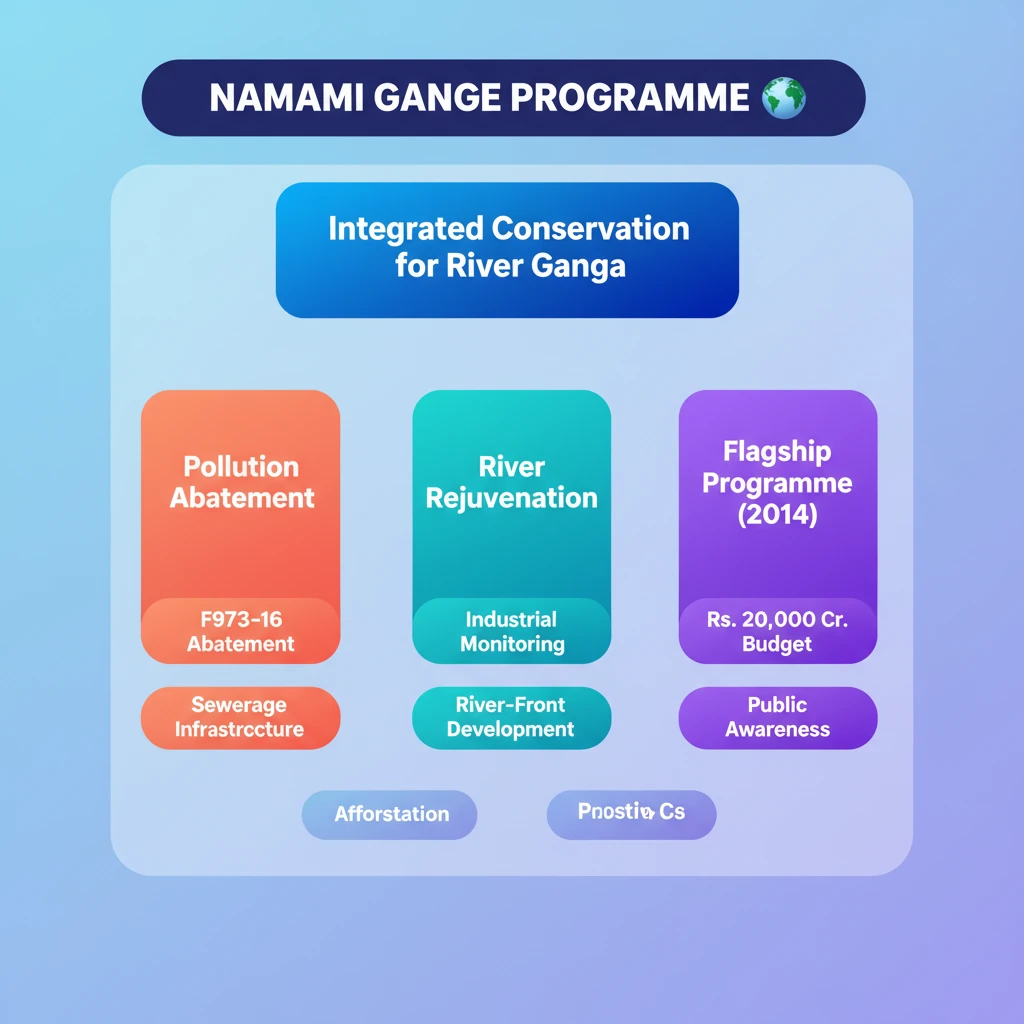
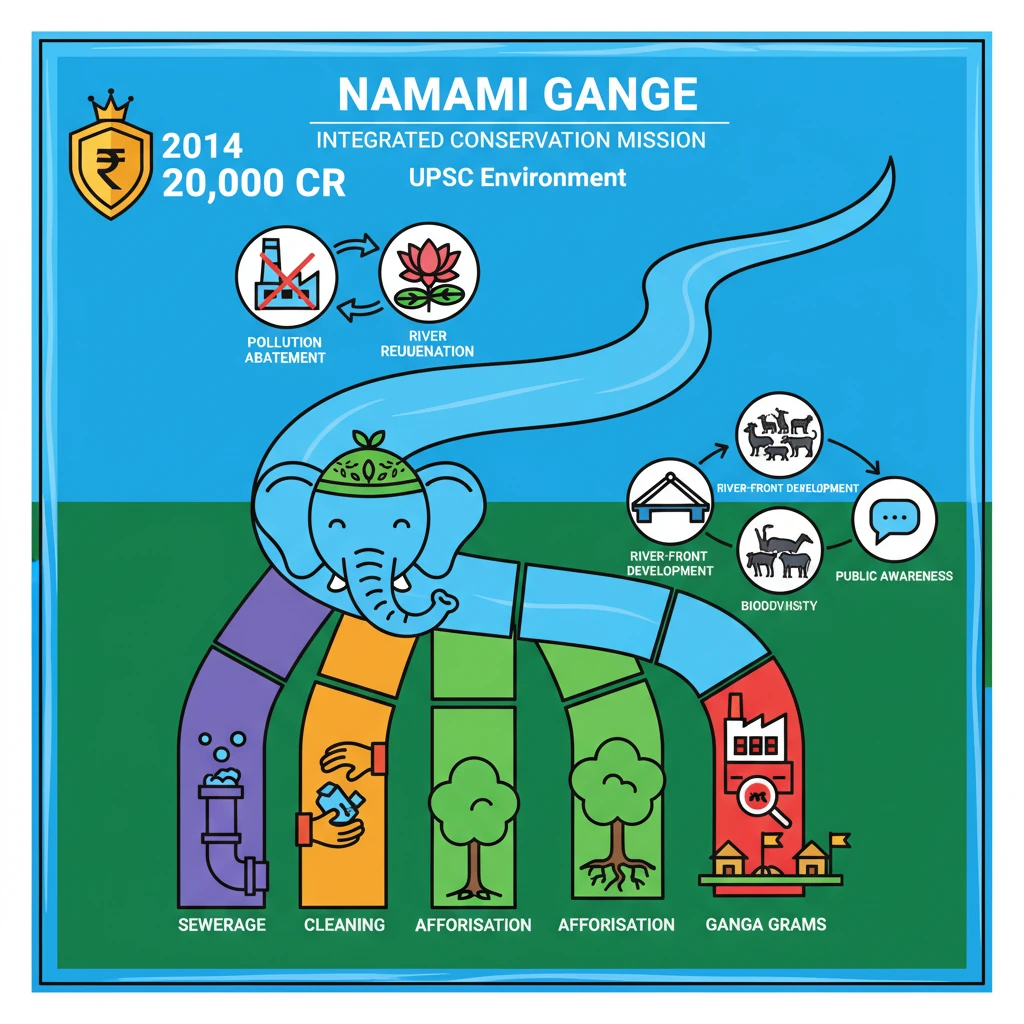
<h4>Introduction to Namami Gange Programme</h4><p>The <strong>Namami Gange Programme</strong> is a significant <strong>Integrated Conservation Mission</strong> launched by the Government of India. Its primary goal is the effective abatement of <strong>pollution</strong> and the comprehensive <strong>conservation and rejuvenation</strong> of the <strong>National River Ganga</strong>.</p><div class='info-box'><p>The programme was approved as a <strong>'Flagship Programme'</strong> by the <strong>Union Government</strong> in <strong>June 2014</strong>. It was allocated a substantial budget outlay of <strong>Rs. 20,000 Crore</strong> to achieve its twin objectives.</p></div><div class='key-point-box'><p>A <strong>Flagship Programme</strong> is a major national initiative designed to address critical concerns. These concerns often span vital sectors such as <strong>health, education, environment, irrigation, urban development</strong>, and <strong>rural development</strong>, reflecting broad national priorities.</p></div><h4>Key Pillars of Namami Gange Programme</h4><p>The success of the <strong>Namami Gange Programme</strong> is built upon several interconnected pillars, each addressing a specific aspect of river conservation and rejuvenation.</p><ul><li><strong>Sewerage Treatment Infrastructure:</strong> This pillar focuses on developing and upgrading infrastructure to manage <strong>wastewater</strong> effectively, preventing untreated sewage from entering the river.</li><li><strong>River-Surface Cleaning:</strong> Initiatives under this pillar are dedicated to removing <strong>solid waste</strong> and visible pollution from the river's surface, improving its aesthetic and ecological health.</li><li><strong>Afforestation:</strong> This involves extensive tree planting and restoring green cover along the river banks. It helps in soil conservation, improving water quality, and enhancing biodiversity.</li><li><strong>Industrial Effluent Monitoring:</strong> Strict monitoring mechanisms are put in place to control and prevent the discharge of harmful <strong>industrial effluents</strong> into the river, safeguarding its water quality.</li><li><strong>River-Front Development:</strong> This pillar aims to create and improve public spaces along the river. These developments promote <strong>community engagement</strong>, enhance <strong>tourism</strong>, and connect people with the river.</li><li><strong>Biodiversity:</strong> Efforts are made to enhance the river's overall <strong>ecological health</strong>. This includes supporting and conserving diverse <strong>biological communities</strong> that depend on the Ganga ecosystem.</li><li><strong>Public Awareness:</strong> This crucial pillar focuses on educating citizens about the immense importance of <strong>river conservation</strong>. It encourages community participation and responsible behavior towards the river.</li><li><strong>Ganga Gram:</strong> This initiative aims to develop villages situated along the main stem of <strong>River Ganga</strong> into <strong>model villages</strong>. These villages serve as examples of sustainable living and river-friendly practices.</li></ul><h4>Integrated Mission Approach and Priority Areas</h4><p>The <strong>Namami Gange Programme</strong> adopts an <strong>Integrated Mission Approach</strong>. This approach significantly emphasizes the crucial linkage between <strong>economic development</strong> and <strong>ecological improvement</strong>.</p><p>It showcases a strong commitment to achieving <strong>sustainable growth</strong> by ensuring that developmental activities do not compromise the river's health.</p><div class='key-point-box'><p>Identified <strong>priority areas</strong> for ongoing and future initiatives include <strong>clean energy, waterways development, biodiversity conservation,</strong> and <strong>wetland development</strong>. These areas are crucial for the holistic rejuvenation of the Ganga basin.</p></div>
💡 Key Takeaways
- •Namami Gange is an Integrated Conservation Mission for River Ganga.
- •Approved in June 2014 as a Flagship Programme with a Rs. 20,000 Crore budget.
- •Twin objectives: pollution abatement and river rejuvenation.
- •Key pillars include sewerage infrastructure, river surface cleaning, afforestation, industrial monitoring, river-front development, biodiversity, public awareness, and Ganga Grams.
- •Emphasizes an Integrated Mission Approach linking economic development with ecological improvement.
- •Priority areas are clean energy, waterways, biodiversity, and wetland development.
🧠 Memory Techniques
95% Verified Content