Horseshoe Crabs - Environment And Ecology | UPSC Learning
Topics
0 topics • 0 completed
🔍
No topics match your search
Horseshoe Crabs
Medium⏱️ 8 min read
environment and ecology
📖 Introduction
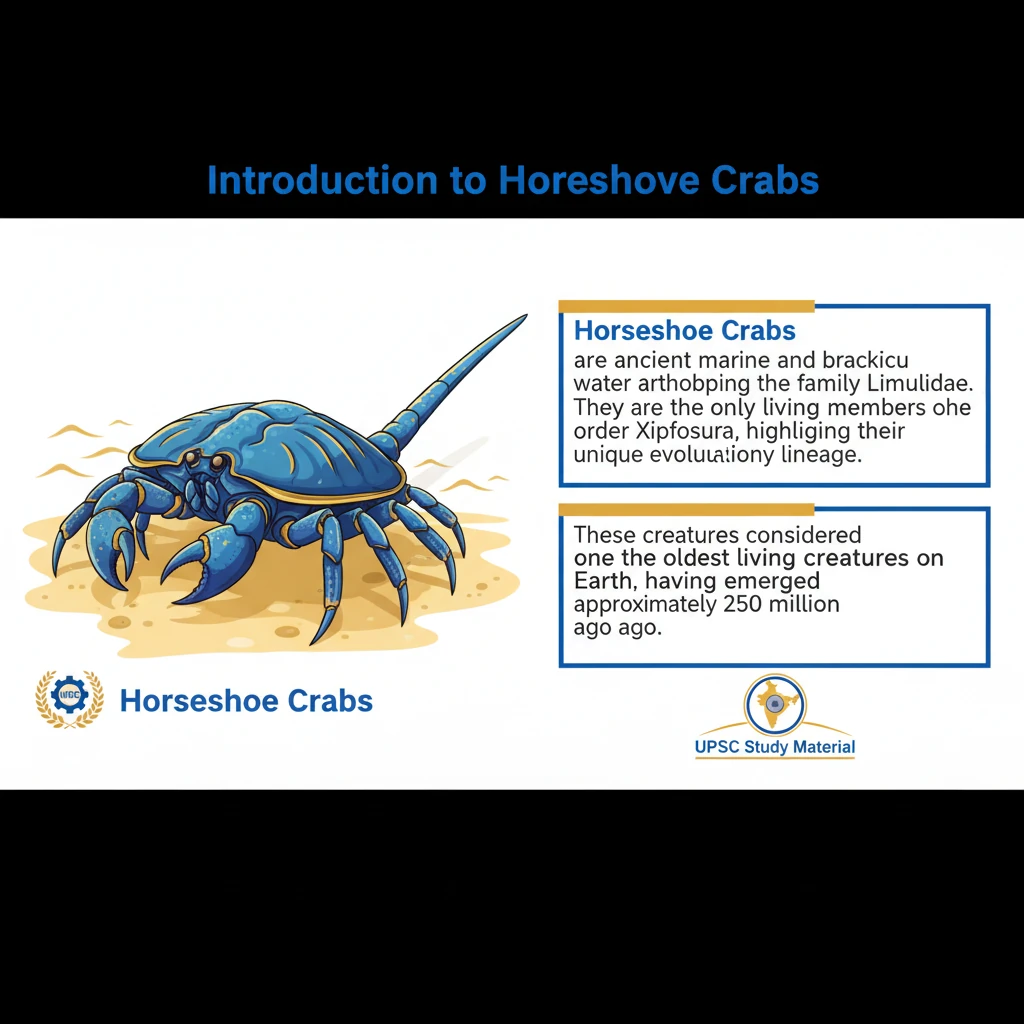
<h4>Introduction to Horseshoe Crabs</h4><p><strong>Horseshoe crabs</strong> are ancient <strong>marine</strong> and <strong>brackish water arthropods</strong> belonging to the family <strong>Limulidae</strong>. They are the only living members of the order <strong>Xiphosura</strong>, highlighting their unique evolutionary lineage.</p><p>These creatures are considered one of the <strong>oldest living creatures on Earth</strong>, having emerged approximately <strong>250 million years ago</strong>. Due to their minimal evolutionary change over vast geological periods, they are often referred to as <strong>living fossils</strong>.</p><div class='key-point-box'><p><strong>Living Fossils:</strong> A term for any living species of organism which appears to be the same as a species otherwise known only from fossils and has no close living relatives.</p></div><h4>Species and Distribution</h4><p>Globally, there are <strong>four existing species</strong> of <strong>horseshoe crabs</strong>. Their distribution spans various coastal regions, reflecting their adaptability to different marine environments.</p><ul><li><strong>India</strong> is home to <strong>two species</strong> of horseshoe crabs:</li><ul><li><strong>Tachypleus Gigas</strong>: Primarily found along the coasts of <strong>Odisha</strong> and <strong>West Bengal</strong>.</li><li><strong>Carcinoscorpius rotundicauda</strong>: Predominantly located in the <strong>Sundarbans mangroves</strong> of <strong>West Bengal</strong>.</li></ul><li><strong>American Horseshoe Crab (Limulus polyphemus)</strong>: Inhabits the <strong>eastern coast of the USA</strong> and the <strong>Gulf of Mexico</strong>.</li><li><strong>Tri-spine Horseshoe Crab (Tachypleus tridentatus)</strong>: Distributed across the <strong>Indo-Pacific region</strong>.</li></ul><h4>Threats to Horseshoe Crabs</h4><p>Despite their ancient lineage and resilience, <strong>horseshoe crabs</strong> face significant threats in modern times. These pressures endanger their populations and ecological stability.</p><ul><li><strong>Destructive fishing practices</strong>: Non-selective fishing methods often result in the accidental capture and mortality of horseshoe crabs.</li><li><strong>Illegal smuggling</strong>: Demand for their parts, especially for medicinal purposes, drives illicit trade.</li></ul><h4>Conservation Status</h4><p>Recognizing their ecological and scientific importance, various measures have been taken for their protection. Their conservation status varies by species and region.</p><div class='info-box'><ul><li><strong>Wildlife Protection Act (WPA), 1972</strong>: The <strong>Indian species</strong> of horseshoe crabs are protected under <strong>Schedule II</strong> of this Act, providing them with high legal protection.</li><li><strong>IUCN Status</strong>:</li><ul><li><strong>American horseshoe crab</strong> (Limulus polyphemus): Listed as <strong>Vulnerable</strong>.</li><li><strong>Tri-spine horseshoe crab</strong> (Tachypleus tridentatus): Listed as <strong>Endangered</strong>.</li><li>The other two species are currently <strong>not listed</strong> on the IUCN Red List.</li></ul></ul></div><h4>Medicinal Significance</h4><p>The unique biological properties of <strong>horseshoe crabs</strong> have made them invaluable in medical science, particularly their blood, which possesses remarkable characteristics.</p><ul><li>Their <strong>carapace</strong> (hard upper shell) has traditional applications, such as being applied onto scars for healing.</li><li><strong>Horseshoe crab blood</strong> is distinctively <strong>bright blue</strong>. It contains specialized immune cells called <strong>amebocytes</strong>.</li><li>These <strong>amebocytes</strong> are highly sensitive to <strong>toxic bacteria</strong> and clot around invading pathogens, effectively protecting the crab's body from infection.</li></ul><div class='key-point-box'><p><strong>Limulus Amebocyte Lysate (LAL) Test</strong>: Scientists developed this crucial test using the immune cells from horseshoe crab blood. The <strong>LAL test</strong> is vital for checking new vaccines, injectable drugs, and medical devices for <strong>bacterial contamination</strong>, preventing the distribution of harmful products.</p></div><h4>International Horseshoe Crab Day</h4><p>To raise awareness and foster collective conservation efforts, <strong>International Horseshoe Crab Day</strong> is celebrated annually on <strong>June 20th</strong>. This day highlights their importance and the need for their protection.</p>
💡 Key Takeaways
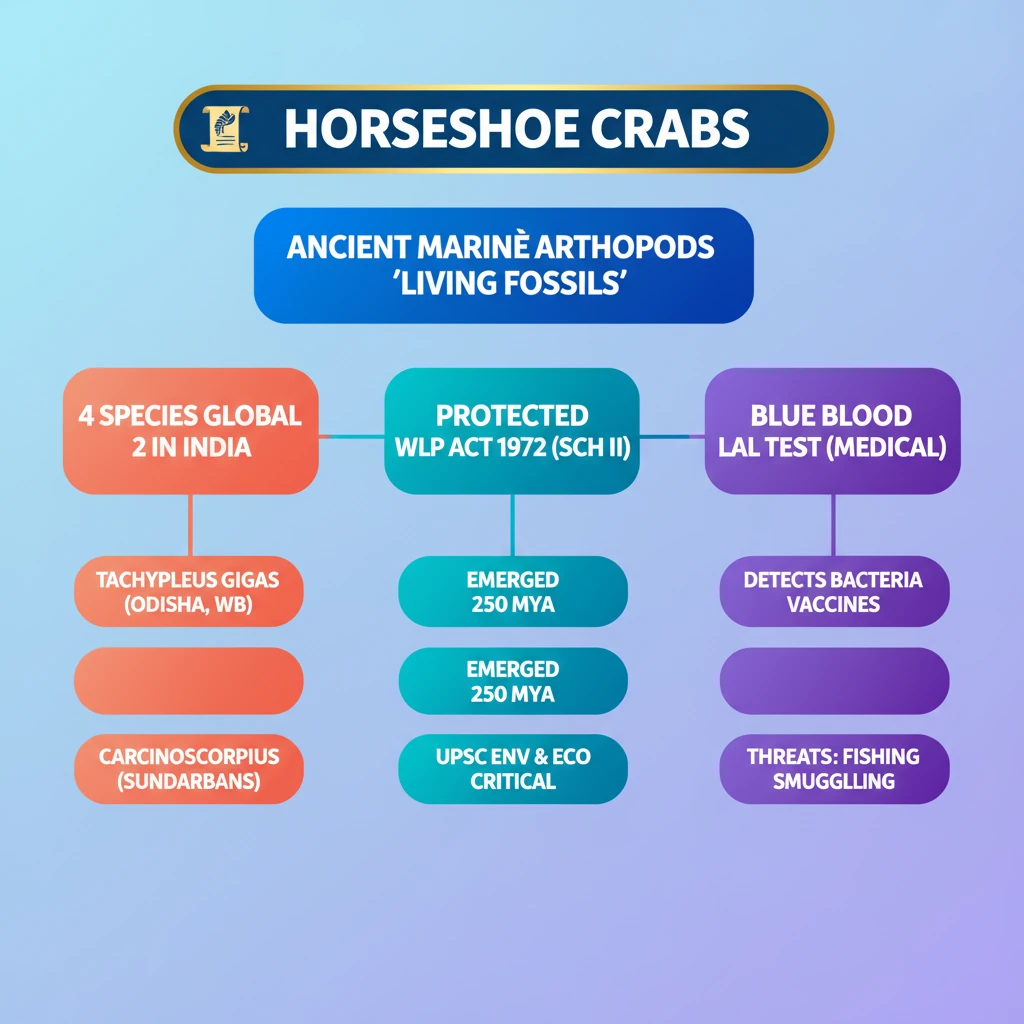
- •Horseshoe crabs are ancient marine arthropods, often called 'living fossils' (emerged 250 million years ago).
- •There are 4 species globally; India has 2: Tachypleus Gigas (Odisha, WB) and Carcinoscorpius rotundicauda (Sundarbans).
- •Indian species are protected under Schedule II of the Wildlife Protection Act, 1972.
- •Their blue blood is used to produce the Limulus Amebocyte Lysate (LAL) test, crucial for detecting bacterial contamination in vaccines and medical devices.
- •Major threats include destructive fishing practices and illegal smuggling.
- •Conservation efforts are ongoing, including a recent tagging exercise by ZSI and Odisha Forest Department.
- •International Horseshoe Crab Day is celebrated on June 20th.
🧠 Memory Techniques
95% Verified Content