What is Black Carbon (BC)? - Environment And Ecology | UPSC Learning
Topics
0 topics • 0 completed
🔍
No topics match your search
What is Black Carbon (BC)?
Medium⏱️ 7 min read
environment and ecology
📖 Introduction
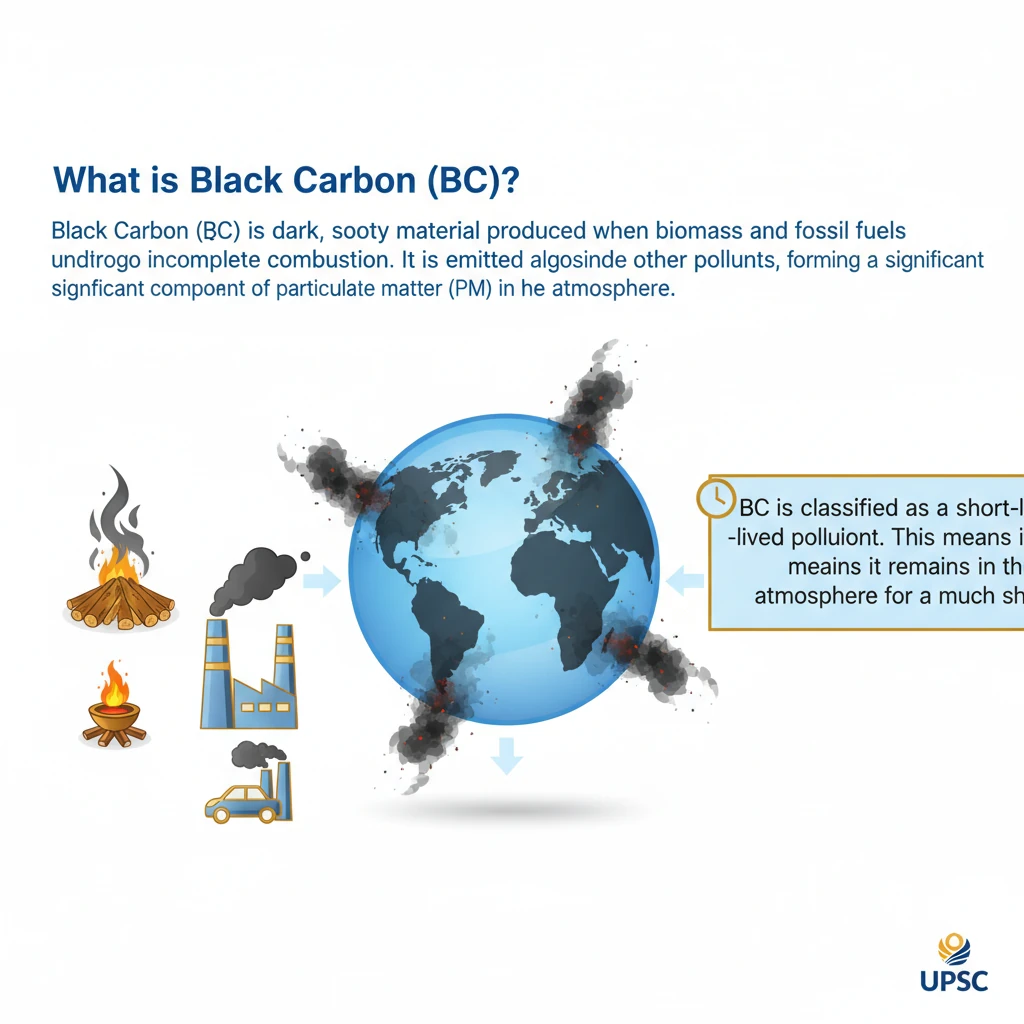
<h4>What is Black Carbon (BC)?</h4><p><strong>Black Carbon (BC)</strong> is a dark, sooty material produced when <strong>biomass</strong> and <strong>fossil fuels</strong> undergo <strong>incomplete combustion</strong>. It is emitted alongside other pollutants, forming a significant component of particulate matter (PM) in the atmosphere.</p><div class='info-box'><p><strong>BC</strong> is classified as a <strong>short-lived pollutant</strong>. This means it remains in the atmosphere for a much shorter duration compared to long-lived greenhouse gases like carbon dioxide (CO2).</p></div><p>Despite its short atmospheric lifespan, <strong>Black Carbon</strong> is recognized as the <strong>second-largest contributor to warming the planet</strong>, trailing only behind <strong>carbon dioxide (CO2)</strong>. Its potent warming effect makes it a critical focus in climate change mitigation.</p><div class='key-point-box'><p>Unlike other greenhouse gas emissions, <strong>BC</strong> is quickly washed out of the atmosphere by precipitation. This characteristic implies that its presence can be significantly reduced or even eliminated if emissions are stopped, offering a more immediate climate benefit.</p></div><p>Furthermore, unlike historical carbon emissions that disperse globally, <strong>Black Carbon</strong> is primarily a <strong>localized source</strong>. This means its impacts are often more pronounced in the regions where it is emitted, leading to greater local environmental and health consequences.</p><p>Scientifically, <strong>Black Carbon</strong> is a type of <strong>aerosol</strong>. Aerosols are tiny solid or liquid particles suspended in the atmosphere, and they play a complex role in Earth's climate system.</p><h4>Impacts of Black Carbon</h4><p>Among various <strong>aerosols</strong>, such as brown carbon and sulphates, <strong>Black Carbon</strong> has been identified as the <strong>second most important anthropogenic agent</strong> for climate change. It also serves as the primary marker for understanding the adverse effects caused by air pollution.</p><p>One of the most significant impacts of <strong>Black Carbon</strong> is its ability to <strong>absorb solar energy</strong>. When suspended in the atmosphere, it directly warms the surrounding air, contributing to atmospheric heating and global warming.</p><div class='info-box'><p>When <strong>BC</strong> eventually falls to Earth with precipitation, it settles on surfaces like snow and ice. This darkens their appearance, significantly <strong>reducing their albedo</strong> (the reflecting power of a surface). The diminished reflectivity causes more solar energy to be absorbed, warming the snow and ice and accelerating their melting.</p></div><p>Beyond its climate effects, <strong>Black Carbon</strong> poses severe risks to human health. Studies have established a <strong>direct link</strong> between exposure to <strong>BC</strong> and a higher risk of serious health conditions.</p><p>These health risks include an increased likelihood of <strong>heart disease</strong>, various <strong>birth complications</strong>, and a higher incidence of <strong>premature death</strong>, highlighting the urgent need for emission control.</p><h4>Sources of Black Carbon in India</h4><p>In India, the majority of <strong>Black Carbon emissions</strong> originate from the burning of <strong>biomass</strong>. This primarily includes materials like <strong>cow dung</strong> and <strong>straw</strong>, which are commonly used in traditional cookstoves in rural households.</p><p>Other significant sources of <strong>BC</strong> include emissions from <strong>gas and diesel engines</strong>, particularly in the transportation sector. <strong>Coal-fired power plants</strong> and various other industrial processes that burn <strong>fossil fuels</strong> also contribute substantially.</p><div class='info-box'><p>According to a <strong>2016 study</strong>, the breakdown of India's total <strong>Black Carbon emissions</strong> by sector is as follows:</p><ul><li><strong>Residential sector</strong>: 47%</li><li><strong>Industries</strong>: 22%</li><li><strong>Diesel vehicles</strong>: 17%</li><li><strong>Open burning</strong> (e.g., agricultural waste): 12%</li><li><strong>Other sources</strong>: 2%</li></ul></div><p>This data underscores the dominant role of the <strong>residential sector</strong>, particularly traditional cooking practices, in India's overall <strong>Black Carbon</strong> emission profile.</p>
💡 Key Takeaways
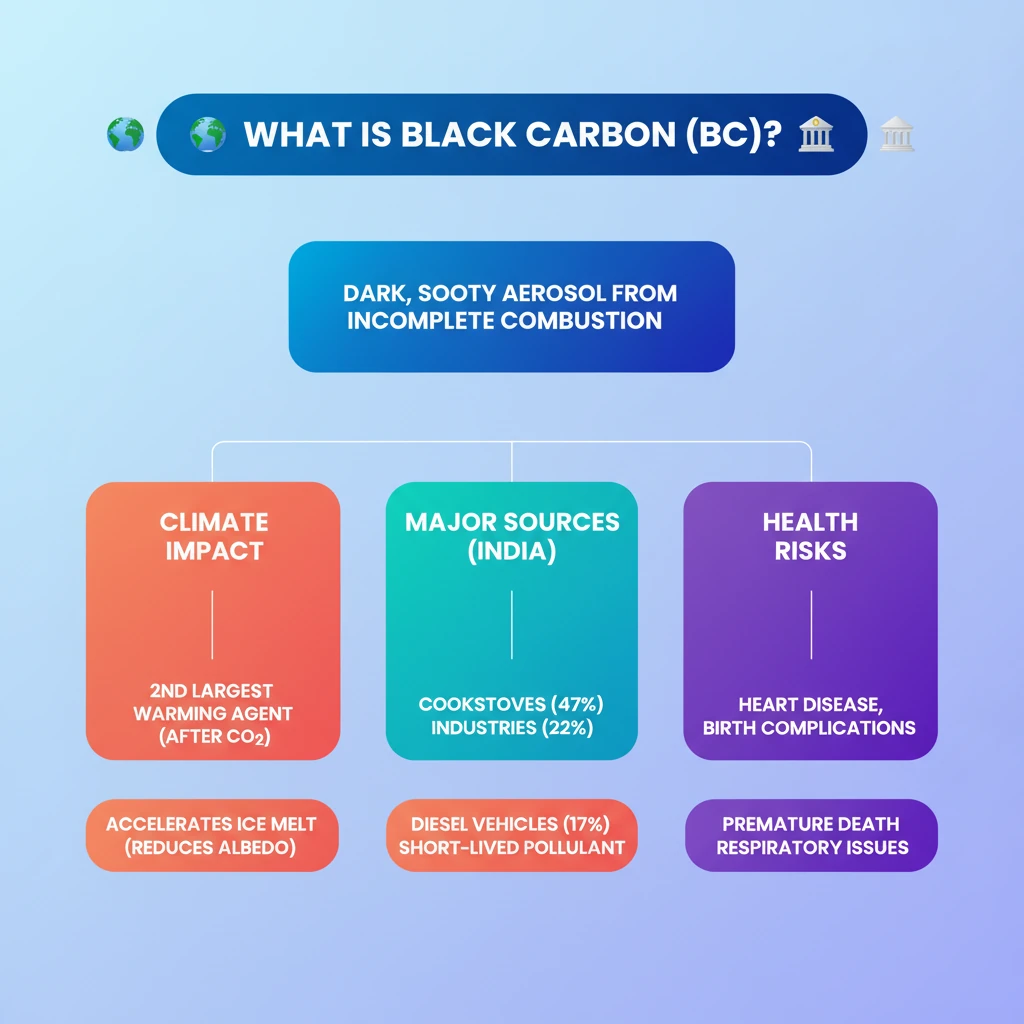
- •Black Carbon (BC) is a dark, sooty aerosol from incomplete combustion of biomass and fossil fuels.
- •It is the second-largest contributor to global warming after CO2, despite being a short-lived pollutant.
- •BC warms the atmosphere and accelerates snow/ice melt by reducing albedo.
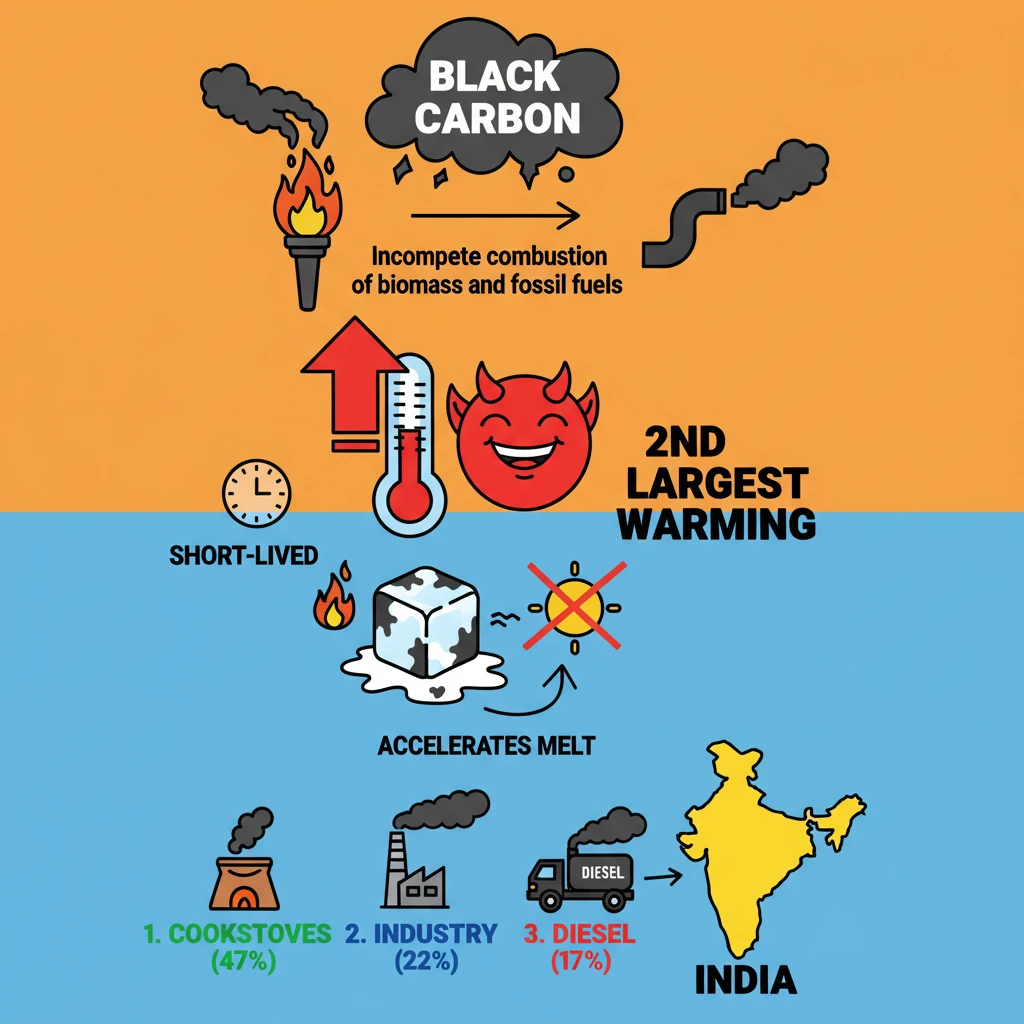
- •Major sources in India are traditional cookstoves (47%), industries (22%), and diesel vehicles (17%).
- •BC poses severe health risks, including heart disease, birth complications, and premature death.
- •Its short atmospheric lifetime offers opportunities for rapid climate benefits through emission reductions.
🧠 Memory Techniques
95% Verified Content
📚 Reference Sources
•UN Environment Programme (UNEP) reports on Short-Lived Climate Pollutants
•Intergovernmental Panel on Climate Change (IPCC) assessment reports
•Studies on Black Carbon emissions in India (e.g., TERI, CSTEP)