What are the Key Highlights of the Report? - Environment And Ecology | UPSC Learning
Topics
0 topics • 0 completed
🔍
No topics match your search
What are the Key Highlights of the Report?
Medium⏱️ 8 min read
environment and ecology
📖 Introduction
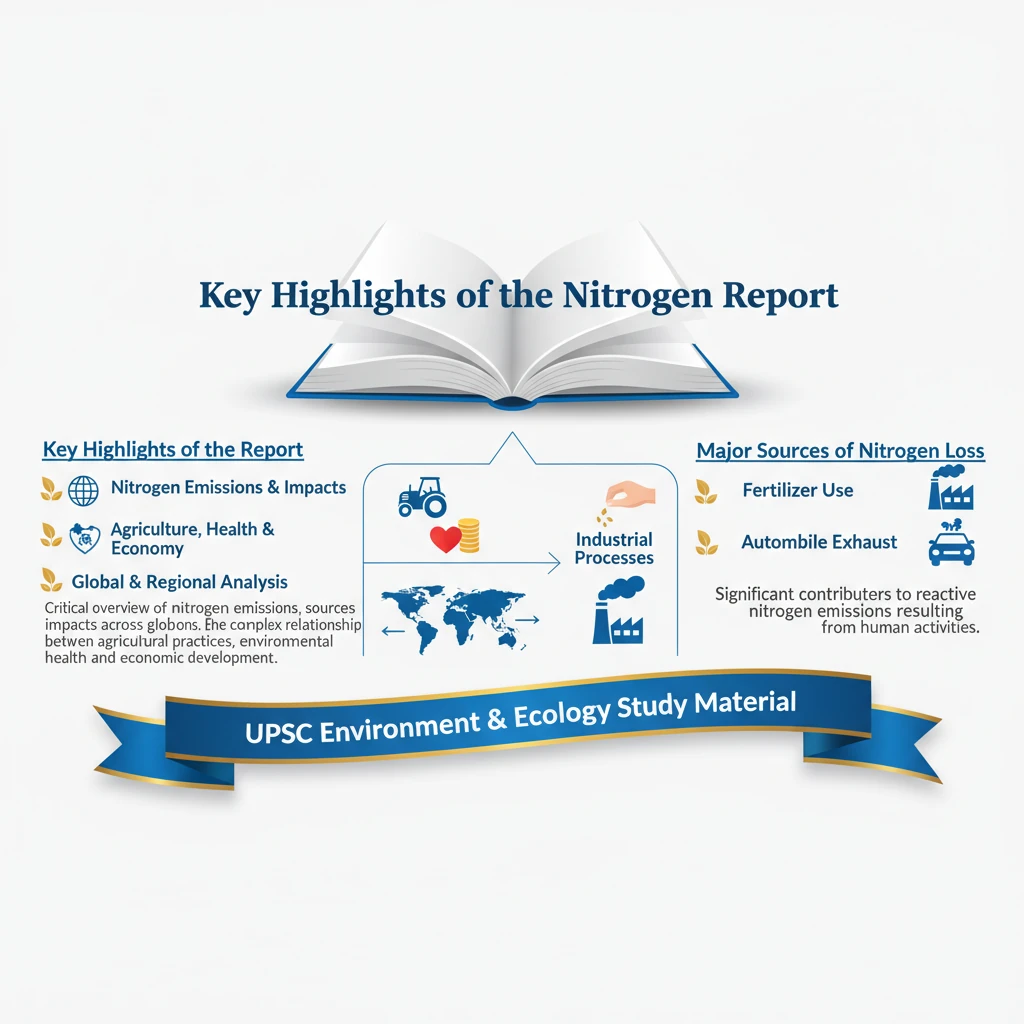
<h4>Key Highlights of the Nitrogen Report</h4><p>The report provides a critical overview of <strong>nitrogen emissions</strong>, their primary sources, and the varied impacts across different global regions. It emphasizes the complex relationship between agricultural practices, environmental health, and economic development.</p><h4>Major Sources of Nitrogen Loss</h4><p>The report identifies several significant contributors to <strong>reactive nitrogen emissions</strong> resulting from human activities.</p><div class='key-point-box'><p><strong>Livestock</strong> stands out as the primary source, accounting for approximately <strong>one-third</strong> of the total nitrogen emissions.</p></div><p>Other substantial contributors include the widespread use of <strong>synthetic fertilizers</strong>, changes in <strong>land-use patterns</strong>, and emissions from inadequate <strong>manure management</strong> practices.</p><h4>Regional Differences in Nitrogen Use Efficiency (NUE)</h4><p>The report highlights considerable variations in <strong>Nitrogen Use Efficiency (NUE)</strong> across different global regions, influenced by distinct agricultural practices and policies.</p><h5>Asia's Nitrogen Trajectory</h5><p>In <strong>Asia</strong>, the implementation of <strong>fertilizer subsidies</strong> during the <strong>Green Revolution</strong> significantly boosted crop yields but concurrently led to substantial <strong>nitrogen pollution</strong>.</p><p><strong>Southeast Asia</strong> experienced a notable decline in <strong>NUE</strong>, dropping from <strong>65% in 1961</strong> to <strong>45% in the 1990s</strong>. However, it showed recovery, reaching <strong>54% by 2022</strong>.</p><div class='info-box'><p><strong>Nitrogen Use Efficiency (NUE)</strong>: A measure of how effectively applied nitrogen is utilized by crops to produce yield, minimizing losses to the environment.</p></div><h5>Challenges in Africa</h5><p><strong>Africa</strong> continues to grapple with persistently <strong>low crop yields</strong> and severe <strong>nutrient depletion</strong> in its soils.</p><p>These issues are largely attributed to inadequate agricultural policies and limited access to essential <strong>nitrogen fertilizers</strong>.</p><h5>Progress in Europe & North America</h5><p>Regions like <strong>Europe</strong> and <strong>North America</strong> have achieved higher <strong>NUE</strong> levels.</p><p>This success is primarily due to the implementation of stringent <strong>nutrient management guidelines</strong> and effective regulatory frameworks.</p><p><strong>North America</strong> initially saw its <strong>NUE drop from 65% in 1961</strong> to below <strong>50% in the 1980s</strong>, but then recorded a significant increase to <strong>69% in 2022</strong>.</p><h5>Latin America's Fertilizer Dependency</h5><p><strong>Latin America</strong> faces unique challenges, including a heavy reliance on <strong>imported fertilizers</strong>.</p><p>Disruptions in <strong>supply chains</strong> severely impact nitrogen management practices in the region.</p><h4>Crop-Level Variation in Nitrogen Use Efficiency</h4><p>The report underscores that <strong>NUE</strong> varies considerably depending on the <strong>crop type</strong>.</p><ul><li><strong>Soybeans</strong> demonstrated a high <strong>NUE of 80% in 2010</strong>, indicating efficient nitrogen utilization.</li><li>In contrast, <strong>fruits and vegetables</strong> exhibited a much lower <strong>NUE, around 14% in 2010</strong>, pointing to substantial nitrogen losses during their production cycle.</li></ul><h4>Challenges for Developing Nations</h4><p><strong>Low- and Middle-Income countries</strong> face a dual challenge regarding nitrogen management.</p><p>They often have <strong>limited access to nitrogen fertilizers</strong>, which impacts food security, alongside widespread <strong>soil health degradation</strong>.</p><p>Without effective strategies to address <strong>nitrogen losses</strong>, these nations experience low crop yields, and poor <strong>manure management</strong> exacerbates nitrogen emissions.</p><div class='exam-tip-box'><p>UPSC often asks about environmental challenges in developing countries. Understanding <strong>nitrogen loss</strong> and its socio-economic impacts is crucial for <strong>GS-III Environment</strong> and <strong>Agriculture</strong> papers.</p></div>
💡 Key Takeaways
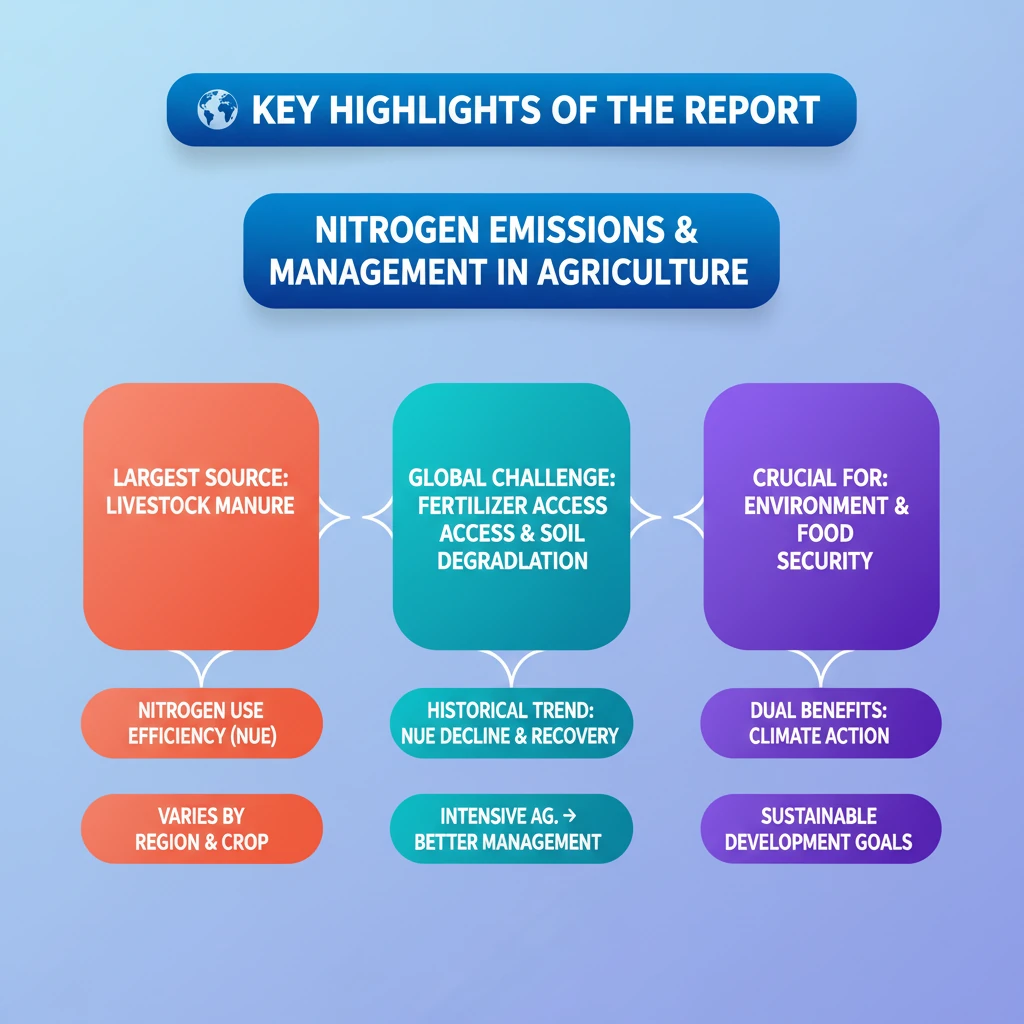
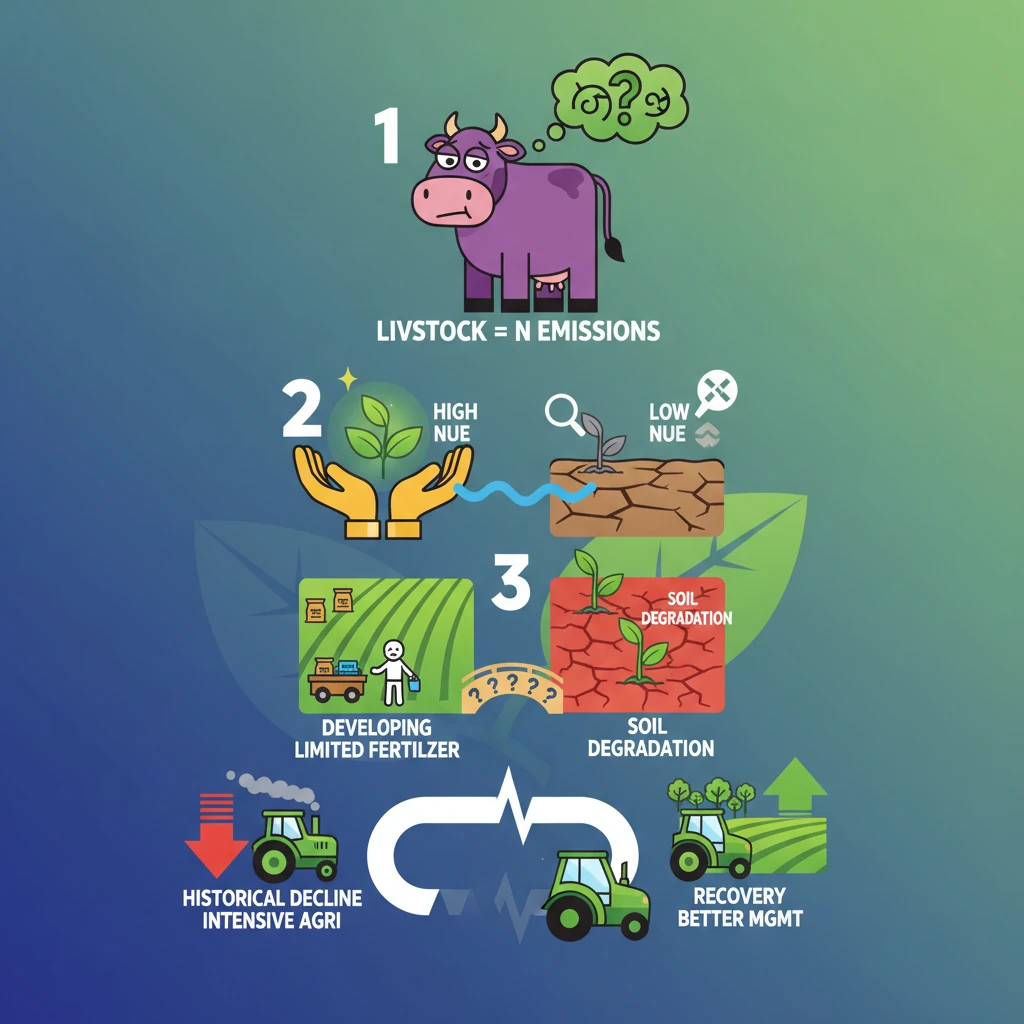
- •Livestock is the largest source of human-induced nitrogen emissions.
- •Nitrogen Use Efficiency (NUE) varies significantly by region and crop type.
- •Developing countries face dual challenges of limited fertilizer access and soil degradation.
- •Historical trends show NUE decline due to intensive agriculture, followed by recovery with better management.
- •Effective nitrogen management is crucial for environmental protection, food security, and climate action.
🧠 Memory Techniques
95% Verified Content
📚 Reference Sources
•General knowledge on Nitrogen Cycle and Green Revolution