Protecting Sacred Groves - Environment And Ecology | UPSC Learning
Topics
0 topics • 0 completed
🔍
No topics match your search
Protecting Sacred Groves
Medium⏱️ 6 min read
environment and ecology
📖 Introduction
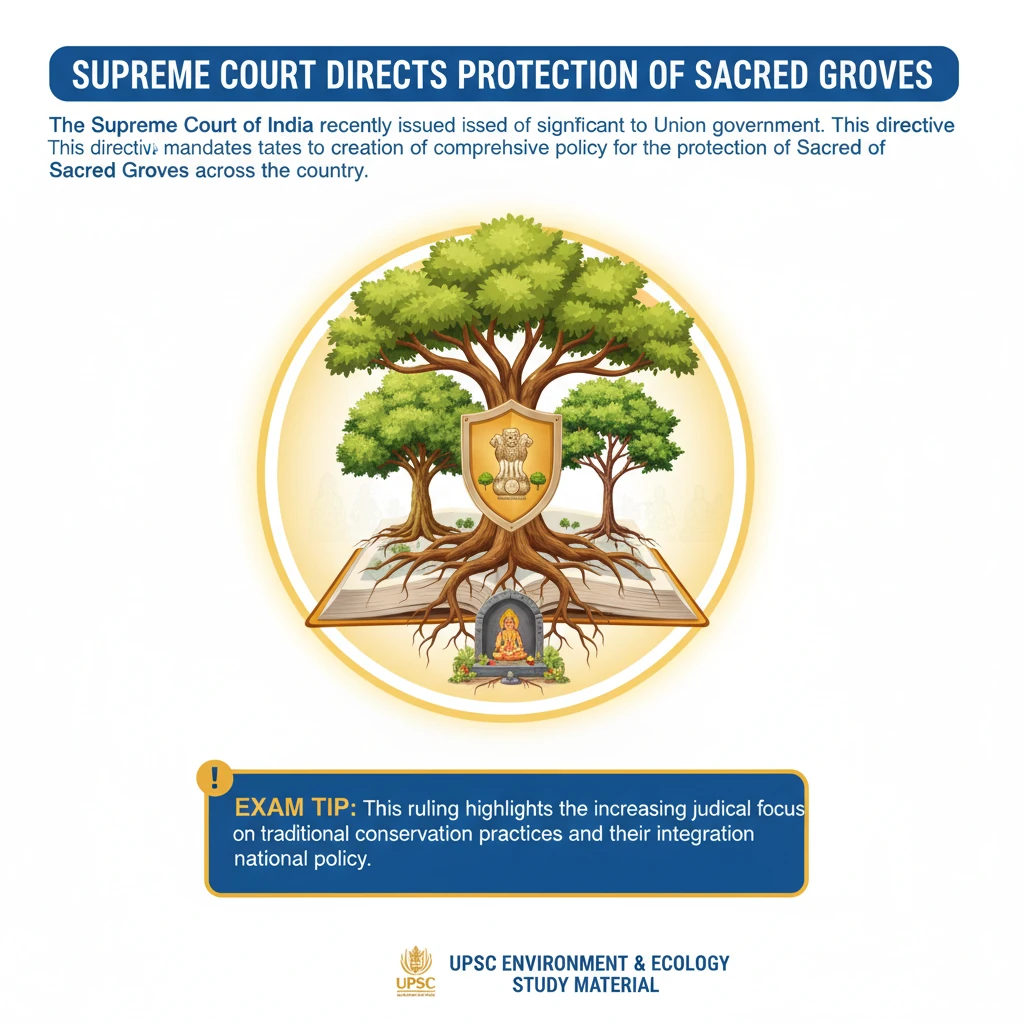
<h4>Supreme Court Directs Protection of Sacred Groves</h4><p>The <strong>Supreme Court of India</strong> recently issued a significant directive to the <strong>Union government</strong>.</p><p>This directive mandates the creation of a <strong>comprehensive policy</strong> for the protection of <strong>Sacred Groves</strong> across the country.</p><div class='exam-tip-box'>This ruling highlights the increasing judicial focus on traditional conservation practices and their integration into national policy. It is highly relevant for <strong>GS-III Environment and Ecology</strong>.</div><h4>Inspiration: The Piplantri Model</h4><p>The Supreme Court's judgment drew inspiration from the successful <strong>Piplantri Model</strong>.</p><div class='info-box'>The <strong>Piplantri village</strong> in <strong>Rajasthan's Rajsamand district</strong> is renowned for its unique initiative where <strong>111 trees</strong> are planted every time a girl child is born. This model combines social welfare with environmental conservation.</div><h4>Understanding Sacred Groves</h4><p><strong>Sacred Groves</strong> are defined as tracts of <strong>virgin forests</strong> that remain untouched by local inhabitants.</p><p>These areas are protected primarily due to the <strong>cultural and religious beliefs</strong> of the local communities.</p><div class='key-point-box'>They represent <strong>relic vegetation</strong>, serving as remnants of once dominant flora in a particular region.</div><h4>Presence and Distribution in India</h4><p>India is home to a vast number of these ecologically and culturally significant sites.</p><ul><li>Over <strong>1 million sacred forests</strong> exist across the nation.</li><li>There are an estimated <strong>100,000 to 150,000 individual sacred groves</strong>.</li></ul><p>These groves are particularly prominent in states like <strong>Maharashtra, Karnataka, Kerala, Tamil Nadu,</strong> and <strong>Uttarakhand</strong>.</p><h4>Statutory and Policy Framework for Protection</h4><p>Several legal and policy instruments support the protection of <strong>Sacred Groves</strong> in India.</p><div class='info-box'><ul><li><strong>Wild Life (Protection) Act, 1972</strong>: This Act empowers State Governments to declare any private or community land as a <strong>Community Reserve</strong>. <strong>Sacred Groves</strong> can be designated as such under this provision.</li><li><strong>National Forest Policy, 1988</strong>: This policy encourages communities with customary rights to protect and improve forest patches, recognizing their dependence on these areas.</li><li><strong>Godavarman Case, 1996</strong>: This landmark Supreme Court judgment further reinforced the importance of forest protection and community involvement.</li></ul></div>
💡 Key Takeaways
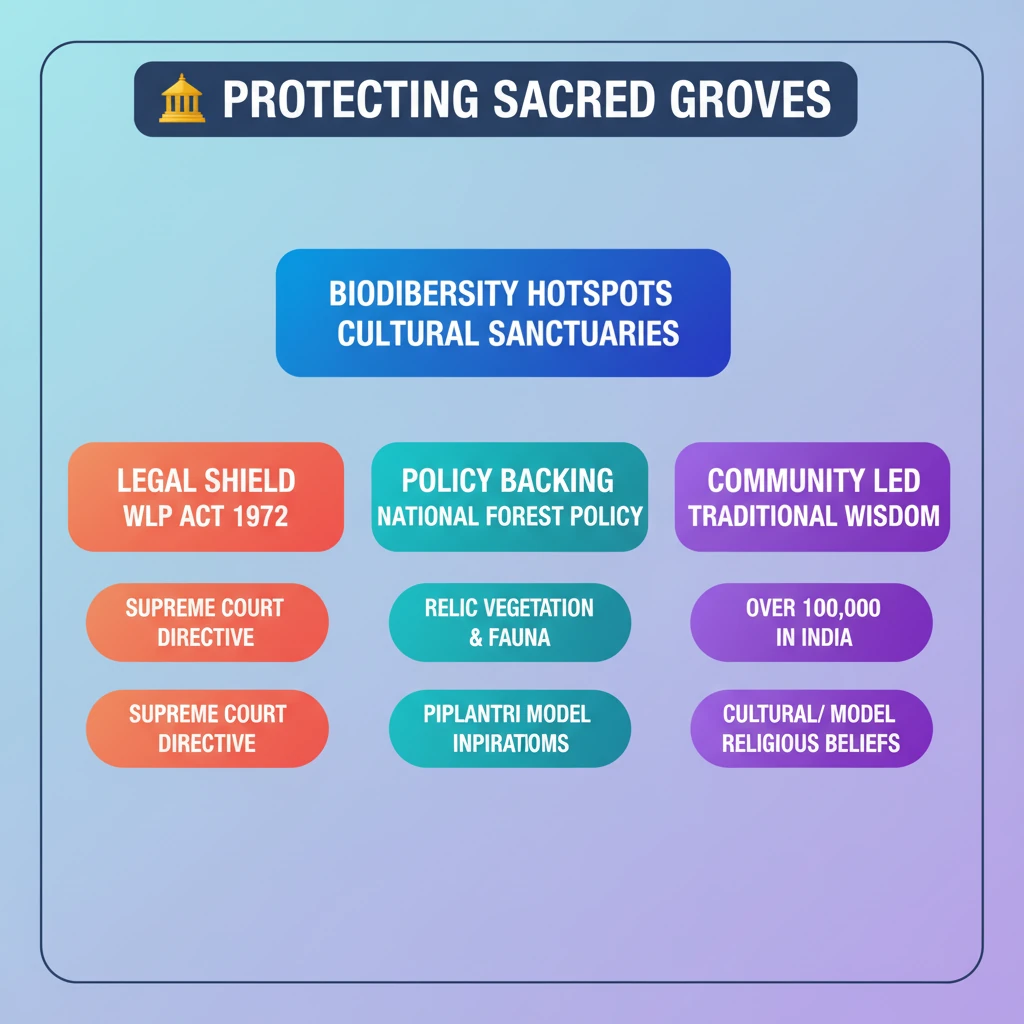
- •Sacred Groves are virgin forest tracts protected by local communities due to cultural and religious beliefs.
- •The Supreme Court recently directed the Union government to create a comprehensive policy for their protection.
- •The Piplantri Model (Rajasthan) served as an inspiration for the Supreme Court's judgment.
- •India hosts over 100,000 Sacred Groves, serving as relic vegetation and biodiversity hotspots.
- •They are legally supported by the Wild Life (Protection) Act, 1972 (Community Reserves) and the National Forest Policy, 1988.
🧠 Memory Techniques

95% Verified Content