No reason to worry - Environment And Ecology | UPSC Learning
Topics
0 topics • 0 completed
🔍
No topics match your search
No reason to worry
Medium⏱️ 7 min read
environment and ecology
📖 Introduction
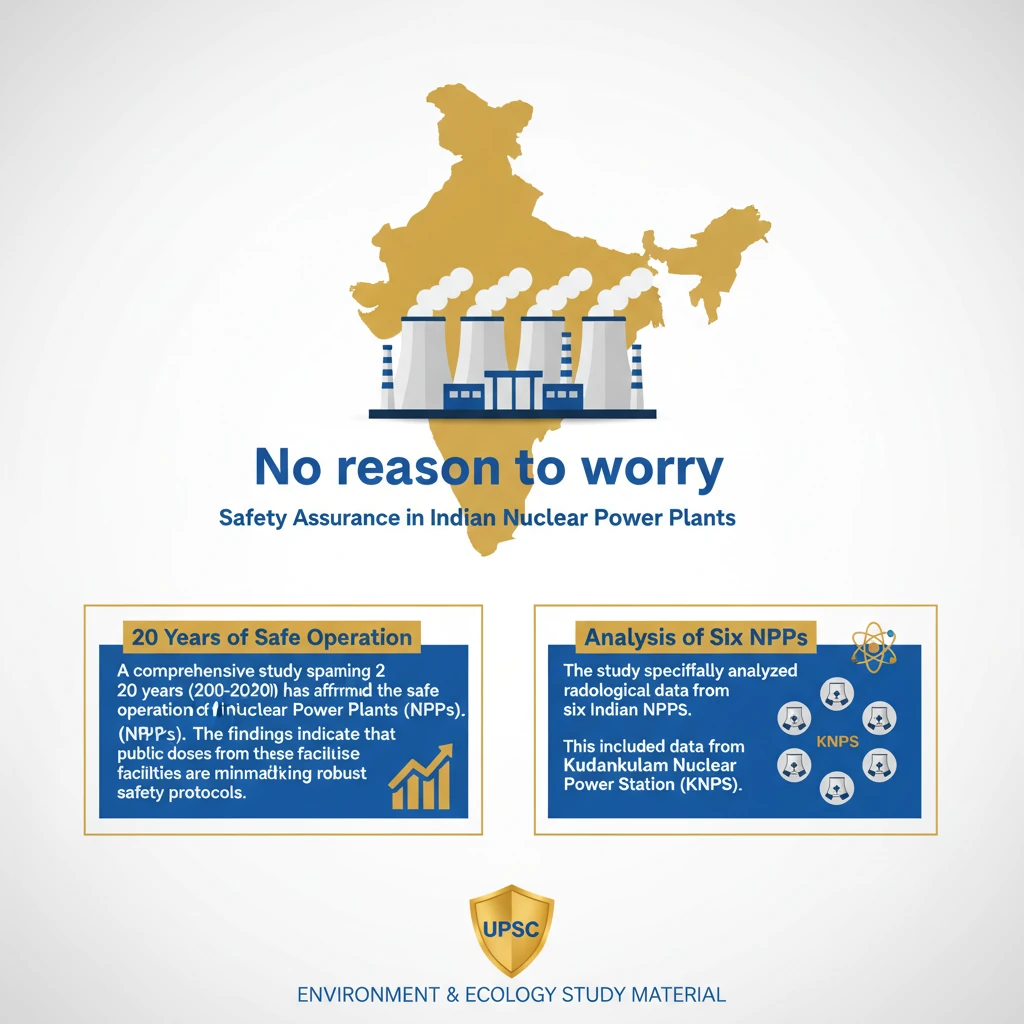
<h4>Safety Assurance in Indian Nuclear Power Plants</h4><p>A comprehensive study spanning <strong>20 years (2000-2020)</strong> has affirmed the safe operation of <strong>Indian Nuclear Power Plants (NPPs)</strong>. The findings indicate that public doses from these facilities are minimal, underscoring robust safety protocols.</p><p>The study specifically analyzed radiological data from <strong>six Indian NPPs</strong>. This included data from the <strong>Kudankulam Nuclear Power Station (KNPS)</strong>, which was covered for the period from <strong>2013 to 2020</strong>.</p><div class='info-box'><p><strong>Study Focus:</strong> Concentrations of <strong>fission products</strong> and <strong>neutron-activated nuclides</strong> within a <strong>5 km radius</strong> of the plants.</p><p><strong>Key Finding:</strong> Monitored values within the 5 km radius were consistently <strong>well below 1%</strong> of the permissible limits. This suggests extremely low environmental impact close to the facilities.</p></div><h4>Monitored Radioactive Substances</h4><p>The study meticulously examined various radioactive substances released as gaseous and liquid waste from the NPPs. These substances are crucial indicators of operational safety and environmental impact.</p><div class='key-point-box'><p><strong>Gaseous Waste Components:</strong></p><ul><li><strong>Fission product noble gases</strong></li><li><strong>Argon 41</strong></li><li><strong>Radioiodine</strong></li><li><strong>Particulate radionuclides:</strong> <strong>cobalt-60</strong>, <strong>strontium-90</strong>, <strong>caesium-137</strong>, and <strong>tritium</strong></li></ul><p><strong>Liquid Discharge Components:</strong></p><ul><li><strong>Fission product radionuclides:</strong> <strong>radioiodine</strong>, <strong>tritium</strong>, <strong>strontium-90</strong>, <strong>caesium-137</strong></li><li><strong>Activation products:</strong> <strong>cobalt-60</strong></li></ul></div><h4>Environmental Concentrations of Radionuclides</h4><p>Monitoring extended to various environmental matrices, including rivers, lakes, sea water, and air particulates. The concentrations observed were remarkably low, often below detection limits or significantly below specified safety thresholds.</p><div class='info-box'><p><strong>In Rivers and Lakes:</strong></p><ul><li><strong>Caesium-137</strong> and <strong>strontium-90</strong> were below <strong>5 mBq per litre</strong>.</li><li>Average concentrations were below <strong>1 mBq per litre</strong> for <strong>caesium-137</strong> and <strong>average iodine-131 activity</strong>.</li></ul><p><strong>In Sea Water:</strong></p><ul><li>Concentrations were below <strong>5 mBq per litre</strong>.</li><li>Near nuclear plants, the concentration was less than <strong>50 mBq per litre</strong>.</li><li>For <strong>caesium-137</strong> and <strong>strontium-90</strong>, average concentrations were below <strong>1 mBq per litre</strong> for both.</li></ul></div><h4>Air Particulates Monitoring</h4><p>Monitoring of air particulates provides crucial data on atmospheric releases. The study reported very low levels of radioactivity in the air around the plants.</p><div class='info-box'><p><strong>Average Gross Alpha Activity:</strong> Less than <strong>0.1 millibecquerel (mBq) per cubic meter</strong> at all seven nuclear plants monitored.</p><p><strong>Specific Marker Concentrations in Air:</strong> Average concentrations of <strong>radioiodine (Iodine-131)</strong>, <strong>caesium-137</strong>, and <strong>strontium-90</strong> across all sites were below <strong>1 mBq per cubic meter</strong>.</p></div><h4>Regional Variations and Regulatory Adherence</h4><p>While overall levels were low, some regional variations were noted, primarily due to environmental factors rather than operational issues.</p><p>The <strong>Narora Atomic Power Station</strong> in <strong>Uttar Pradesh</strong> exhibited slightly higher maximum values for air particulates. This was attributed to a higher <strong>atmospheric dust load</strong> prevalent in the region, rather than increased radioactive emissions.</p><div class='exam-tip-box'><p><strong>UPSC Insight:</strong> When discussing environmental impact, it's crucial to differentiate between plant-specific emissions and ambient environmental factors like dust load. This demonstrates a nuanced understanding for <strong>GS Paper III</strong>.</p></div><p>All <strong>radioactive discharges</strong> are carried out through controlled processes of <strong>dilution and dispersion</strong>. These operations strictly adhere to stringent <strong>radiological and environmental regulatory regimes</strong> established by Indian authorities.</p>
💡 Key Takeaways
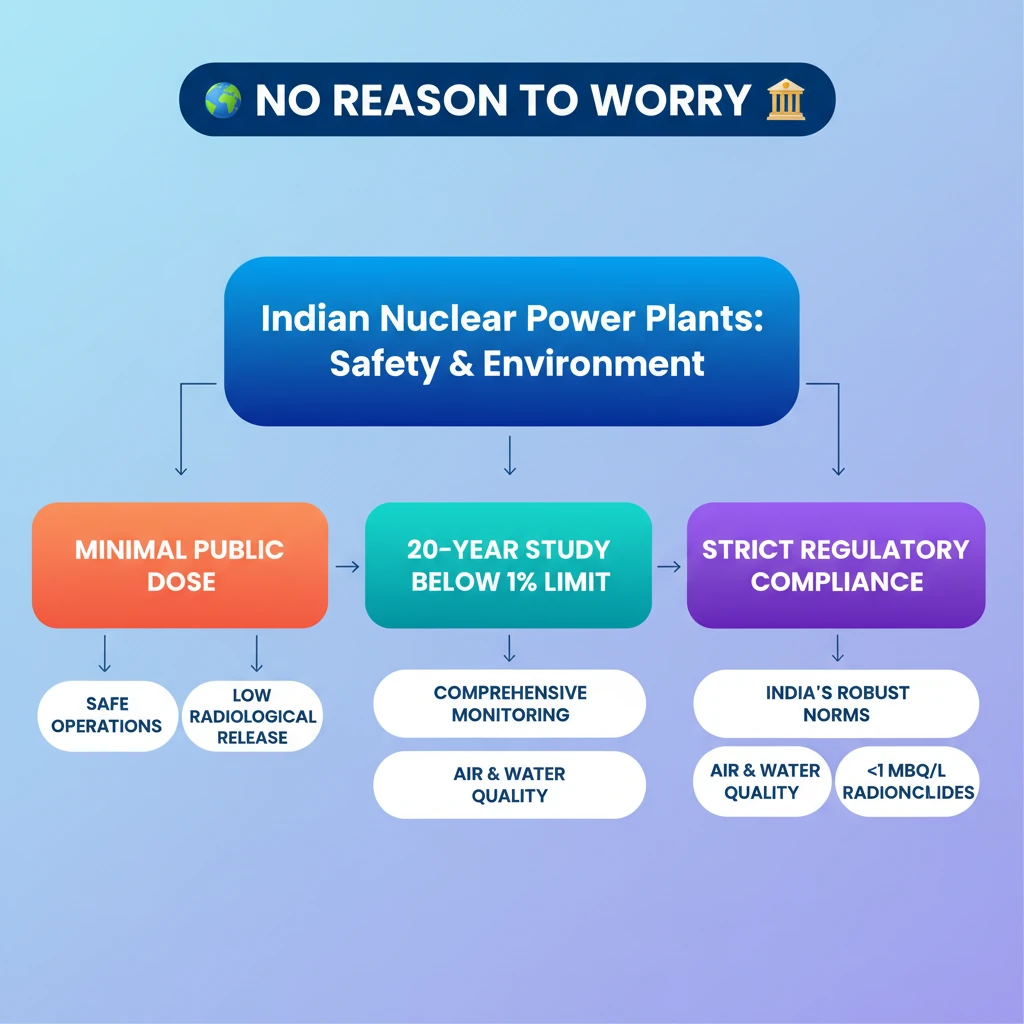
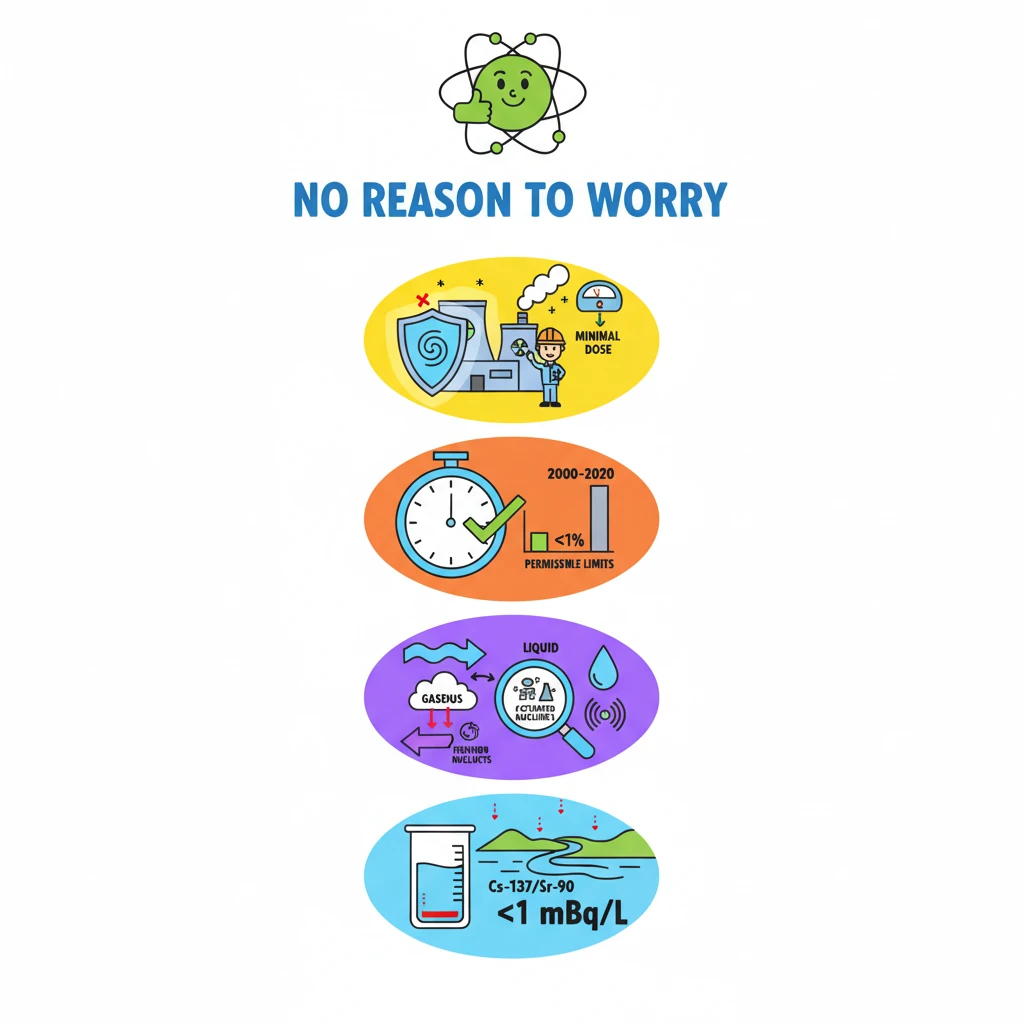
- •Indian Nuclear Power Plants (NPPs) operate safely with minimal public radiological doses.
- •A 20-year study (2000-2020) confirms environmental releases are well below 1% of permissible limits.
- •Comprehensive monitoring covers gaseous and liquid waste, including fission products and activated nuclides.
- •Radionuclide concentrations in air, rivers, lakes, and sea water are consistently very low (e.g., <1 mBq/L for Cs-137/Sr-90 in water).
- •Discharges adhere strictly to India's robust radiological and environmental regulatory regimes.
🧠 Memory Techniques
95% Verified Content
📚 Reference Sources
•Implicitly: Reports from Indian Nuclear Power Corporation Limited (NPCIL)
•Implicitly: Data from Atomic Energy Regulatory Board (AERB)