Nitrogen Pollution - Environment And Ecology | UPSC Learning
Topics
0 topics • 0 completed
🔍
No topics match your search
Nitrogen Pollution
Medium⏱️ 6 min read
environment and ecology
📖 Introduction
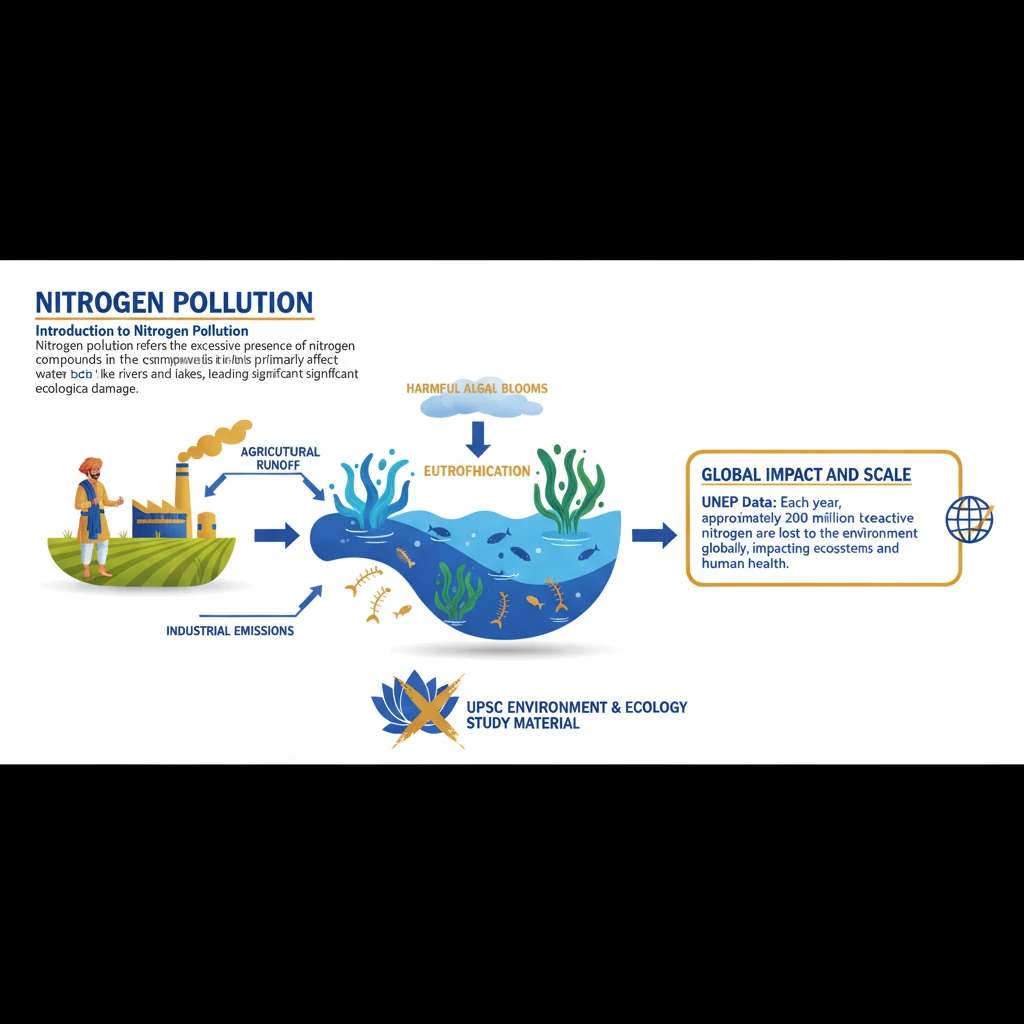
<h4>Introduction to Nitrogen Pollution</h4><p><strong>Nitrogen pollution</strong> refers to the excessive presence of <strong>nitrogen compounds</strong> in the environment. These compounds primarily affect <strong>water bodies</strong> like rivers and lakes, leading to significant ecological damage.</p><h4>Global Impact and Scale</h4><div class='info-box'><p><strong>UNEP Data:</strong> Each year, approximately <strong>200 million tonnes</strong> of <strong>reactive nitrogen</strong> are lost to the environment globally.</p><p>This accounts for <strong>80%</strong> of the total reactive nitrogen, highlighting the vast scale of human impact.</p></div><p>Human activities now produce more <strong>reactive nitrogen</strong> than natural processes, indicating a significant imbalance in the natural nitrogen cycle.</p><h4>Projected Future Scarcity</h4><div class='highlight-box'><p>Recent research projects that by <strong>2050</strong>, <strong>one-third</strong> of global river sub-basins will face severe <strong>scarcity of clean water</strong>.</p><p>This critical issue is directly attributed to the escalating problem of <strong>nitrogen pollution</strong>, impacting human health and ecosystems.</p></div><h4>Key Drivers: Fertilizer Consumption</h4><p>A primary driver of nitrogen pollution is the increasing use of <strong>nitrogen-based fertilizers</strong> in agriculture worldwide.</p><div class='info-box'><p><strong>Historical Trend:</strong> Global consumption of nitrogen-based fertilizers <strong>doubled</strong> between <strong>1978 and 2014</strong>, contributing significantly to environmental overload.</p></div><h4>Sources of Nitrogen Pollution</h4><p>Nitrogen pollution originates from a variety of anthropogenic activities, releasing nitrogen compounds into the atmosphere, soil, and water systems.</p><h5>Agricultural Activities</h5><p>The extensive use of <strong>nitrogen-based fertilizers</strong> is a major contributor to environmental nitrogen overload.</p><ul><li>These fertilizers can <strong>leach into groundwater</strong>, contaminating drinking water sources.</li><li>They also lead to <strong>runoff into surface water bodies</strong>, causing eutrophication and algal blooms.</li></ul><h5>Industrial Processes</h5><p>Manufacturing industries, especially those producing <strong>nitrogen-based chemicals and fertilizers</strong>, release nitrogen compounds directly into the environment.</p><p>The <strong>combustion of fossil fuels</strong> in industrial settings also emits harmful <strong>nitrogen oxides (NOx)</strong> into the atmosphere, contributing to acid rain and smog.</p><h5>Livestock Farming</h5><p>Waste from livestock, including <strong>manure and urine</strong>, contains significant amounts of <strong>nitrogen compounds</strong> such as <strong>ammonia</strong>.</p><div class='info-box'><p><strong>Emissions:</strong> The livestock sector currently emits <strong>65 teragrams (Tg) of nitrogen per year</strong>, which is equivalent to <strong>one-third</strong> of all current human-induced nitrogen emissions.</p></div><p>Improper storage and management of livestock waste lead to <strong>nitrogen runoff</strong>, polluting water bodies and exacerbating <strong>eutrophication</strong>.</p><h5>Biomass Burning</h5><p>Activities such as <strong>wildfires</strong> and the burning of <strong>cow dung cakes</strong> (often used as fuel in rural areas) release nitrogen compounds.</p><p>These processes emit <strong>nitrogen oxides (NOx)</strong> and <strong>nitrous oxide (N2O)</strong> into the atmosphere, contributing to air pollution and acting as potent greenhouse gases.</p>
💡 Key Takeaways
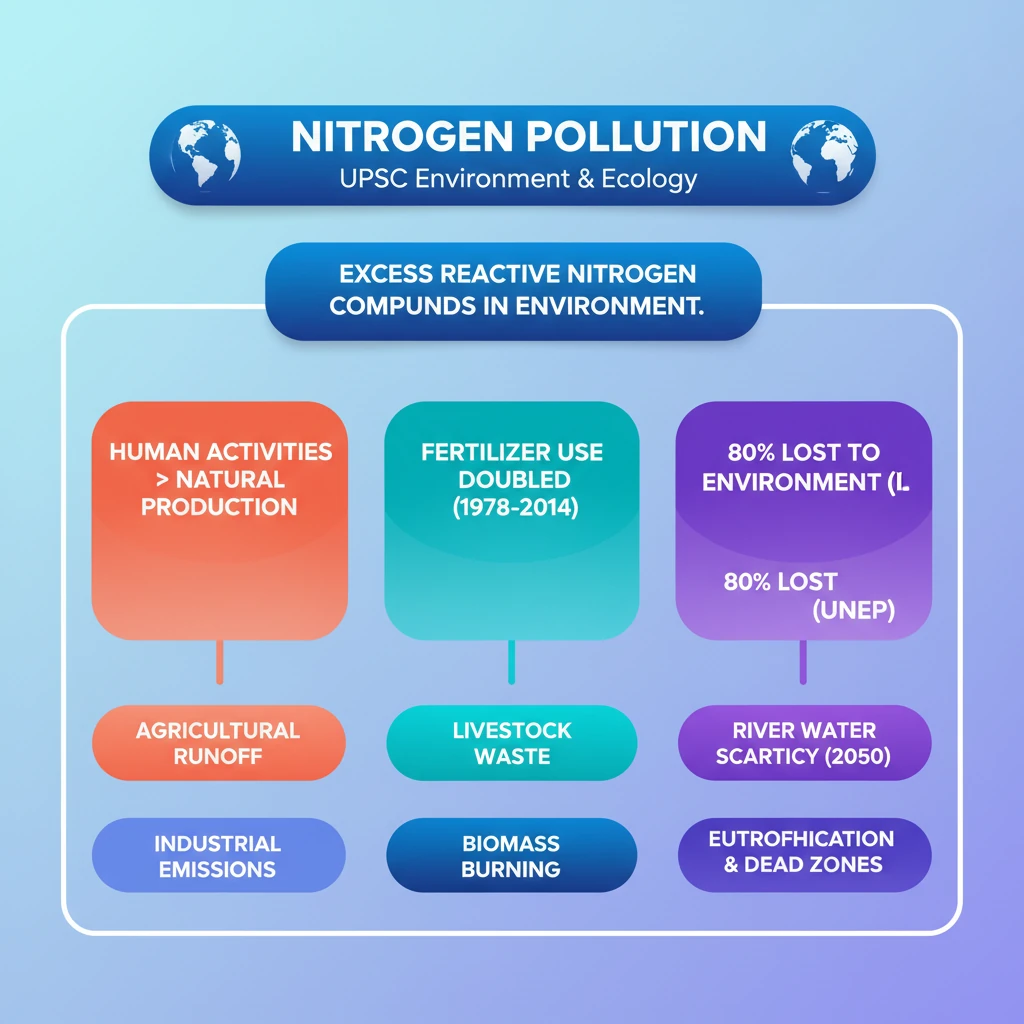
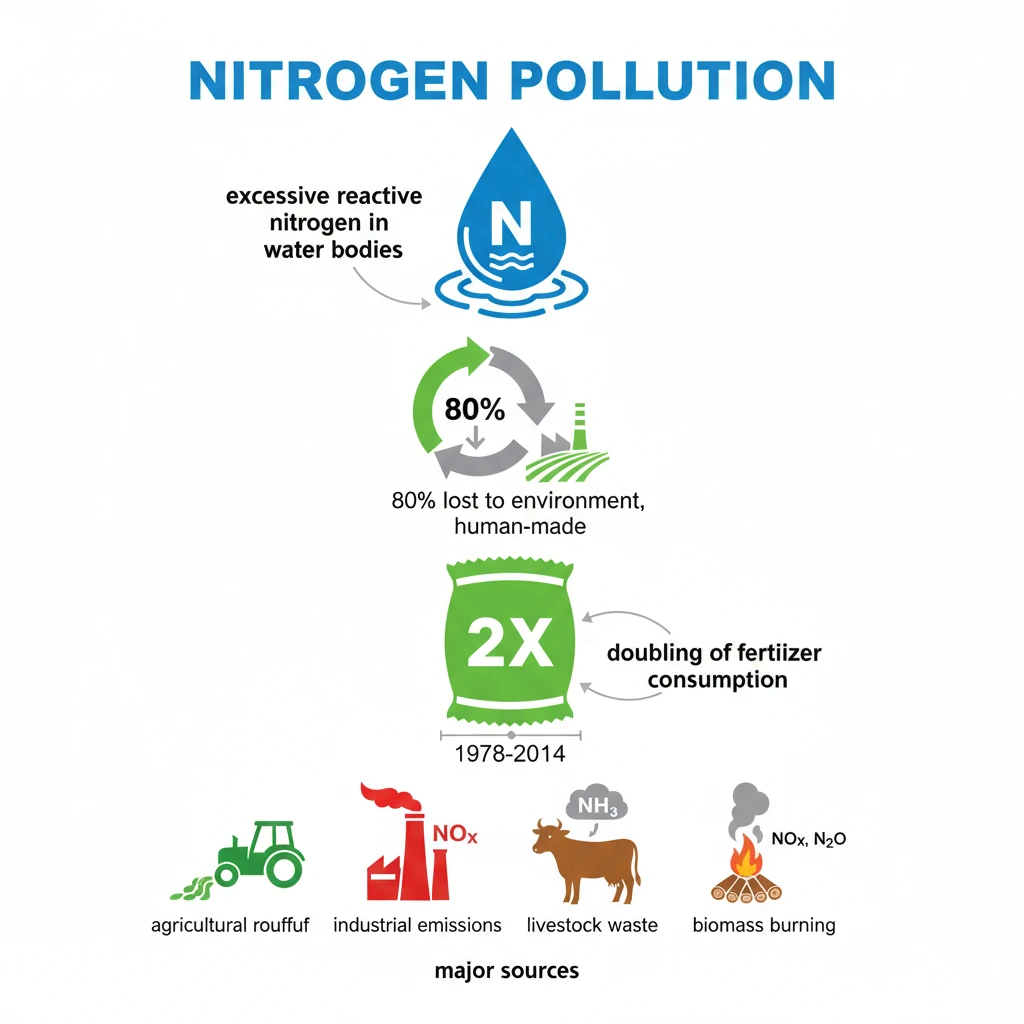
- •Nitrogen pollution is the excessive presence of reactive nitrogen compounds in the environment, primarily in water bodies.
- •Human activities now produce more reactive nitrogen than natural processes, with 80% lost to the environment annually (UNEP).
- •A key driver is the doubling of nitrogen-based fertilizer consumption globally between 1978 and 2014.
- •Major sources include agricultural runoff, industrial emissions (NOx), livestock waste (ammonia), and biomass burning (NOx, N2O).
- •By 2050, one-third of global river sub-basins are projected to face severe clean water scarcity due to this pollution.
🧠 Memory Techniques
95% Verified Content