Mangroves in Coastal Resilience - Environment And Ecology | UPSC Learning
Topics
0 topics • 0 completed
🔍
No topics match your search
Mangroves in Coastal Resilience
Medium⏱️ 8 min read
environment and ecology
📖 Introduction
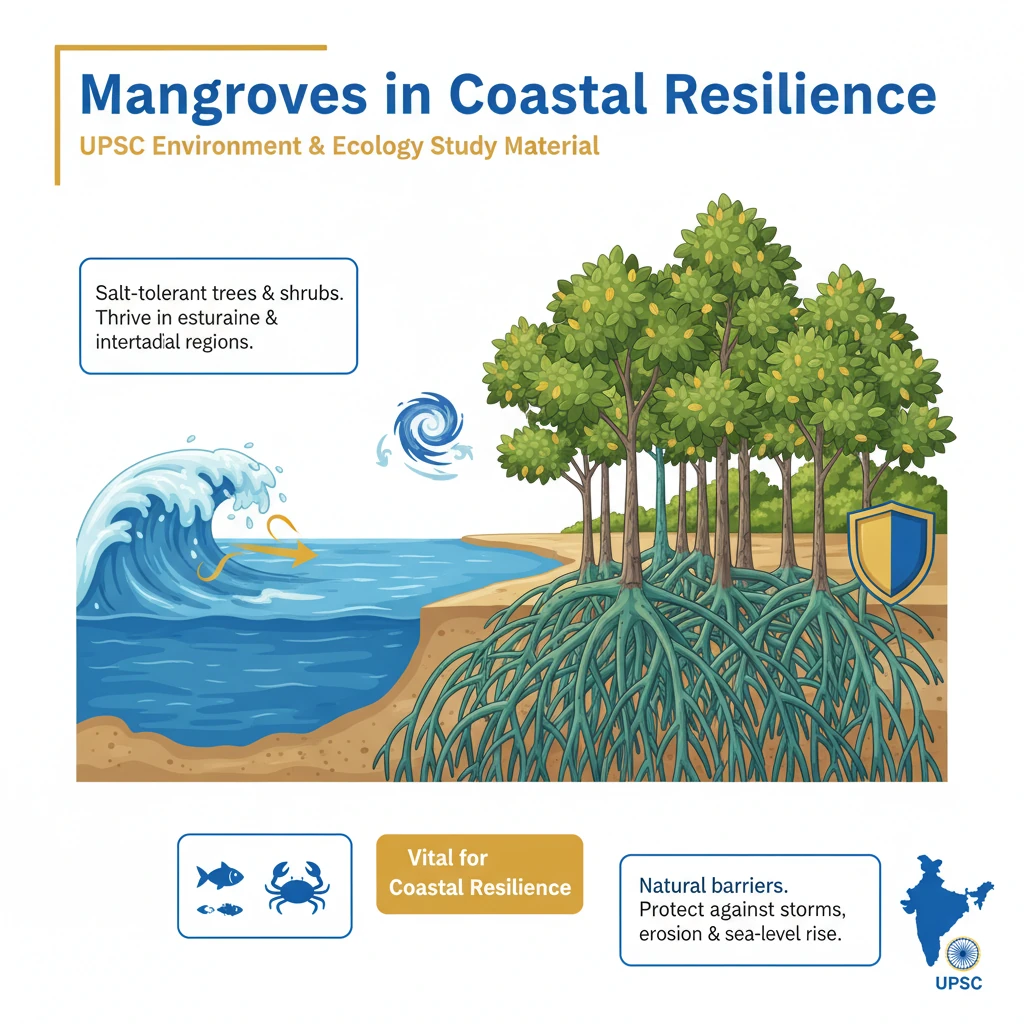
<h4>Introduction: Mangroves and Coastal Resilience</h4><p><strong>Mangroves</strong> are vital <strong>salt-tolerant trees and shrubs</strong> that thrive in the unique environment of <strong>estuarine and intertidal regions</strong>. These areas are characterized by a mix of freshwater and saltwater, creating a challenging yet rich ecosystem.</p><p>Their presence is crucial for <strong>coastal resilience</strong>, acting as natural barriers against various environmental threats. They form a significant part of <strong>littoral forest ecosystems</strong> found in tropical regions.</p><h4>Why Mangroves are in the News: Cyclone Dana</h4><p>The critical role of <strong>mangrove forests</strong> in mitigating the impact of cyclones was recently highlighted. <strong>Cyclone Dana's landfall</strong> near <strong>Bhitarkanika National Park</strong> and <strong>Dhamra Port</strong> in <strong>Odisha</strong> underscored their essential protective function.</p><div class='exam-tip-box'><p><strong>UPSC Insight:</strong> Recent events like <strong>Cyclone Dana</strong> provide excellent case studies for questions on <strong>disaster management</strong> and <strong>environmental conservation</strong>. Always link current affairs to core concepts.</p></div><p>Despite the anticipation of significant damage, the region experienced less severe impacts, largely attributed to the robust <strong>mangrove forest cover</strong> of <strong>Bhitarkanika</strong>. This national park has a proven track record of withstanding major cyclonic events.</p><h4>What are Mangroves? Definition and Adaptations</h4><p><strong>Mangroves</strong> are defined as a group of trees and shrubs that grow in the coastal intertidal zone. They are specifically adapted to harsh, saline conditions.</p><div class='info-box'><p><strong>Key Adaptations:</strong></p><ul><li><strong>Aerial Roots:</strong> Such as <strong>prop roots</strong> and <strong>pneumatophores</strong>, which help in respiration in waterlogged, anaerobic soil.</li><li><strong>Waxy Leaves:</strong> Reduce water loss and excrete excess salt.</li><li><strong>Salt Glands:</strong> Found on leaves to excrete salt.</li><li><strong>Viviparity:</strong> Seeds germinate while still attached to the parent tree, increasing survival rates in the harsh environment.</li></ul></div><p>They represent a unique <strong>littoral forest ecosystem</strong>, flourishing in saline or brackish waters predominantly in <strong>tropical regions</strong>. Common types include <strong>Red mangrove</strong>, <strong>Grey mangrove</strong>, and species like <strong>Rhizophora</strong>.</p><h4>Mangrove Cover and Distribution in India</h4><p>India boasts a significant area under mangrove cover, which is vital for its extensive coastline. These ecosystems are distributed across various states and Union Territories.</p><div class='info-box'><p><strong>Indian Mangrove Statistics (Indian State Forest Report 2021):</strong></p><ul><li><strong>Total Cover:</strong> <strong>4992 sq. Km</strong></li><li><strong>Percentage of Geographical Area:</strong> <strong>0.15%</strong> of India's total geographical area.</li></ul></div><p>Significant mangrove ecosystems are found in states such as <strong>West Bengal</strong> (Sundarbans), <strong>Gujarat</strong>, <strong>Andaman & Nicobar Islands</strong>, <strong>Andhra Pradesh</strong>, and <strong>Odisha</strong>.</p><h4>Overview of Protected Area Management Frameworks</h4><p>The following table provides a general overview of different management authorities, public access regulations, and legal frameworks governing various types of protected areas in India. While not exclusively about mangroves, this information contextualizes broader conservation efforts.</p><table class='info-table'><tr><th>Feature</th><th>Framework 1 (General Protected Area)</th><th>Framework 2 (Tiger Reserve)</th><th>Framework 3 (Biosphere Reserve)</th></tr><tr><td><strong>Management Authority</strong></td><td>Managed by <strong>state governments</strong> or <strong>private organizations</strong>.</td><td>Managed by the <strong>National Tiger Conservation Authority (NTCA)</strong> under <strong>MoEF&CC</strong>.</td><td>Managed by the <strong>MoEF&CC</strong> in collaboration with <strong>local communities</strong>.</td></tr><tr><td><strong>Public Access</strong></td><td>Generally <strong>open to visitors</strong> with some restrictions on activities.</td><td>Access is <strong>regulated</strong> to minimize human disturbance; tourism is allowed in designated areas.</td><td><strong>Limited public access</strong>; primarily for research and education purposes.</td></tr><tr><td><strong>Legal Framework</strong></td><td>Governed by the <strong>Wildlife Protection Act, 1972</strong>.</td><td>Established under the <strong>Wildlife Protection Act, 1972</strong> with specific provisions for <strong>tiger conservation</strong>.</td><td>Recognized under <strong>UNESCO’s Man and Biosphere Programme</strong>; governed by national laws for conservation.</td></tr></table>
💡 Key Takeaways
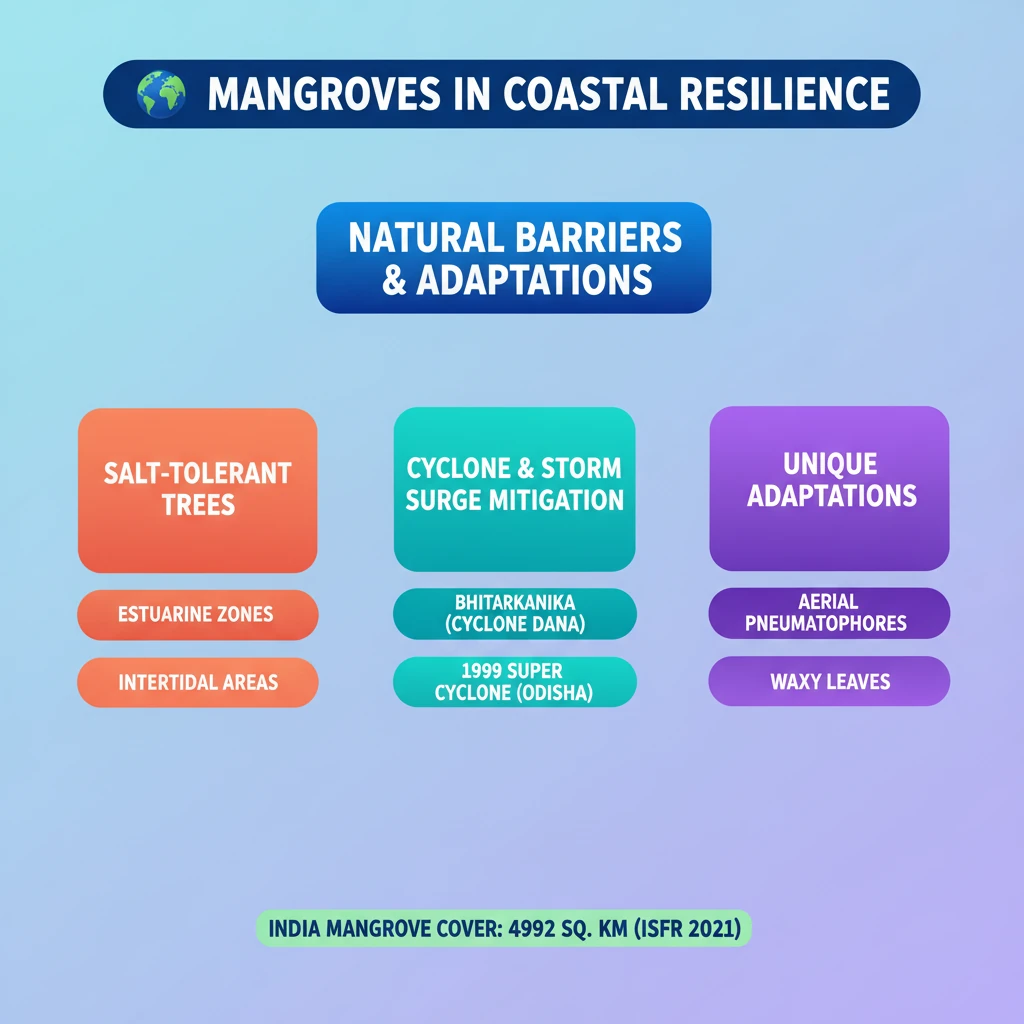
- •Mangroves are salt-tolerant trees/shrubs thriving in estuarine/intertidal zones.
- •They possess unique adaptations like aerial roots and waxy leaves for saline environments.
- •Mangroves act as vital natural barriers, reducing cyclone and storm surge impacts.
- •Bhitarkanika National Park is a prime example, mitigating damage from Cyclone Dana and the 1999 Super Cyclone.
- •India's mangrove cover is 4992 sq. Km (0.15% of total area, as per ISFR 2021).
- •They are crucial for coastal resilience, biodiversity, carbon sequestration, and local livelihoods.
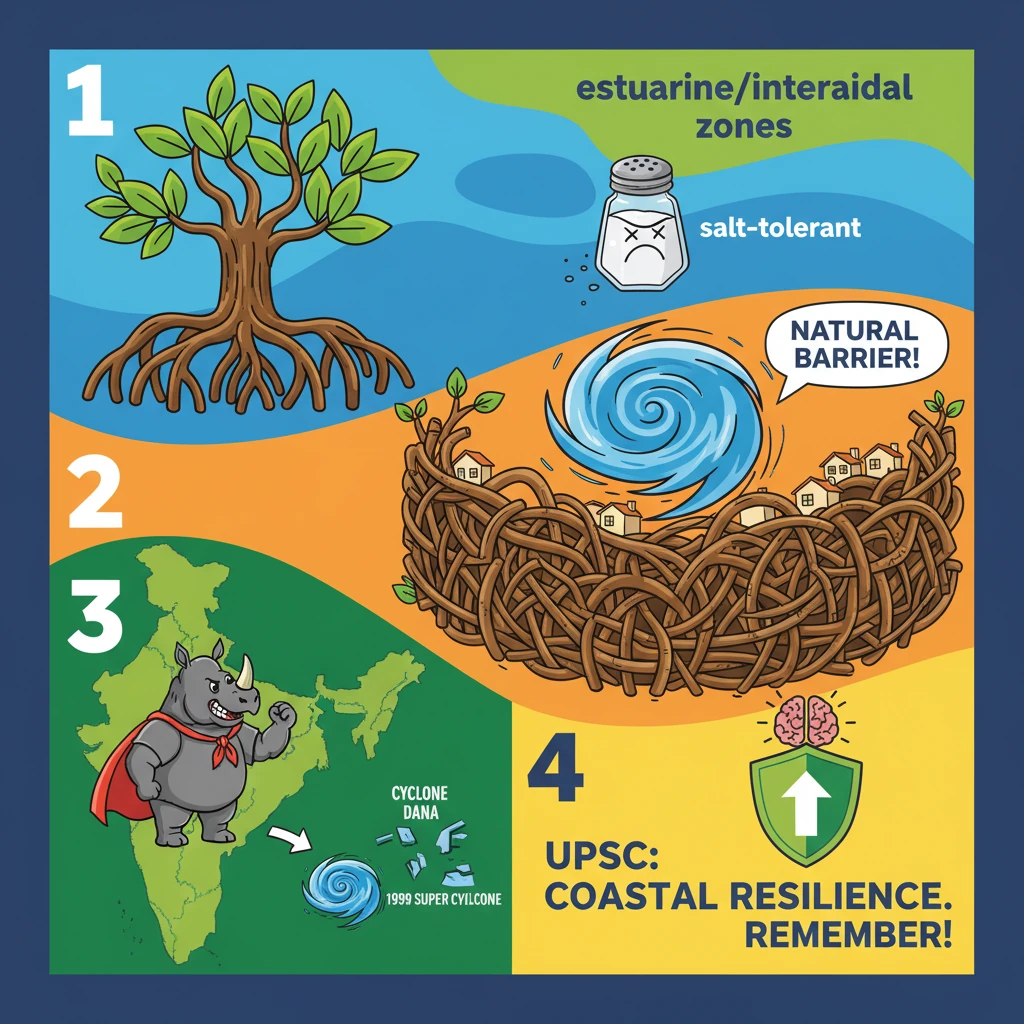
🧠 Memory Techniques
95% Verified Content
📚 Reference Sources
•Indian State Forest Report 2021 (ISFR 2021)
•General knowledge on Cyclone Dana and 1999 Super Cyclone