Lodha Tribe: PVTG in Odisha, Culture, and Socio-Economic Profile - Environment And Ecology | UPSC Learning
Topics
0 topics • 0 completed
🔍
No topics match your search
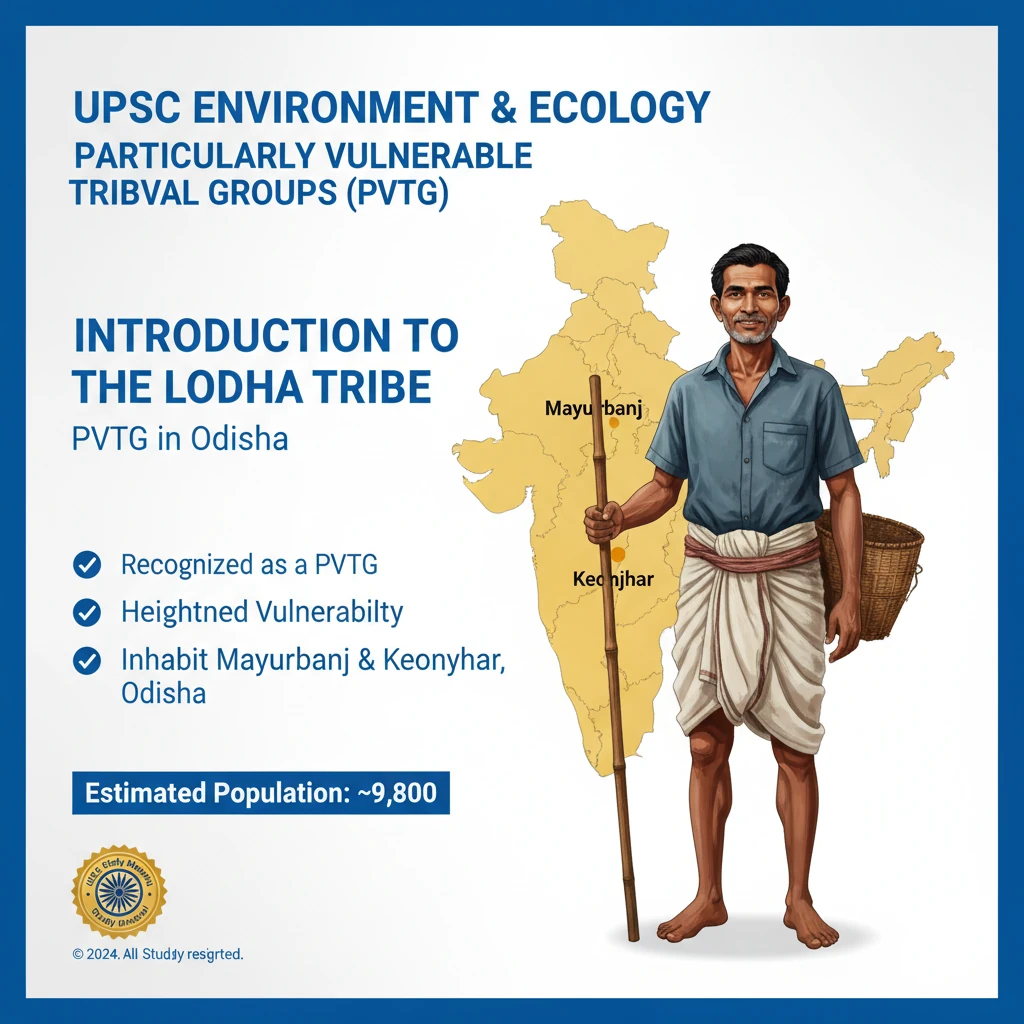
Lodha Tribe: PVTG in Odisha, Culture, and Socio-Economic Profile
Easy⏱️ 7 min read
environment and ecology
📖 Introduction
<h4>Introduction to the Lodha Tribe</h4><p>The <strong>Lodha Tribe</strong> is recognized as a <strong>Particularly Vulnerable Tribal Group (PVTG)</strong> in India. This classification highlights their heightened vulnerability compared to the general <strong>Scheduled Tribe (ST)</strong> population.</p><p>They primarily inhabit the districts of <strong>Mayurbhanj</strong> and <strong>Keonjhar</strong> in <strong>Odisha</strong>. Their population is relatively small, estimated to be around <strong>5,000</strong> individuals.</p><div class='info-box'><p>📍 <strong>Location:</strong> Mayurbhanj and Keonjhar districts, Odisha</p><p>👥 <strong>Population:</strong> Approximately 5,000</p><p>🏷️ <strong>Status:</strong> Particularly Vulnerable Tribal Group (PVTG)</p></div><h4>Understanding Particularly Vulnerable Tribal Groups (PVTGs)</h4><p>A <strong>PVTG</strong> is a sub-category within the broader <strong>Scheduled Tribes (ST)</strong> framework. These groups are identified based on specific criteria indicating greater vulnerability, such as declining or stagnant population, low literacy levels, pre-agricultural technology, and a subsistence economy.</p><p>The classification of a tribal group as a <strong>PVTG</strong> is crucial. It enables the government to focus efforts on improving their living conditions and providing targeted support through specific welfare programs and developmental initiatives.</p><div class='key-point-box'><p><strong>Purpose of PVTG Classification:</strong> To identify and provide focused, targeted support for the most vulnerable tribal communities, ensuring their socio-economic development and cultural preservation.</p></div><div class='info-box'><p><strong>PVTG Statistics in India:</strong></p><ul><li>Total <strong>PVTGs</strong> in India: <strong>75</strong></li><li>State with maximum <strong>PVTGs</strong>: <strong>Odisha</strong> (<strong>13</strong>)</li><li>Second highest <strong>PVTGs</strong>: <strong>Andhra Pradesh</strong> (<strong>12</strong>)</li></ul></div><h4>Key Characteristics of the Lodha Tribe</h4><p>The <strong>Lodha Tribe</strong> possesses distinct cultural and historical characteristics that define their identity and way of life. Understanding these aspects is vital for appreciating their unique challenges and heritage.</p><h5>Language and Communication</h5><p>Members of the <strong>Lodha Tribe</strong> primarily communicate using <strong>Kudmali</strong>, which is their traditional language. Many also speak <strong>Odia</strong>, the official language of <strong>Odisha</strong>, facilitating interaction with the broader state population.</p><div class='info-box'><p>🗣️ <strong>Languages Spoken:</strong> <strong>Kudmali</strong>, <strong>Odia</strong></p></div><h5>Historical Origin and Naming</h5><p>Historically, the <strong>Lodha Tribe</strong> was classified under the discriminatory <strong>Criminal Tribes Act</strong> by the <strong>British colonial administration</strong>. This act stigmatized many indigenous communities, leading to significant social and economic marginalization.</p><p>Their name, <strong>Lodha</strong>, is believed to be derived from the Sanskrit word <strong>Lubdhaka</strong>, which means 'trapper'. This origin reflects their traditional occupations and close relationship with forest resources.</p><div class='info-box'><p>📜 <strong>Historical Classification:</strong> Under the <strong>Criminal Tribes Act</strong> (British Era)</p><p>🌳 <strong>Name Origin:</strong> From <strong>Lubdhaka</strong> (trapper)</p></div><h5>Traditional and Current Occupations</h5><p>Traditionally, the <strong>Lodha Tribe</strong> were <strong>hunter-gatherers</strong> and collectors of <strong>forest produce</strong>. Their livelihood was intrinsically linked to the forest ecosystem, providing them with food, shelter, and resources.</p><p>In contemporary times, their occupational patterns have diversified. Many <strong>Lodha</strong> individuals are now engaged in <strong>agriculture</strong>, working as <strong>laborers</strong>, practicing <strong>rope making</strong>, and operating <strong>small businesses</strong> to sustain themselves.</p><div class='info-box'><p>🏹 <strong>Traditional Occupation:</strong> Hunter-gatherers, forest-produce collectors</p><p>👨🌾 <strong>Current Occupation:</strong> Agriculture, labor, rope making, small businesses</p></div><h5>Dietary Habits</h5><p>The traditional diet of the <strong>Lodha Tribe</strong> includes <strong>fish</strong> and <strong>tortoise</strong>. These food sources reflect their historical dependence on local aquatic and terrestrial environments for sustenance.</p><div class='info-box'><p>🍲 <strong>Diet:</strong> Fish, tortoise</p></div><div class='exam-tip-box'><p><strong>UPSC Insight:</strong> Questions on <strong>PVTGs</strong> often appear in <strong>GS Paper I (Society)</strong>, <strong>GS Paper II (Social Justice, Government Policies)</strong>, and <strong>GS Paper III (Environment, Sustainable Development)</strong>. Knowing specific examples like the <strong>Lodha Tribe</strong> helps in enriching answers on tribal welfare and conservation.</p></div>
💡 Key Takeaways
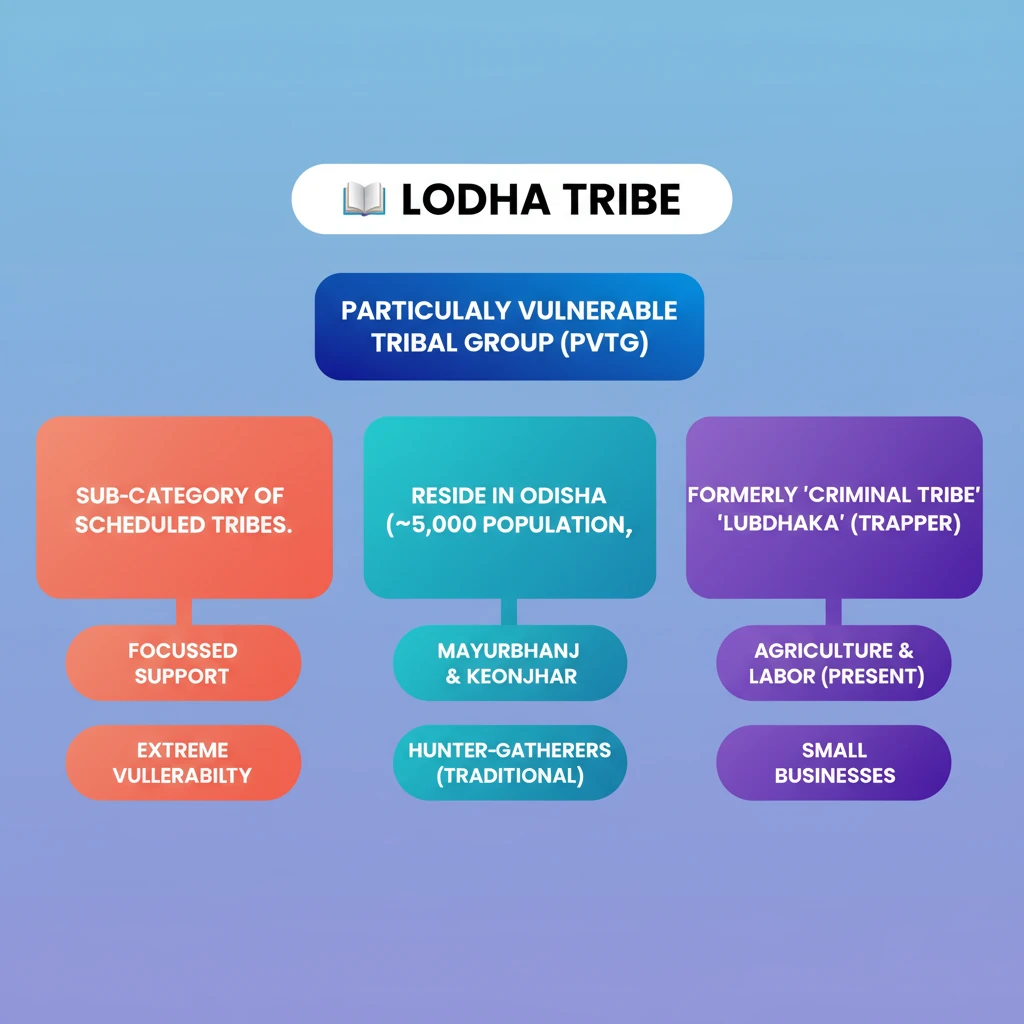
- •The Lodha Tribe is a Particularly Vulnerable Tribal Group (PVTG) in Odisha.
- •They reside in Mayurbhanj and Keonjhar districts, with a population of around 5,000.
- •PVTGs are a sub-category of Scheduled Tribes requiring focused support due to extreme vulnerability.
- •Historically, the Lodha Tribe was classified under the British Criminal Tribes Act, deriving their name from 'Lubdhaka' (trapper).
- •Their traditional occupation was hunter-gathering; now they engage in agriculture, labor, and small businesses.
- •Odisha has the highest number of PVTGs (13) in India.
🧠 Memory Techniques
95% Verified Content