The Royal Bengal Tigers - Environment And Ecology | UPSC Learning
Topics
0 topics • 0 completed
🔍
No topics match your search
The Royal Bengal Tigers
Medium⏱️ 7 min read
environment and ecology
📖 Introduction
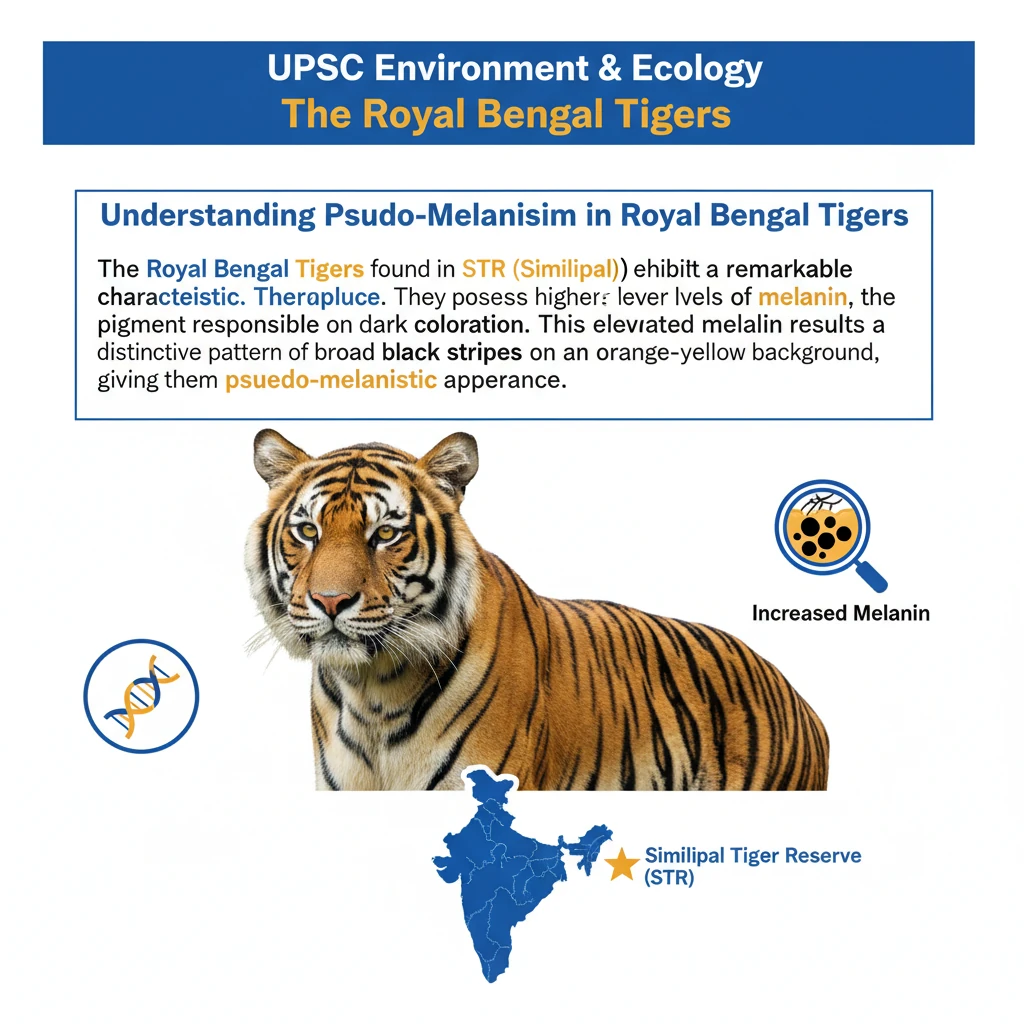
<h4>Understanding Pseudo-Melanism in Royal Bengal Tigers</h4><p>The <strong>Royal Bengal Tigers</strong> found in <strong>STR</strong> (Similipal Tiger Reserve) exhibit a remarkable genetic characteristic. They possess higher levels of <strong>melanin</strong>, the pigment responsible for dark coloration.</p><p>This elevated melanin results in a distinctive pattern of broad black stripes on an orange-yellow background, giving them a <strong>pseudo-melanistic</strong> appearance. This trait makes them visually unique among tiger populations.</p><div class='key-point-box'><p><strong>Pseudo-melanism</strong> is a genetic variation where an animal appears darker than normal due to increased pigmentation, but not fully melanistic (completely black).</p></div><h4>All Odisha Tiger Estimation (AOTE) 2023-24 Findings</h4><p>Recent surveys confirm the presence of these unique tigers. The <strong>All Odisha Tiger Estimation (AOTE) 2023-24 report</strong> provides crucial data on the tiger population in the region.</p><div class='info-box'><p>The <strong>AOTE 2023-24 report</strong> estimates that <strong>Similipal Tiger Reserve (STR)</strong> is home to <strong>27 tigers</strong>. Significantly, <strong>13 adult pseudo-melanistic tigers</strong> were identified within this population.</p></div><p>This particular genetic trait, leading to pseudo-melanism, is currently <strong>not found in any other wild habitat</strong> globally, making STR a critically important site for tiger conservation.</p><div class='exam-tip-box'><p>For <strong>UPSC Prelims</strong>, remember the location (<strong>STR</strong>), the specific trait (<strong>pseudo-melanism</strong>), and its uniqueness. For <strong>Mains</strong>, discuss its implications for biodiversity and conservation strategies.</p></div><h4>Other Notable Color Variations in Tigers</h4><p>While pseudo-melanism is rare, tigers display several other fascinating color variations, each stemming from distinct genetic factors.</p><ul><li><strong>Orange with Black or Brown Stripes:</strong> This is the most prevalent and widely recognized coloration of tigers, including the typical <strong>Royal Bengal Tiger</strong>.</li><li>Each tiger possesses a <strong>unique stripe pattern</strong>, akin to human fingerprints. This intricate patterning provides effective <strong>camouflage</strong> within their natural forest habitats.</li></ul><h4>Understanding White Tigers</h4><p><strong>White tigers</strong> are often mistaken for a separate subspecies, but they are not. Their distinct appearance is due to a specific genetic condition.</p><div class='info-box'><p>The white fur of these tigers is a result of a <strong>genetic mutation</strong> known as <strong>leucism</strong>. This mutation causes a significant reduction in overall pigmentation, leading to pale-colored skin, fur, or scales.</p></div><p>Unlike albinism, leucism affects only pigment cells, not eye color, so white tigers typically have blue eyes.</p><h4>Exploring Golden Tigers</h4><p>Another striking variation is the <strong>Golden Tiger</strong>, which, like white tigers, is not considered a distinct subspecies. Their unique coloration is also genetically determined.</p><div class='info-box'><p>The golden hue in these tigers is caused by a <strong>recessive gene</strong> referred to as <strong>“wideband.”</strong> This gene interferes with <strong>melanin production</strong> during the hair growth phase, resulting in a lighter, golden-orange coat.</p></div><p>This rare variation has been specifically observed in the wild within <strong>Kaziranga National Park</strong> in India, highlighting the genetic diversity present in Indian tiger populations.</p>
💡 Key Takeaways
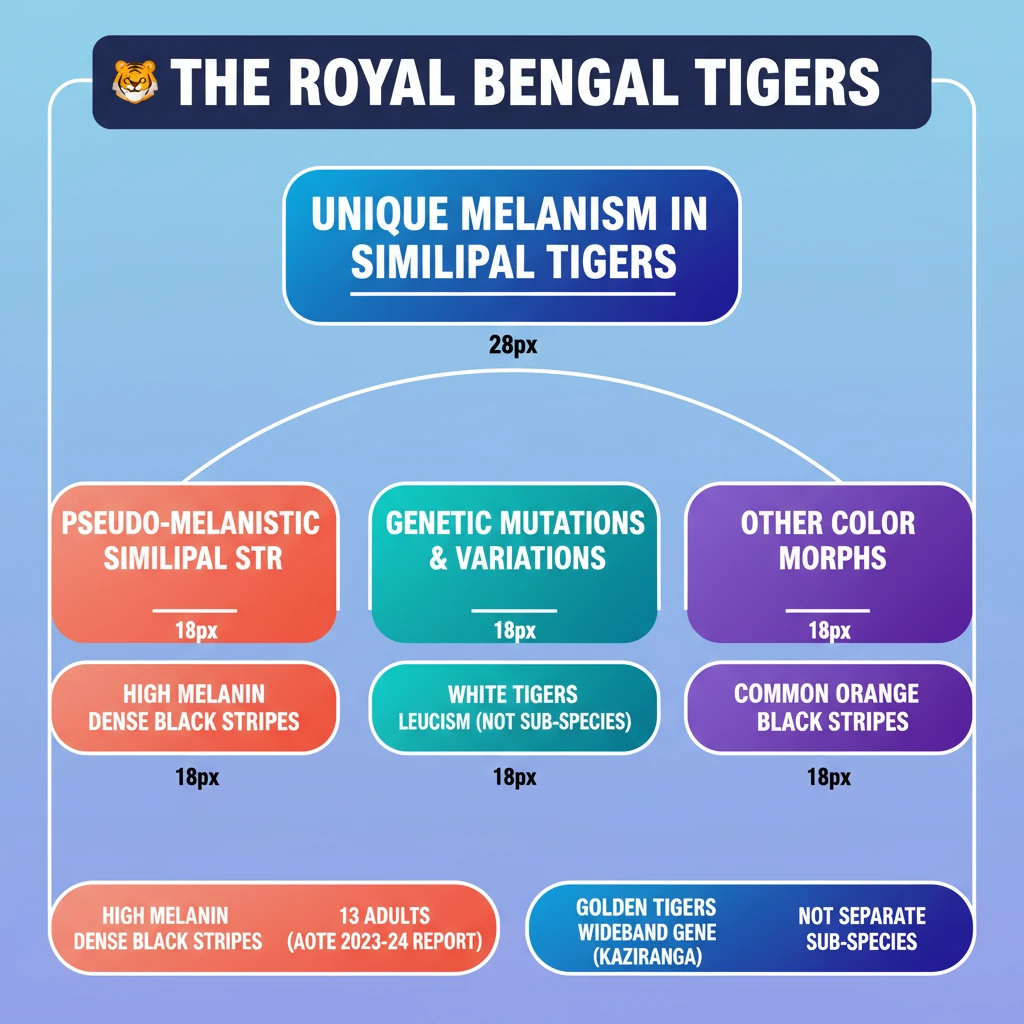
- •Pseudo-melanistic Royal Bengal Tigers in Similipal STR have unique high melanin levels, resulting in dense black stripes.
- •AOTE 2023-24 report identified 13 adult pseudo-melanistic tigers in STR, a trait unique to this wild habitat.
- •Other tiger color variations include common orange with black stripes, white tigers (due to leucism), and golden tigers (due to the wideband gene).
- •White tigers are not a separate subspecies but a genetic mutation (leucism) reducing pigmentation.
- •Golden tigers, seen in Kaziranga, are also not a subspecies, caused by a recessive 'wideband' gene affecting melanin.
- •Genetic diversity and unique traits are crucial for long-term species survival and conservation strategies.
🧠 Memory Techniques
95% Verified Content