Air Quality Life Index (AQLI) 2024 - Environment And Ecology | UPSC Learning
Topics
0 topics • 0 completed
🔍
No topics match your search
Air Quality Life Index (AQLI) 2024
Medium⏱️ 7 min read
environment and ecology
📖 Introduction
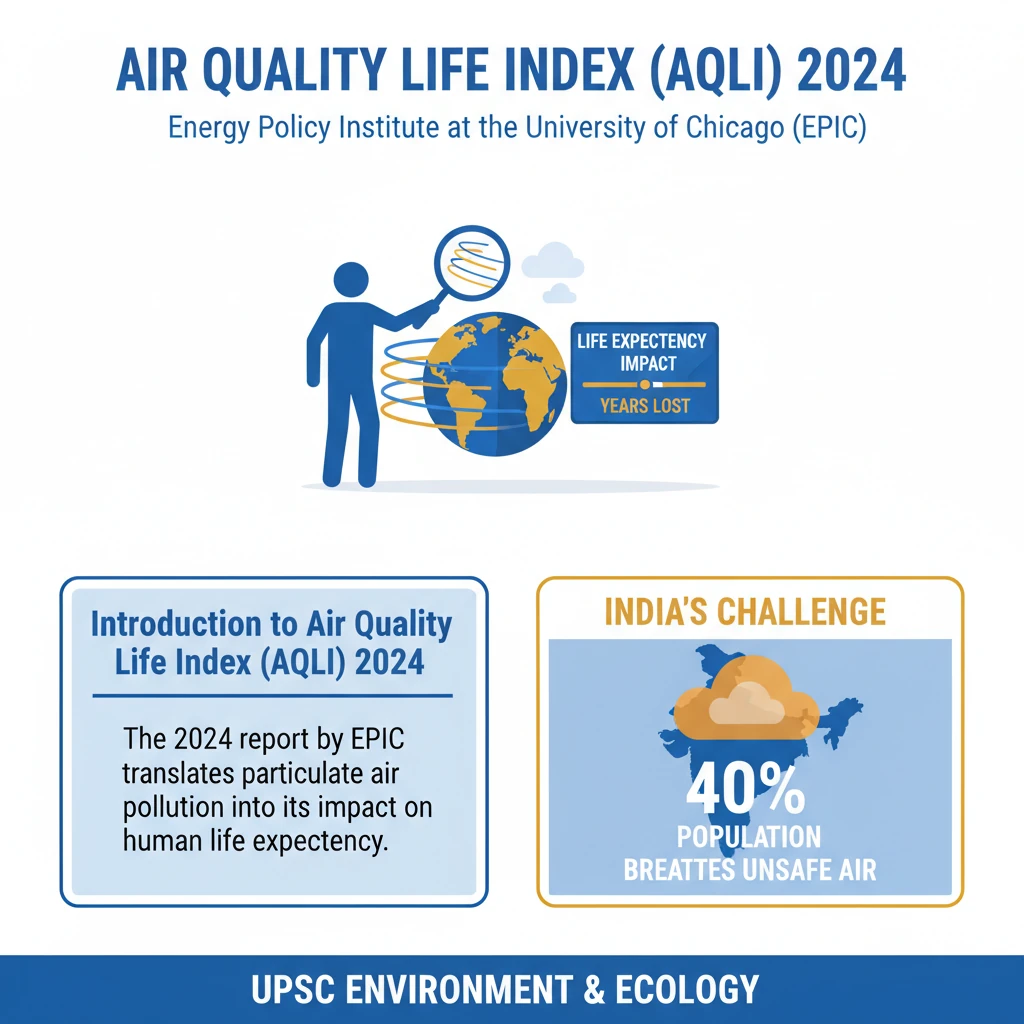
<h4>Introduction to Air Quality Life Index (AQLI) 2024</h4><p>The <strong>Air Quality Life Index (AQLI) 2024</strong> report was recently released by the <strong>Energy Policy Institute at the University of Chicago (EPIC)</strong>. This index translates particulate air pollution into its impact on human life expectancy, making the invisible threat tangible.</p><p>In <strong>India</strong>, a significant challenge persists: over <strong>40% of the population</strong> breathes air exceeding the national annual <strong>PM2.5 standard of 40 µg/m³</strong>. This highlights the urgent need for robust air quality management.</p><div class='info-box'><p><strong>What is PM2.5?</strong></p><p><strong>PM2.5</strong> refers to <strong>particulate matter</strong> that is <strong>2.5 micrometres or less in diameter</strong>. These fine particles are small enough to penetrate deep into the lungs and even enter the bloodstream, posing severe health risks.</p></div><h4>Key Findings: Impact on Life Expectancy</h4><p>The <strong>AQLI 2024 report</strong> underscores the profound impact of air pollution on global life expectancy. It reveals that achieving the <strong>World Health Organization (WHO) guidelines</strong> for <strong>PM2.5</strong> could significantly extend human lives.</p><div class='key-point-box'><p><strong>Global Life Expectancy Gain:</strong> If <strong>PM2.5 pollution</strong> were reduced to meet <strong>WHO guidelines</strong>, the average person could live <strong>1.9 years longer</strong>, collectively adding a staggering <strong>14.9 billion life years globally</strong>.</p></div><h4>Global Scenario: Pollution Reduction and Life Gains</h4><p>Several regions have demonstrated the effectiveness of stringent environmental policies in combating air pollution and improving public health.</p><ul><li><strong>United States (US):</strong> Has achieved a substantial <strong>67.2% reduction</strong> in pollution levels since <strong>1970</strong>, leading to an average lifespan extension of <strong>1.5 years</strong> for its citizens.</li><li><strong>China:</strong> Implemented rigorous policies since <strong>2014</strong>, resulting in a remarkable <strong>41% decrease</strong> in air pollution. This improvement has added <strong>2 years</strong> to the life expectancy of the average Chinese person.</li><li><strong>Europe:</strong> Has seen a <strong>30.2% reduction</strong> in pollution since <strong>1998</strong>, contributing an additional <strong>5.6 months</strong> to the average life expectancy across the continent.</li></ul><div class='exam-tip-box'><p>These examples of successful policy implementation in the <strong>US, China, and Europe</strong> can be used in <strong>UPSC Mains GS-III answers</strong> to illustrate effective strategies for environmental governance and public health improvement.</p></div><h4>Regional Analysis: South and Southeast Asia</h4><p>Despite some improvements, <strong>South and Southeast Asia</strong> continue to face severe air quality challenges, remaining the most polluted region globally.</p><ul><li><strong>Recent Trends:</strong> The region observed a <strong>4% decline</strong> in <strong>PM2.5 levels</strong> in <strong>2022</strong> compared to <strong>2012</strong>, indicating some progress.</li><li><strong>Persistent Challenge:</strong> Despite this, <strong>South Asia</strong> alone accounts for <strong>45% of global life years lost</strong> due to high pollution, highlighting the immense health burden.</li><li><strong>Most Polluted Countries:</strong> <strong>Bangladesh, India, Nepal, and Pakistan</strong> are consistently ranked among the most polluted nations worldwide.</li><li><strong>Myanmar's Impact:</strong> In <strong>Myanmar</strong>, air pollution is currently reducing life expectancy by an average of <strong>2.9 years</strong>.</li></ul><h4>Regional Analysis: Africa</h4><p>Air pollution levels in <strong>Central and West Africa</strong> largely remained unchanged in <strong>2022</strong>, posing a significant public health threat.</p><ul><li><strong>Average PM2.5 Concentration:</strong> The region's average <strong>PM2.5 concentration</strong> stands at <strong>22.2 µg/m³</strong>, which is <strong>4.4 times higher</strong> than the <strong>WHO guideline</strong>.</li><li><strong>Life Expectancy Reduction:</strong> This level of pollution is reducing life expectancy by an average of <strong>1.7 years</strong> across the region.</li><li><strong>Emerging Policies:</strong> Encouragingly, countries like <strong>Nigeria, Rwanda, and Ghana</strong> have recently initiated and implemented their own air quality regulations and standards.</li></ul><h4>Regional Analysis: West Asia (MENA)</h4><p>The <strong>Middle East and North Africa (MENA) region</strong> has emerged as a new hotspot for air pollution, with growing concerns about its impact on public health.</p><ul><li><strong>Life Expectancy Reduction:</strong> Air pollution in the <strong>MENA region</strong> is reducing life expectancy by an average of <strong>1.3 years</strong>.</li><li><strong>Most Polluted Nations:</strong> <strong>Qatar and Iraq</strong> are identified as the most polluted countries within this region.</li></ul><h4>Regional Analysis: Latin America</h4><p><strong>Latin America</strong> has experienced a concerning increase in <strong>PM2.5 levels</strong> in recent years, indicating a deteriorating air quality situation.</p><ul><li><strong>Rising Pollution:</strong> <strong>PM2.5 levels</strong> increased by <strong>4.8% from 2021</strong> and <strong>3% from 1998</strong> in the region.</li><li><strong>Most Polluted:</strong> <strong>Bolivia</strong> is the most polluted country in <strong>Latin America</strong>.</li><li><strong>Guatemala's Impact:</strong> In <strong>Guatemala</strong>, air pollution is reducing life expectancy by <strong>2.1 years</strong>.</li><li><strong>Urban Initiatives:</strong> Major cities such as <strong>Bogotá, Mexico City, and Quito</strong> are actively implementing measures like driving restrictions and improvements in public transport to combat urban air pollution.</li>
💡 Key Takeaways
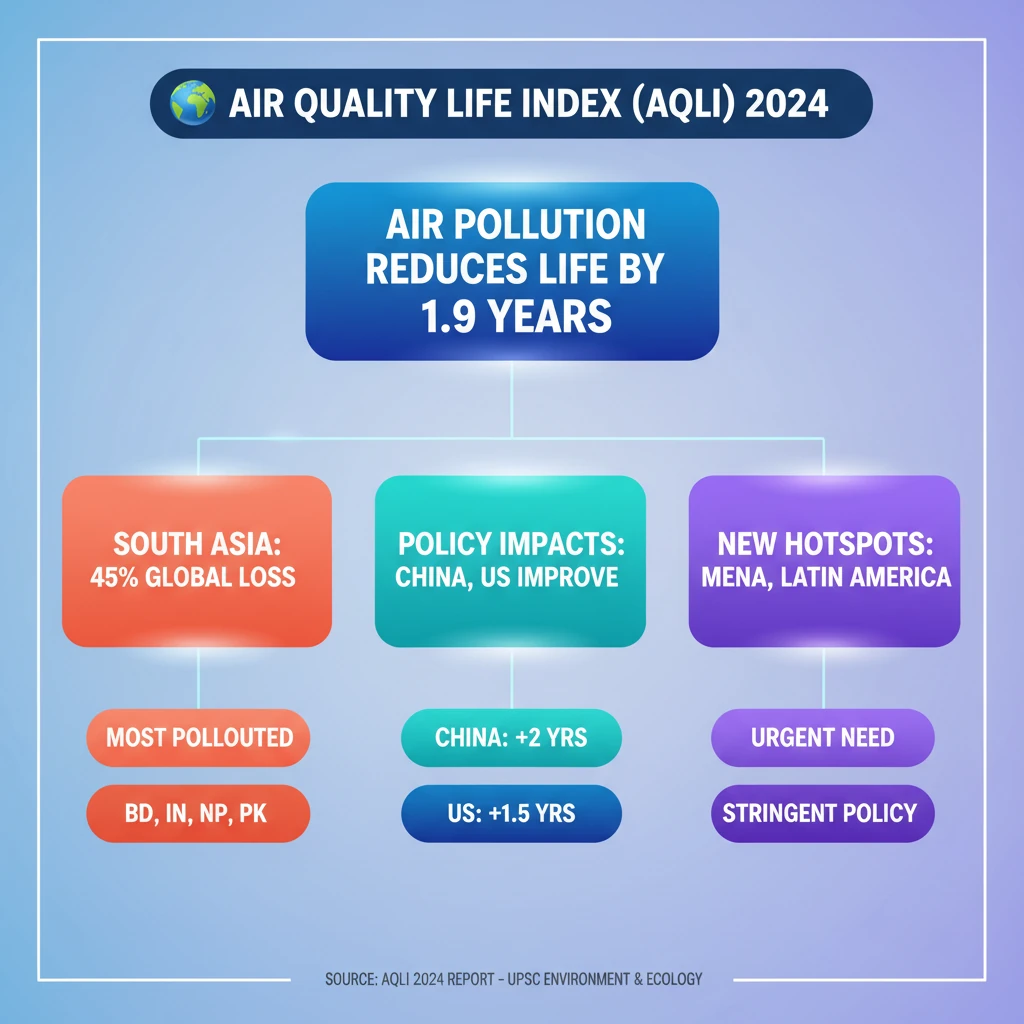
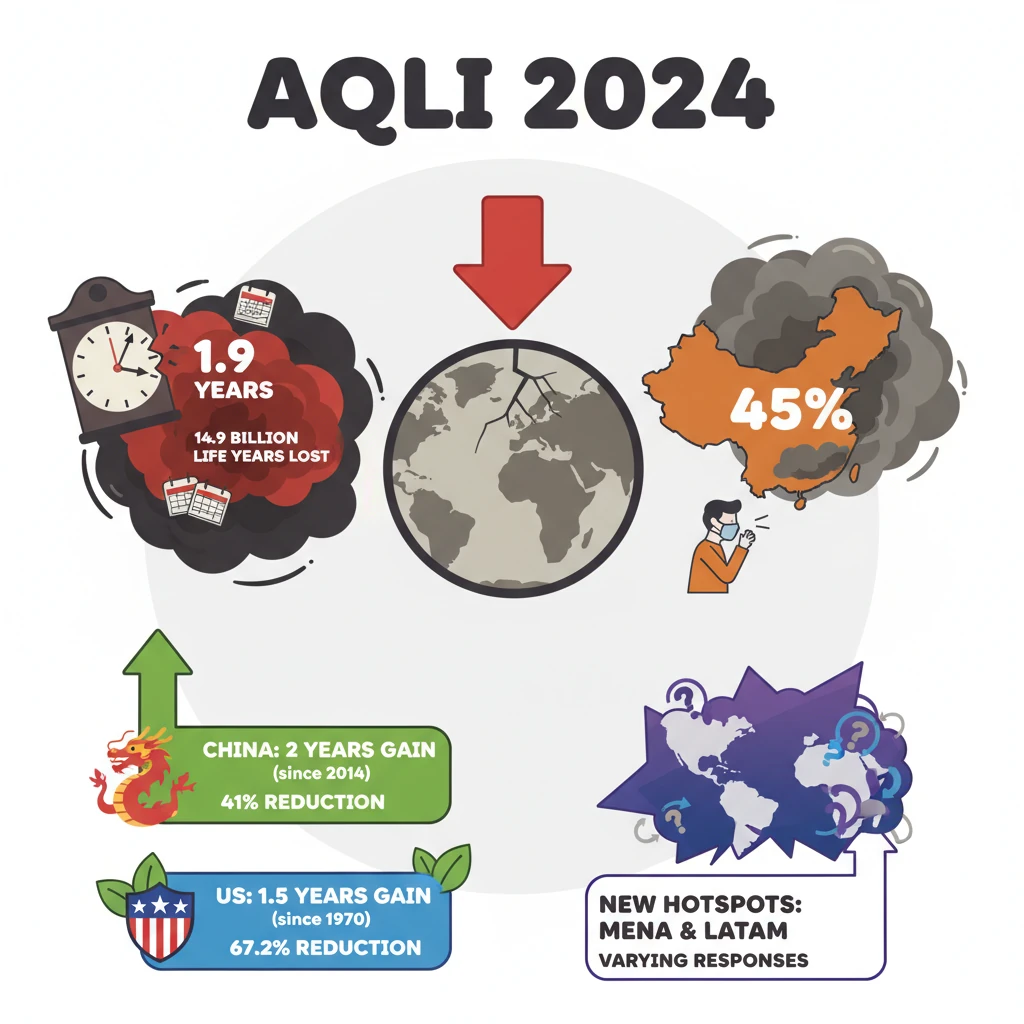
- •AQLI 2024 reveals air pollution could reduce global average life expectancy by 1.9 years, totaling 14.9 billion life years lost.
- •South Asia is the most polluted region, accounting for 45% of global life years lost, with Bangladesh, India, Nepal, and Pakistan being highly affected.
- •Countries like China (41% reduction, 2 years life gain since 2014) and the US (67.2% reduction, 1.5 years life gain since 1970) demonstrate effective policy impacts.
- •New pollution hotspots are emerging in MENA and Latin America, with varying regional responses.
- •The report emphasizes the critical need for stringent air quality policies and their direct link to public health and longevity.
🧠 Memory Techniques
95% Verified Content
📚 Reference Sources
•Drishti IAS Summary on AQLI 2024 (secondary source for content structure)
•World Health Organization (WHO) Air Quality Guidelines (contextual reference)