What are the Key Facts about Buxa Tiger Reserve? - Environment And Ecology | UPSC Learning
Topics
0 topics • 0 completed
🔍
No topics match your search
What are the Key Facts about Buxa Tiger Reserve?
Easy⏱️ 5 min read
environment and ecology
📖 Introduction
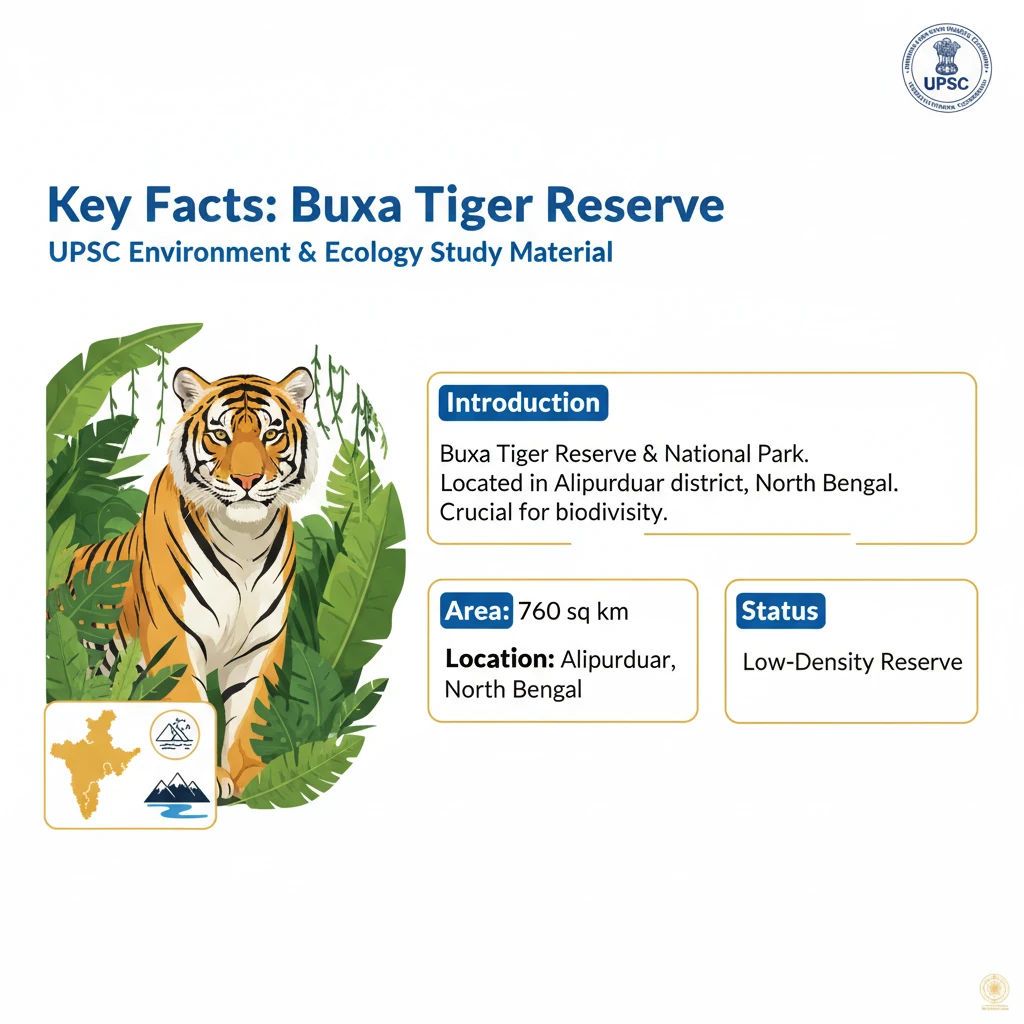
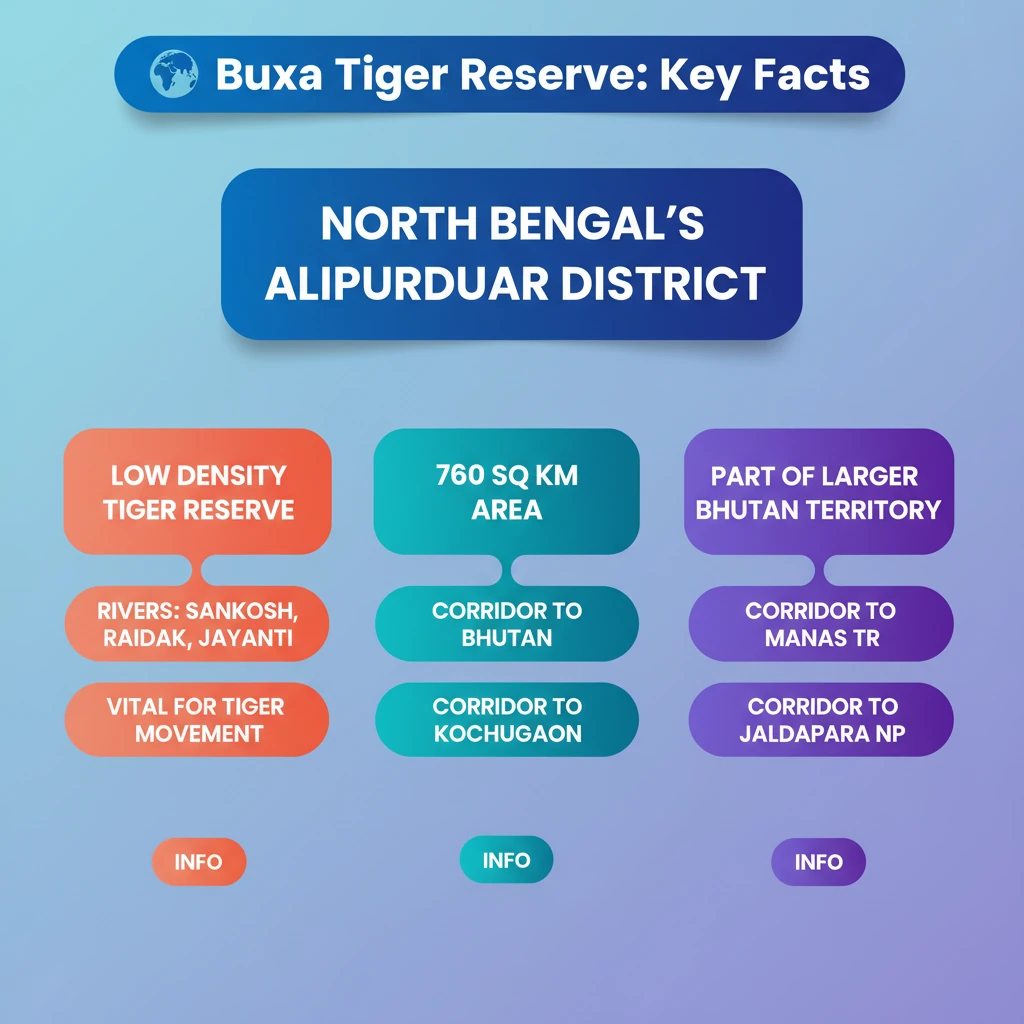
<h4>Introduction to Buxa Tiger Reserve</h4><p>The <strong>Buxa Tiger Reserve</strong> and <strong>National Park</strong> is a significant protected area located in <strong>North Bengal's Alipurduar district</strong>. It plays a crucial role in regional biodiversity conservation.</p><div class='info-box'><p><strong>Area:</strong> 760 square kilometers</p><p><strong>Location:</strong> Alipurduar district, North Bengal</p></div><h4>Status as a Low-Density Reserve</h4><p><strong>Buxa</strong> is characterized as a <strong>"low density" reserve</strong>. This indicates that while it is a designated tiger habitat, its tiger population density is relatively lower compared to some other reserves.</p><div class='key-point-box'><p>Being a <strong>low-density reserve</strong> highlights the importance of its conservation efforts and the need to support its tiger population recovery.</p></div><h4>Geographical Significance and River Systems</h4><p>The reserve is an integral part of a larger <strong>tiger territory</strong> that extends beyond India's borders into <strong>Bhutan</strong>. This cross-border connectivity is vital for genetic exchange and population viability.</p><p>Several important rivers flow through the <strong>Buxa National Park</strong>, contributing to its rich ecosystem and providing essential water sources for its flora and fauna.</p><ul><li><strong>Sankosh</strong></li><li><strong>Raidak</strong></li><li><strong>Jayanti</strong></li><li><strong>Churnia</strong></li><li><strong>Turturi</strong></li><li><strong>Phashkhawa</strong></li><li><strong>Dima</strong></li><li><strong>Nonani</strong></li></ul><h4>Critical Corridor Connectivity</h4><p>According to the <strong>National Tiger Conservation Authority (NTCA)</strong>, <strong>Buxa Tiger Reserve</strong> boasts vital corridor connectivity with several other significant forest areas. These corridors are essential for the movement of wildlife, especially tigers, between protected zones.</p><div class='info-box'><p><strong>Northern Linkage:</strong> Forests of <strong>Bhutan</strong> (across the border)</p><p><strong>Eastern Linkages:</strong> <strong>Kochugaon forests (Assam)</strong> and <strong>Manas Tiger Reserve (Assam)</strong></p><p><strong>Western Linkage:</strong> <strong>Jaldapara National Park</strong></p></div><div class='exam-tip-box'><p>Understanding <strong>corridor connectivity</strong> is crucial for UPSC. It's a key concept in wildlife conservation, habitat fragmentation, and mitigating human-wildlife conflict. Questions often revolve around the importance of such linkages for genetic diversity and species survival.</p></div>
💡 Key Takeaways
- •Buxa Tiger Reserve is in North Bengal's Alipurduar district, covering 760 sq km.
- •It's a 'low density' tiger reserve, part of a larger territory extending to Bhutan.
- •Key rivers flowing through it include Sankosh, Raidak, and Jayanti.
- •It has critical corridor connectivity with Bhutan, Kochugaon forests, Manas Tiger Reserve, and Jaldapara National Park.
- •These corridors are vital for tiger movement and genetic exchange.
🧠 Memory Techniques

95% Verified Content