What are the Key Findings of the GHG Bulletin? - Environment And Ecology | UPSC Learning
Topics
0 topics • 0 completed
🔍
No topics match your search
What are the Key Findings of the GHG Bulletin?
Medium⏱️ 8 min read
environment and ecology
📖 Introduction
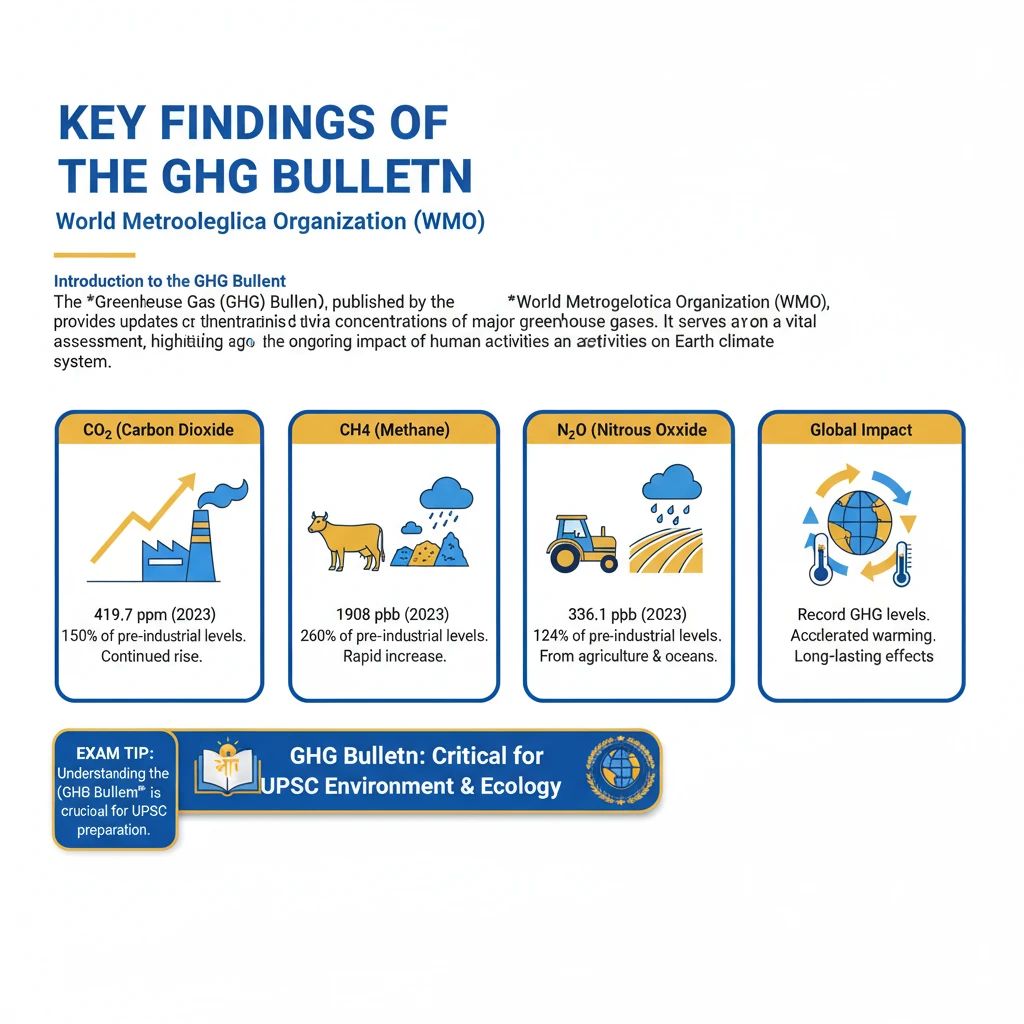
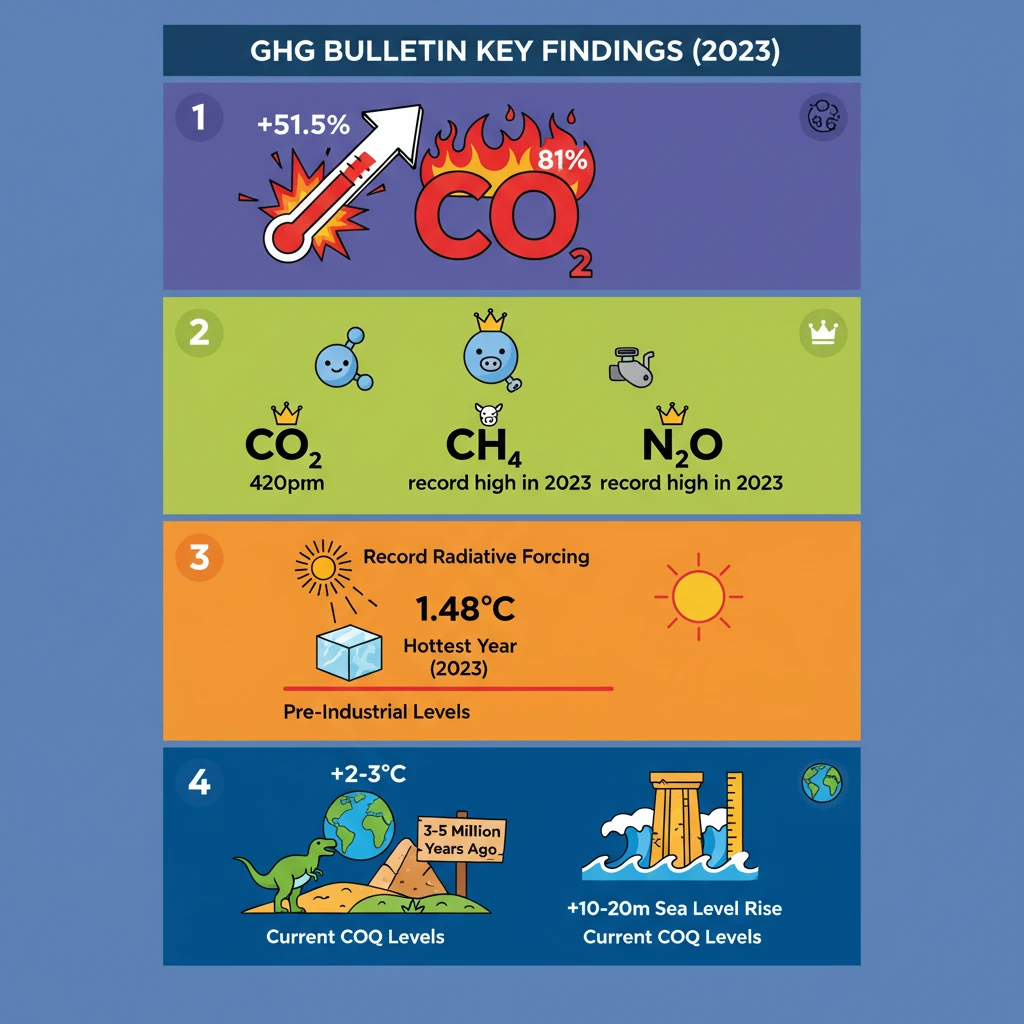
<h4>Introduction to the GHG Bulletin</h4><p>The <strong>Greenhouse Gas (GHG) Bulletin</strong>, published by the <strong>World Meteorological Organization (WMO)</strong>, provides critical updates on the atmospheric concentrations of major greenhouse gases.</p><p>It serves as a vital scientific assessment, highlighting the ongoing and accelerating impact of human activities on Earth's climate system.</p><div class='exam-tip-box'>Understanding the <strong>GHG Bulletin</strong> is crucial for <strong>UPSC Mains GS-III</strong> (Environment) and <strong>Prelims</strong>, as it provides authoritative data for climate change discussions.</div><h4>Overall Warming Effect Increase</h4><p>Since <strong>1990</strong>, the warming effect on our planet, primarily driven by <strong>greenhouse gases</strong>, has seen a significant surge.</p><p>This increase, known as <strong>radiative forcing</strong>, quantifies the energy imbalance caused by these gases.</p><div class='info-box'>The warming effect from <strong>greenhouse gases</strong> has surged by <strong>51.5%</strong> since <strong>1990</strong>. <strong>Carbon Dioxide (CO2)</strong> alone contributed a substantial <strong>81%</strong> of this overall rise.</div><div class='key-point-box'>This data underscores the dominant role of <strong>CO2 emissions</strong> in driving global warming over the past few decades.</div><h4>Record High Greenhouse Gas Concentrations in 2023</h4><p>The year <strong>2023</strong> marked a concerning milestone, with the concentrations of key <strong>greenhouse gases</strong> reaching unprecedented levels in the atmosphere.</p><p>These gases include <strong>Carbon Dioxide (CO2)</strong>, <strong>Methane (CH4)</strong>, and <strong>Nitrous Oxide (N2O)</strong>, all critical contributors to the enhanced greenhouse effect.</p><div class='info-box'>In <strong>2023</strong>:<ul><li><strong>CO2</strong> reached <strong>420 ppm</strong> (parts per million), increasing by <strong>2.3 ppm</strong>.</li><li><strong>CH4</strong> and <strong>N2O</strong> also recorded <strong>unprecedented highs</strong>.</li></ul></div><div class='key-point-box'>The continuous rise in these concentrations indicates a failure to curb emissions effectively, despite international climate commitments.</div><h4>2023: The Hottest Year on Record</h4><p>Consistent with the rising <strong>GHG concentrations</strong>, <strong>2023</strong> was officially declared the <strong>hottest year on record</strong>, surpassing previous benchmarks.</p><p>This record-breaking temperature was a direct consequence of the elevated <strong>radiative forcing</strong> caused by the accumulated greenhouse gases.</p><div class='info-box'>Global temperatures in <strong>2023</strong> were approximately <strong>1.48°C</strong> above <strong>pre-industrial levels</strong>. This surpassed the previous record set in <strong>2016</strong>.</div><div class='exam-tip-box'>Cite <strong>2023</strong> as the <strong>hottest year on record</strong> in answers related to climate change impacts, global warming, and the urgency of mitigation strategies.</div><h4>Historical Context of CO2 Levels</h4><p>The current atmospheric <strong>CO2 levels</strong> are not just record highs in recent human history but also in geological timescales.</p><p>Comparing today's concentrations to past geological epochs provides a stark warning about potential future climate scenarios.</p><div class='info-box'>Current <strong>CO2 levels</strong> (around <strong>420 ppm</strong>) are comparable to those observed approximately <strong>3-5 million years ago</strong>. During that period, global temperatures were <strong>2-3°C higher</strong>, and sea levels were <strong>10-20 metres above today’s levels</strong>.</div><div class='key-point-box'>This historical comparison highlights the potential long-term consequences, including significant sea-level rise and altered climate patterns, if current trends persist.</div><h4>Persistent Rise in CO2 Concentrations</h4><p>The increase in <strong>atmospheric CO2</strong> is not an isolated event but part of a sustained and worrying trend.</p><p>Annual growth rates continue to exceed critical thresholds, indicating a persistent imbalance in the carbon cycle.</p><div class='info-box'><strong>2023</strong> marked the <strong>12th consecutive year</strong> where the annual growth in <strong>CO2 concentration</strong> exceeded <strong>2 ppm</strong>.</div><div class='exam-tip-box'>Mentioning the "<strong>12th consecutive year</strong>" statistic can add weight to arguments about the sustained nature of climate change and the need for long-term solutions in <strong>UPSC Mains</strong> answers.</div>
💡 Key Takeaways
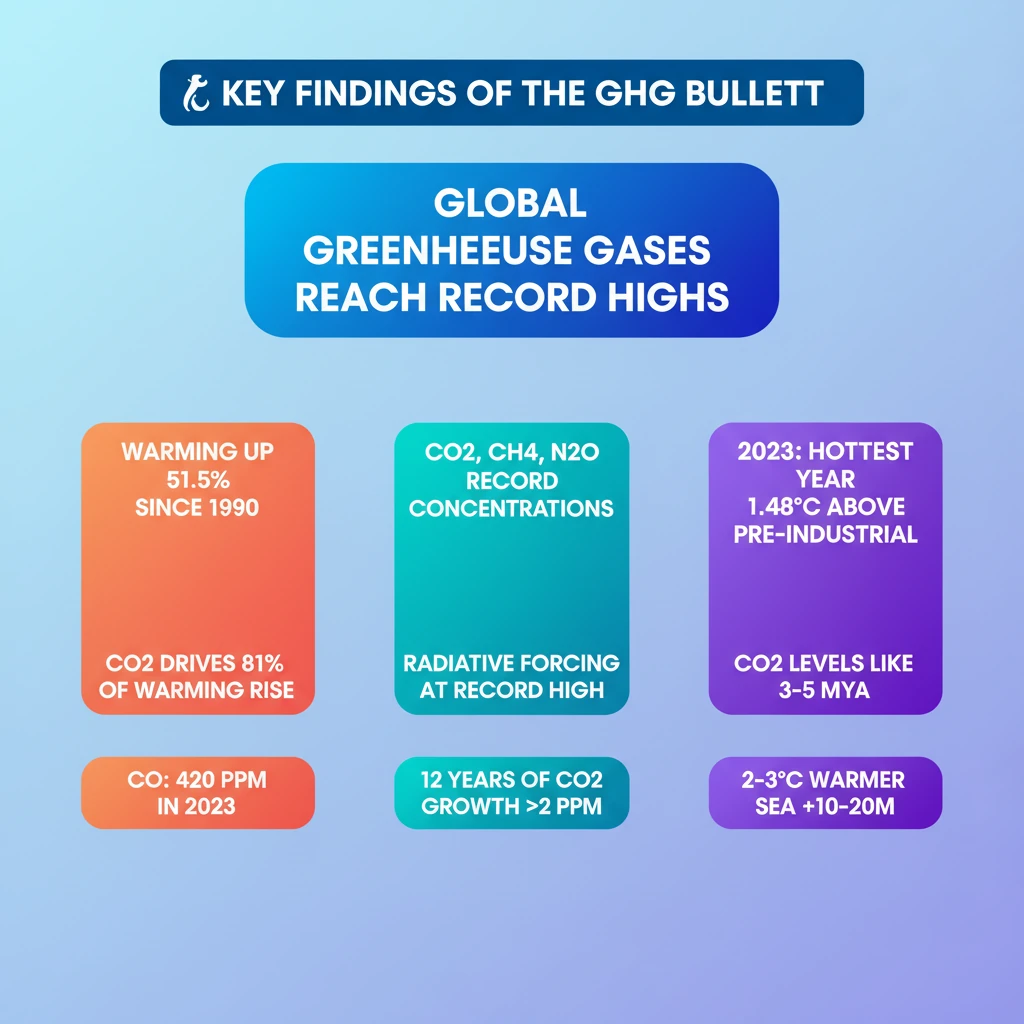
- •Greenhouse gas warming effect up 51.5% since 1990, with CO2 contributing 81% of this rise.
- •CO2, CH4, and N2O reached record high concentrations in 2023; CO2 hit 420 ppm.
- •2023 was the hottest year on record, 1.48°C above pre-industrial levels, driven by record radiative forcing.
- •Current CO2 levels resemble those 3-5 million years ago, when global temperatures were 2-3°C higher and sea levels 10-20m higher.
- •2023 marked the 12th consecutive year with annual CO2 growth exceeding 2 ppm, indicating a persistent upward trend.
🧠 Memory Techniques
98% Verified Content
📚 Reference Sources
•Intergovernmental Panel on Climate Change (IPCC) Assessment Reports
•UN Environment Programme (UNEP) Emissions Gap Report