Reptile Census at Bhitarkanika National Park - Environment And Ecology | UPSC Learning
Topics
0 topics • 0 completed
🔍
No topics match your search
Reptile Census at Bhitarkanika National Park
Medium⏱️ 6 min read
environment and ecology
📖 Introduction
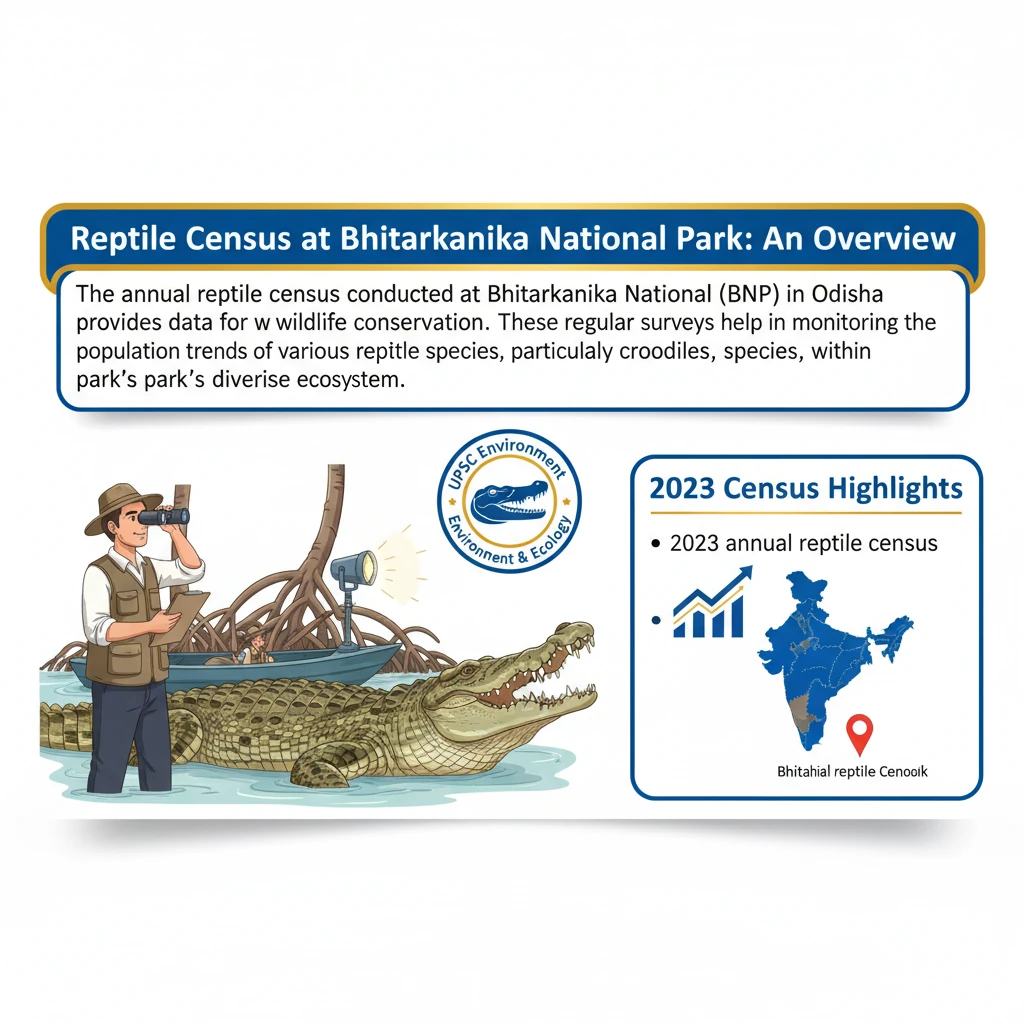
<h4>Reptile Census at Bhitarkanika National Park: An Overview</h4><p>The <strong>annual reptile census</strong> conducted at <strong>Bhitarkanika National Park (BNP)</strong> in <strong>Odisha</strong> provides crucial data for wildlife conservation.</p><p>These regular surveys help in monitoring the health and population trends of various reptile species, particularly crocodiles, within the park's diverse ecosystem.</p><h4>2023 Census Highlights</h4><p>The <strong>2023 annual reptile census</strong> revealed a significant population of <strong>saltwater crocodiles</strong> in <strong>Bhitarkanika National Park</strong>.</p><p>The total count for saltwater crocodiles stood at <strong>1,826 individuals</strong>, indicating a robust population within the park's protected areas.</p><div class='info-box'><p><strong>Key Finding:</strong> The 2023 census recorded <strong>1,826 saltwater crocodiles</strong> in <strong>Bhitarkanika National Park</strong>.</p><p>This count also included a rare sighting of <strong>18 albino crocodiles</strong>, which are white-colored crocodiles due to a genetic condition, highlighting the park's unique biodiversity.</p></div><h4>Advanced Census Methodology</h4><p>The <strong>2023 census</strong> employed modern technology to enhance accuracy and minimize human error in data collection.</p><p>This innovative approach ensures reliable population estimates, which are vital for effective conservation planning.</p><div class='info-box'><p><strong>Technology Used:</strong> The census was conducted using the <strong>Timestamp Camera App</strong>.</p><p>This application records video with integrated <strong>time watermarks</strong> and <strong>GPS coordinates</strong>, providing precise location and time data for each sighting.</p></div><h4>The Crocodile Conservation Project: A Historical Initiative</h4><p>The success seen in Bhitarkanika's crocodile population is largely attributed to a long-standing conservation effort.</p><p>This project was a pioneering initiative in India for the protection of endangered crocodile species.</p><div class='key-point-box'><p><strong>Project Start:</strong> The <strong>Crocodile Conservation Project</strong> was initiated in <strong>1975</strong>.</p><p>It was launched specifically at <strong>Bhitarkanika National Park</strong>, recognizing its importance as a critical habitat for crocodiles.</p></div><h4>Goals of the Crocodile Conservation Project</h4><p>The primary objective of the project was to protect and help recover the populations of three critically endangered crocodile species found in India.</p><p>This ambitious goal aimed to restore these apex predators to healthy numbers within their natural habitats.</p><ul><li><strong>Target Species:</strong> The project focused on conserving the <strong>Mugger crocodile</strong>, <strong>Gharial</strong>, and <strong>Saltwater Crocodile</strong>.</li><li><strong>Population Goal:</strong> A key aim was to increase the population density to a point where <strong>5 to 6 crocodiles</strong> could be sighted per kilometer of water body, indicating a thriving ecosystem.</li></ul>
💡 Key Takeaways
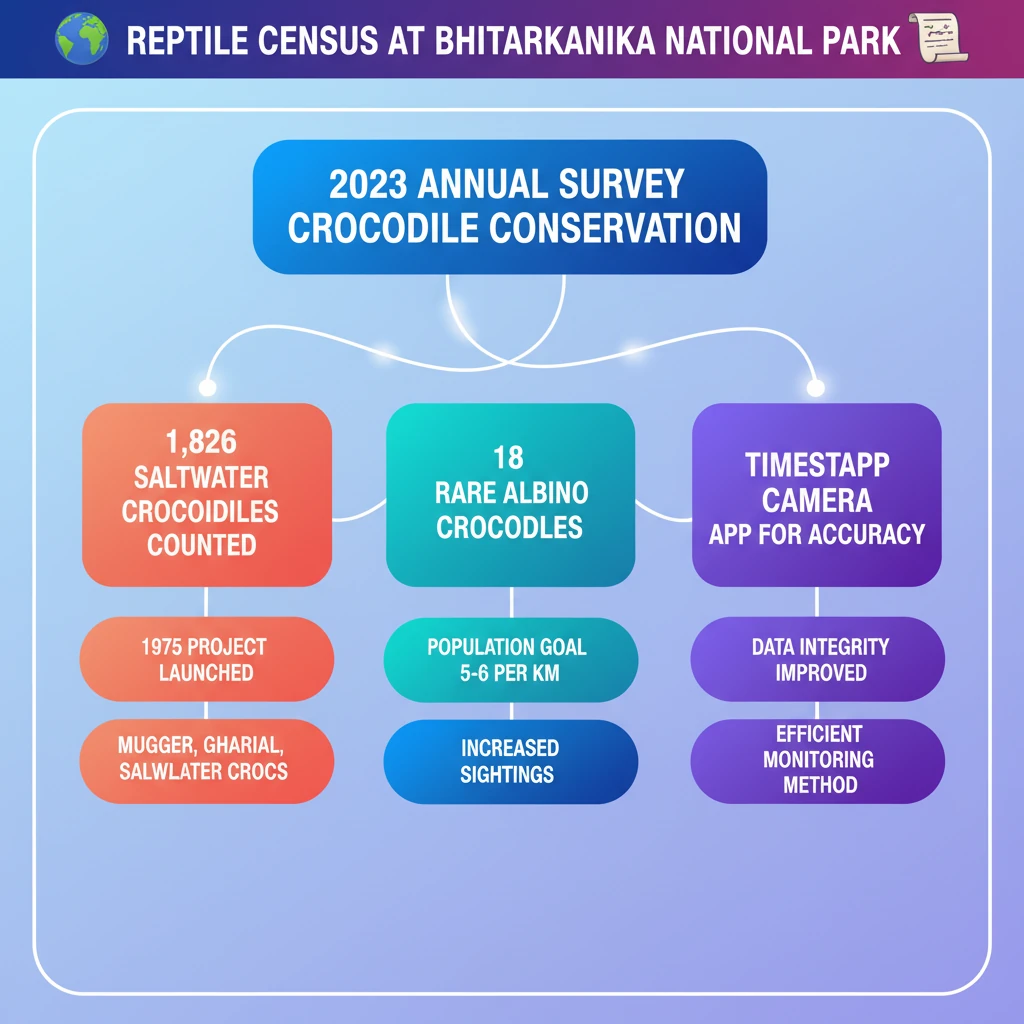
- •Bhitarkanika National Park conducted its annual reptile census in 2023.
- •The census recorded 1,826 saltwater crocodiles, including 18 rare albino crocodiles.
- •The survey utilized the Timestamp Camera App for improved accuracy and data integrity.
- •The Crocodile Conservation Project, launched in 1975 at Bhitarkanika, aimed to protect Mugger, Gharial, and Saltwater Crocodiles.
- •The project's goal was to increase crocodile populations to 5-6 sightings per kilometer of water.
- •Bhitarkanika is a key site for saltwater crocodile conservation in India.
🧠 Memory Techniques
98% Verified Content
📚 Reference Sources
•General knowledge on Bhitarkanika National Park and Crocodile Conservation Project in India.