Increase in Coastal Erosion - Environment And Ecology | UPSC Learning
Topics
0 topics • 0 completed
🔍
No topics match your search
Increase in Coastal Erosion
Medium⏱️ 7 min read
environment and ecology
📖 Introduction
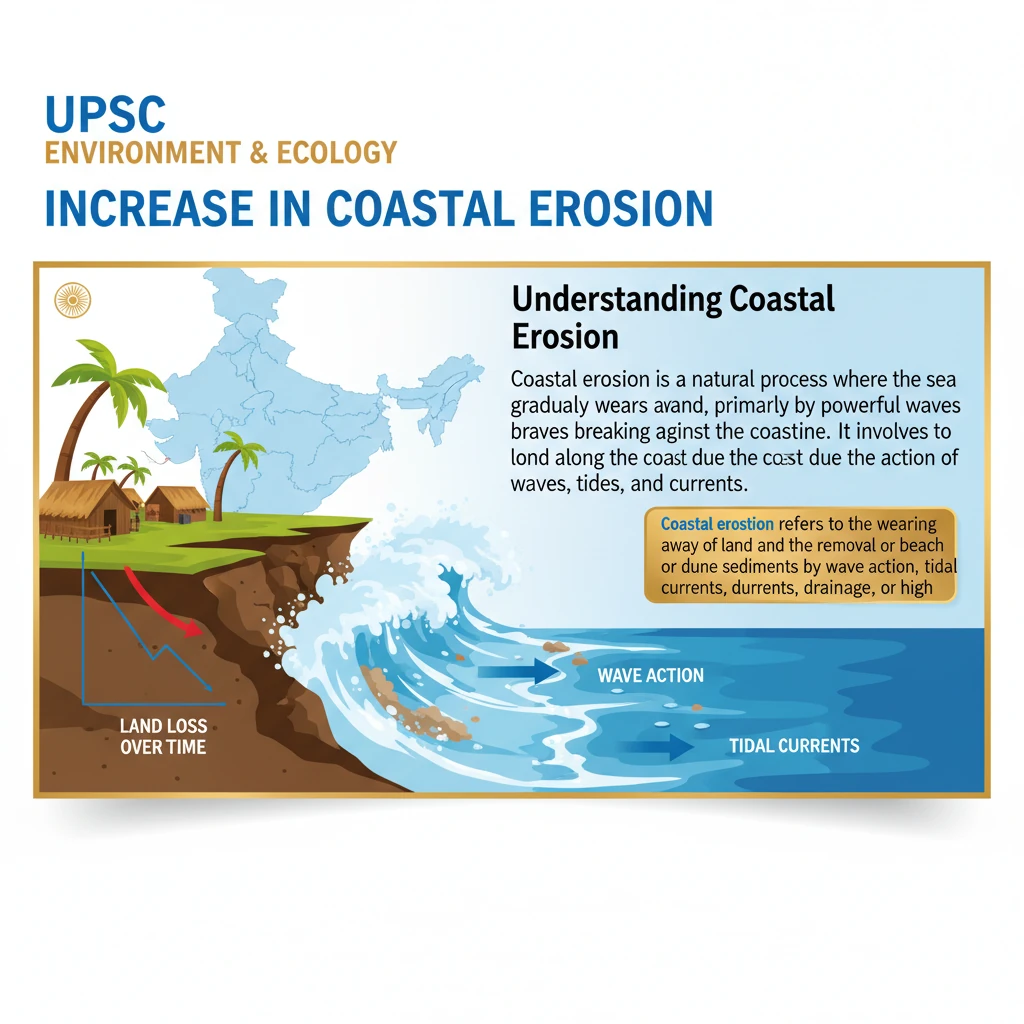
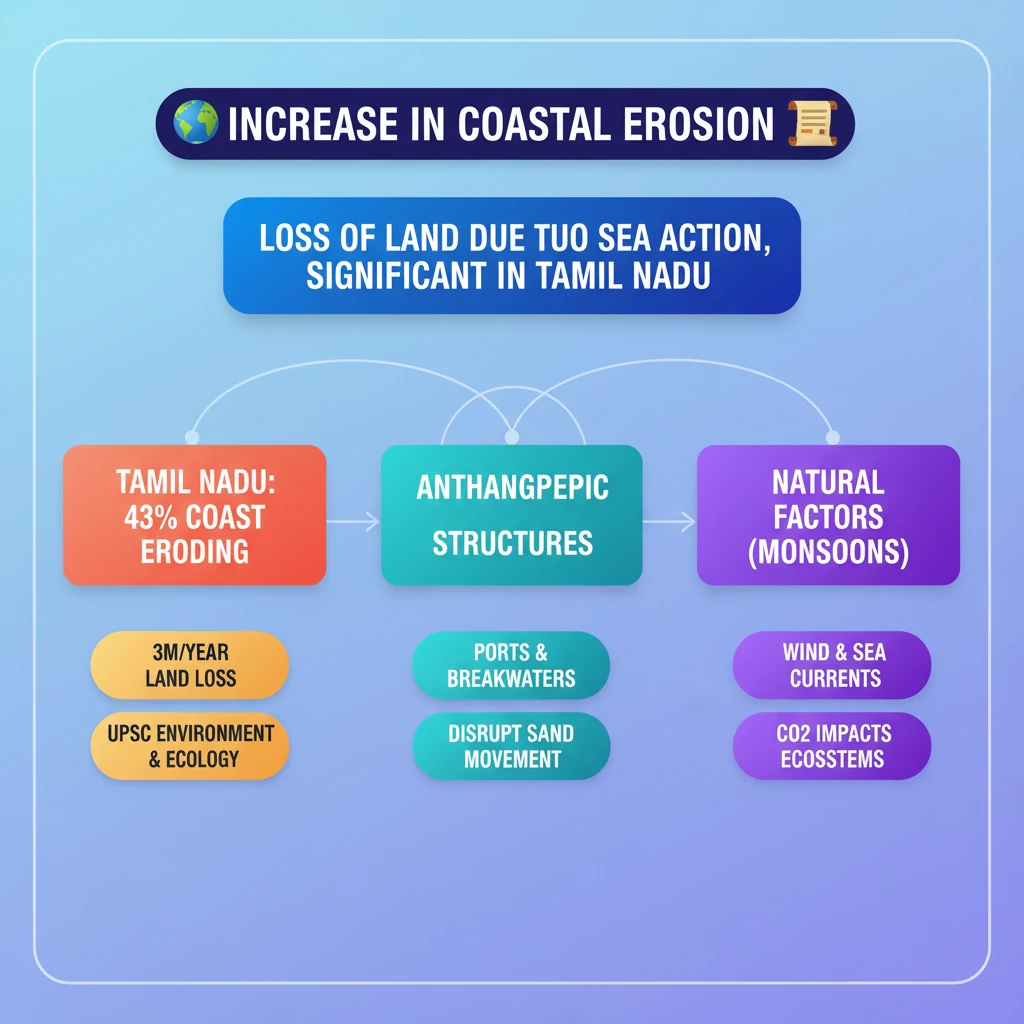
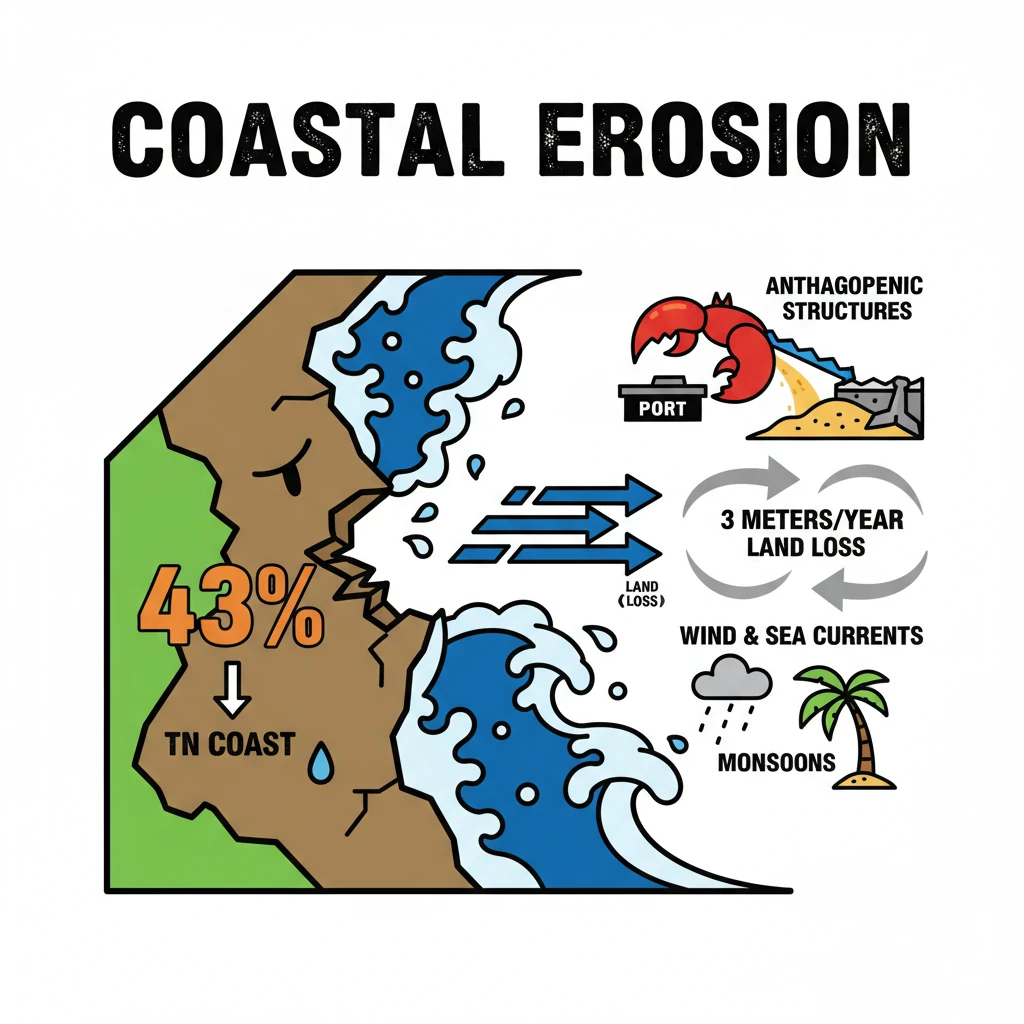
<h4>Context: Coastal Erosion in Tamil Nadu</h4><p>A recent study has highlighted the significant threat posed by <strong>coastal erosion</strong> to the livelihoods of fishers and other inhabitants along the coast of <strong>Tamil Nadu</strong>.</p><p>This issue is causing substantial land loss and impacting coastal communities directly.</p><div class='info-box'><p><strong>Key Statistics for Tamil Nadu:</strong></p><ul><li>Nearly <strong>43%</strong> of Tamil Nadu's coast faces erosion.</li><li>This erosion has resulted in a loss of more than <strong>4,450 acres</strong> of land.</li><li>The area under erosion is increasing by approximately <strong>3 metres per year</strong> on the <strong>east coast</strong>.</li><li>On the <strong>west coast</strong>, the increase is about <strong>2.5 metres per year</strong>.</li></ul></div><h4>Impact of Development Projects on Shoreline Dynamics</h4><p>The study reveals that various <strong>development projects</strong>, initially intended for economic growth and erosion prevention, are paradoxically exacerbating the problem by altering the natural shoreline.</p><p>These projects disrupt the delicate balance of coastal processes, leading to accelerated erosion.</p><div class='key-point-box'><p><strong>Natural Sand Movement in Tamil Nadu:</strong></p><ul><li>For about <strong>eight months</strong> of the year, wind and sea currents move from <strong>south to north</strong>, carrying sand.</li><li>During the <strong>northeast monsoon</strong> (approximately four months), these currents flow in the <strong>opposite direction</strong>.</li></ul></div><p>When structures such as <strong>ports</strong>, <strong>breakwaters</strong>, or <strong>groynes</strong> are constructed extending into the sea, they obstruct this natural movement of sand.</p><p>This obstruction causes sand to accumulate on one side of the structure, while the other side experiences a loss of sand, leading to erosion.</p><p>This imbalance significantly speeds up <strong>coastal erosion</strong>, causing waves to penetrate further inland and increasing the vulnerability of coastal areas.</p><h4>Understanding Coastal Erosion</h4><p><strong>Coastal erosion</strong> is a natural process where the sea gradually wears away land, primarily driven by powerful wave action.</p><div class='info-box'><p><strong>Definition:</strong> <strong>Coastal erosion</strong> is the process by which local <strong>sea level rise</strong>, strong <strong>wave action</strong>, and <strong>coastal flooding</strong> wear down or carry away rocks, soils, and/or sands along the coast.</p></div><p>This continuous wearing away reshapes coastlines over time, but human activities can intensify its rate and impact.</p><h4>Processes of Coastal Erosion</h4><p>There are four primary processes through which coastal erosion occurs:</p><ol><li><strong>Corrosion (Solution):</strong> This happens when seawater dissolves soluble materials from the cliff face, particularly effective on limestone or chalk cliffs.</li><li><strong>Abrasion (Corrasion):</strong> This process occurs when waves, laden with beach material like pebbles and sand, are hurled against the base of a cliff or headland. This constant impact gradually breaks down the rock, creating features like a <strong>wave-cut notch</strong>.</li><li><strong>Hydraulic Action:</strong> This is a powerful erosional force where waves crash against a cliff, compressing air within cracks and joints. As the wave recedes, the trapped air expands explosively, dislodging chunks of rock. Repeated action weakens the cliff, making it more susceptible to further erosion.</li><li><strong>Attrition:</strong> This process involves rocks and pebbles carried by waves colliding with each other. These collisions cause the rock fragments to break down into smaller, smoother, and more rounded pieces over time.</li></ol>
💡 Key Takeaways
- •Coastal erosion is a natural process exacerbated by human interventions like coastal infrastructure.
- •Tamil Nadu faces significant erosion (43% of its coast) due to disrupted natural sand movement.
- •Structures like ports and breakwaters block sand, causing accumulation on one side and erosion on the other.
- •Four main processes of erosion are corrosion, abrasion, hydraulic action, and attrition.
- •Coastal erosion is linked to global challenges like sea-level rise and impacts livelihoods.
- •Sustainable coastal management and integrated approaches are crucial to mitigate its effects.
🧠 Memory Techniques
95% Verified Content
📚 Reference Sources
•NCERT Geography Textbooks (relevant chapters on geomorphology and oceanography)
•Ministry of Earth Sciences reports (general understanding of coastal processes in India)