What is the Island Coastal Regulation Zone (ICRZ)? - Environment And Ecology | UPSC Learning
Topics
0 topics • 0 completed
🔍
No topics match your search
What is the Island Coastal Regulation Zone (ICRZ)?
Medium⏱️ 7 min read
environment and ecology
📖 Introduction
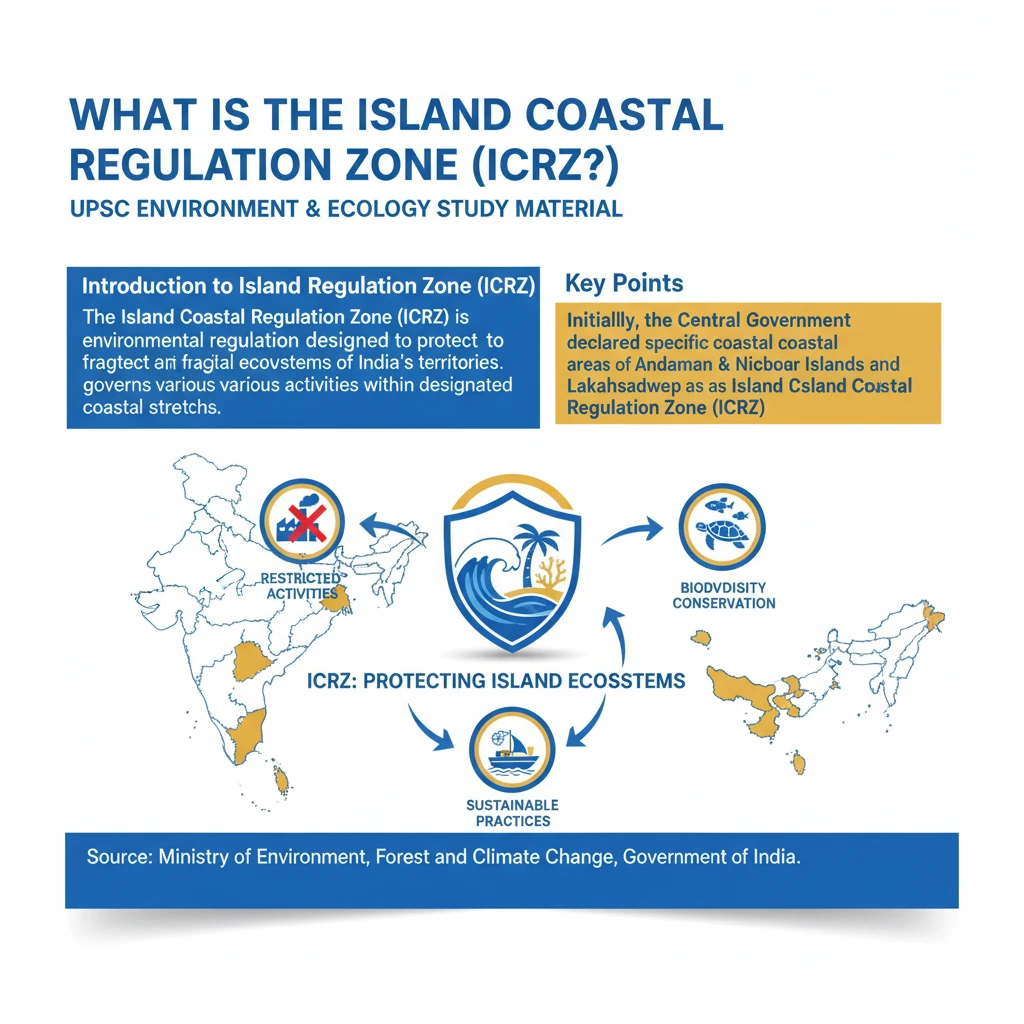
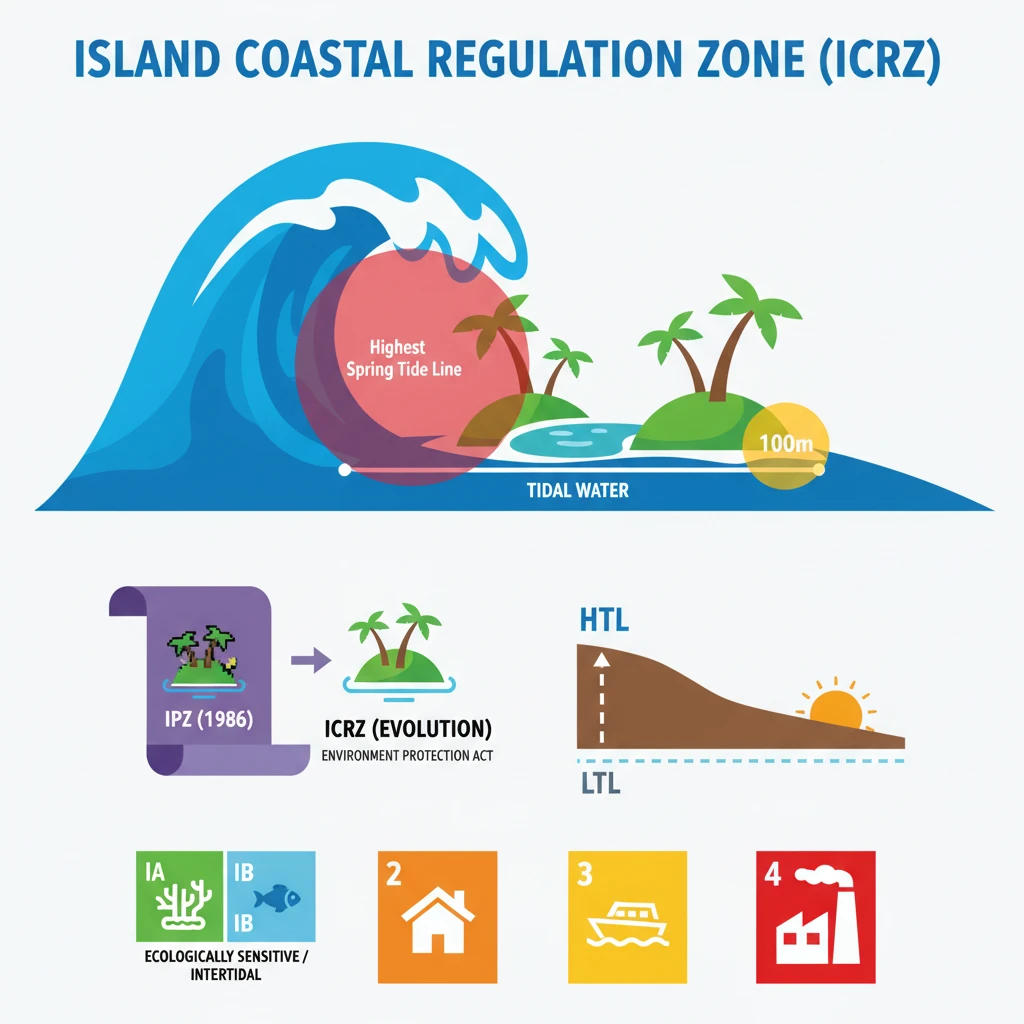
<h4>Introduction to Island Coastal Regulation Zone (ICRZ)</h4><p>The <strong>Island Coastal Regulation Zone (ICRZ)</strong> is a critical environmental regulation designed to protect the fragile coastal ecosystems of India's island territories. It governs various activities within designated coastal stretches.</p><p>Initially, the <strong>Central Government</strong> declared specific coastal areas of the <strong>Andaman & Nicobar Islands</strong> and <strong>Lakshadweep</strong> as <strong>Island Protection Zone (IPZ)</strong> under the <strong>Environment Protection Act, 1986</strong>.</p><div class='key-point-box'><p>The <strong>ICRZ</strong> was established to regulate activities within <strong>500 meters</strong> of the <strong>High Tide Line (HTL)</strong> and <strong>100 meters</strong> along the banks of creeks, estuaries, backwaters, and rivers subject to tidal fluctuations.</p></div><h4>Evolution from IPZ to ICRZ, 2011</h4><p>Due to various representations from stakeholders, the <strong>Ministry of Environment, Forest and Climate Change (MoEF&CC)</strong> undertook a revision of the earlier <strong>IPZ Notification, 2011</strong>.</p><p>This revision led to the establishment of the comprehensive <strong>Island Coastal Regulation Zone (ICRZ), 2011</strong>, which superseded the previous IPZ regulations.</p><h4>Defining High Tide Line (HTL) and Low Tide Line (LTL)</h4><div class='info-box'><p>The <strong>High Tide Line (HTL)</strong> is defined as the line on the land up to which the highest water line reaches during the <strong>spring tide</strong>.</p><p>Conversely, the <strong>Low Tide Line (LTL)</strong> refers to the line on the land up to which the lowest water line reaches during the <strong>spring tide</strong>.</p></div><h4>Categorization and Restrictions within ICRZ</h4><p>The <strong>ICRZ</strong> is divided into <strong>four categories</strong>, and the notification imposes strict restrictions on setting up and expanding industries or processing plants within these zones.</p><div class='key-point-box'><p>The source material specifically details <strong>ICRZ-I</strong>, which encompasses both ecologically sensitive areas and the intertidal zone. Other categories (ICRZ-II, ICRZ-III, ICRZ-IV) exist within the broader framework but are not detailed in this summary.</p></div><ul><li><strong>ICRZ-I: Ecologically Sensitive Areas and Areas between LTL and HTL</strong><ul><li><strong>ICRZ-IA: Ecologically Sensitive and Important Areas</strong><p>This sub-category covers crucial natural habitats and heritage sites, where activities are highly restricted to preserve biodiversity and ecological balance.</p><div class='info-box'><p>These include: <strong>national parks/marine parks</strong>, <strong>sanctuaries</strong>, <strong>reserve forests</strong>, <strong>wild habitats</strong>, <strong>mangroves</strong>, <strong>corals/coral reefs</strong>, areas close to <strong>breeding and spawning grounds of fish</strong>, areas of <strong>outstanding natural beauty</strong>, <strong>historical and heritage areas</strong>, areas rich in <strong>genetic biodiversity</strong>, and areas likely to be inundated due to <strong>sea-level rise</strong> from <strong>global warming</strong>, along with any other areas declared by authorities.</p></div></li><li><strong>ICRZ-IB: Intertidal Zones</strong><p>These are the areas located specifically between the <strong>Low Tide Line (LTL)</strong> and the <strong>High Tide Line (HTL)</strong>.</p><div class='key-point-box'><p>In <strong>non-ecologically sensitive intertidal zones</strong> (between LTL and HTL), the following activities are permitted:</p><ul><li><strong>Exploration and extraction of natural gas</strong>.</li><li>Construction of <strong>basic amenities for traditional inhabitants</strong> living within the biosphere reserves.</li><li><strong>Salt harvesting</strong> by solar evaporation of seawater.</li><li>Establishment of <strong>desalination plants</strong>.</li><li><strong>Storage of non-hazardous cargo</strong>, such as edible oil and fertilizers, within notified ports.</li></ul></div></li></ul></li></ul>
💡 Key Takeaways
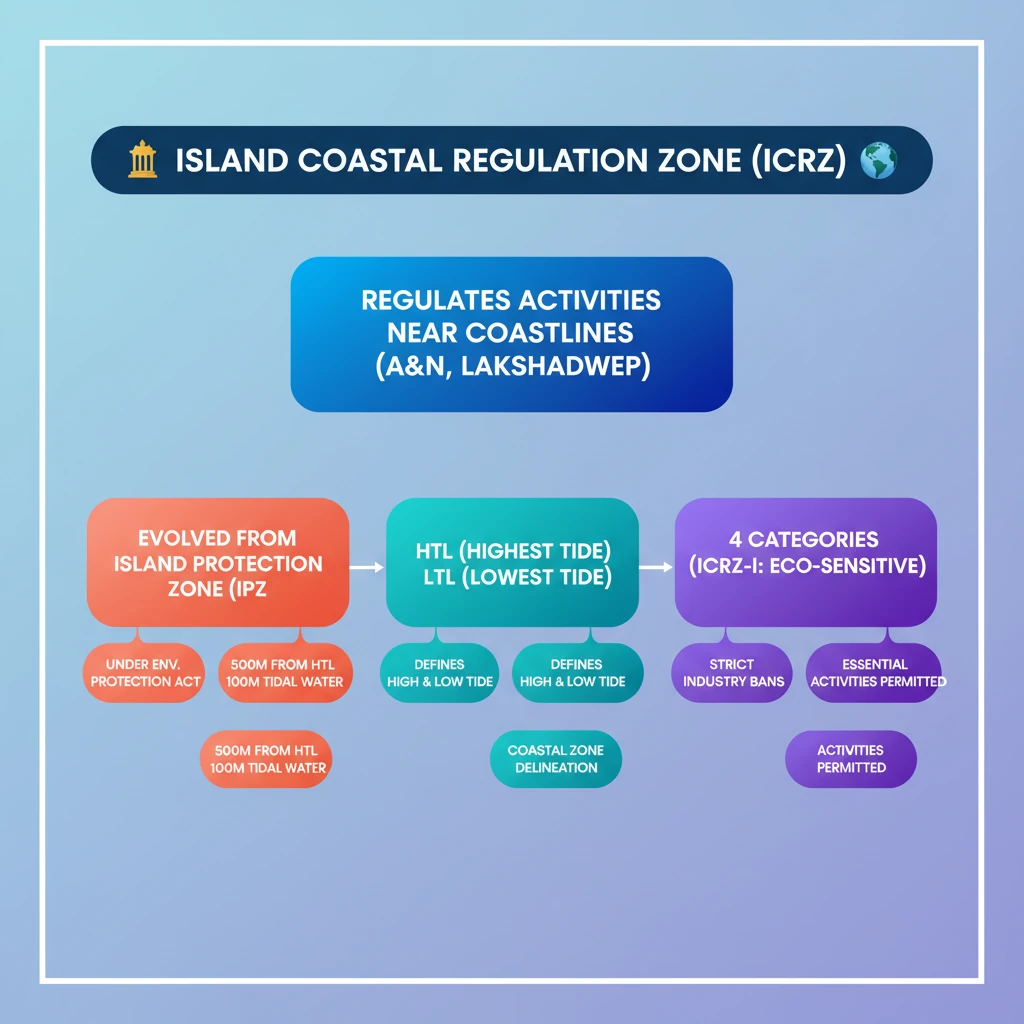
- •ICRZ regulates activities within 500m of HTL and 100m of tidal water bodies in Andaman & Nicobar and Lakshadweep.
- •It evolved from the earlier Island Protection Zone (IPZ) under the Environment Protection Act, 1986.
- •HTL is the highest spring tide line, LTL is the lowest spring tide line.
- •ICRZ is divided into four categories, with ICRZ-I (IA and IB) detailing ecologically sensitive and intertidal zones.
- •Strict restrictions apply to industries; specific essential activities are permitted in non-sensitive ICRZ-IB areas.
- •Crucial for biodiversity, climate resilience, and sustainable development of island ecosystems.
🧠 Memory Techniques
95% Verified Content
📚 Reference Sources
•Environment Protection Act, 1986
•Ministry of Environment, Forest and Climate Change (MoEF&CC) notifications on Coastal Regulation Zones