Economic Impacts of Climate Change: India & APAC - Environment And Ecology | UPSC Learning
Topics
0 topics • 0 completed
🔍
No topics match your search
Economic Impacts of Climate Change: India & APAC
Medium⏱️ 8 min read
environment and ecology
📖 Introduction
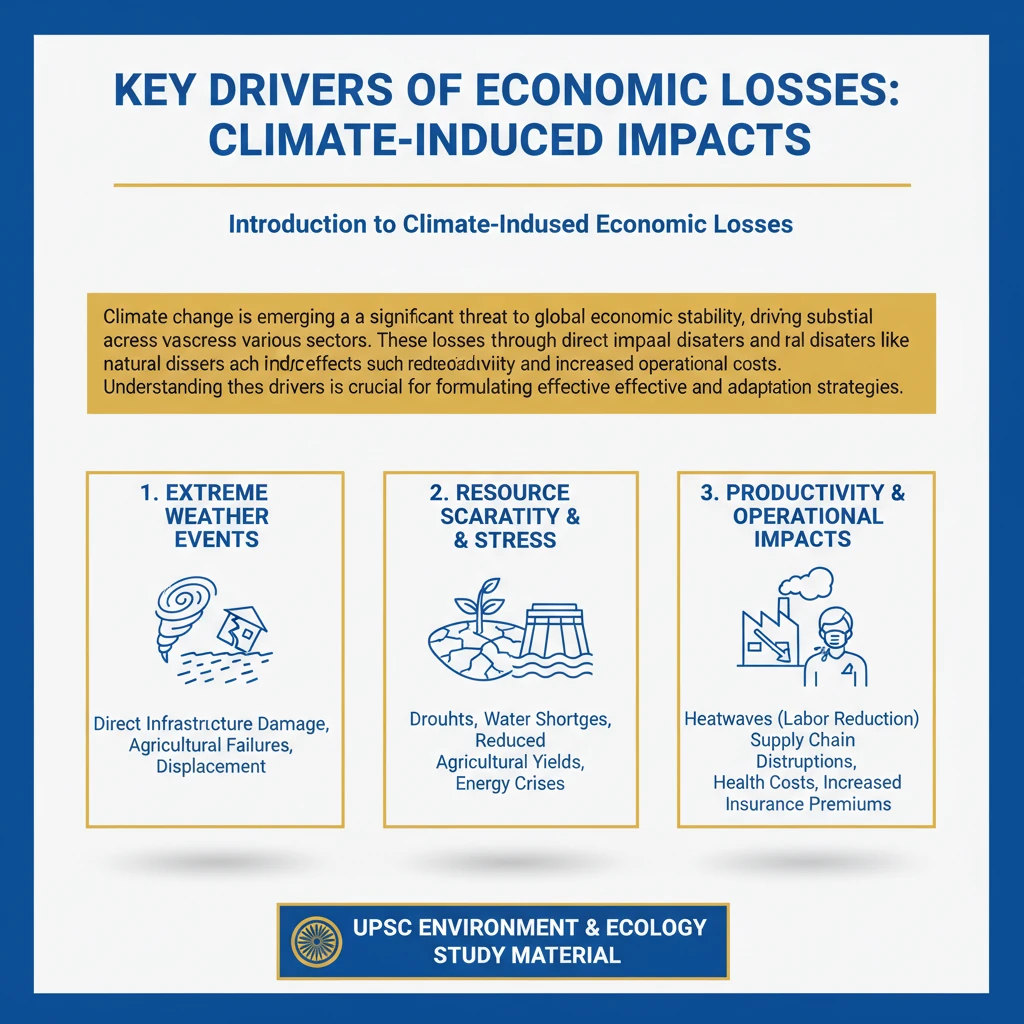
<h4>Introduction to Climate-Induced Economic Losses</h4><p><strong>Climate change</strong> is emerging as a significant threat to global economic stability, driving substantial losses across various sectors. These losses manifest through direct impacts like natural disasters and indirect effects such as reduced productivity and increased operational costs. Understanding these drivers is crucial for formulating effective mitigation and adaptation strategies.</p><div class='key-point-box'><p><strong>Key Concept: Economic Losses</strong> refer to the financial costs incurred due to climate change impacts, affecting GDP, infrastructure, human capital, and natural resources.</p></div><h4>Sea Level Rise: A Growing Coastal Threat</h4><p>One of the most immediate and impactful drivers of economic losses is <strong>sea level rise</strong>. This phenomenon threatens densely populated coastal areas, leading to increased flooding, displacement, and damage to critical infrastructure.</p><div class='info-box'><ul><li><strong>Projected Impact (by 2070):</strong> Approximately <strong>300 million people</strong> are estimated to be at risk of severe <strong>coastal flooding</strong>.</li><li><strong>Estimated Annual Damages:</strong> The global economic cost could reach <strong>USD 3 trillion</strong> annually due to sea level rise.</li></ul></div><div class='exam-tip-box'><p><strong>UPSC Insight:</strong> Questions on <strong>coastal vulnerability</strong>, <strong>displacement</strong>, and <strong>infrastructure resilience</strong> often feature in <strong>GS Paper I (Geography)</strong> and <strong>GS Paper III (Disaster Management)</strong>.</p></div><h4>Declining Labour Productivity</h4><p>Rising temperatures directly impact human health and the ability to perform physical and cognitive tasks, leading to a significant decline in <strong>labour productivity</strong>. This effect is particularly pronounced in sectors reliant on outdoor work, such as agriculture and construction.</p><div class='info-box'><ul><li><strong>Asia-Pacific (APAC) Region:</strong> Faces an estimated <strong>4.9% loss in GDP</strong> due due to reduced labour productivity.</li><li><strong>India's Vulnerability:</strong> Projections indicate India's GDP loss could be as high as <strong>11.6%</strong>, highlighting its extreme susceptibility.</li></ul></div><h4>Increased Cooling Demand and Energy Costs</h4><p>As global temperatures rise, the demand for cooling systems in residential, commercial, and industrial sectors escalates. This surge in <strong>cooling demand</strong> translates into higher energy consumption and increased operational costs, negatively impacting regional economies.</p><div class='info-box'><ul><li><strong>Regional GDP Impact:</strong> Rising temperatures are projected to cut <strong>regional GDP</strong> by <strong>3.3%</strong>.</li><li><strong>India's Specific Decline:</strong> India is projected to experience a <strong>5.1% decline</strong> in its GDP due to increased cooling demand.</li></ul></div><h4>Climate-Induced Disasters: Riverine Flooding</h4><p><strong>Climate change</strong> intensifies extreme weather events, making <strong>riverine flooding</strong> more frequent and severe. These events cause widespread destruction to property, infrastructure, and livelihoods, leading to substantial economic setbacks.</p><div class='info-box'><ul><li><strong>Global Damages (by 2070):</strong> Damages from riverine flooding could hit <strong>USD 1.3 trillion</strong>, affecting approximately <strong>110 million people</strong>.</li><li><strong>India's Economic Burden:</strong> India alone may suffer <strong>USD 400 billion</strong> in residential losses and <strong>USD 700 billion</strong> in commercial losses from riverine flooding.</li></ul></div><h4>Climate-Induced Disasters: Storms and Landslides</h4><p>The increasing intensity of <strong>storms</strong> and changes in precipitation patterns contribute to more severe flooding and a higher incidence of <strong>landslides</strong>. These events devastate infrastructure, disrupt transportation, and displace communities.</p><div class='info-box'><ul><li><strong>Storm Intensity:</strong> More <strong>intense storms</strong> will inevitably escalate the severity and frequency of <strong>flooding</strong>.</li><li><strong>Landslide Risk:</strong> On the sensitive <strong>India-China border</strong>, landslides may increase by <strong>30-70%</strong> under severe warming scenarios, posing significant geopolitical and economic challenges.</li></ul></div>
💡 Key Takeaways
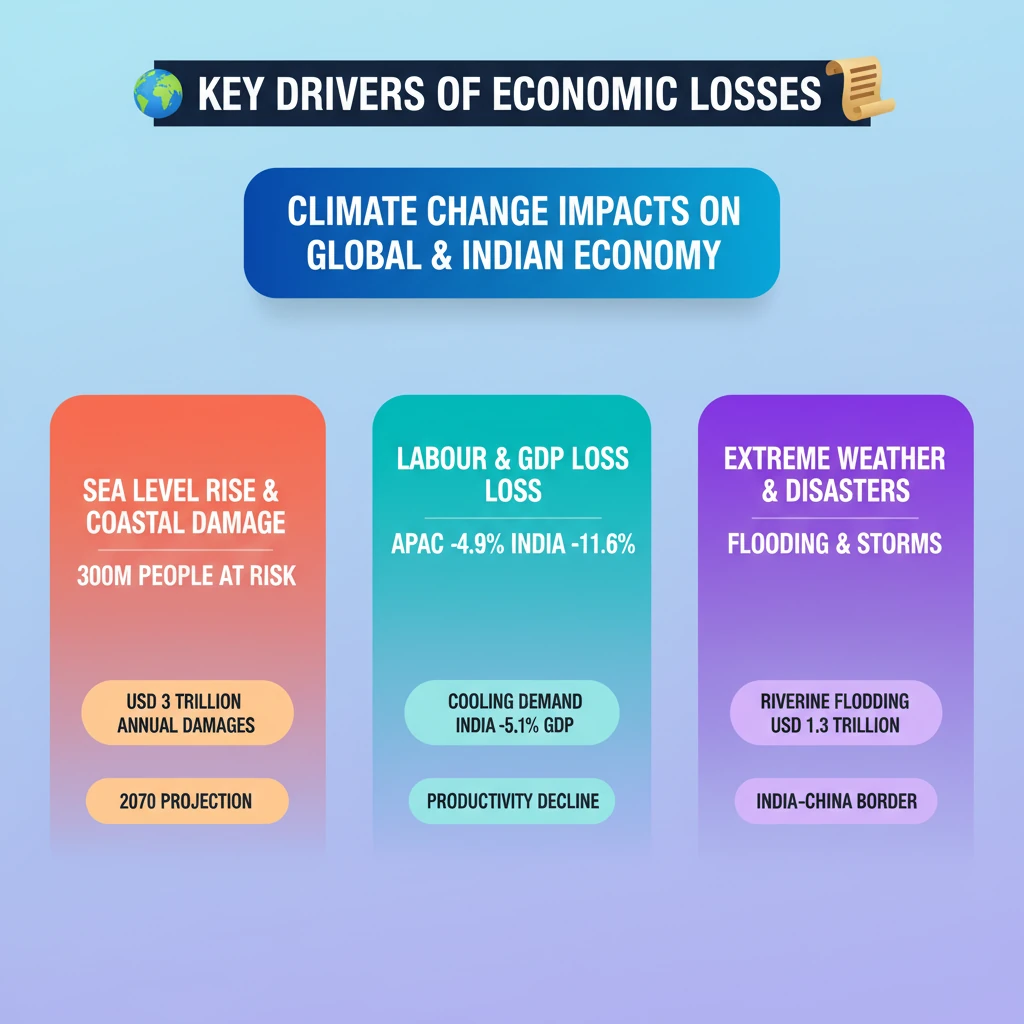
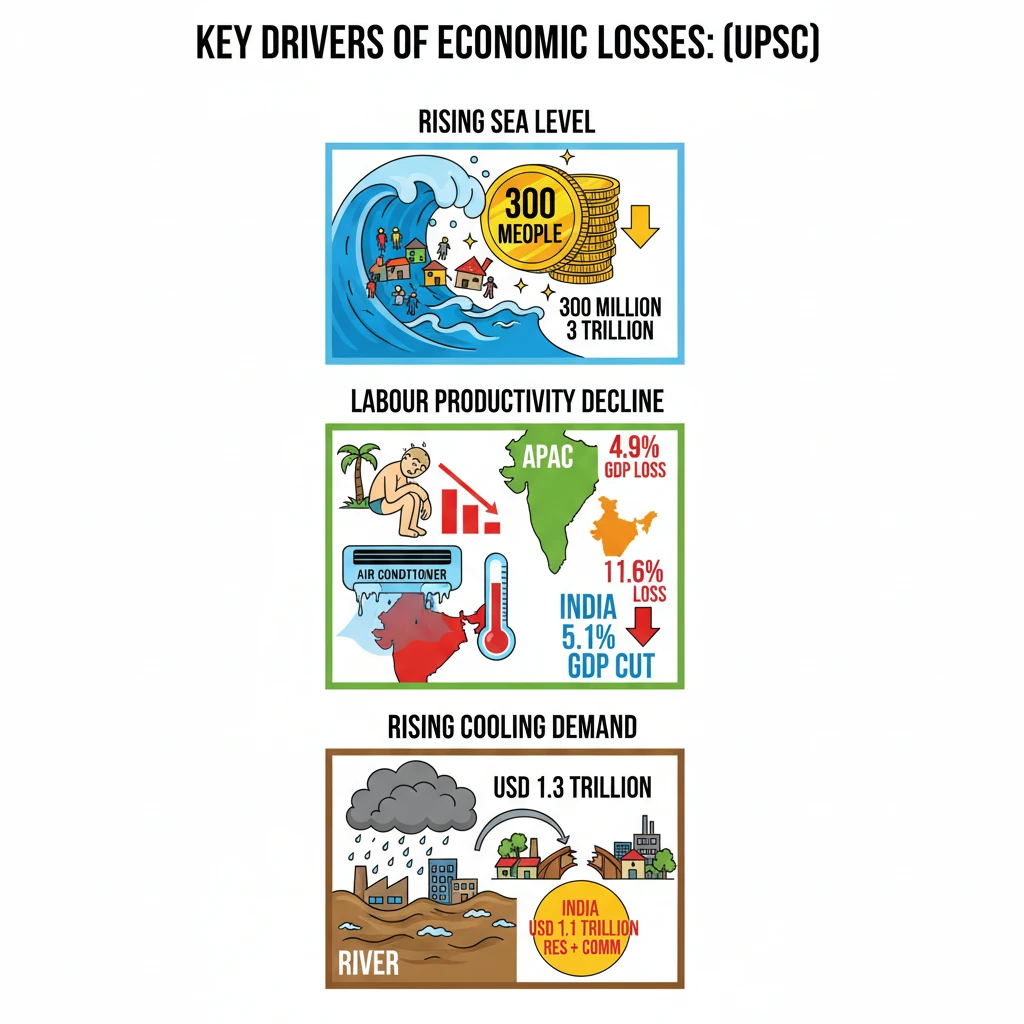
- •Sea level rise by 2070 could put 300 million people at risk, with USD 3 trillion in annual damages.
- •Labour productivity decline could cost APAC 4.9% GDP, with India facing an 11.6% loss.
- •Rising cooling demand is projected to cut India's GDP by 5.1%.
- •Riverine flooding could cause USD 1.3 trillion in damages by 2070, with India suffering USD 1.1 trillion (residential + commercial).
- •Increased storm intensity and landslides (30-70% rise on India-China border) are critical climate-induced disaster risks.
🧠 Memory Techniques
95% Verified Content
📚 Reference Sources
•General knowledge of climate change reports (e.g., IPCC)