WMO’s Greenhouse Gas Bulletin 2023 - Environment And Ecology | UPSC Learning
Topics
0 topics • 0 completed
🔍
No topics match your search

WMO’s Greenhouse Gas Bulletin 2023
Medium⏱️ 8 min read
environment and ecology
📖 Introduction
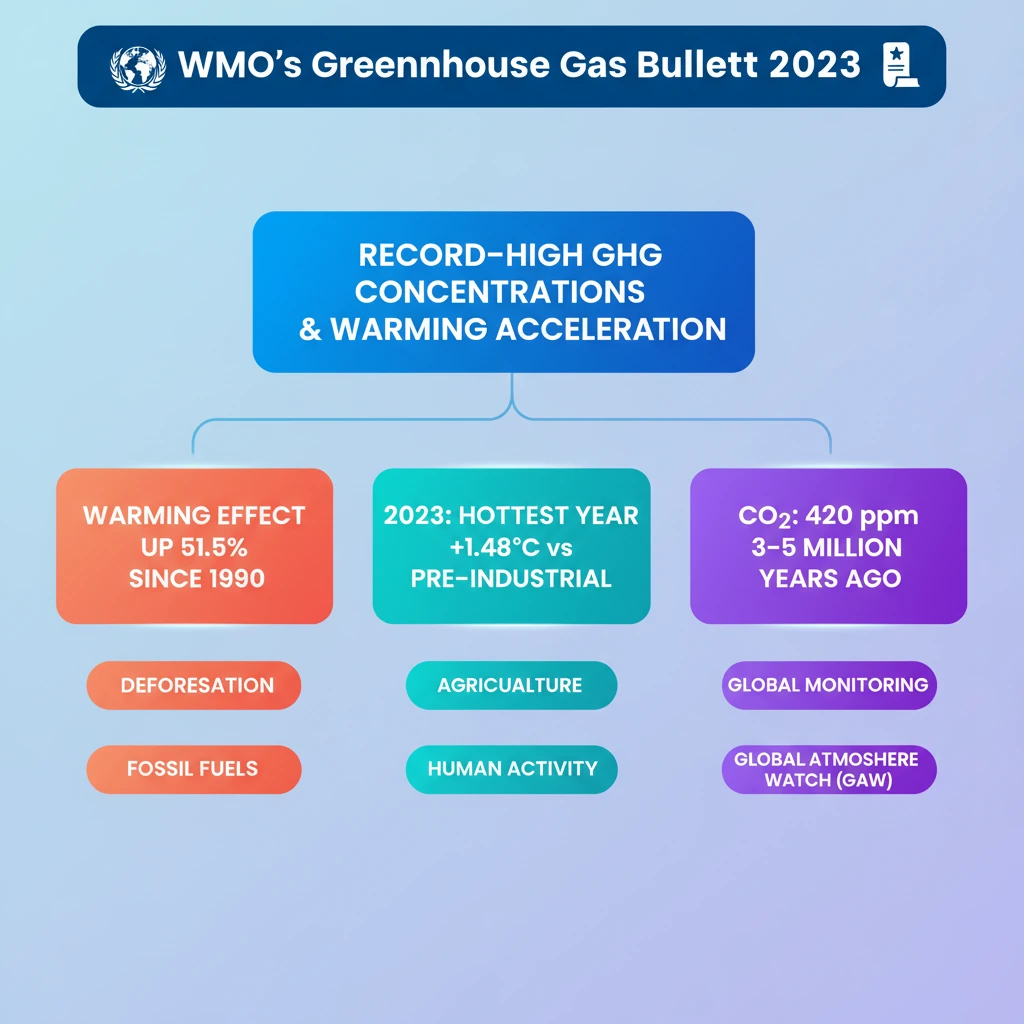
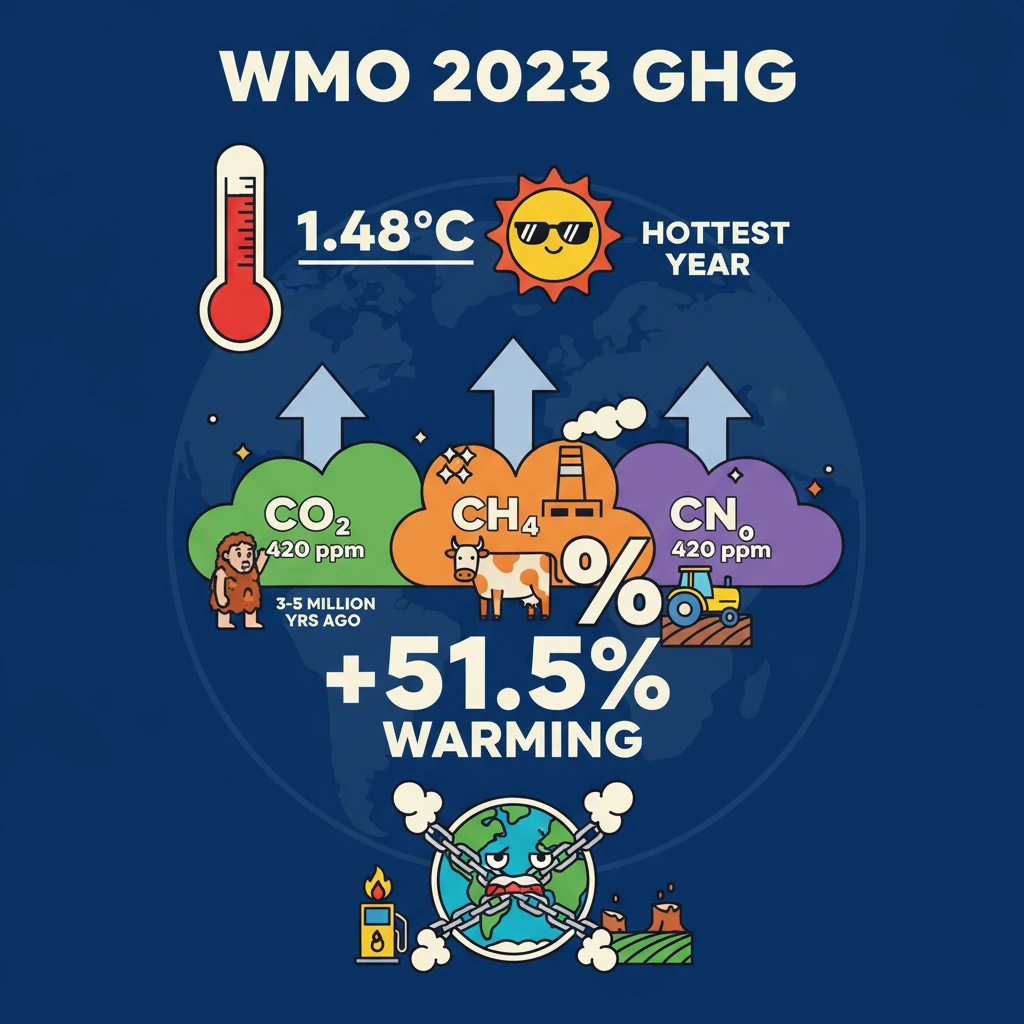
<h4>Introduction to WMO's Greenhouse Gas Bulletin 2023</h4><p>The <strong>World Meteorological Organisation (WMO)</strong> recently released its annual <strong>Greenhouse Gas (GHG) Bulletin</strong> for the year <strong>2023</strong>. This bulletin provides a critical analysis of atmospheric concentrations of <strong>Greenhouse Gases (GHGs)</strong>.</p><p>It compiles the latest data from the <strong>WMO Global Atmosphere Watch (GAW)</strong> programme. This ensures a comprehensive overview of global atmospheric composition changes.</p><h4>Understanding Greenhouse Gases (GHGs)</h4><p><strong>Greenhouse Gases (GHGs)</strong> are atmospheric gases that possess the ability to <strong>trap heat</strong> from the sun. This natural process is essential for keeping Earth’s surface warm enough to sustain life.</p><div class='info-box'><p><strong>Definition:</strong> <strong>Greenhouse Gases (GHGs)</strong> are gases that absorb and emit radiant energy within the thermal infrared range, causing the <strong>greenhouse effect</strong>.</p></div><p>However, human activities have significantly increased the concentration of these gases. Activities such as burning <strong>fossil fuels</strong>, extensive <strong>deforestation</strong>, and various <strong>industrial processes</strong> are major contributors.</p><p>This amplification of the natural greenhouse effect leads to <strong>global warming</strong> and subsequent <strong>climate change</strong>, posing a significant threat to global ecosystems.</p><h4>Key Greenhouse Gases and Their Characteristics</h4><ul><li><p><strong>Carbon Dioxide (CO₂)</strong>: This is a primary GHG, entering the atmosphere mainly through the burning of <strong>fossil fuels</strong> (coal, natural gas, oil) and solid waste. It is the most significant anthropogenic GHG.</p></li><li><p><strong>Methane (CH₄)</strong>: Human activities are largely responsible for increased methane levels. Key sources include <strong>cattle farming</strong>, waste in <strong>landfills</strong>, <strong>rice farming</strong>, and the extraction of <strong>fossil fuels</strong>.</p></li><li><p><strong>Nitrous Oxide (N₂O)</strong>: Emissions of N₂O occur during <strong>agricultural activities</strong>, changes in <strong>land use</strong>, and various <strong>industrial processes</strong>. It also results from the combustion of fossil fuels and solid waste.</p></li><li><p><strong>Water Vapour (H₂O)</strong>: This is the <strong>most abundant GHG</strong> in the atmosphere. Unlike other GHGs, it exists for only a few days before condensing, but it plays a crucial role in the climate system.</p></li><li><p><strong>Industrial Fluorinated Gases</strong>: These include <strong>hydrofluorocarbons (HFCs)</strong>, <strong>perfluorocarbons (PFCs)</strong>, and <strong>sulphur hexafluoride (SF₆)</strong>. They are known for their exceptionally high <strong>Global Warming Potential (GWP)</strong>.</p></li></ul><div class='info-box'><p><strong>Global Warming Potential (GWP):</strong> <strong>GWP</strong> indicates how much heat a <strong>Greenhouse Gas (GHG)</strong> traps in the atmosphere over a specific period (e.g., 100 years) relative to <strong>Carbon Dioxide (CO₂)</strong>. For example, <strong>SF₆</strong> has a GWP <strong>23,000 times greater</strong> than CO₂, making it an extremely potent contributor to global warming.</p></div><h4>Key Findings of the WMO GHG Bulletin 2023</h4><p>The <strong>2023 Greenhouse Gas Bulletin</strong> highlighted several concerning trends in atmospheric concentrations.</p><ul><li><p><strong>GHG Impact Since 1990</strong>: The overall warming effect from <strong>greenhouse gases</strong> has surged by a significant <strong>51.5%</strong> since <strong>1990</strong>. <strong>Carbon Dioxide (CO₂)</strong> alone contributed a staggering <strong>81%</strong> of this rise.</p></li><li><p><strong>Record Highs in 2023</strong>: Concentrations of <strong>CO₂</strong>, <strong>CH₄</strong>, and <strong>N₂O</strong> all reached unprecedented levels in <strong>2023</strong>. Specifically, <strong>CO₂</strong> increased by <strong>2.3 ppm</strong>, reaching <strong>420 ppm</strong> in the atmosphere.</p></li><li><p><strong>Hottest Year on Record</strong>: The year <strong>2023</strong> surpassed <strong>2016</strong> to become the <strong>hottest year on record</strong>. Global temperatures were recorded at <strong>1.48°C above pre-industrial levels</strong>, primarily due to record-high <strong>radiative forcing</strong> from GHGs.</p></li><li><p><strong>Historical Comparison</strong>: Current <strong>CO₂ levels</strong> are comparable to those observed <strong>3-5 million years ago</strong>. During that period, global temperatures were <strong>2-3°C higher</strong>, and sea levels were <strong>10-20 metres above today’s levels</strong>.</p></li><li><p><strong>Continuous Rise</strong>: This marks the <strong>12th consecutive year</strong> where the annual growth of <strong>CO₂</strong> has exceeded <strong>2 ppm</strong>, indicating a persistent upward trend.</p></li></ul><h4>Global Atmosphere Watch (GAW)</h4><div class='info-box'><p><strong>About GAW:</strong> The <strong>Global Atmosphere Watch (GAW)</strong> is a collaborative programme involving <strong>100 countries</strong>. It provides crucial scientific data on <strong>atmospheric composition</strong> and changes influenced by both natural and human factors. This network is vital for monitoring long-term trends in GHGs.</p></div><div class='exam-tip-box'><p><strong>UPSC Insight:</strong> Understanding the <strong>WMO GHG Bulletin</strong> and the role of <strong>GAW</strong> is crucial for <strong>GS-III Environment and Ecology</strong>. Be prepared to discuss the findings and their implications for climate policy and sustainable development.</p></div>
💡 Key Takeaways
- •WMO's 2023 GHG Bulletin reports record-high atmospheric concentrations of CO₂, CH₄, and N₂O.
- •The warming effect from GHGs has surged by 51.5% since 1990, with 2023 being the hottest year on record (1.48°C above pre-industrial levels).
- •Current CO₂ levels (420 ppm) are comparable to those 3-5 million years ago, indicating unprecedented human impact.
- •Human activities like fossil fuel burning, deforestation, and agriculture are the primary drivers of increased GHG emissions.
- •The Global Atmosphere Watch (GAW) program is crucial for global monitoring of atmospheric composition and climate change trends.
🧠 Memory Techniques
95% Verified Content
📚 Reference Sources
•World Meteorological Organisation (WMO) official publications (implied)