Oil Drilling in Assam’s Hoollongapar Gibbon Sanctuary - Environment And Ecology | UPSC Learning
Topics
0 topics • 0 completed
🔍
No topics match your search

Oil Drilling in Assam’s Hoollongapar Gibbon Sanctuary
Medium⏱️ 9 min read
environment and ecology
📖 Introduction
<h4>Context of the Controversy</h4><p>The <strong>Union Environment Ministry</strong> recently approved <strong>exploratory oil and gas drilling</strong> in <strong>Assam's eco-sensitive zones</strong>.</p><p>This decision has raised significant concerns about the potential threat to the <strong>endangered hoolock gibbons</strong>.</p><div class='info-box'><p><strong>Cairn India</strong>, the oil and gas unit of <strong>Vedanta Ltd</strong>, seeks to utilize <strong>4-498 hectares</strong> of <strong>reserved forest land</strong> for exploration.</p><p>This land is located within the <strong>eco-sensitive zone</strong> of the <strong>Hoollongapar Gibbon Wildlife Sanctuary</strong>.</p></div><h4>About Hoollongapar Gibbon Wildlife Sanctuary</h4><p>The <strong>Hoollongapar Reserve Forest</strong> was upgraded to a <strong>Gibbon Wildlife Sanctuary</strong> by the <strong>Government of Assam</strong> in <strong>1997</strong>.</p><div class='key-point-box'><p>It holds the distinction of being the <strong>first protected area in India</strong> specifically dedicated to a <strong>primate species</strong>.</p></div><h4>Key Facts About the Hoolock Gibbon</h4><p><strong>Gibbons</strong> are the <strong>smallest and fastest apes</strong>, naturally inhabiting <strong>Asia's tropical and subtropical forests</strong>.</p><p>The <strong>hoolock gibbon</strong> is particularly unique as it is <strong>endemic to India's northeast</strong> region.</p><div class='info-box'><ul><li>There are approximately <strong>20 gibbon species</strong> globally.</li><li>The estimated population of hoolock gibbons in India is around <strong>12,000</strong>.</li><li>All 20 gibbon species face a <strong>high risk of extinction</strong> due to population and distribution decline since <strong>1900</strong>.</li></ul></div><p>The primary threat to the <strong>hoolock gibbon</strong> is <strong>deforestation</strong>, largely driven by <strong>infrastructure projects</strong>.</p><h4>Hoolock Gibbon Species in India: A Genetic Perspective</h4><p>Historically, two distinct hoolock gibbon species were believed to exist in India's northeastern region: the <strong>eastern hoolock gibbon (<em>Hoolock leuconedys</em>)</strong> and the <strong>western hoolock gibbon (<em>Hoolock hoolock</em>)</strong>.</p><div class='info-box'><p>A <strong>2021 study</strong> by the <strong>Hyderabad-based Centre for Cellular and Molecular Biology (CCMB)</strong> provided new insights.</p><p>Through <strong>genetic analysis</strong>, the study concluded that there is <strong>only one species of ape in India</strong>, effectively debunking earlier research.</p></div><p>The <strong>CCMB study</strong> indicated that the two populations diverged approximately <strong>1.48 million years ago</strong>, while gibbons separated from a common ancestor around <strong>8.39 million years ago</strong>.</p><div class='key-point-box'><p>Despite the genetic findings, the <strong>IUCN Red List</strong> currently categorizes the <strong>western hoolock gibbon</strong> as <strong>Endangered</strong> and the <strong>eastern hoolock gibbon</strong> as <strong>Vulnerable</strong>.</p></div><h4>Conservation Status and Measures</h4><p>In India, the hoolock gibbon species receives protection under <strong>Schedule 1</strong> of the <strong>Indian (Wildlife) Protection Act 1972</strong>.</p><div class='exam-tip-box'><p>Understanding the <strong>IUCN status</strong> and <strong>legal protection</strong> under the <strong>Wildlife Protection Act</strong> is crucial for <strong>UPSC Prelims</strong> and <strong>Mains</strong> questions on biodiversity and conservation.</p></div>
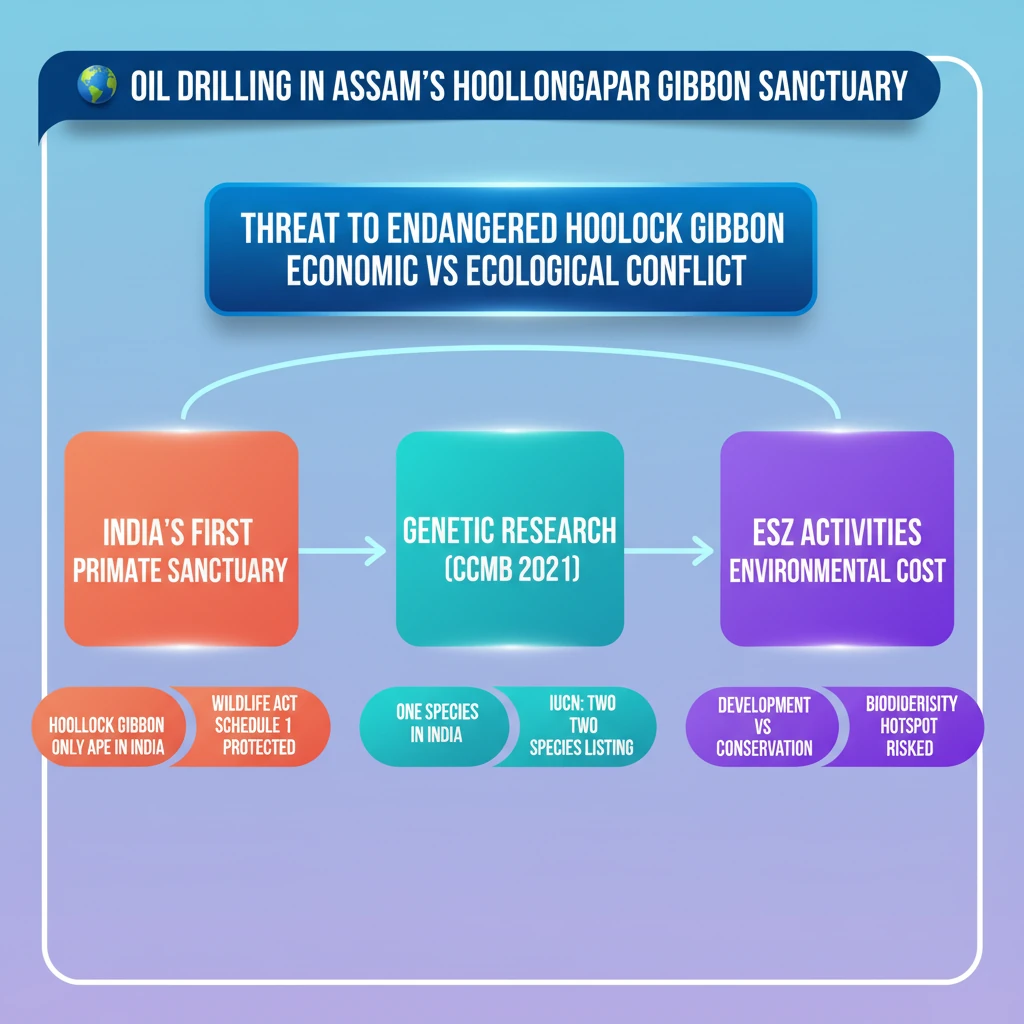
💡 Key Takeaways
- •Oil drilling in Hoollongapar Gibbon Sanctuary's ESZ threatens the endangered hoolock gibbon.
- •Hoollongapar is India's first primate-dedicated sanctuary, protecting the only ape species.
- •Genetic research (CCMB 2021) suggests only one hoolock gibbon species in India, despite IUCN's two-species listing.
- •Hoolock gibbons are protected under Schedule 1 of the Wildlife Protection Act 1972.
- •The issue highlights the conflict between economic development and biodiversity conservation in India.
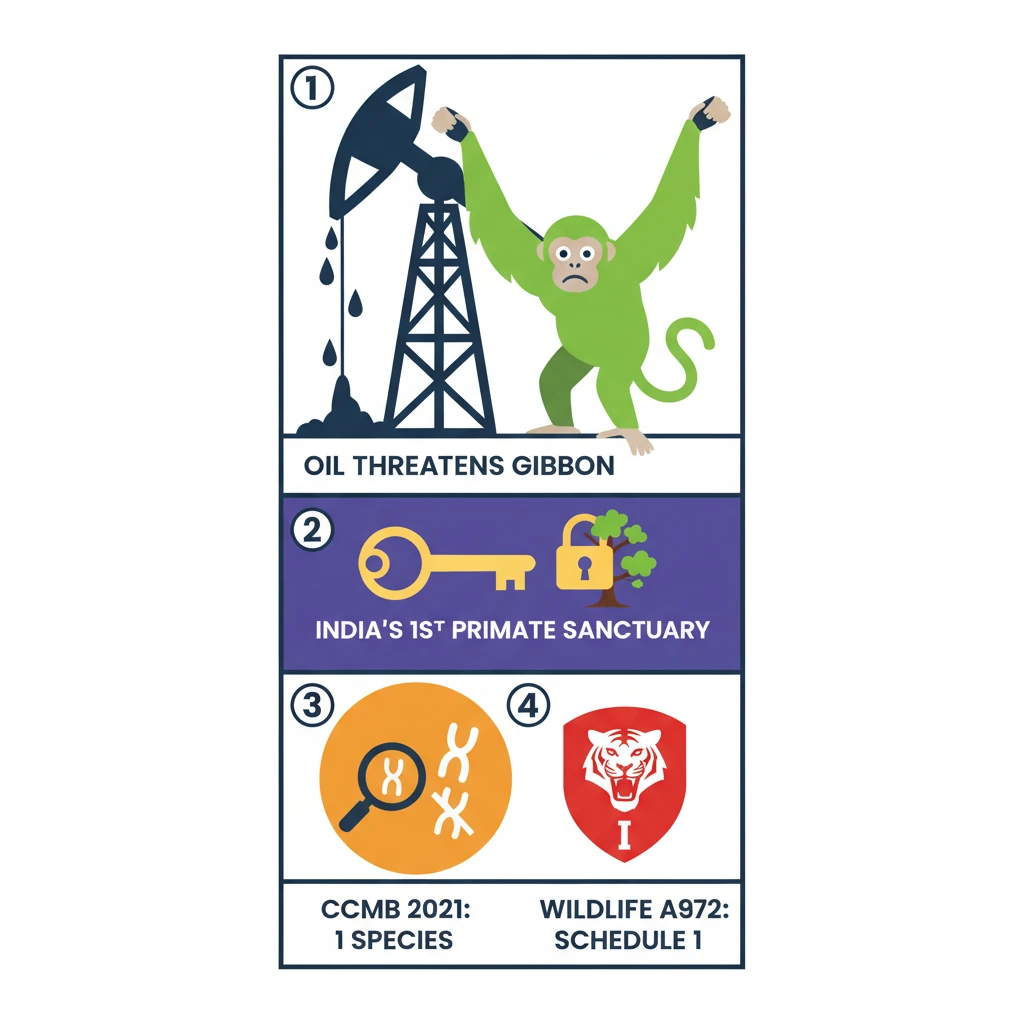
🧠 Memory Techniques
95% Verified Content
📚 Reference Sources
•IUCN Red List (for species status)
•Indian (Wildlife) Protection Act 1972
•Centre for Cellular and Molecular Biology (CCMB) 2021 study on Hoolock Gibbon genetics