Living Fossils: Definition, Significance, and Examples - Environment And Ecology | UPSC Learning
Topics
0 topics • 0 completed
🔍
No topics match your search

Living Fossils: Definition, Significance, and Examples
Medium⏱️ 5 min read
environment and ecology
📖 Introduction
<h4>Introduction to Living Fossils</h4><p><strong>Living fossils</strong> are a remarkable category of species that have persisted for millions of years. They exhibit extraordinary <strong>evolutionary stasis</strong>, meaning they have maintained nearly identical traits to their ancient ancestors.</p><p>These organisms offer unique windows into Earth's deep past. They provide invaluable insights into <strong>evolutionary history</strong> and the characteristics of <strong>ancient ecological landscapes</strong>.</p><h4>Characteristics of Living Fossils</h4><div class='key-point-box'><p>The defining feature of a <strong>living fossil</strong> is its long-term survival with minimal morphological change. They represent lineages that have largely escaped significant evolutionary pressures that drive diversification in other groups.</p></div><p>Their existence challenges the perception of constant, rapid evolution. Instead, they highlight periods of stasis and the success of certain adaptive strategies over geological timescales.</p><h4>The Coelacanth: A Prime Example</h4><p>One of the most famous examples of a <strong>living fossil</strong> is the <strong>Coelacanth</strong>. This deep-sea fish was believed to be extinct for millions of years until its rediscovery.</p><div class='info-box'><ul><li><strong>Rediscovery Date:</strong> <strong>1938</strong></li><li><strong>Location:</strong> Off the coast of <strong>South Africa</strong></li><li><strong>Key Feature:</strong> Notable for its <strong>lobed fins</strong>, which function similarly to limbs.</li></ul></div><p>The <strong>lobed fins</strong> of the <strong>Coelacanth</strong> are particularly significant. They are considered homologous to the limbs of terrestrial vertebrates, offering clues about the transition from water to land.</p>
💡 Key Takeaways
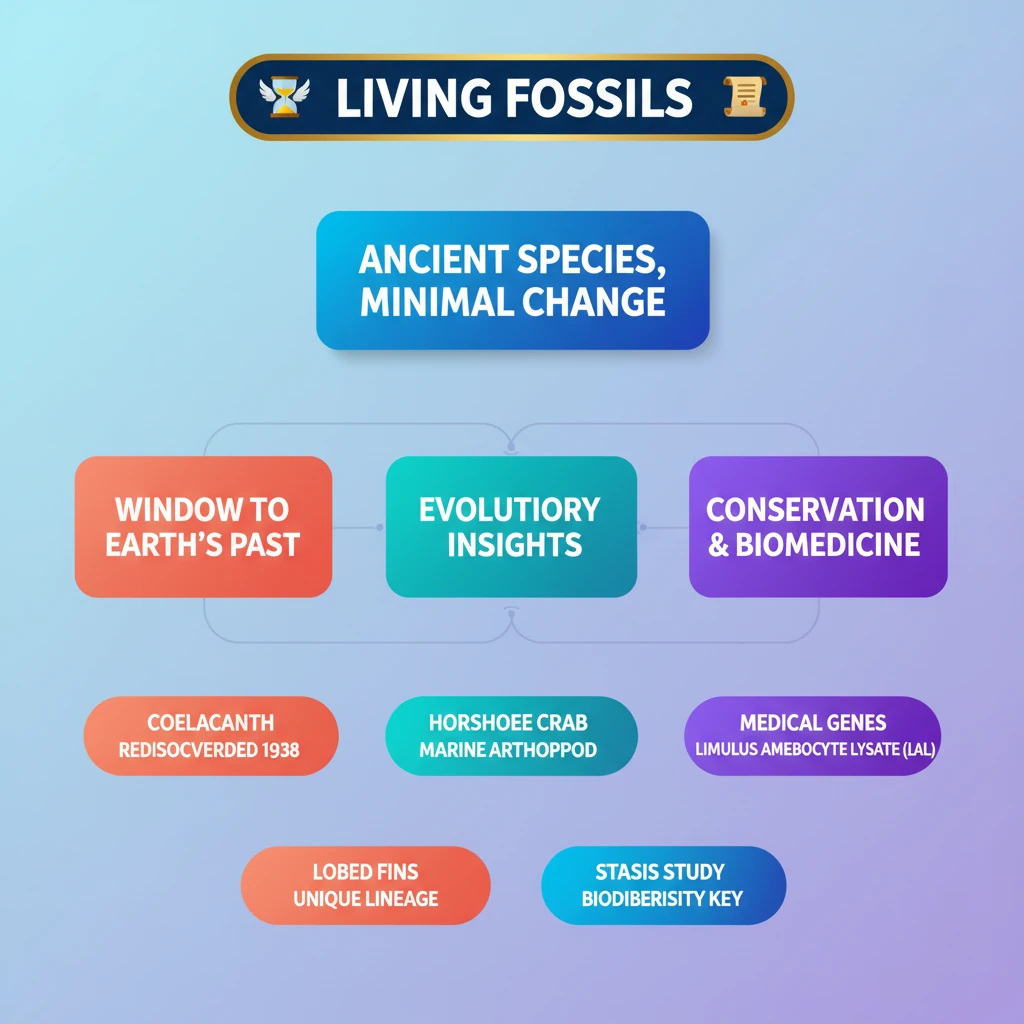
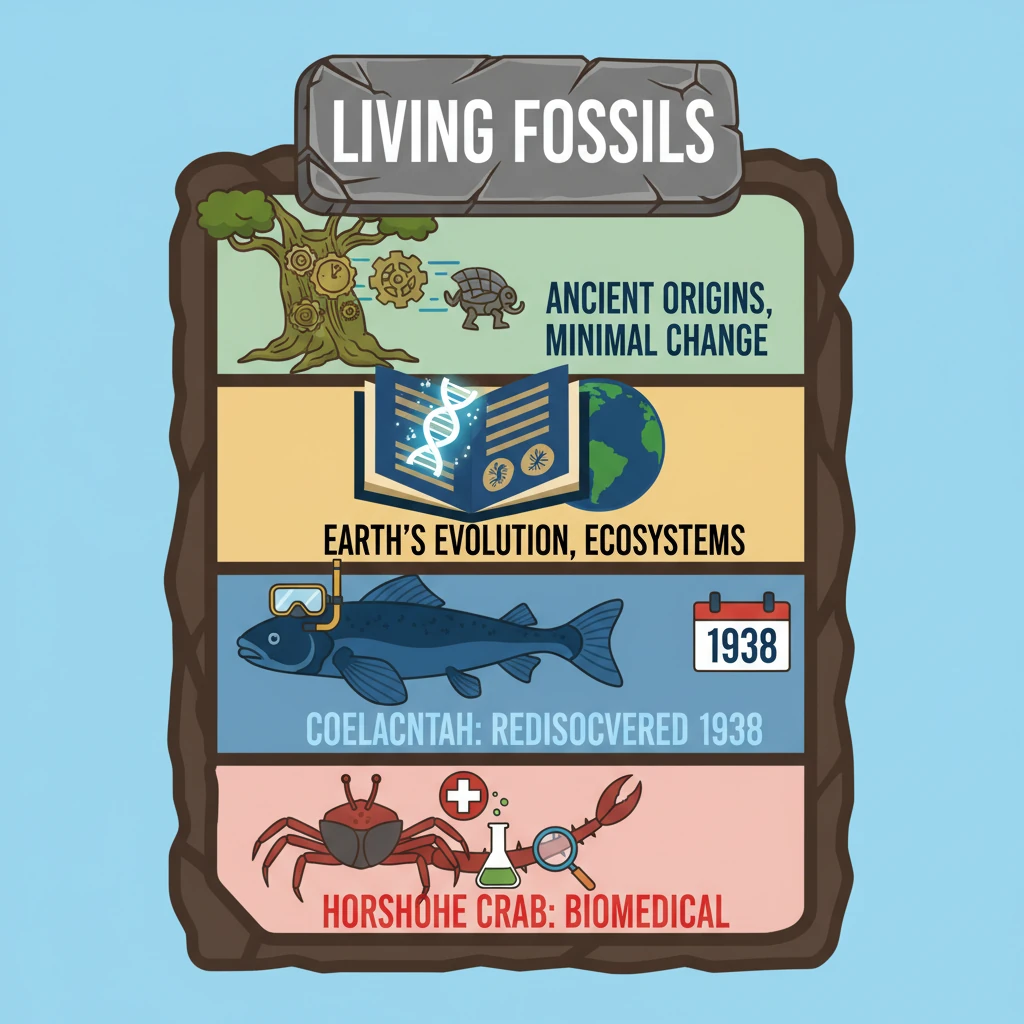
- •Living fossils are species with ancient origins that have undergone minimal evolutionary change.
- •They provide vital insights into Earth's evolutionary history and ancient ecosystems.
- •Coelacanth, rediscovered in 1938, is a prime example, known for its distinctive lobed fins.
- •Horseshoe crabs are another example, significant for both evolutionary study and biomedical applications.
- •Their study helps understand evolutionary stasis and informs conservation strategies for unique lineages.
🧠 Memory Techniques
95% Verified Content
📚 Reference Sources
•National Geographic (for Coelacanth details)
•Smithsonian Magazine (for Horseshoe Crab details)
•University of California Museum of Paleontology